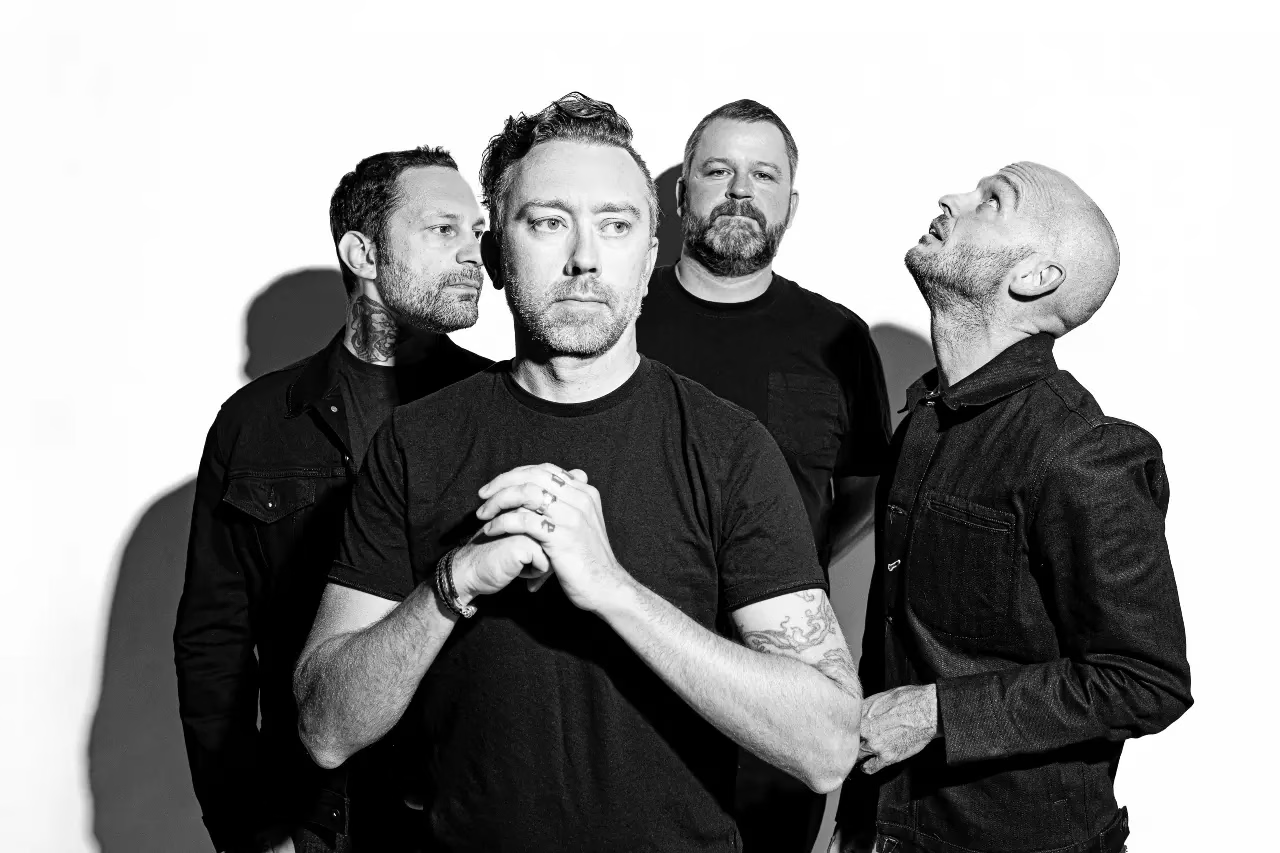
When Rise Against's Tim McIlrath talks to his fans and teenage daughters, a troubling throughline emerges: how difficult it is to achieve the American Dream.
"These ideas kept coming up," the singer and guitarist tells GRAMMY.com. "These anxieties about what tomorrow's going to look like, and also just the weight, they felt they were waking up with every day." Because of this, McIlrath says, the ideal and reality of the American Dream are pulling further apart.
After hearing those repeated concerns, he decided enough was enough. So on their latest album, Nowhere Generation, which was released June 4, Rise Against takes a stand against these demoralizing, capitalistic forces. "We are the nowhere generation/We are the kids that no one wants," he sings in the title track. "We are a credible threat to the rules you set/A cause to be alarmed."
"I think the Nowhere Generation concept is giving [a voice] to the fears of the younger generation," McIlrath says. "What they've communicated to me is that they feel like they are being asked to run this race while the finish line just keeps moving on them." Because of this, "I wanted to give that perspective a platform and a voice and create a song that was speaking to that sentiment."
To coincide with Rise Against's recent appearance at the GRAMMY Museum's Programs at Home series, available now on COLLECTION:live, GRAMMY.com spoke to McIlrath about the process of writing honest and authentic lyrics about the collective struggle, returning to the road in their 20th year as a band and why young people shouldn't feel alone in their fight.
<style>.embed-container { position: relative; padding-bottom: 56.25%; height: 0; overflow: hidden; max-width: 100%; } .embed-container iframe, .embed-container object, .embed-container embed { position: absolute; top: 0; left: 0; width: 100%; height: 100%; }</style><div class='embed-container'><iframe src='https://www.youtube.com/embed//75S5PDXTEVQ' frameborder='0' allowfullscreen></iframe></div>
This interview has been edited and condensed for clarity.
What was your biggest inspiration for writing "Nowhere Generation"?
When we would talk to our fans, the theme was apparent. These ideas kept coming up. This idea of these anxieties about what tomorrow's going to look like, and also the weight they felt they were waking up with every day.
The more I examined that, the more I realized that there's a lot of evidence and a lot of good reasons to feel that weight. Whether it's living in a time that has normalized the idea that one can work full-time and still live below the poverty level or living in a time where we're expected to accept the idea of concentrated wealth and the rise of the one percent.
Living in a time where we're dealing with global warming and climate change, and society's response or lack of response to it. A number of other elements have contributed to this downwardly mobile landscape.
How did these conversations help you be more honest and authentic as a songwriter?
I think that having a relationship with our audience helps that. I think being a father of two teenagers gives me a bit of a crash course in it as well—and then just talking to the band about it.
It's amazing how many people have their own stories—their own things to add to this narrative. It takes on a life of its own. People talk about what it's like to feel like they're swimming upstream as they try to get ahead. They started asking questions like, "Why? Why does it feel like this? What's happening?"
What parallels do you see with your own experience?
I grew up in a relatively stable time politically, economically and socially, and I think we took a lot of that for granted. That's what made [succeeding] generations less sympathetic to these concerns. I think that we all think, 'Well, this is life. It's hard, and you figure it out,' without acknowledging 'Is life different? Is the experience different now than it was before? Are we living in a society that is ripping the crops out without replanting the seeds for the future?'
That's what's happening now. I think that we're starting to realize the new and unique obstacles to getting ahead in today's world. Young people are less likely to own a home or have savings. That is keeping people from being able to pursue that American Dream.
"Nowhere Generation" reminded me of the Replacements' "Bastards of Young." A song about people that are trying to find a place in the world.
Yeah, that's one of my favorite songs. I think you're right. I think people feel a little bit lost. And "Nowhere Generation" is speaking to people who are trying to figure out where they fit in the landscape nowadays, if they fit in at all.
And I talked about young people, but you don't need to be young to relate to this idea. For people my age, older than me, if you were part of this generation that is sort of falling victim to the short-term way of thinking instead of long-term, then you're part of the Nowhere Generation.
<style>.embed-container { position: relative; padding-bottom: 56.25%; height: 0; overflow: hidden; max-width: 100%; } .embed-container iframe, .embed-container object, .embed-container embed { position: absolute; top: 0; left: 0; width: 100%; height: 100%; }</style><div class='embed-container'><iframe src='https://www.youtube.com/embed//k0aS7AvD_mc' frameborder='0' allowfullscreen></iframe></div>
On the song "The Numbers," and elsewhere on the album, you remind the listener that they're not alone in this fight. Why do you think that's important, especially entering into this post-pandemic world?
I think it's pointing out things like, despite its flaws, democracy is still our most effective way of governing. Giving voice to the people is still the best way we've figured out for human society to function. But it definitely requires those voices. It requires that voice. I think that not only that voice, but social movements throughout history have given rise to a lot of the ideas and concepts that we take for granted today.
"The Numbers" is reminding people that, no, you don't need to take it from us. There's a lot of evidence of individuals or groups that have put their hand on the steering wheel of history. And it shows them for the better. And that progress is often the result of somebody simply being fed up and trying to demand that they be listened to.
We still have a government that's based on voting. It's people that need to be listened to. "The Numbers" reminds people that no matter how helpless you feel, your voice is still one of the most powerful gears of governance.
That song opens with a sample from "The Internationale." Why did you think that it fits with the album? And how can history be part of the solution?
Especially with a song like "The Numbers," it was talking about the people. "The Internationale" has always been an anthem of working-class people. It has been used by many different countries and [adapted into] most popular languages.
I thought it was a good way to show the listener just how timeless some of these concepts really are. It turned into a great way to start the song and to start the album. It sets a good tone.
What was the most challenging song to write?
One of the last ones I got to was "Broken Dreams, Inc." I feel like I was out of ideas by the time I got into that one. I'd sit there for a while until one day I started writing that chorus and then the rest of it just fell out of me. But it took me a long time to get around to. I was almost going to give up on the song. Then, it all came together as one of the best songs on the album.
The band worked with GRAMMY-nominated creative director Brian Roettinger for the visual aspects of the album. Was it important to have a universal look and feel?
We wanted this era of Rise Against to be defined by a look that people would recognize. If you were to look back at it, you would see the imagery around development. You would know specifically that this was this era of Rise Against.
And part of the way of doing that was working with a single person instead of many different people, which is what we've done in the past: Someone for the album, someone for the video, someone for the live look, someone for the merchandise and that. [They're all] great people, but this is way more universal and cohesive.
<style>.embed-container { position: relative; padding-bottom: 56.25%; height: 0; overflow: hidden; max-width: 100%; } .embed-container iframe, .embed-container object, .embed-container embed { position: absolute; top: 0; left: 0; width: 100%; height: 100%; }</style><div class='embed-container'><iframe src='https://www.youtube.com/embed//8PTKACZr7vw' frameborder='0' allowfullscreen></iframe></div>
I recently read the story of a Chicago fan who was so inspired by the band's music that he became a lawyer. What does it mean to see that tangible impact?
Seeing things like that is the best part of being in this band because you write these songs hoping that they land with people. [That they don't] just listen to it, but actually connect with it. Not everybody connects with it. It's just not the way it always turns out.
When somebody does, it really takes this song that you pull out of thin air—you just made up—and turns it into something real and tangible. It validates the effort that you put in. It helps that person, but it also helps you as the writer of it to know, "Alright, there was a reason that put these words out to the world. They found somebody and they helped shape their path."
Have you stayed in touch with him?
No, it was just a very quick and random interaction at a coffee shop. We ate there, we just ran into each other on the street. But the story stuck with me.
The band's debut album turned 20 this year. What does that milestone mean to you?
It really puts a fine point on just how long we've been doing this. [It causes me to] look back on those days where we've come from, looking back on those songs, how we've grown musically, and sonically, and how Rise Against snowballed into what it is from some pretty humble beginnings.
I don't think that the guys that made that record had any idea of what was ahead of them. That we would be touching the lives of people that were being born that year, or the years after that. That's something that I never thought we'd be playing shows for the babies that were born the same year the debut album came out.
Why do you think the band's sound is still effective all these years later?
That's a good question. I think punk rock has always been dark and angsty. And it's always been our response to mainstream music. And even no matter how popular it gets, it's still always going to have those roots, that it's something that was created in response. It's something that was created by people who felt like they didn't hear what they wanted to hear on the radio. They created their own thing, and I think that will always resonate with the outsider.
The band just announced tour dates for later this year. What does it mean to be able to get back on the road?
It means the world to us; it's really incredible. Especially during some of the darkest times, the pandemic, we wondered when our show would ever happen. If it would ever happen again. To see it actually getting greenlit, seeing the lights turn back on, that's pretty emotional. And I imagine it will be an emotional experience to play these shows again.
The Roots of 'Roots': Sepultura's Game-Changing Metal Masterpiece At 25