Renata Yazzie considers herself a musicologist, advocate and supporter of Indigenous music and musicians — whether she’s making music herself, or studying at Columbia in New York.
"Everything I do is in support of Native people pursuing their musical love," the Diné classical pianist tells GRAMMY.com. "Whether that be teaching, uplifting their music, filling in on keys for a band, promoting shows or writing about them for different outlets, teaching music, or teaching piano… I aim to just help Native musicians get the tools they need to make the music they want to make."
While her work braids Native and classical influences, Yazzie is attuned to sounds across the Indigenous musical spectrum; for instance, she tipped off GRAMMY.com about Levi Platero, a blazing New Mexican blues guitarist who hails from the Navajo Nation.
And as 2023 winds down, Yazzie's championing a panoply of Indigenous acts, from a neo-soul groove machine to a heavy metal fiddler — and below, she explains why she is. Some wear their identities and heritages in more elaborate displays, and some less so — which is just as valid.
"In terms of Indigenous artistry in music and in film and in TV, we are in a moment where Native people are negotiating their own terms with how they want their identity and their art to be connected or not connected," she explains, referring to sensations like "Reservation Dogs." "They're negotiating that on their own terms, and it's an act of sovereignty for us to be able to do that. We haven't always been able to do that."
With this in mind, open your hearts and ears to this cross-section of Indigenous talent, as the curtain opens for Native American Heritage Month 2023.
Earth Surface People
Led by Dakota Yazzie — no relation to Renata — Earth Surface People is a genre-fluid collective with a Navajo core: Yazzie, and his synth-playing younger brother, Cochise Yazzie, are Diné.
Skillfully weaving threads of jazz, fusion, R&B, soul, the group's sound achieves a seamless dialogue between Indigenous and Black American musics — driven home by the artistry of a key collaborator, in Diné vocalist Nanibaah. This aural tapestry is heard on their latest album, 2022's nihookááʼ diyin dineʼé (Earth Surface People).
"Earth Surface People came from a need to tell Indigenous stories, places, history, attitude. It's something I saw a lack of growing up in rural Arizona," Dakota Yazzie told Shoutout Arizona. I grew up around my traditional people: farmers, storytellers, medicine people, jewelers, weavers, artists, revolutionaries, creatives.
"I found a lot of solace in their stories of survival and their stories of triumph," he continued. "How some overcame extraordinary odds with minimal resources."
"I think their work is important because they're pushing Native music into new sounds," Renata Yazzie says, "You don't hear a lot of Native bands that sound like Earth Surface People….. [They're] continuing to showcase that Native people can make whatever sounds they want, and they do."
Ailani
Hailing from Santa Clara Pueblo, New Mexico, the mononymous Ailani — born Ailani Swentzell — is an up-and-coming singer/songwriter who's been committed to the craft since high school.
And the first thing you'll absorb about the indie-popper's driving and intimate sound is her bell-like tone as a vocalist.
"She has got such a clear, pristine, pretty voice," Yazzie says, noting that Ailani comes from a long line of artists, including visual art and ceramics. As she continues, Ailani represents a milieu of young, Native artists who simply write quality songs and put them out there.
"She was always the youngest. And what she was putting out was very well done," Yazzie says of her early perception of Ailani. "And I think her voice is what makes her quite unique."
When Ailani released her last album, 2022's Mortified, she made it clear she was broaching uncharted territory for her artistry.
"I am proud that I broke out of my usual shell a bit. This isn't a usual Ailani heartbreak/falling in love album — don't worry though, you'll still get a solid share of those themes," Ailani told Grimy Goods. She went on to explain that Mortified's title is an unflinching reference to self-hatred, and overcoming it.
"There are so many different things going on in this album, but I like it. I like how it's sort of unapologetically thrown together," Ailani said. "It needs to be, because not everything is clean-cut storylines."
Tinge
Tinge represents the Anishinaabe star in the Indigenous cosmology, as well as that of the Two-Spirit gender identity: their leader, Veronica Blackhawk, who uses they/she pronouns, is both.
Blackhawk has described Tinge's themes as encompassing "mental health and identity" — and if you zoom out, their "experience as a young Indigenous person navigating and healing through intergenerational trauma."
Back in the spring of 2023, the indie rock trio released their debut EP, Big Deep Sigh. Blackhawk characterized its songs, as "accumulated over years of quiet bedroom writing [where it felt like holding in a deep breath for far too long.
"I exhaled," she continued, "and out came the biggest, deepest sigh I had ever released." And that comes through not only in Blackhawk's unvarnished lyricism, but in the dynamism of the band.
Side Montero
Yazzie calls the Albuquerque-based, Indigenous-led four-piece Side Montero "a band with Native members, but not necessarily a 'Native band'."
Which does not undermine two of its members' Navajo identity one whit, but underscores how some Indigenous artists choose not to make their heritage the focal point.
"They're not super forthright about the Native members' identity. They just [have two] guys who happen to be Native, and they kind of pride themselves on that a little bit, I think," Yazzie opines. "They acknowledge who they are without being over the top about it."
Which leaves the music, which iswhat Side Montero are all about, and their sound represents a fresh spin on well-trod indie and alternative rock territory.
Together, incisive vocals from singer/guitarist Aaron Lee, curlicuing lead guitar from Jaren Robledo, and a walloping rhythm section in bassist Ben Work and drummer Levi Maes make Side Montero a band to watch out for — Indigenous commentary or none.
Sage Cornelius
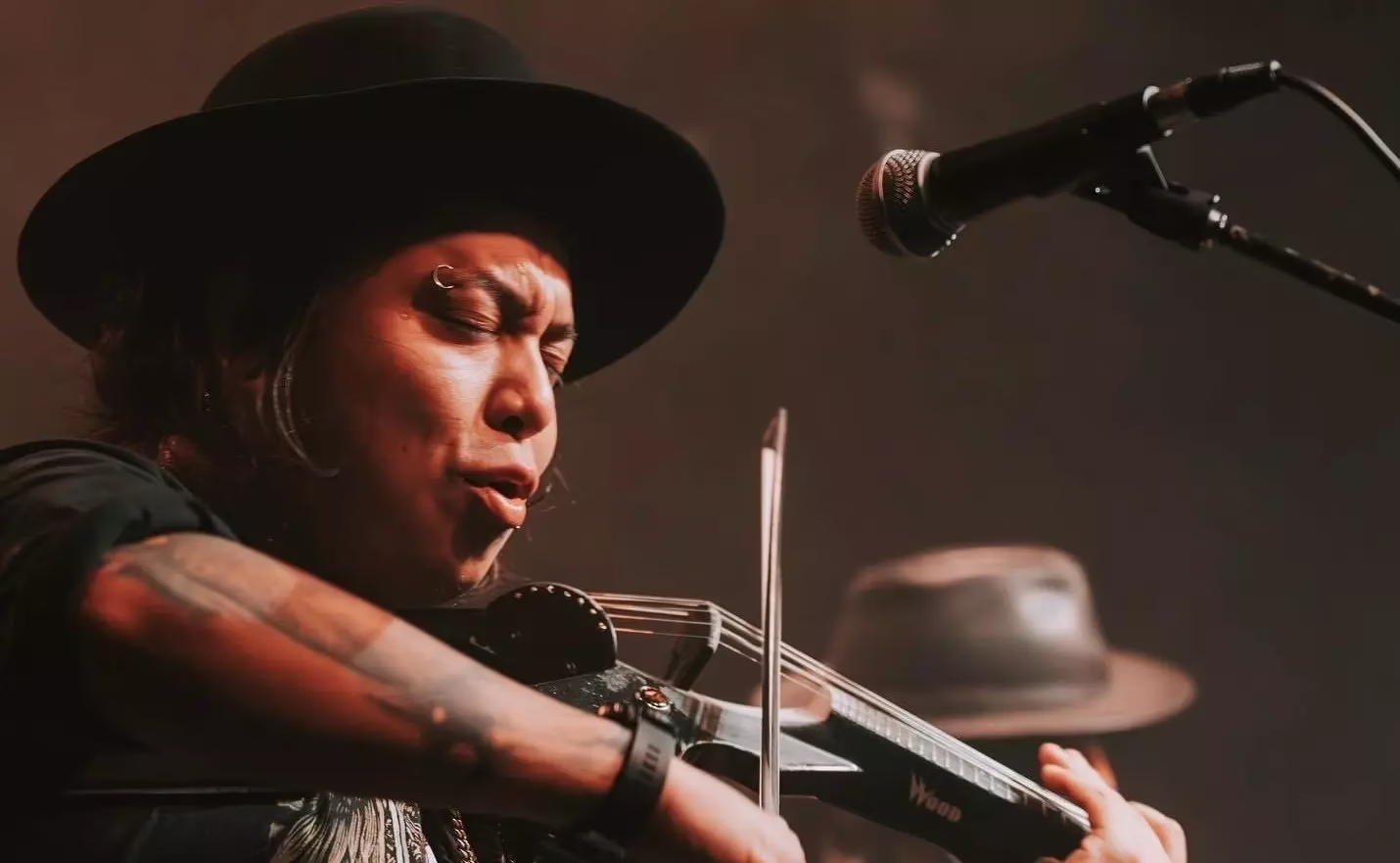
A heavy metal fiddler? You read that right. Billed as "the most metal fiddle player you know," Sage Haskelchi'i Cornelius is a monster on this unconventional vehicle for riffs and rage.
"He went to school, got a business degree, and just couldn't give up his fiddle," Yazzie says of Cornelius, who has Navajo, Oneida, Potawatomi, and Kickapoo roots. "So, at some point, he made the turn into fiddling full time."
Although Cornelius' YouTube channel features him sawing through headbanging originals, like "Entombed," and covers, like Metallica's "To Live is to Die," Cornelius inhabits all sorts of genres; he just finished a tour with singer/songwriter Shawn James, for instance.
"He always blows people away," Yazzie says admiringly of Cornelius. And like everyone else on this list, his music speaks loud and clear: he, nor any other Indigenous creators, defies compartmentalization or easy assessment.