In the AAPI acronym, "AA" and "PI" are presented in parallel for a reason; it’s paramount to elevate those of Pacific Islander descent just as much as Asian American heritage. Yet, there’s sometimes been an imbalance — and an attendant fight to rebalance those scales.
Consisting of three ethnogeographic groupings — Melanesia, Micronesia and Polynesia — the Pacific Island region covers more than 300,000 square miles of land; as such, those two letters encompass a staggering array of cultures and peoples, from Hawaii and American Samoa to New Guinea and New Zealand.
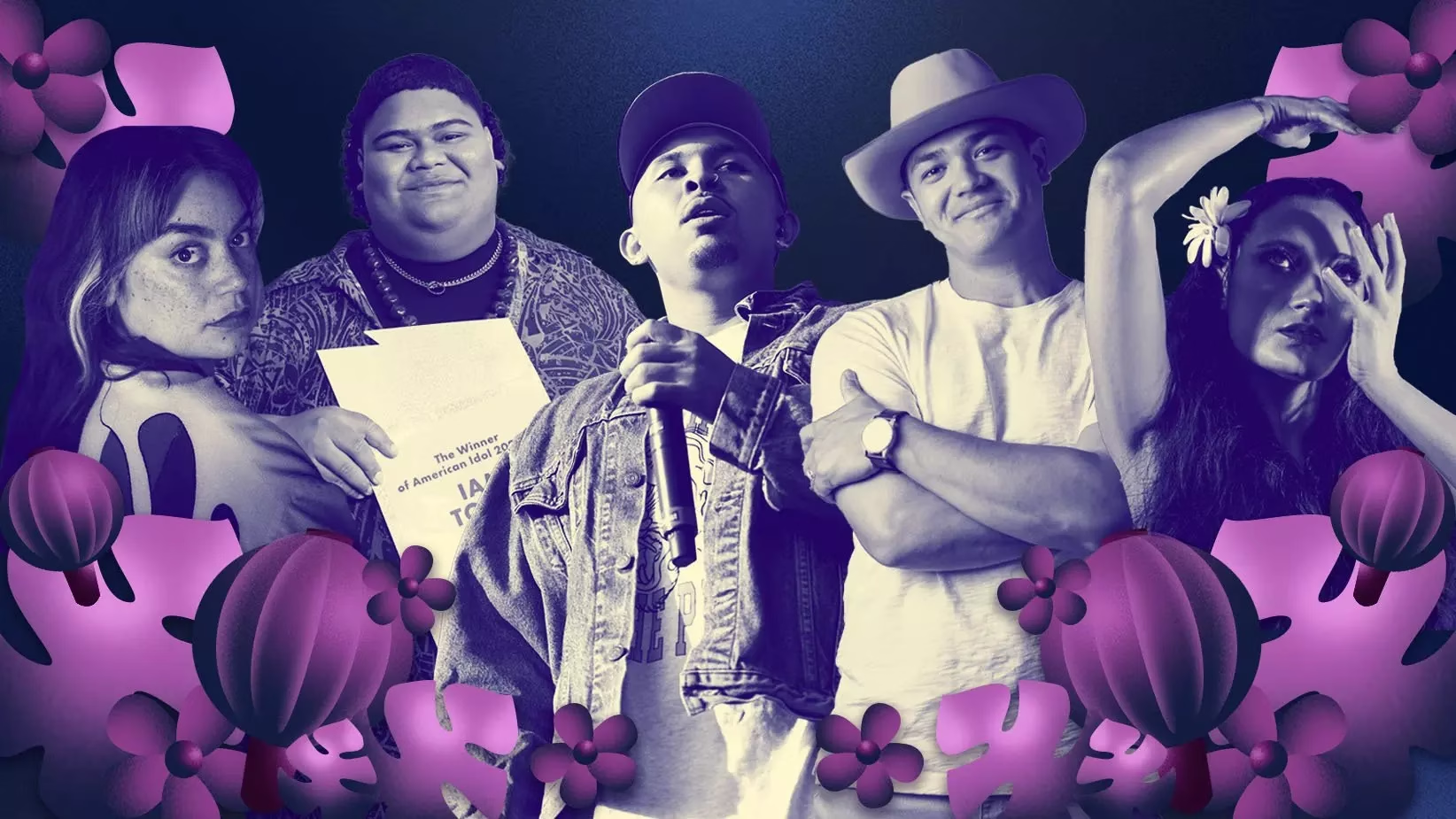
Accordingly, the wellspring of musics that pours from these islands couldn’t be contained in one article — or a dozen. But a quick look at musicians of Pacific Islander descent currently getting their moment can act as a window into these worlds.
Some, like Iam Tongi, are operating on a nationally broadcast stage. Others work in quieter, more localized spaces. What they share is profound connections to the Pacific Islands, which are founts of musical brilliance.
Read on for five of them, from vastly divergent genres and traditions.
Iam Tongi
Simon and Garfunkel’s "The Sound of Silence" has resonated far, far past the 1960s; its unflinching gaze into the void is for our time as much as any other.
In 2016, Disturbed brought it back to television; Hawaiian high school senior Iam Tongi recently did the same thing — on "American Idol." In the process, he even made judge Katy Perry cry.
Tongi is a man who has known darkness well: he had lost his father, Rodney, a few years earlier to kidney disease. The cataclysm has informed his choices of tunes, like James Blunt’s father-son ballad "Monsters" and debut single "I’ll Be Seeing You."
Clearly, Tongi’s emotionally incisive pipes and gripping story have gone a long way: on May 21, he beat out finalists Megan Danielle and Colin Stough, and became the next American Idol — the youngest male winner in the show’s history.
Taimane Gardner
If you didn’t know ukulele virtuosity is a thing, get on board. Taimane Gardner is not just in her own league on the instrument; she’s a captivating performer as well. And on top of that, she’s a masterful songwriter and interpreter. Ukulele, meet your triple threat.
Gardner was born in Honolulu and is of Samoan descent; in the Samoan language, her name translates to "diamond." Indeed, she’s a rare gem, as she can deftly move from Bach to rock to flamenco and back again, all while weaving in impressive original compositions.
In 2022, Gardner released HAWAIKI, an album steeped in her Polynesian heritage — with the loss of her mother in 2018 weighing heavily in the material.
Therein, the protagonist embarks on a journey of self-discovery "as she goes through Hawaiki, this special island where the gods and goddesses live," Gardner has described. "it's a spiritual place where Polynesians come from and go after they pass."
HAWAIKI may specifically point its arrow at Polynesia, but if there’s one takeaway from Gardner’s artistry, it’s that Pacific Islander music readily perforates boundaries and boxes.
Try The Pie
Further representing Polynesia is the Bay Area downer-punk band Try The Pie, led by Tonga-American vocalist and guitarist Bean Tupou — who also happens to be queer and nonbinary.
Not only do they kick up an enticing duststorm musically; their psychologically freighted yet economical lyrics truly connect.
"We are not built like walls To hold up structures, to be the glue," Tupou sings in "Every Week," the opening track on their 2015 album Domestication. "I wanna do it all/ I wanna let go and remember you."
Rounded out by guitarist Laine Barriga, bassist Bailey Lupo and drummer Nick Lopez, Try The Pie most recently released A Widening Burst of Forever; on tunes like "Shell," "New Dust" and "3 Swords," their sound and aesthetic bloom like time-lapse flowers. So does the influence of Tupou’s heritage.
"As a child, I would often wake in the mornings to my father playing guitar and singing Westlian style hymns in Tongan — a ritual I’ve come to miss dearly," Tupou said this year. "As a part of our family’s legacy, I have chosen to write songs and archive my own experience through music."
Kala’e Parish
Native Hawaiian country music? Consider your horizons expanded. Just as American country music celebrates the contiguous U.S.’s working-class South and heartland, Native Hawaiian music is all about island pride. And Kala’e Parish is right at the vanguard of this form.
Parish didn’t start writing his own music, however, until he attended college in Oregon, pursuing a degree in Business Marketing. Upon moving back to Hawaii, his star rose by way of his band Eden Roc.
In 2016, he struck out solo to clamorous applause; his 2020 EP Where I Reside was nominated for EP Of The Year at the Nā Hōkū Hanohano Awards, and he was featured on Kuha’o Maunakea, a compendium of tunes by Hawaii’s top performers.
Parish is still firing on all cylinders, while residing in Waimea. And considering the vitality of tunes like "These Islands," this terrific singer/songwriter has a lot more to say about the islands he hails from.
"Crystal clear blue waters with a never-ending flow," he sings. "Here we go."
P-Lo
Despite being born and raised in a Filipino American household in the Bay Area, rapper and producer Paolo Rodriguez — better known as P-Lo — successfully transcends the confines of identity in his music.
"I never wanted to take that route and use that Asian thing as a crutch," Rodriguez, who's Filipino, once stated. "People are already going to identify with me 'cause I look like them. I never wanted to use that as a crutch to get where I wanted to be."
Disposing of that "crutch" hasn’t stymied P-Lo one iota. He’s worked with everyone from Wiz Khalifa to Iggy Azalea to Flo Rida; His songs have been featured in visual media from Space Jam: A New Legacy to "Insecure." the tour around his new album, Stunna, takes him across the U.S. until the end of June.
"Always adapt while bringing your own flavor," P-Lo has said, a sentiment which applies to everyone on this list, and emerging AAPI musicians of every stripe. They know and honor their roots. But their roots are just the beginning of the story.
Commonalities, Subtleties & Purpose: 7 Musicians Pushing Ancient Asian Instruments Into The Future