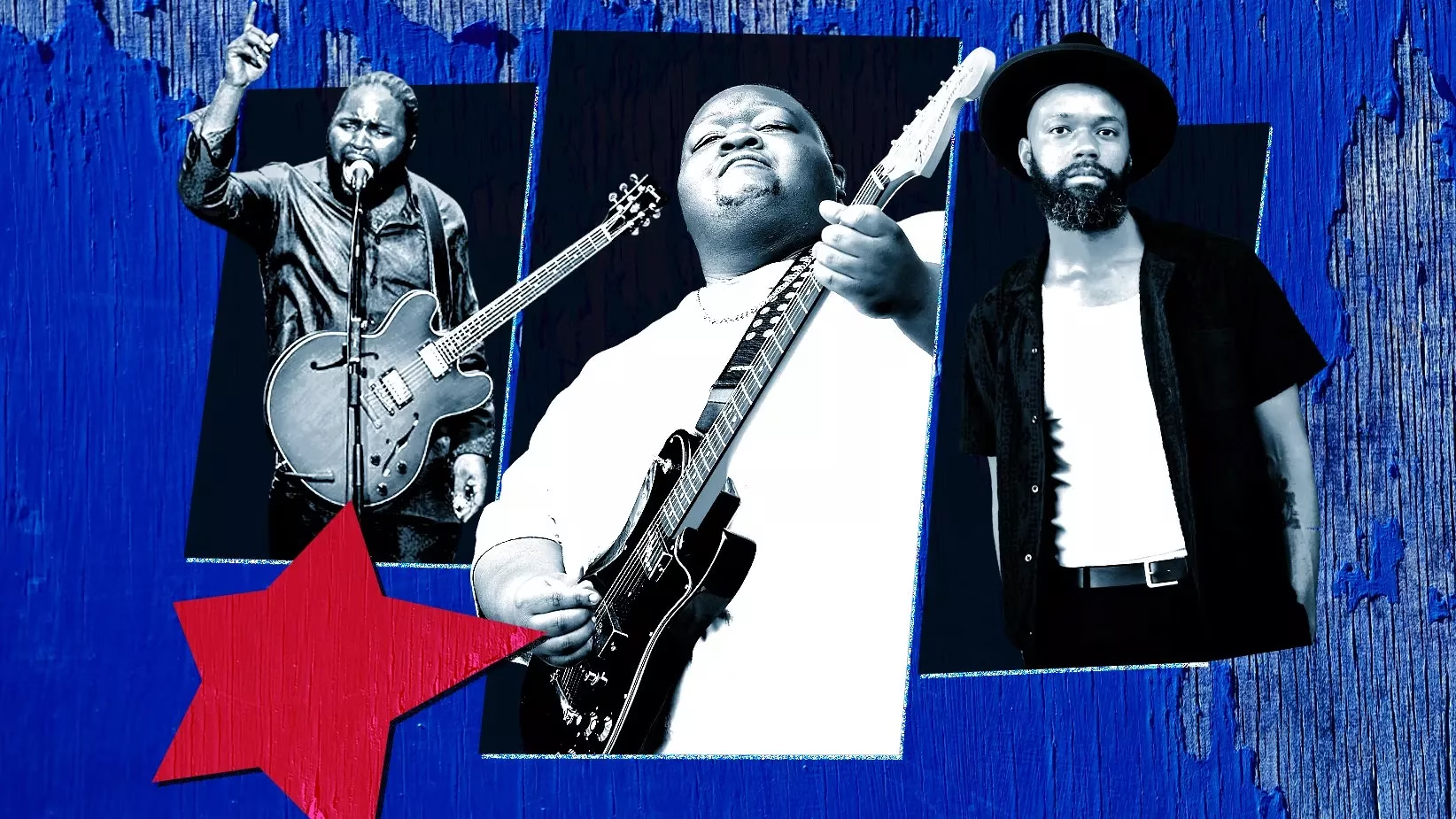
Does blues-based music have a certain agelessness?
Robert Johnson, Chuck Berry, the early Beatles and Stones — all of them, and so many more — seemingly walked out of this primordial soup and flipped the world on its head. At their peak, their songs could have been written this morning.
But timelessness can be a double-edged sword. While the parameters of 12 bars has beene a launchpad for innovation and imagination, it can also stymie and bind.
Most of us know the shadow side of the issue: pentatonic scales and pitch harmonics, laboriously picked out in the suburban sports bars of America. God bless, but it's difficult to imagine that's keeping the blues alive, per se. Negative associations with the genre can even wall it off from youthful possibilities
If the utterance of the b-word conjures visions of scrunch-faced dads, let's unwind them. In the 21st century, younger folks are excellent stewards of this music; GRAMMY.com takes a quick tour through five of such bluesbreakers.
Marquise Knox
The St. Louis native has been shedding and performing since he was a pre-teen — and by hitting the ground running, he left much of his competition in the dust.
Since his early years under the tutelage of GRAMMY-winning blues great Henry James Townsend, Knox has successfully married his craggy, gravitational voice with his combustible way with an electric guitar.
At just 16 years old, Knox recorded his debut album, 2010's Man Child, with guitarist Michael Burks and his band. The album was nominated for a Blues Music Award for Best New Artist Debut, among other impressive plaudits.
In the ensuing years, Knox has released reverent yet unflinching works, including 2011's Here I Am and 2017's Black and Blue. A stabbing attack in 2017 couldn't sideline him: he's been burning it up on stages up to this very week.
"The world don't owe me nothing," Knox said the following year. "I ain't never felt no kind of privilege in this world. Mules have kicked me, but didn't damage my pride. The rattlesnake bit me, but just crawled off and died. I represent St. Louis blues like no other. I am the blues."
Marcus King
Dan Auerbach has deservedly made his biggest impression on the music industry via the Black Keys. But his production and label work with Easy Eye Sound has proven to be an equal and parallel stream — and it's allowed him to elevate young luminaries like Marcus King.
"I just feel very fortunate that I get to make records with artists that I love, and people that blow me away," Auerbach told GRAMMY.com in 2022. Which King clearly did — and then some.
The album they made together, 2022's Young Blood, is drenched in the blues, but also the music in its wake: Cream, Hendrix, Sabbath, Led Zeppelin. (With some Free, ZZ Top, and Creedence for good measure.)
Thereby, King is a bridge from pure blues to all manner of realms in the rock 'n' roll canon — smoldering psychedelia, fried Southern rock, head-shop heavy metal.
"It ended up sounding like something new to me," King told Spin. "Even though it was inspired by music I've listened to for a long time." With that in mind, let King's artistry straddle two zones: your memories, and what's coming down the pike.
Ally Venable
A native Texan, Ally Venable took profound inspiration from one of the Mount Rushmore figures of blues guitar: the one and only Stevie Ray Vaughan.
"I didn't really know a whole lot about guitar before I discovered him," Venable admitted to Guitar Girl magazine. "And then my influences opened to discover who Albert King was; that was Stevie's big influence. Then I soon discovered who Buddy Guy was, right?"
Speaking of the latter legend: Guy appears on her all-the-way-there 2023 album Real Gone, on the romping "Texas Louisiana."
And that's not the only high-profile cosigner on the thing: three-time GRAMMY nominee Joe Bonamassa — one of the most influential guitarists of the past three decades — augments her sound for the downcast "Broken & Blue."
Venable strikes a terrific balance as a singer, songwriter and guitarist; she imprints herself on your brain without contrivedness or reinventing the wheel. Often, pushing the blues forward is contingent on simply being yourself — as Venable proves throughout Real Gone.
Christone "Kingfish" Ingram
Upon winning a GRAMMY for Best Traditional Blues Album, a 23-year-old Christone "Kingfish" Ingram offered a shout-out to his generation — and grew visibly emotional.
"For years, I had to sit and watch the myth that young Black kids are not into the blues," he said, golden gramophone in hand. "So, I just hope I can show the world different."
In this enterprise, he's been a smashing success. By the time he was old enough to vote, Ingram was playing with the likes of Gary Clark, Jr.
And at said GRAMMY night, in 2022, Ingram's excellent second album 662 beat out heavy hitters in Joe Bonamassa, the Black Keys, Shemekia Copeland, and Steve Cropper.
As a guitarist and vocalist, Ingram radiates vitality; he offers a distinct and personal vantage, a ripping story to tell. And that GRAMMY win helped galvanize him.
"I have different album ideas. I want to put out a gospel record sometime soon," he told GRAMMY.com in 2022. "Yeah, so it definitely lit a fire under me, for sure."
Buffalo Nichols
The singer, guitarist and songwriter born Carl Nichols is deeply aware of how the term "blues" can be a trap or a constraint. For a while, he didn't want to even assume the label.
"It's just not creative, it's not inclusive, it's not diverse — it's not even good most of the time," he told the Austin Chronicle in 2022. "But I've been leaning into it because I'm already in it, so I'm trying to see what I can do with it."
By simply picking up a guitar and opening his mouth, Nichols doesn't just do something with it: he changes the game. The millennial's voice is both a sonorous cavern and a raw nerve: his lyrics have a haunted, lived-in quality that draws you in.
"If you see me in your town looking tired with my head hanging down / You may wonder what went wrong, why am I always all alone," he sings at the top of "Lost and Lonesome," the opener from his self-titled 2021 debut.
Watch Now: Buffalo Nichols On How We Can Save The Blues Genre | On The Road
Throughout that inspired dispatch — leading into his hotly anticipated new album, The Fatalist, out Sept. 15 — Nichols addresses that question.
Just listen to the white-knuckled advance single "The Difference." Like everyone else on this list, this is a younger person with fathoms of feeling — and the wherewithal to execute it vitally, in the now.
Meet Levi Platero, A Formidable Guitarist Bringing Blues-Rock To The Navajo Nation