Cameron Crowe’s Almost Famous is one of the definitive rock movies and it has now become an exuberant Broadway musical. As some of its characters like to cheerily proclaim: "It’s all happening!"
Inspired by Crowe’s own experiences as a music journalist, the story focuses on 15 year-old William Miller who goes on assignment for Rolling Stone following the fictional band Stillwater as they tour the country in 1973. While chronicling the rock 'n' roll circus he is documenting – bonding with Stillwater guitarist Russell Hammond and their biggest fan, a self-proclaimed "band aid" (not groupie) named Penny Lane – Miller's illusions get stripped away as he comes of age.
While Almost Famous was not a box office success upon its release in 2000 — though writer-director Crowe won an Oscar for Best Original Screenplay, and the soundtrack won a GRAMMY Award for Best Compilation Soundtrack for Visual Media — its audience and legend have grown thanks to home video releases and cable TV airings.
Four years ago, Crowe teamed up with Tony and GRAMMY Award-winning composer Tom Kitt ("Jagged Little Pill," "American Idiot," "Next To Normal") to adapt his famed film into a musical and give it a new life. But they did not set out to do a simple translation from screen to stage — Kitt encouraged Crowe to explore his story’s autobiographical source more directly, so it’s less William Miller and more Cameron Crowe. Although the story’s overall chronology remains the same, some of the characterizations and scenes have been tweaked to ring truer to the author’s life. Infamous rock critic Lester Bangs (portrayed by the late Philip Seymour Hoffman in the film) becomes something of a surrogate father figure and master of ceremonies for the show.
While integrating classic rock songs and melodies from the era, "Almost Famous: The Musical" features an entirely new score of 17 songs composed by Kitt with lyrics co-written with Crowe. A testament to his passion for the material, Kitt's new ‘70s-inspired material is integrated seamlessly with classic rock tracks and original Stillwater tunes. This show also marks his Broadway debut as a lyricist.
The musical opened Nov. 2 at the Bernard Jacobs Theatre — its premiere was attended by Joni Mitchell, Rolling Stone’s Jann Wenner, Steely Dan’s Donald Fagen, Clive Davis, and Paul Rudd — and the cast album is slated for a March 17 release. Over Zoom, Crowe and Kitt got into the nitty gritty of the story, the adaptation, and how their collaboration was destined from the start.
While there is new music created for this show, how many of the original Stillwater songs have crossed over?
Tom Kitt: I think we've used most of them in underscore or a song in the show. We did write a new Stillwater song called "I Come At Night" which, in Cameron's book, could be a pre-existing Jeff Bebe song from another one of his bands that he brought into Stillwater. He says "this was a big hit when we were the Jeff Bebe Band," and maybe that's what Stillwater was before. Was the song that Jeff Bebe had in a band pre-Stillwater called the Jeff Bebe Band, or it was Stillwater called the Jeff Bebe Band before it was called Stillwater?
Cameron Crowe: I'm so glad we're digging into this. The Jeff Bebe Band was the other local Troy, Michigan band that Russell's band was always being compared with, or on the same bill with. I should look at the family tree. I think there's one member of Stillwater who was in the Jeff Bebe Band, but Stillwater was like the two big local bands fusing.
Kitt: So "I Come At Night" is a song that Jeff [Stillwater’s singer] brought into Stillwater. So there's even more animosity that Russell's being forced to play the song. [Laughs]
Crowe: Exactly. Now we’re into the band dynamic of Stillwater and the Jeff Bebe Band. Because the Jeff Bebe Band also would do a country song sometimes. He was more of a dinner theater rocker. We can go deep on this stuff, man. We could go all the way.
Cameron, this musical fixes the film’s one musical cheat, the song played at the Topeka party that’s out of time…
Crowe: "Burn" from Deep Purple was not in 1973. So like if you're a deep, deep, deep, wise rock man or woman, that's like the little Holy Grail of the wrong easter egg. That "Burn" was ‘75.
I also thought it was '75, but it’s February '74.
Crowe: Tom, you like how he grinds it in? ‘74 actually!
Tom, you've done everything from original musicals to adapting movies and albums for the stage to creating jukebox musicals with "Jagged Little Pill," "American Idiot" and "High Fidelity." Cameron, this is your first show. What were the challenges for you to distill the essence of your film into a smaller space because of the musical numbers? And Tom, what was the challenge in shepherding him along?
Crowe: Your question shows that you know the process here. It was basically finding Tom and just having the most inspiring, educational process that two big music fans could ever have. Tom goes deeper than what's on the page; he goes, "What is the feeling that created the day where you wrote that? Let's get into what happened that produced this feeling and these events, and let's start with the feeling." This was a very lucky thing for me, the day Tom walked in the door and was available to work on Almost Famous. He made that journey to figuring out how to best use form joyous. He also comes to it knowing my stuff so well, which is humbling because he really appreciates what the feeling was in those projects. So much of what people feel in the theater is the elixir that Tom brought.
Kitt: Thanks for that, Cameron. It's truly beautiful and hugely meaningful. I've said this a lot, and Cameron speaks to it as well, that I am a lifelong, enormous Cameron Crowe fan. His work has spoken to me on so many levels, and it's the thing that I point to when I look at the artist I am and how that came to be. I didn't know if I would get the job. But it was a conversation that I was hoping I would have one day, just to tell him what his work has meant to me. I think that what I was able to say in that first meeting we had was, "I am a fan, and your work has been so important to me that I want to take care of it. And I think I know how to do that and make a musical that celebrates your work. [That] both looks at what is already in existence, and then how do we jump off and create a new musical version."
It asks everything of you to make a new musical. It's years, and it is digging deep. The things that have spoken to me in musical theater are the things that feel like they're hitting me on many different levels. A song, a feeling, as Cameron says, a moment in time, and I love that gesture. I think all of his work is poetic, so I was excited that we were looking at this as an original musical. Meaning that we were going to be able to create new language in the tonality of Cameron to explore these characters.
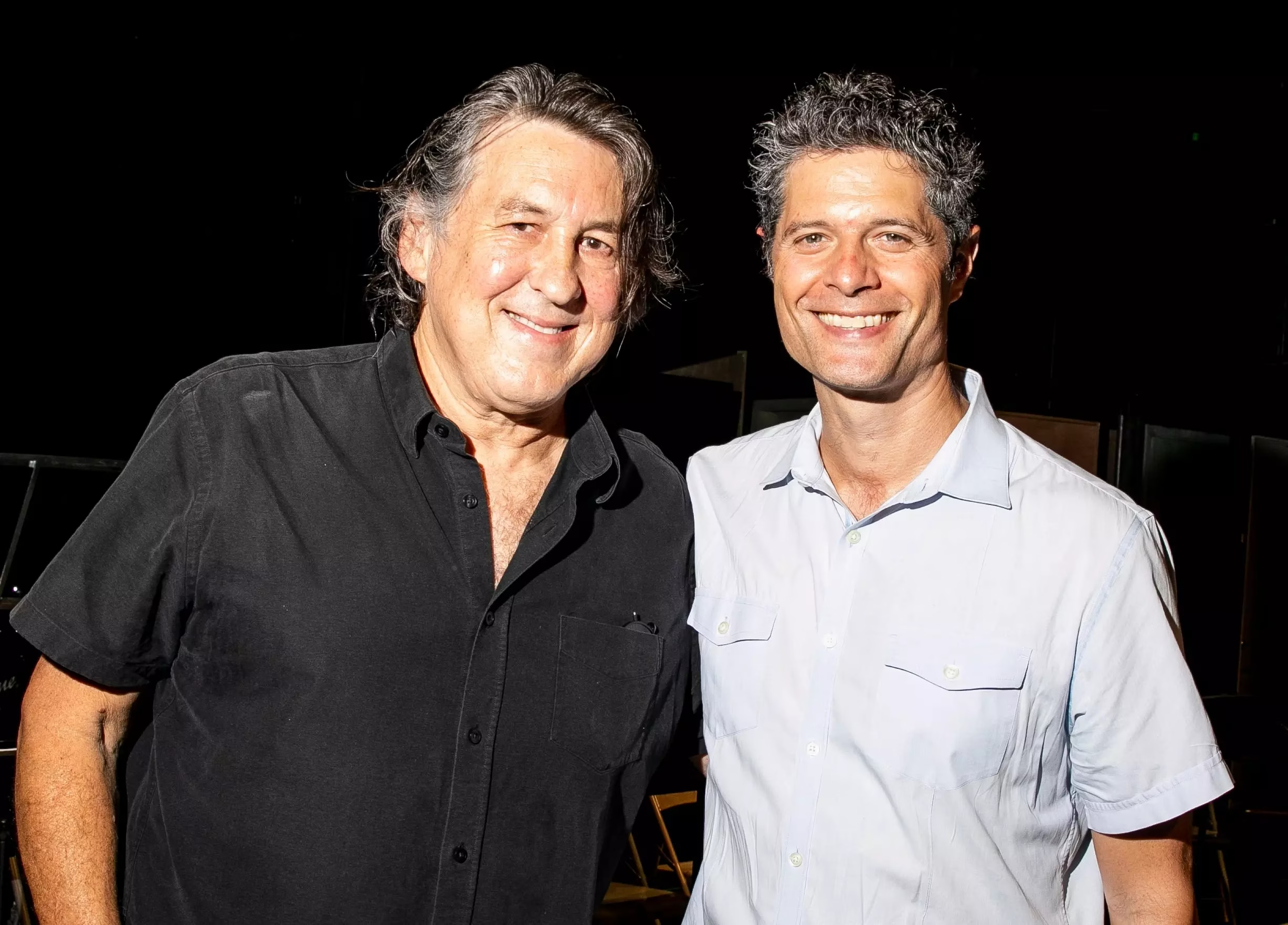
Cameron Crowe and Tom Kitt| Photo: Krista Schuleter
Speaking of real-life characters, you got rid of the quick "Bowie" cameo from the movie and brought in a very obvious "Ozzy Osbourne" cameo here. That makes complete sense given the story.
Crowe: Yeah, but we tried all of it. We definitely had a Bowie that ran through the Hyatt House and stuff. We had fun exploring all of this. You know, as you guys were talking, I was just thinking that in 1973 I was so jazzed to do the first cover story on Jackson Browne. I love Jackson Browne and still do. But he would do this thing where he would play in a theater and as the roadies were breaking it down [later] he would go out and play in the empty theater at this piano. I would stand there and listen to him play, and he was really just summoning ideas and melodies. It was such a magical thing.
I never had that feeling again until the writing process with Tom, where you could sit in a room with Tom and say, "This song is about this feeling, and this is what my sister said," and all this stuff. He would start playing, and the music would just flow through in the pieces. You'd see him just searching and finding, and I would film them and keep little pieces and play it back for him later. I was actually able to say, "That piece there sounds like the greatest song we could possibly write." Then sometimes he would just carve out that piece, and from that, the song would come. So it was the realization of a 50 year-old dream to just have that elixir available with an artist that you love, and you're actually collaborating.
A musical takes certain emotional moments and amplifies them, pun intended. You had to pick key things to highlight from the film and cut other things out — it feels like the first 20 minutes of the movie are compressed into the first five minutes of the musical.
Kitt: There was a point where Cameron had a draft that existed, and we started that process where you "song spot," and I think we just kind of went in order. I was in San Francisco working on [the Go-Gos musical] "Head Over Heels," and I would wake up, go to the theater, and try to write a song a day and send it to him. I remembered we got to a point where I just was thinking we haven't heard from William in a while [in a song in the story]. And that's where the song idea came for "No Friends," and I pitched it to Cameron.
It works on the level of a journalist and the job [they're] supposed to do, and it works for a 15 year-old kid who has felt awkward and alone. The perfect musical theater song speaks on multiple levels and hits something emotional, and for a character for the first time to be feeling this glow of importance and love and then have to say, "No, I can't do that. I have to say no, I have to remain objective. I can't get into this crowd." It felt like a perfect moment.
We had a core group of songs: "Everybody's Coming Together," "Lost In New York City," "Morocco," and "Night-Time Sky." But there were some discoveries along the way like "No Friends" that gave us great confidence early on.
Crowe: I don't view "Almost Famous: The Musical" as an adaptation so much as another look at my family and that period. It’s not going back to the movie as much as going back to the events that inspired a life, and so I got to actually make some emotional changes. Some relationships, like the relationship between [his sister] Anita and [mother] Elaine. That's why I sit in the theater sometimes and really get caught up in the emotion of it because that's closer to what their relationship was.
You have the silent drummer who in the movie has the one line, "I'm gay!" when they’re all revealing their secrets in a plane that may be about to crash. Why was that changed for the musical?
Crowe: I'll jump into this very quickly. The "I'm gay" joke was the biggest joke when Almost Famous was in the theater, briefly. I think we tried it at some juncture [here], and it was angry crickets. I think it's just because times have changed really in that it wouldn't be a closely held secret as it was in the day.
In real life, you went on the road with the Allman Brothers Band at 16, and that’s young.
Crowe: Trust me, the people that I met on the Allman Brothers tour at 16, I would have never met in any other way, nor would they have looked after me in the same way. Because we had a common goal which was loving music, and to be able to stand on the stage with the Allman Brothers Band, that's hallowed ground, my friend. Band aids, roadies, managers, relatives of the brothers, they all felt it was church on some nights. No setlist. No video feeds. Just a band that's ready to play for four hours if they feel. In the right night, in the right place, you go on the greatest journey. That was always the dream of the musical, to get you in a room where you felt what that was like, and maybe even to over answer the question, what it was like to get swept up and taken out of your town.
I always loved the fan nature of how the so-called "band aids" loved the set that the band was playing. They knew their s— better than the bands in many ways. Their biggest joy is that they figure out that Black Sabbath are going to open with "Sweet Leaf," which is the perfect opener for that era in Black Sabbath.
So they're clearly knowledgeable about the band, whereas the actual band Stillwater can barely figure out a song. They get an extra song to play in New York City, [and] they can barely get through "I Come At Night." But the band aids are like lasers — here's the greatest opening to any song ever, here's what Black Sabbath should be opening with, here's the hotel you stay at, here's what it is to be a fan of John Bonham. They got it down. So that's what I love in the musical — we actually remove the band aids from the context of sex and add to it that they're all fans. Everybody's fans in this story.
I noticed that Russell’s onstage electrocution moment wasn’t included here.
Crowe: Listen, man. If I had a shot at adding any one scene to this, I probably would go with the electrocution.
By the way, Tom, I thought after "American Idiot" that we would get some heavy rock on Broadway. But no. Many years ago, I think one of the cast members in "Rent" wanted to bring Queensrÿche’s Operation: Mindcrime as a musical to Broadway. Maybe this musical will open the door for something like that. What are you guys hoping will happen with this show?
Crowe: We're gonna do the Queensrÿche musical.
That's it, you should do it.
Crowe: I just felt a telepathic surge with Tom, and I think we have to do that. [Kitt laughs.]
Tom, after you've done all these shows and adaptations, was there something new you're able to do with "Almost Famous" that you haven't been able to do with another show?
Kitt: I've gotten the opportunity to do these really challenging, ambitious stories on the stage that speak directly to my heart. As artists, we hold something close and then let it go and see how it takes in the world. What I hope is that we will have honored Cameron's work and what this film has meant to people, but [that] we will also make them appreciate, in a new way, this character finding their voice and what it means for all of us to find our voice in the world.
There's a simple message that one of the first [songs] we wrote, "Everybody's Coming Together," this idea that in a world where we all see the discord and the challenges and the things that make you want to turn away. [Rather than run, we're] looking into a vibe where you say, "I'm going to show up and I'm going to make harmony with people. I'm going to learn how to play and make music and find a vibe and live in that moment." I hope people will sit in "Almost Famous" and have an appreciation for that feeling, and it will carry them into the next thing.