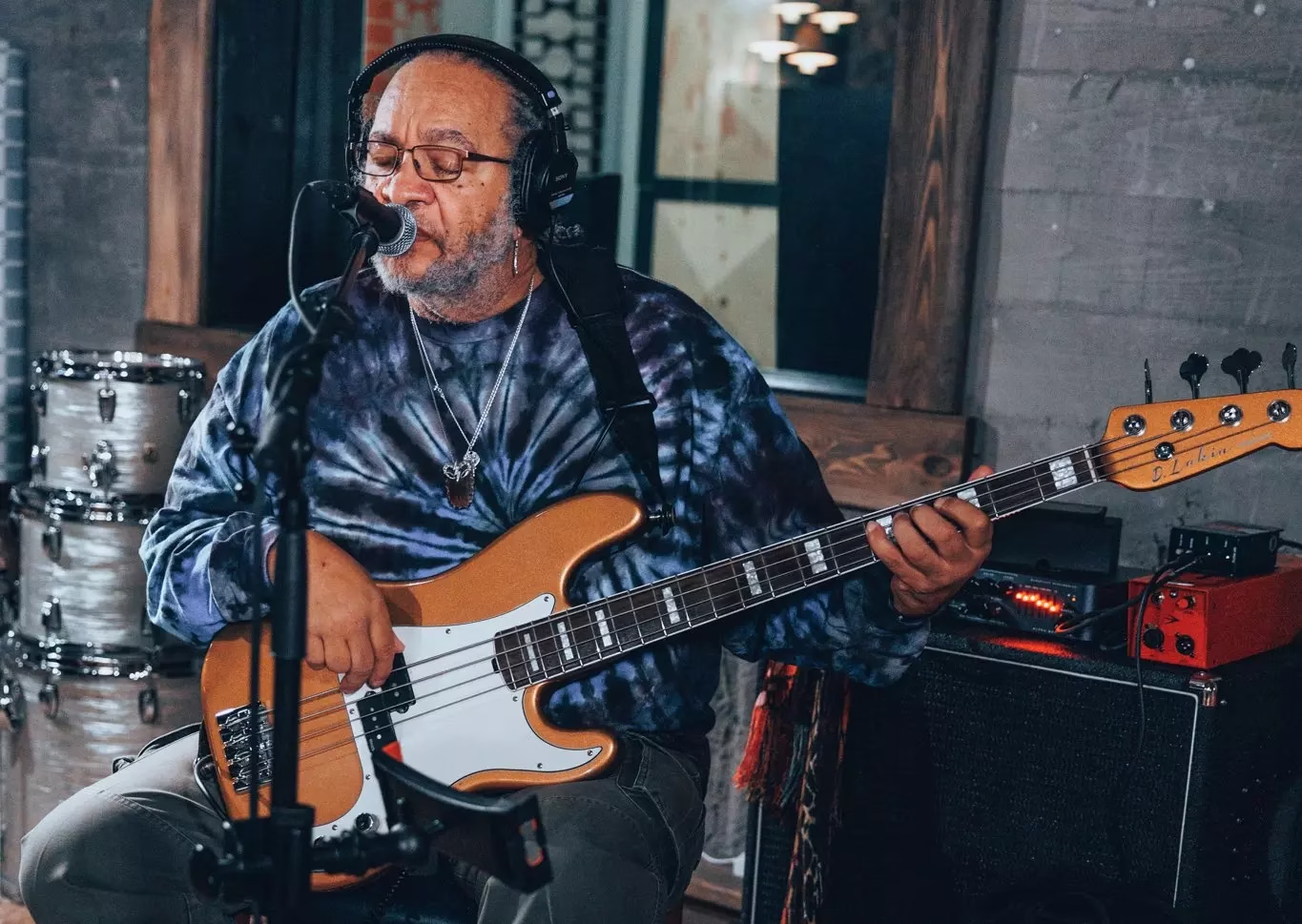
Living Legends is a series that spotlights icons in music who are still going strong today. This week, GRAMMY.com spoke with George Porter Jr., the bassist for the GRAMMY Lifetime Achievement-award-winning funk legends the Meters. In 2023, he received an honorary doctorate from Loyola University. His latest album, Boots in Place, is available now.
George Porter Jr.'s music is like a sumptuous, well-rounded dish, so it makes a certain amount of sense that he often talks about food.
Regarding a recent trip to Iceland to record with a big slice of the roots community, the Meters bassist hails the "well-designed sandwich" on offer at the hotel. "We got three gourmet meals every day," he glows to GRAMMY.com. "I mean, breakfast was like, Wow, I didn't know you can do this with eggs."
The funky, soulful product of that trip was Flóki Sessions' Boots in Place, which arrived July 7. "Flóki" refers to Flóki Studios, located off the mountainous Troll Valley Peninsula in North Iceland.
Therein, the GRAMMY winner's core group included, among others, guitarist Eddie Roberts, keyboardist Robert Walter and drummer Nikki Glaspie — who has traveled the world behind the kit for Beyoncé. Big Chief Donald Harrison, Erica Falls, Son Little, Lamar Williams Jr.
Porter admits he hasn't actually heard Boots in Place. ("Bad me, bad me," he says over Zoom.) But he's already on to the next project: He just wrote some "songs about alligators and stuff" on the Bayou with singer/songwriters Tab Benoit and Anders Osborne, and they'll head back next month to write more.
Naturally for this New Orleanian, the meals were as memorable as the tunes. Benoit, a "Cajun boy," cooked up "jambalaya shrimp one night, and then the next night, he brought crabs. It was killing," Porter says. With tunes as well as meals, "There are some things on the table that look good."
Read on for the full interview with George Porter Jr. about the making of Boots in Place, how his current music-making connects to the Meters, and his memories of their classic album Rejuvenation — which will turn 50 next year.
This interview has been edited for clarity.
Lay the groundwork for our readers regarding how Boots in Place came to be.
I got the call from Eddie Roberts asking me if I wanted to go to Iceland and record a record. Pretty much, that was it. I told him that I had to bring a tech with me and I wanted to bring my girl. He said, "OK, and bring your ideas."\
\
So, that's what we do, man. Everybody came with pretty much an open mind every day. We were there for nine or 10 days. I think we did about five days of recording, and then they did a couple of days of overdubbing and stuff; I wasn't involved. I kind of stayed back at the hotel those days.
But, yeah, it wasn't a whole bunch of legwork, at least on my end. Eddie did a whole lot more legwork getting people together. The music pretty much came natural. Everybody took a turn at throwing something out, and everybody opened their ears and played off what they heard, and songs came about.
I'm not sure if anybody came with a total, prepared song. I think it was all open for interpretation and jamming into a song.
So you had little riffs lying around — pieces that were jogging your imagination.
Yeah, there were things like that. We would start a groove. And if we were on one chord way too long, I might call another chord. And then maybe Robert would call another chord and say, "Oh, yeah, let's go here."
After maybe a 15-minute jam, we'd go in, listen to what we just did, and say, "OK, let's fine-tune that and make this move quicker, and don't stay on this one too long. And it came together.
Is that similar to or different from how the Meters operated?
The Meters operated pretty much in the same way. In the earlier days,it was all pretty much one, maybe two takes of whatever we did. It was never more than that.
In the later years, once the primary songwriter started actually bringing completed songs into the sessions, those took different ways — more overdubs and stuff like that. But in the original days, the first records were all sort of similar to that version of getting a song on tape.
We didn't have as much opportunity to go back and listen to playbacks and stuff like that, because of how it was recorded. It wasn't a multi-track.
Then, as now, you treasured spontaneity.
Yes, exactly. If it felt good, that's the way it was. We weren't going to try and change this. We weren't going to try and make it better. Usually, [when there were] third and fourth takes, we wind up going back to take number one — the one that we use.
Tell me about Iceland. Had you ever been?
Nope, never been there. It was a beautiful studio. The body of water that was right outside — maybe 25, 40 feet from the door of the studio — we were looking at Russia.
The guys would tell us that sometimes, when they stayed out there long enough, they would see whales going by and stuff like that. But I never stayed outside long enough to see a whale.
I know you weren't directly involved with who would appear on Boots in Place, but tell me about them regardless. New friends? Old friends?
[Vocalist] Erica Falls and [saxophonist] Donald Harrison Jr. I knew personally. Some of the other names I heard, but didn't really know personally.
Donald, I think we go back probably 30, 40 years. We don't have a day-to-day personal relationship, but we've been on many stages together in different formulas and have always had a great deal of respect for each other's musical input.
Any particular tunes that you especially enjoyed playing on?
There were some good ones, but see, at the time, they were grooves and didn't have names. I brought one that was a 6/8 kind of feeling. There was one that [drummer] Nikki [Glaspie] came up with that was a real hip-hop, kind of pocket-funk feel.
The Meters' Rejuvenation will turn 50 years old next year.
Oh my god. Really? Wow.
Yeah, it came out in 1974. What are your memories of that one?
Oh man. I thought that was of our better recordings of the band, actually. Well, I say the band, because I wasn't part of getting through all the vocals and all that kind of stuff. I didn't do any singing back then.
Once I had my bass parts and stuff together and was happy with the bottom end — the relationship assignment between myself and the drums — I would go away. But [Meters guitarist] Leo [Nocentelli] and [drummer] Zig [Modeliste] pretty much took that record all the way from start to finish.
That was our first recording that the members of the band actually had a relationship with — all the way to the end of it, to the release date.
I thought it was a positive thing for us to be able to do that, because the previous four recordings we had no input on. We'd play the session, and then they'd ship us out on the road, and some A&R man would show up on our gig somewhere in New Jersey and say, "Hey, guys, here's your new record." "Oh, really?"
And then the songs would be named, and we said, "Wow, we've got to learn the names of these songs now." Because when we did them, they would just be "Meter 1," "Meter 2."
On Rejuvenation, two members of the band actually took it to the ready-to-publish stage. I thought it sounded great because we had input. It may have been different if we had been left out of the circuit, like we had been with the previous four.
All these decades into your career, what's the state of your bass thinking?
I'm thinking that I'm having fun with the new one that I have — the D Lakin that I've been playing on for a while now. I'm still making an effort to learn how to be a good songwriter. I'm working with my Runnin' Pardners guys, [keyboardist] Michael Lemmler, [drummer] Terrence [Houston] and [guitarist] Chris Adkins.
We just released the record — well, it's almost two years old now. But it's the current project for Runnin' Pardners, and it's called Crying for Hope. I think it's, to date, our best effort that has been released.
What are you guys up to these days?
We just finished recording, like, 32 songs, and basically, it's going to be boiled down to two bands. Because one of them is done as a trio, with Michael and Terrence and myself, and that's the Porter Trio.
That band came about when Brent Anderson, the former guitar player, left the band. We had not really taken on a fourth player at that point — until almost a year later, when Chris Atkins came to our front door, and we accepted him with open arms, and he came ready.
As a trio, we started recording our live performances all the time. When we play our Maple Leaf show, we multi-track that gig every night. There's a lot of jamming going on on that gig — just like the Meters did back in the old days, when jams got to be songs. That's pretty much where we are now.
Living Legends: Smokey Robinson On New Album Gasms, Meeting The Beatles & Staying Competitive