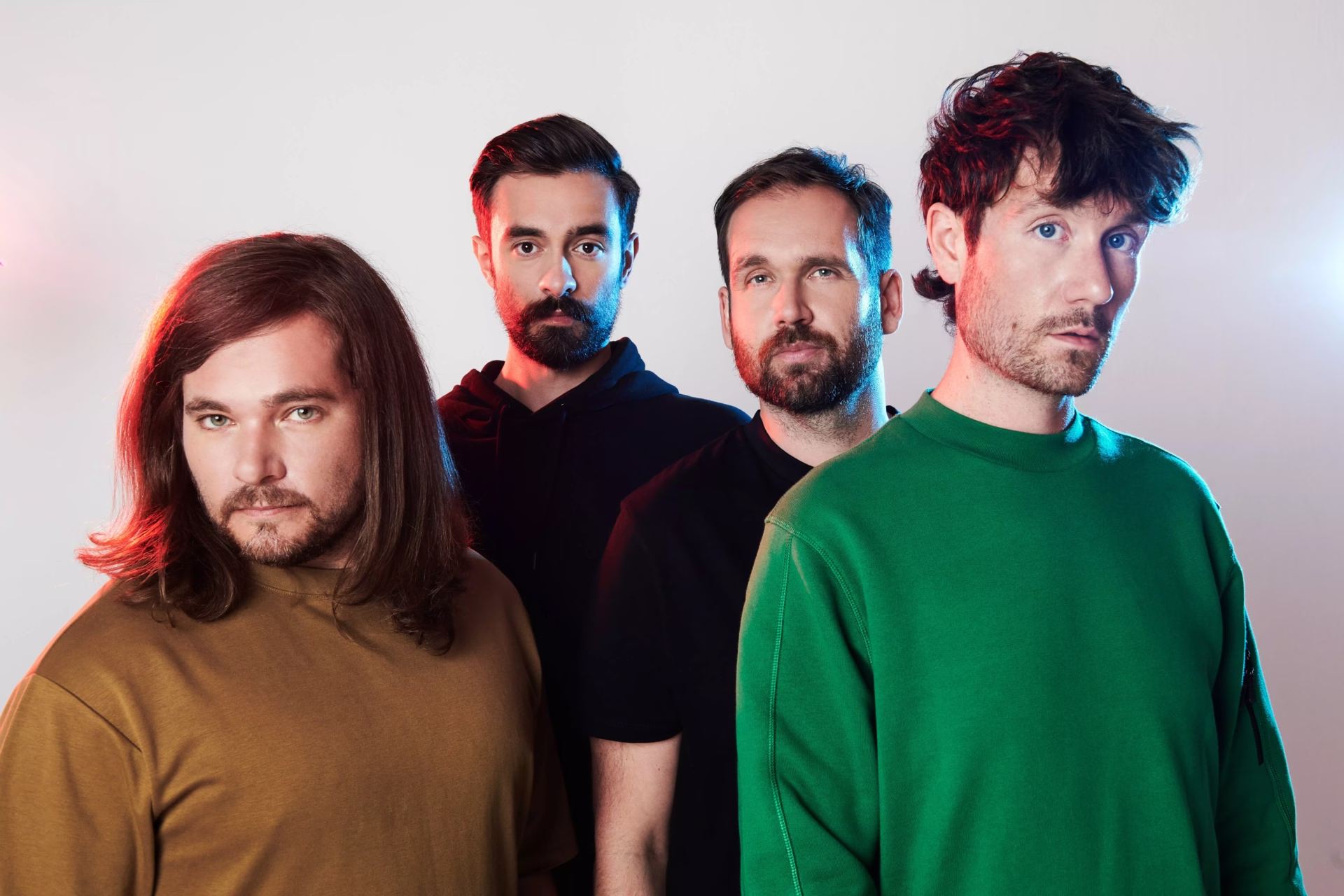
Like many artists, Bastille's Dan Smith used the unprecedented downtime induced by the COVID-19 pandemic to churn out an abundance of music. But perhaps unlike his peers, Smith had already begun feverishly creating before quarantine — and even more uniquely, he practically manifested the technology-driven era that ensued.
Bastille's fourth album, aptly titled Give Me the Future, explores the transportive nature of technology, and the complexities and pitfalls that come with it. Take the opening verse of the racing track "Back To the Future" ("Feels like we danced into a nightmare/ We're living 1984") or the entire message of "Plug In," which encapsulates in the line "We're living in a sci-fi fantasy."
Despite this, Smith and his band still feel hopeful about what lies ahead. And sonically, Give Me the Future hasn't steered away from the British group's signature upbeat, pop-driven melodies — if anything, the album's escapist nature has sent their anthemic sound into hyperdrive.
Smith attributes part of its impactfulness to their collaborators, as it's the first time Bastille has opened the doors to co-writers and co-producers beyond their go-to guys, Mark Crew and Dan Priddy. GRAMMY-winning superproducer Ryan Tedder executive-produced the LP; pop hitmaker Rami Yacoub co-penned four tracks; and actor Riz Ahmed provided "Promises," a moving interlude that was born out of his takeaways from listening to Give Me the Future.
Ahead of the album's release, Smith chatted with GRAMMY.com to detail its thought-provoking themes, what it was like to let go creatively, and where he thinks the future is headed.
What was it like seeing the pandemic unfold after you had conceptualized an album that had eerily similar themes to some of what we experienced with technology and beyond?
I wanted to make this record that was about escapism via losing yourself in your mind, and transporting yourself elsewhere with technology and with dreaming — with imagination. And I loved the idea of the freedom that that allowed within an album. But I think, ultimately, it was kind of too freeing. So as the album progressed, we honed in on the science-fiction, more future-leaning elements of it.
The fact that we live in a time where the future can often look pretty grim, and people are trying to reverse that or change it in a positive way. We're constantly confronted by what the future is for us on a macro and micro level, and personally and societally, and that's a f***ing s***load to get your head around whilst also getting on with your life.
It was just about trying to create a bunch of songs that kind of represent that, and speak to what it is to be a human with a kind of vulnerable brain and existence in and amongst all that stuff. I think the point of the album was to be like, "Some of this is terrifying. Some of this is hilarious. Some of this is completely absurd." Hopefully, it kind of pulls together these themes whilst also being quite honest and human about it.
The irony is not lost on me that we made this album about humanity and its relationship to technology in the context of writing songs over Zoom. Looking back at this album, it feels pretty fitting that it was made in this time.
It's also crazy that the album before this was called Doom Days. Is that a coincidence? Or are you, like, a psychic?
If I am, I'm sorry for what I've brought forward. [Laughs.]
When the pandemic began, all of our fans were joking that we predicted it. To have just come out of an album cycle for an album called Doom Days about a night out during an apocalypse, it's totally bizarre. And very surreal.
We released a song in 2020 called "survivin'." We literally finished it and played it for our A&R guy, like, a week before lockdown hit the UK. For me, it was about mental health struggles, and it was about coming off the back of seven, eight years of touring and the impact that that has on your head. It was quite a personal song, but obviously veiled in imagery.
It took quite a lot of encouraging for me to allow us to put that song out, because I just felt like releasing a song called "survivin'" in the middle of a pandemic, when people were struggling so much and so many people were losing their lives, felt in really poor taste. Also, I was worried that it would seem like I'd written it in response. Enough of my friends who'd heard it had said, "This feels different. It feels fresh, and it also is quite cathartic."
It is a pretty poignant song.
It's just weird. Maybe it's because I only ever write about depressing topics, but it seems to keep happening. First it was the apocalyptic album, then it was "survivin'," and now it's this.
I'm constantly joked with by our team and our managers. They're like, "Just write some f***ing love songs. Write some f***ing breakup songs. Make your life a bit easier, stop trying to write about all of these things." That's why I wrote [the Marshmello collab] "Happier," just to prove that I could have a go at writing a breakup song.
You're like, "Screw you guys for asking me for love songs. This is clearly working. Look at this amazing album."
I f***ing love pop music in all of its many, many, many forms. So there's always going to be a pop sensibility to what we write. But it's about having fun within that and exploring, like, "How interesting can you make melodies? How much can we push the lyrical content and themes to take you somewhere you weren't expecting to go?"
I wrote a load of love songs and breakup songs in and around writing this album, and maybe some of them will see the light of day. But I think about "Happier," and it's such a f***ing ridiculously depressing, sad, breakup song. It was written on a piano, but obviously, it's framed in the context of an EDM track. It really transforms it and changes it.
It's those kind of Trojan-horse tracks where you hear it, and you're like, "This is catchy." And then, if you properly listen to the lyrics, you're like, "Oh my god, is this person, okay?"
I feel like nine times out of 10 when you actually listen to a song's lyrics, you're like, "Wait, this is horribly depressing — but I was dancing the whole time?"
I think that's the responsibility of a songwriter, or a musician, or a pop star. It's your responsibility to use your platform to try and subtly — or very obviously — Trojan horse in something interesting, something different, something a bit provocative, or whatever. That's where pop can be really exciting. And it can be like, whatever the f*** you want it to be.
This album was the first Bastille project on which you brought in collaborators, like Ryan Tedder, who executive produced it. How did he get involved?
We can go down rabbit holes with our albums. We just made so much music, we really wanted a fresh perspective from the outside. We sent him all of the music, he listened, and we chatted a few times. It was almost like an A&R role for a minute.
There's a song on the album called "No Bad Days" that I really love, but I wouldn't necessarily have thought that it would be a single. He singled out that track and was like, "This song is amazing. You should definitely make it a kind of focus track for this record."
I think there's probably an expectation with our band, that a single is going to be sonically big, maybe bombastic, and definitely sort of upbeat. But not all of our songs do that. We have so many small, intimate songs — across our albums, we've tried f***ing everything, and I love that about the band. But sometimes, because of the nature of things, the songs that people hear are one type of song.
For him to pick that song out — it's a hugely personal song to me. It's about my aunt who died, and she went down the path of assisted dying. She's from Australia, and she was one of the first people to opt in for that there. That was wildly empowering for her in the context of an illness that didn't really leave her with a huge amount of agency. I went to Australia to say goodbye to her with my sister, and came back, and that song kind of just fell out.
So to have someone from the outside hear something in that song that was maybe relatable, or resonant to him, those were the things, in terms of his involvement, that felt really important. It's become quite an important song on the record.
Did the process kind of make you think, "Hey, maybe we shouldn't be so protective of our music"?
I think so. I feel like as we progress, the moments in our music that I'm most proud of are the ones that other people bring to what we do. I can be like, "Guys, listen to this!" because it's not my f***ing annoying voice singing.
It's me as the sort of dorky music fan getting to sort of signal the genius that other people are generous enough to bring to our music. That's what makes me excited.
[Bastille] has always been quite a DIY project, from sort of concepts to where it gets to. I think I've maybe held onto that slightly too tightly. It's been really nice chilling out a bit.
Between the statements you're making on the album, and the fictional tech world you're creating with Future Inc, are there certain impacts that you're hoping Give Me the Future will have? Or is it more just about saying your piece?
I mean, we're just a little band who make pop songs. So I don't expect there to be any impact at all. I think it's more the catharsis of being able to say things you feel like you want to say, and hopefully articulate them in a way that is vaguely interesting and thought-provoking.
When it comes to the themes of science fiction, and people pondering over the state of the world as it is — and it might be in the future — there are so many incredibly intelligent people spending all of their waking hours thinking about and articulating thoughts on those topics all over the world at all times. I think our whole position is just to sort of wander into it.
We've watched and read a lot, and written some songs, and it's hopefully the kind of thoughtful ecosystem for us to live in and enjoy for however long this album period might be. That was the thinking behind it rather than like, "We're gonna change the world with this album!" Because I'm not completely naïve [Laughs].
Is there anything about today's technology that excites you? Or are we all f***ed?
Well this is the thing — I'm incredibly excited by so much of what technology is offering. On a practical level, look at what it's doing for medical science. And what it does for bringing people together, and its ability to give people a voice, and foster community.
It's so wonderfully unifying and world-shrinking. I guess our point with this album, and just in general, is, for all the amazing benefits, it can also be hugely divisive and really corrupted and really corrupting. That's what's so complicated about it.
So whilst I'm chronically addicted to my phone in a really unhealthy way, it also brings me so much joy because it means I get to chat to people that I miss and be constantly in the loop of things that are happening. There's countless things that it does that are wonderful, for all the hours of doomscrolling I might also partake in.
There's so much to be excited by, but there's also a lot to be scared of. So basically, f*** knows.
How Do You Follow Up A Blockbuster Album? Let Royal Blood, Who Just Released Typhoons, Explain