As encapsulations of key 20th-century creative partnerships go, how monumental is the title Bird and Diz?
It's like calling an album Rodgers and Hammerstein, or Ellington and Strayhorn, or George and Ira Gershwin: this is a dyad of thunderous significance. As musical partners in the mid-1940s, Charlie Parker and Dizzy Gillespie unlocked harmonic, melodic and rhythmic equations that reshaped not just modern jazz, but all music. Although they could be polar opposites in showmanship and demeanor, their mutual love and respect was ironclad — they inspired and galvanized each other to innovative heights on stage and in the studio.
Which brings us to the only studio album to bear their nicknames. Bird and Diz was recorded in 1950, released in 1952 on 78 r.p.m. records via Clef Records, and turns 70 this year.
Therein, the Norman Granz-curated quintet of Parker on alto saxophone, Gillespie on trumpet, Thelonious Monk on piano, Curly Russell on bass, and Buddy Rich on drums tackles Parker originals such as "Bloomdido," "Relaxin' With Lee," and "An Oscar for Treadwell," as well as an gorgeous arrangement of the popular ballad "My Melancholy Baby."
"Although they stopped working together regularly, whenever Parker and Gillespie got together to play, they renewed their partnership immediately," adds Parker biographer Carl Woideck, who authored Charlie Parker: His Music and Life. "Sparks flew. And that is certainly true of the album Bird and Diz."
"They definitely have distinct vocabularies, that in terms of improvising, can work together with each other," veteran trumpeter Brian Lynch tells GRAMMY.com. "But both have the same kind of intent."
For a listener, could this be the document between the two to start with? Arguably, yes. Was it the most conventional format for them? Absolutely not. The more you dig into its temporal and physical context, roster of accompanists, and place in both Parker and Gillespie's trajectories, the more Bird and Diz reveals itself to be a singular artifact.
This is so much so that modern scholars and musicians keep puzzling over Bird and Diz, for multiple reasons. Like: what does this tell us about Thelonious Monk, who appears here years before he was widely venerated as a leading light? Why was Buddy Rich on the record, when fellow drumming ingenue Roy Haynes might have been the more obvious choice? And what's the deal with "Leap Frog" — whose many burning alternate takes appear as highly variable bonus tracks?
All these questions and more remain pertinent, with varying degrees of satisfaction to the answers. But the headline of Bird and Diz is right there in the title: it's a snapshot of their world-beating collaboration at a very special moment.
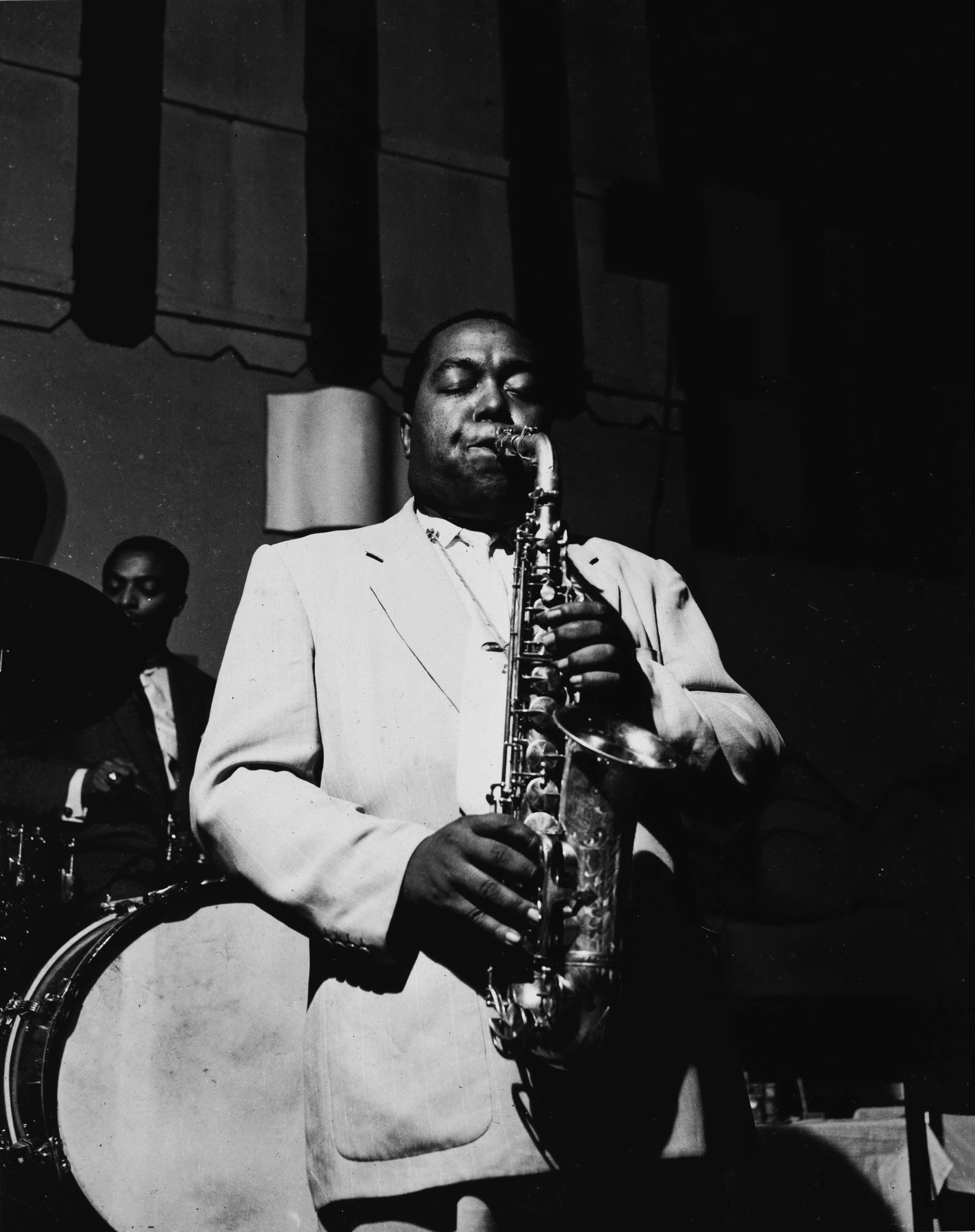
*Charlie Parker in 1953. Photo: Bob Parent/Getty Images*
A Rapprochement Of Innovators
When Parker and Gillespie ignited their musical partnership around 1945, the pair seemingly had no speed limit. Together, they dealt in harmonic, melodic and rhythmic complexity with an ear for dazzling beauty at a thousand miles per hour.
After recording and gigging extensively into 1946, they largely went their separate ways, save for the occasional co-appearance on the bandstand and an all-star, big-band date in 1949. But these were only captured in amateur recordings — not as proper studio dates like Bird and Diz.
Fast-forward a few years to 1950 — when Bird and Diz was recorded — and it was clear their artistry had matured significantly. Arguably, they no longer had anything to prove as artists; they could simply do what they did with full confidence in themselves and one other.
"Parker and Gillespie were no longer the hot new thing in jazz when they recorded Bird and Diz, but seasoned professionals who had known each other for a decade," Ted Gioia, who authored The History of Jazz and other books on the subject, tells GRAMMY.com. "Yes, they're still young in years, but veterans in every other way — and this comes across in the music.
"Even when Parker and Gillespie play fast and furious — as they often do on this date — there's still a sense of comfort and confidence at every juncture," he continues. "They act as if they have nothing to prove, even as they prove it on track after track."
"I think now people consider 'bebop' as something that is always fast," Champian Fulton, a New York-based jazz singer who paid tribute to Parker with her 2020 album Birdsong, tells GRAMMY.com. "But 'Bloomdido' and 'An Oscar for Treadwell' — those are really nice dance tempos. Everything is not burning. Even 'Leap Frog,' which is very fast, doesn't feel hurried or rushed or anything."
When Loren Schoenberg, a saxophonist and bandleader who's a Senior Scholar at the National Jazz Museum in Harlem, plays Bird and Diz for his students, he frames it in terms that anyone with even a general grasp of music can understand.
He lays out the difference between a predilection for daredevil feats and the relative restraint that age brings — even though Gillespie was in his early thirties, and Parker just at the threshold of 30.
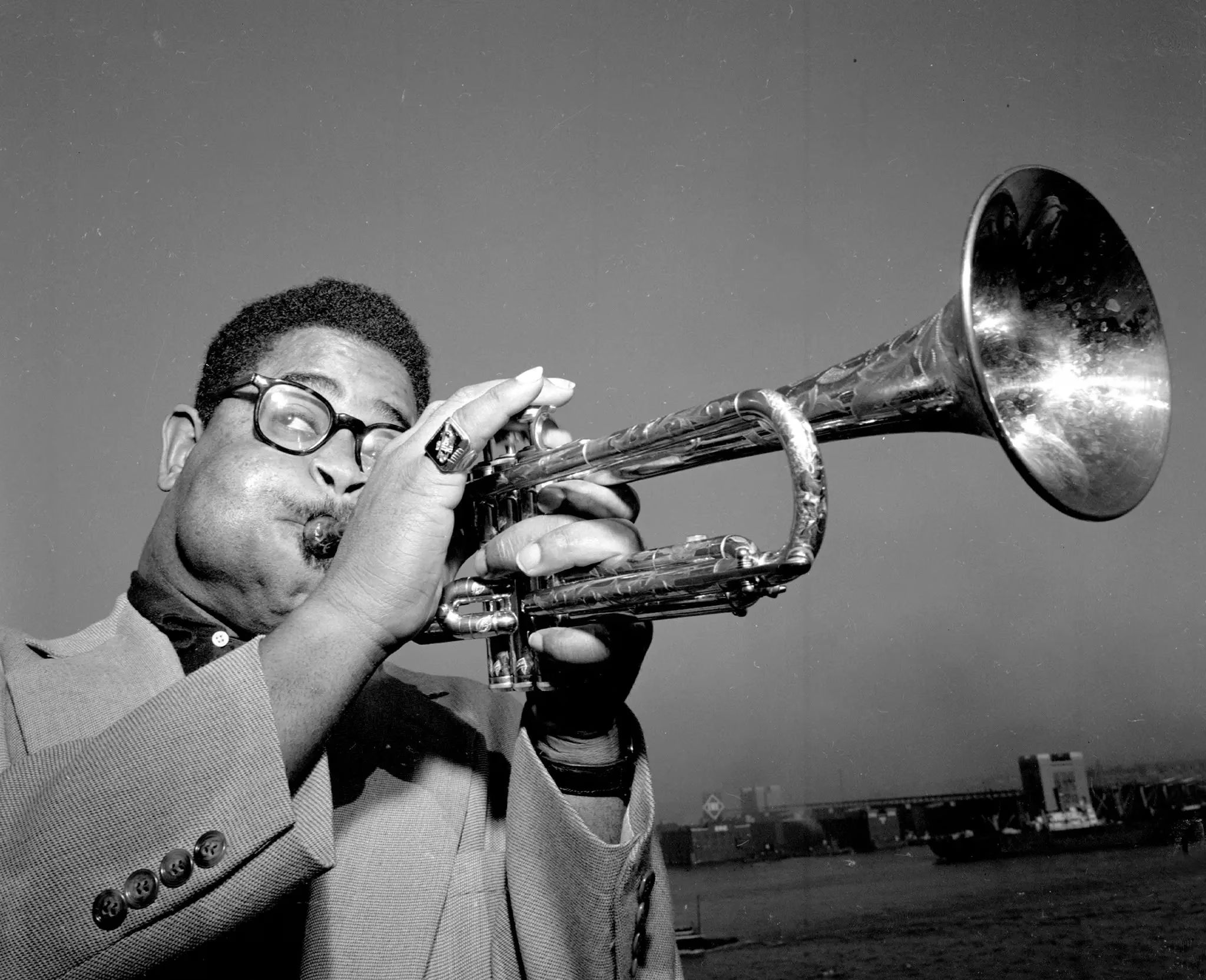
*Dizzy Gillespie in 1952. Photo: NY Daily News Archive via Getty Images*
"They do sound different, and it's not just the sound quality," Schoenberg tells GRAMMY.com, comparing Bird and Diz to early workouts like "Salt Peanuts" and "Hot House." "There's something in those early records of youth and 'We're going to rule the world,' just like a punk-rock band.
"It was something new and bizarre at the time for those people," he continues. "And then, here — even though it's only been five years — this feels almost like a more mature recalibration."
Given that Bird and Diz marked Parker and Gillespie's final studio session together, Schoenberg likens the record to the "last will and testament" of their collaboration. And it wasn't just a testimony to their rapport, but that of the entire band. "I think what united all these people with Buddy Rich was his absolute integrity — and Monk's, too," he adds.
And both men's appearances on Bird and Diz speak volumes about their places in the jazz cosmology — which, in many ways, were proximally closer than one might think.
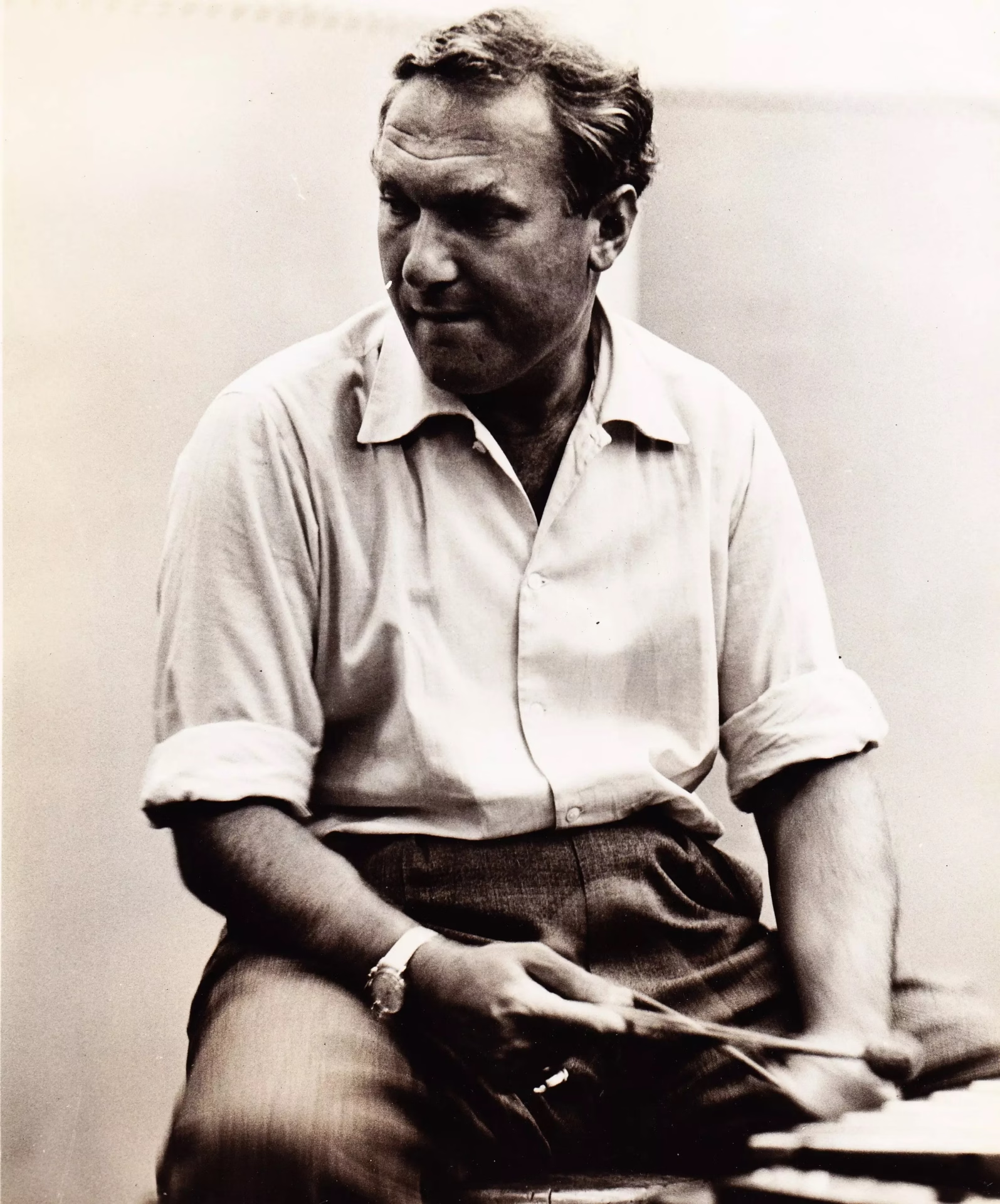
*Norman Granz in 1955. Photo: Gilles Petard/Redferns*
Granz At The Helm
Upon being contacted for comment, Woideck mentioned that Bird and Diz was, fortuitously, on his mind that week. Specifically, he was curious why producer Norman Granz chose Buddy Rich to be behind the kit, rather than Roy Haynes.
But before broaching this question, he explains the cruciality of Granz to the album as a whole.
"Norman Granz was a maverick record label owner and concert presenter who had high standards as to the quality of the music presented, and to the setting where the music was presented," Woideck tells GRAMMY.com. So, what explained Granz's inclusion of Buddy Rich behind the kit, since he was not part of the working groups of Parker, Gillespie or Monk?
To that point, Woideck emails a scan of a DownBeat article from 1952 — headlined "Granz Wouldn't Let Me Record With Parker, Says Roy Haynes."
The article goes on to quote Haynes: "Bird was under record contract to Norman. Before a session, he'd show Norman the list of musicians he'd like to use," the revered drummer explained. "Everything would be all right until he got to my name… The answer [as per Parker's preference] was on the paper, but Buddy always wound up on the date[.]"
"That answers it, really," Woideck concludes. "This was the preference of Norman Granz."
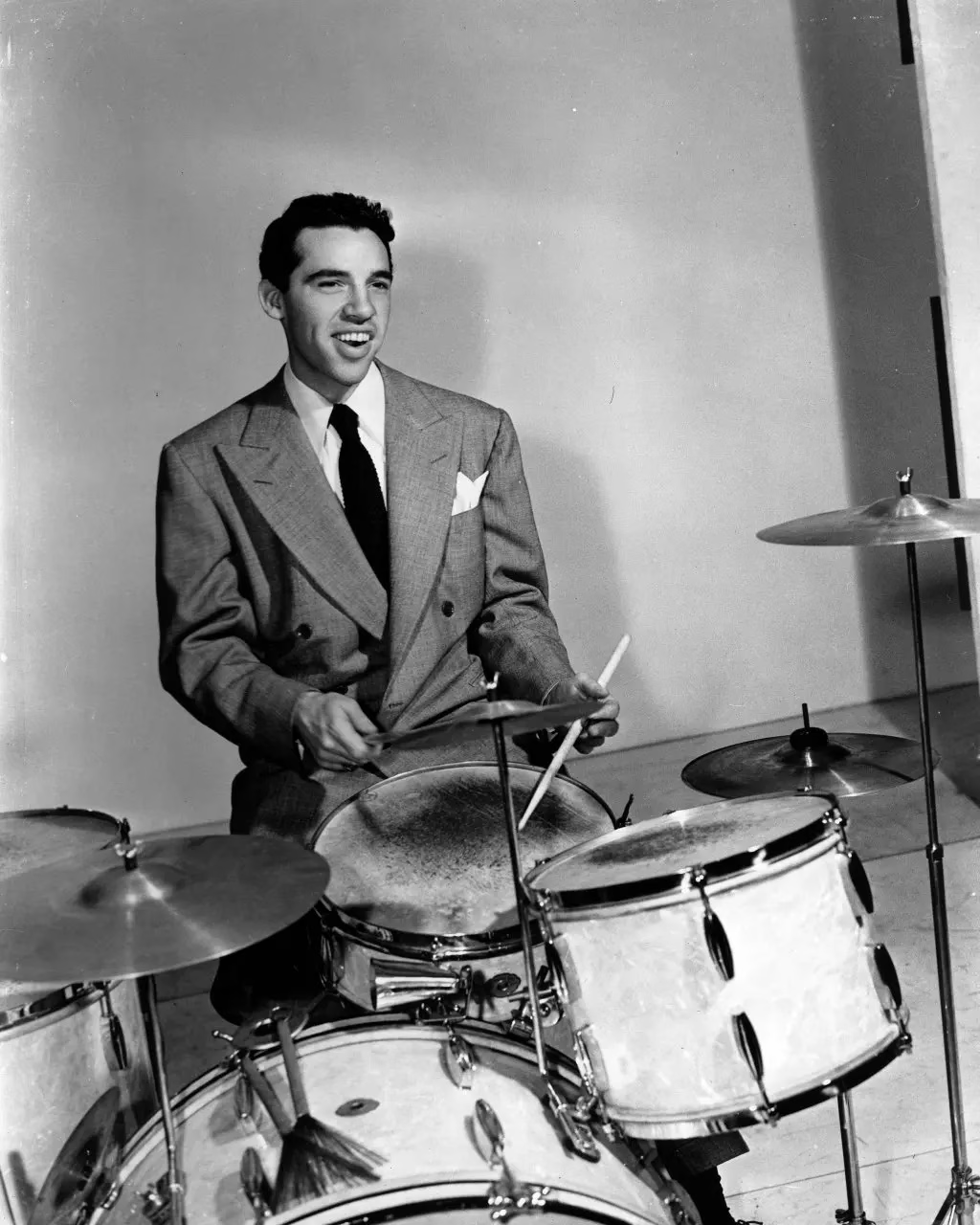
*Buddy Rich in 1950. Photo: Michael Ochs Archives/Getty Images*
Rich Behind The Kit
Despite this on-the-record explanation — and Rich's often inspired performances on Bird and Diz — his presence on the album remains a bit of a flashpoint in the often insular world of jazz scholarship.
Because, as Schoenberg explains, Rich was of a far different sensibility than Parker and Gillespie.
"Although he's the same age [as Gillespie and Monk], he's really from a different generation, as brilliant a technician as he is," Schoenberg observes. "His playing doesn't have all the fill-ins of Max Roach and Roy Haynes and all those people… he's very active, but it's on a straight line."
This has been to the occasional chagrin of jazz gatekeepers. "If you're a bebop snob, you're supposed to complain about Buddy Rich playing on this date. After all, he is more of a big-band drummer, not a bopper," Gioia says. "But I can't agree with that assessment. Rich plays with total authority in this setting, and my only complaint is that he didn't make more records like this."
Veteran saxophonist Charles McPherson, who can be heard in the soundtrack of Clint Eastwood's 1988 biopic Bird, notes that the swing era that produced Rich — and led to the modern-jazz paradigm that Bird and Diz did a great deal to architect — were far from mutually exclusive.
"Bebop is just morphing; it's the natural evolution of the swing era," McPherson tells GRAMMY.com. "And then you've got Bird and Dizzy just a little younger, and it's their collective take on their swing heroes. When you change things just a little bit, voila: you have a bunch of these young guys that think similarly about harmony and rhythm."
McPherson notes the litany of connections between the "old" and "new" guards — a sometimes facile delineation. Among them are the foundational influence of trumpet pioneer Roy Eldridge on Gillespie, as well as Parker's reverence for the introspective tenor luminary Lester Young.
Likewise, to McPherson, the fact that Rich enthusiastically played with those who tore apart the swing rulebook was only natural. Still, this reality stands in contrast to how modern understanding tends to cleave apart those two eras.
"You've got to realize: what is the DNA? What is the etymology? What is the genesis of what we're talking about right now?" McPherson continues. "This categorizing of things — this in this box, as opposed to that box, and neither the twain shall meet."
"It's a natural piece of received wisdom that he was out of place on the record," Lynch says. "But nobody who could play drums that good is completely out of place on any record."
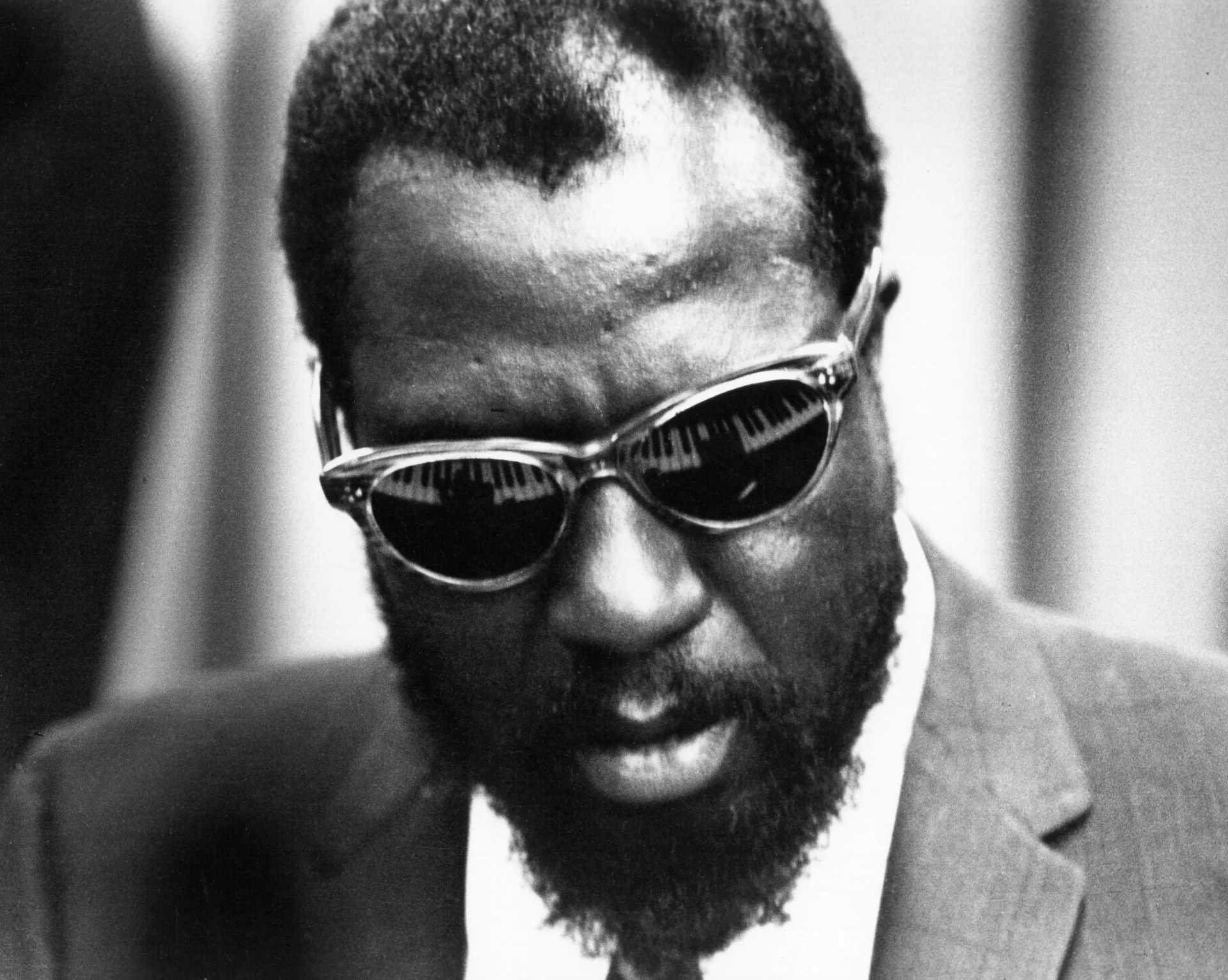
*Thelonious Monk in 1960. Photo: Herb Snitzer/Michael Ochs Archives/Getty Images*
A Rising Monk: No "Lesser Light"
The problem of categorization also applies to Monk, albeit in a different way. Given his modern-day stature as an American original close to Parker and Gillespie in musical importance, it's striking to read Granz's contemporaneous album notes, where he describes Monk as a "lesser light."
In context, this makes a certain amount of sense. As Woideck points out, Monk was an underground figure in 1950 — and would remain so for at least five more years. But, regardless, his playing is exceptional on Bird and Diz — in equal parts elusive, idiosyncratic and capacious.
While Monk and Rich are rarely evoked in the same breath outside of this context, it's worth noting one major connection — they were both born in 1917, so they occupied the same temporal space in jazz history. Partly for this reason, they're simpatico in this setting.
"Monk and Buddy Rich wind up being brothers in rhythm," Schoenberg says. "That's a combination that most people would never, ever think would work."
But it certainly did, as Schoenberg explained in The NPR Curious Listener's Guide to Jazz in 2002. "They merge in a wonderfully stark fashion," he wrote, "the common denominator being their superb time and mastery of the idiom."
As Schoenberg continues to GRAMMY.com, Monk in 1950 played drastically differently than the piano players that Bird and Diz typically hired.
"It's so strange and pointillistic and full of space. They're breathing," he continues. "It's like they're in a gravity field, and it throws their solos and the music into some kind of stark, stark [relief]." As an example, Schoenberg points to Monk's interplay with the headlining pair on "Relaxin' With Lee" — an iteration of Edgar Sampson's 1933 jazz standard "Stompin' at the Savoy."
"Just the treat of hearing Buddy Rich and Thelonious Monk in the same rhythm section is worth the price of admission," Gioia says. "I love Bird and Diz, but I'd wait in line for an hour just for one more chance to hear Monk and Rich."
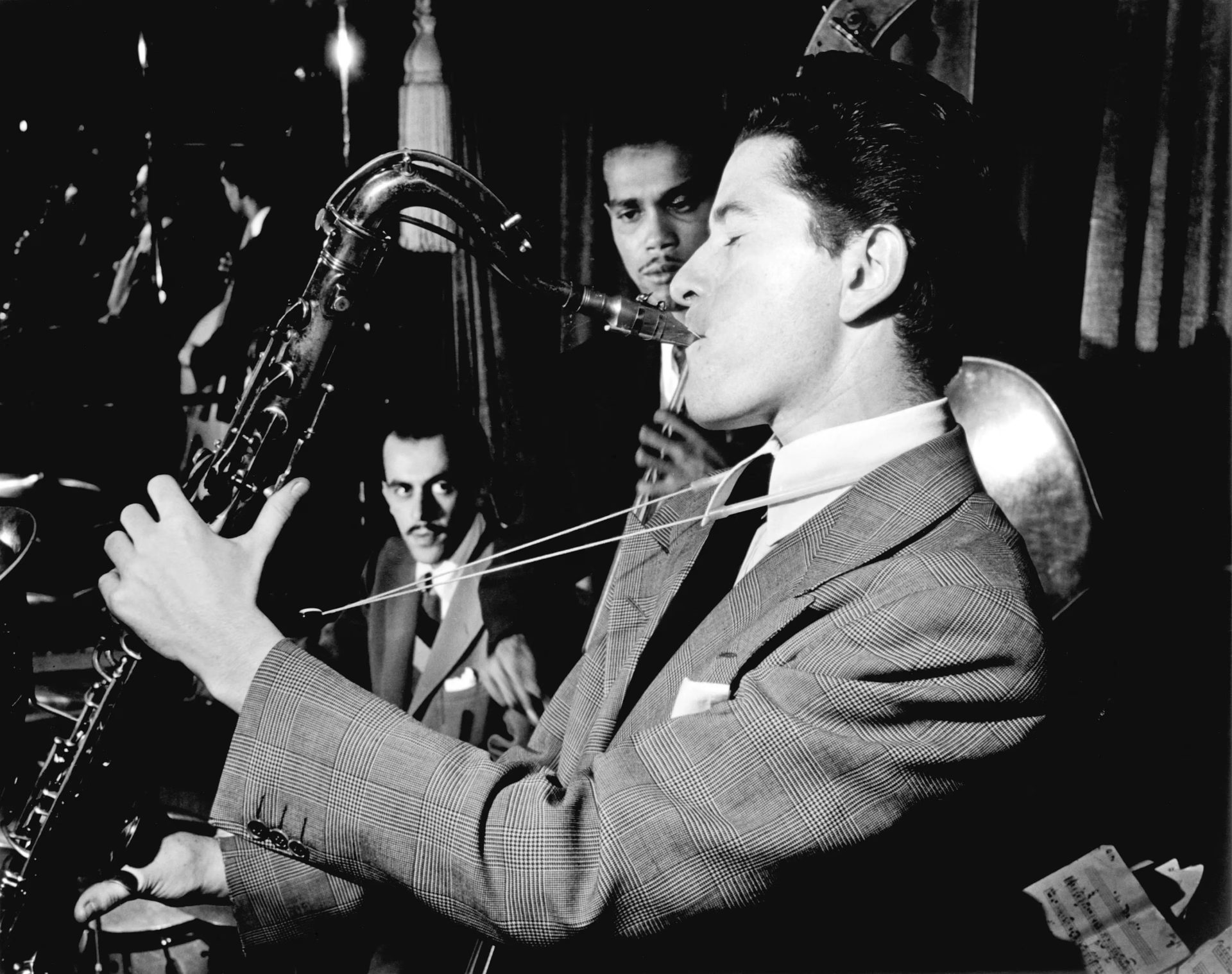
*Curly Russell behind saxophonist Allen Eager. Photo: William Gottlieb/Redferns*
The Importance Of Curly Russell
Not everyone on Bird and Diz was an innovator. But this is no slight to the totally serviceable, reliable, by-all-accounts-well-liked Curly Russell.
"I get asked this question of many musicians of that generation: 'Why was he there?'" Schoenberg says. "We've got Ray Brown and Oscar Pettiford [at this time], and even Tommy Potter's better than him… the bass lines are more schooled."
But there was a very good reason Russell was there: his personality and grounding presence. "Everybody loved him and he swung and he could just do it," Schoenberg adds, paraphrasing an unnamed associate who played with Russell frequently: "If he was there, everything was going to be fine."
When considering Russell, it's worth noting that if all musicians were breaking boundaries at all times, music would become overwhelming and exhausting.
Speaking about tenor saxophone giant Hank Mobley for GRAMMY.com in 2020, fellow tenorman Jeff Lederer made an observation that totally applies to Russell — and all the other perfectly decent musicians like him.
"Jazz is a folk music. It's not a science. It's music that has come out of a culture," Lederer said. "While there are artists that will want to innovate all the time, there's also a really special place for artists who speak and transmit the language and don't feel the need to completely change up what the fundamentals of the music that they love are."
While Schoenberg leaves Russell out of the conversation about titanic presences on Bird and Diz, he means that as no insult.
"I don't think his role is that significant, but not doing the bad thing is worth a million dollars," he says. "The pilot lands the plane; I'm thrilled. I don't care if there's somebody better. He landed it, and we got there — thank you very much."
Flying Forward And Backward
Let's say you've absorbed the original Bird and Diz album — and all those acrobatic outtakes of "Leap Frog" that you can find on streaming services. To further understand the musical brotherhood of Parker and Gillespie, where should you go from here?
Schoenberg points out that within months of this record date, Gillespie would make overtly commercial recordings with a young John Coltrane, and Parker would make a similar swing for a wider audience with his sumptuous Bird with Strings album — where Rich was the drummer.
The troubled and addicted Parker passed away in 1955 at just 34; Gillespie kept working and evolving until his death in 1993. So, to effectively frame Bird and Diz in history, Schoenberg recommends going back to the early days, when the pair burst forth with cocky, youthful, inventive energy — such as on The Legendary Town Hall Concert New York 1945.
But in the end, it's up to you; you can embark on a Bird journey, a Diz journey, or continue plumbing the alchemy they established together. And Bird and Diz stands as a fine and proper gateway to all of it — not only for the playing, or the material, or the unique meeting of minds, but for the intent behind it all.
"It's hard for younger people to realize what a record date meant in those days," Schoenberg concludes. "That was your epitaph; that was your legacy. It was a very serious thing."
And these two pioneers didn't just "understand the assignment," in modern parlance; they left an imprint that hasn't weathered one iota. Laying waste to the barriers of time, technology and transforming tastes, the legacy Bird and Diz blueprinted together has leapfrogged through the ages.