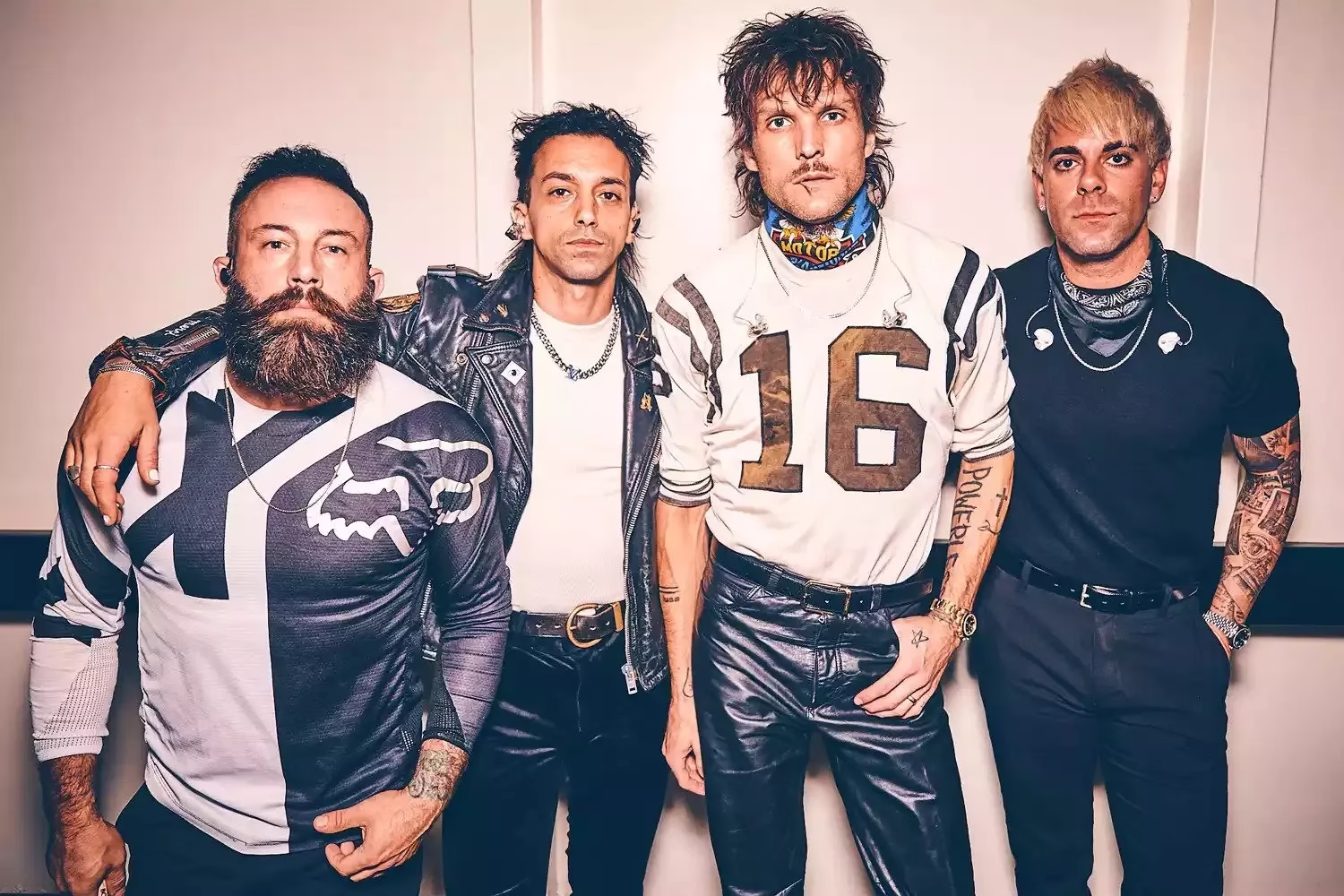
For 3 minutes and 14 seconds of Boys Like Girls' recent set at New York City's Hammerstein Ballroom, Martin Johnson asked just one thing of the sold-out crowd: put your phones away.
"Let's do it like it's 2007," the frontman said before the band went into their biggest hit, "The Great Escape."
Just before that, Johnson had requested exactly the opposite: take your phones out and capture the pop-punk anthem on film. But after the first chorus, phones were pocketed, and the energy in the room shifted to pre-smartphone, pure, and carefree teenage nostalgia.
That's the kind of magic Johnson and his BLG bandmates — original drummer John Keefe, and new recruits (but old friends) guitarist Jamel Hawke and bassist Gregory James — have been feeling on their latest tour, which wraps on Nov. 1 in Raleigh, North Carolina. It's both a celebration of the band's beloved classics and their new album, SUNDAY AT FOXWOODS, their first in 11 years.
As Johnson proudly declared to the NYC crowd on Oct. 27, one week after the album's release, "In case you haven't noticed, we are back and we're better than f—ing ever."
In the time that the band spent apart, Johnson expanded his repertoire songwriter and producer for the likes of Avril Lavigne and Kygo; in 2017, he started a solo venture under the moniker The Night Game. Boys Like Girls was always in the back of his mind, but there was a lot of personal healing to do in order for the band to come back in full force. And after a 12-show reunion in 2016, it felt like maybe Boys Like Girls would never return.
"We sobbed in each other's arms after the [last] show — I don't know why we felt that way, but we all kind of knew that would be our last show ever," Johnson recalls. "That felt a little more like a celebratory victory lap with my best friends than it felt like reopening a chapter."
Yet, BLG still found its way into the music he was making — and once he had a song called "BLOOD AND SUGAR," he knew it was time to try again. Johnson had clearly never fully lost sight of the band's sound, though; SUNDAY AT FOXWOODS carries the same spirit as Boys Like Girls' older material, leaning more into anthemic '80s pop production and their signature guitar-driven, roaring melodies.
Below, Johnson details the healing journey that helped the new-and-improved iteration of Boys Like Girls come to life — and why it's just the beginning of their return.
This interview has been edited for clarity. As told to Taylor Weatherby.
You emotionally kind of go through this roller coaster, being on the radio at 20 and peaking, by cultural standards, at 23. And then you're trying to reassume your place in society at 24 as a normal human being, and you have to drop the narcissism and ego that are required to be that type of an artist. What happens is you bury the good things with the bad, and you almost become a completely different person.
At that point, at 24, I also got sober. It was a bit of the death of a persona of introducing myself as Martin from Boys Like Girls instead of Martin Johnson. And kind of like, Who am I? Because I only know myself in the context of the music I make, and that's not going to make me a happy man long term.
So then 12 years later, you look at your new music, and you've buried your ability to make [the music you used to make], because you've suppressed this kid inside you. You're not ashamed of them at all — I was grateful that that kid brought me so much value and incredible experience and life experience as a man.
A lot of it I don't even remember, because I was so young, or inebriated. But it was important to make peace with that kid, and let him into the room, before figuring out what this was. And looking my 18 to 23-year-old self in the eyeballs and saying "I love you, I accept you, I'm not embarrassed of you, and thank you for everything that you did for me as a man."
Then there's this "emo night" culture, where you go into a club and they play all the songs from 2002 to 2008, and everybody screams along really loud wearing all black and T-shirts that say "Sad as f—." And you're in the epicenter of that, but it feels like another life — it doesn't feel like you. Like, you're standing there in your mid 30s, [and it's] literally like I'm a museum exhibit behind glass. So also finding love for what culture has made out of who I was as a kid was [another] vital component of making this record.
For 12 years, I wasn't really emotionally available to watch old videos of myself. I was, like, on drugs, so watching myself perform in 2009 really hurts my heart. So I went back and I watched everything I could on YouTube, I listened to every single demo that [we] had never put out — and there are hundreds — I listened to every voice memo that I had from 2004 to 2010, I went through my entire video/photo library, all my camcorder tapes.
And what a gift to experience that deep into my 30s, when I had made peace with myself as a human, and learned to love myself but hadn't yet loved my past or felt grateful for my past. There was always this, like, eerie disconnect around the age of 24, and this sort of line in the sand where like a new life began. That line doesn't exist for me anymore — and that was a huge part of creating SUNDAY AT FOXWOODS.
I think it's also vitally important to have no rules. The thing that kept me from being willing to step into the ring to make a Boys Like Girls record for so long is [that] I felt there were rules. We made that first record with two guitars, a bass, drums, and a little bit of synthetic programming. When you do that, you do it with as much intensity and bravado as you possibly can, because you don't know anything else. Then you're in your mid-30s, and your toolkit has expanded so much, from writing music for other people and from time on the globe, and from failing, you know what I mean?
For me, that created this beautiful freedom, where I was able to feel free to use that skill set, but also infuse the things that I had learned in my 20s/30s. Which was super liberating, because it felt like a second chance at creating music that changed my life.
[Last year], I bicycled across the U.S. It was 4,400 miles, it took me 70 days. I did it with one other guy, carrying all this stuff, camping and [staying in] some hotel rooms. I think the purpose for that was, I was looking at my life — and I deeply love my life, but I'm always looking for more. I'm always looking for what's next, I'm always looking for fulfillment, and I'm looking for what's my next creative endeavor — what is going to be the thing that makes me feel free and wild.
For a while, music had actually made me feel a little bit confined. And it's hard to even explain that, but I think a lot of it is to do with the direction the music industry has taken, where everything is dictated by metrics. So the fatigue that's involved with that had created a little bit of a block for me, and I had thought about stepping back on stage to segway out of that block, but I didn't know if that was the answer.
I'm in a super happy marriage, [and I was] super excited that she was gonna let me go on the bike. We weren't sure if we were ready to have a kid yet. I got out on the bike, and within two weeks, the world got really quiet and two things became extremely clear.
Number one, I am supposed to sing. It was the thing I was supposed to do since I was a kid. It became really clear to me that in order to express myself and not feel locked in a box, what I needed to do was make my own music with no rules.
And then also, I was like, I'm ready to be a dad, and I'm ready for what that looks like and I'm ready for that responsibility. It's so funny, because when I was a kid, being a dad felt like not freedom at all. We actually named our daughter Freedom.
I don't know that I'm never gonna write for somebody else again. This chapter for me is about my creative outlet and performance in the context of Boys Like Girls — what that means to my childhood self, what that means to my current self, what that means to me as a father and a man.
We booked a little bit of a trial-and-error tour last year — a soft, like, "Should we do this?" We went to Southeast Asia and Australia, and we played When We Were Young Festival and a couple of headlining sets here. The mutual energy exchange that we were experiencing from the crowd wasn't really something we had felt since maybe 2009. And that's really contagious to feel that — when you look out at the crowd and you're delivering escape and joy and euphoria, you receive it back.
It made sense to feel like, "Guys, let's play some songs here. This was a big part of who we are — why just totally kick it under the rug? It's been a long time. Let's go jam." And then it took on a really big, deeper meaning for us getting it in front of people. It was like, "Let's take a real crack at this. We'd been doing completely other s— for 12 years. Let's put it all on ice and let's do Boys Like Girls again."
It was the most liberating thing any of us have ever [done], and the biggest commitment we've made to ourselves as musicians since 2005 when we signed a record deal.
We played our first show since 2016 in Australia. We were in Perth. I stepped on stage with my best friends, and all of a sudden, this completely full club, sold out, is screaming these songs I wrote at 18. Sometimes you don't choose your path, it chooses you, and it became really clear to me that I had a job to do and this was it. At first, that came with a little bit of guilt that I hadn't done it sooner. Like, How did I neglect this for so long?
But I allowed that to just be the story of Boys Like Girls, and that's because our fans have grown up with us. I look out and I see it. I'm just like, Wow, we grew up together, dude. That was a journey together. And here we are, man. We made it, that's crazy. And it feels like that on this tour.
I feel completely cut loose. I think you can hear that in the music, I think people can feel that in the performances, and playing the older songs has never felt better. I'm really enjoying doing this, and I feel like as soon as I get off the road, I want to make more Boys Like Girls music.
We're closer than we've ever been by a massive long shot. And that's a huge gift, but it came through a lot of work, finding what this looked like in 2023 — really asking ourselves the hard questions.
Obviously Boys Like Girls is not in its original form, but it's pretty much as original as it possibly could be considering the circumstances. Jamel was in the band in 2009 through '11 — he was our auxiliary guitar player. What's funny about Jamel was, we actually asked him to join the band in 2004 and he said no. [Laughs.]
Greg had been around the band and best friends with us for 15 years. He used to live with Paul [DiGiovanni, BLG's original guitarist] when the band was kind of peaking, played bass with us on stage a couple of times in between 2007 and 2009, and opened for us acoustic a few times on the OP Tour with Cobra Starship. He had sort of been a huge part of our story the whole way.
Morgan [Dorr, former bassist] and Bryan [Donohue, original bassist] and Paul, we love those three so, so deeply. I think we're on stage with the exact people that we're supposed to be on stage with right now. The guys are really assuming the character well and owning the music in a way that I'm so proud of. They've been there the whole time, so the context and the cultural significance is so clear. It's not just playing a four-chord part — it's playing a movement, it's playing a cultural moment, it's going back in time with us.
We're lining up stuff for next summer. This tour feels natural and amazing. My family and my wife are so supportive about the journey. My relationship with my bandmates is the best it's ever been in our entire career of 20 years. I feel healthy, happy and supercharged. And I'm ready to make the best music of my career.
10 Pop-Punk Albums Turning 20 In 2023: Fall Out Boy, Blink-182, The Ataris & More