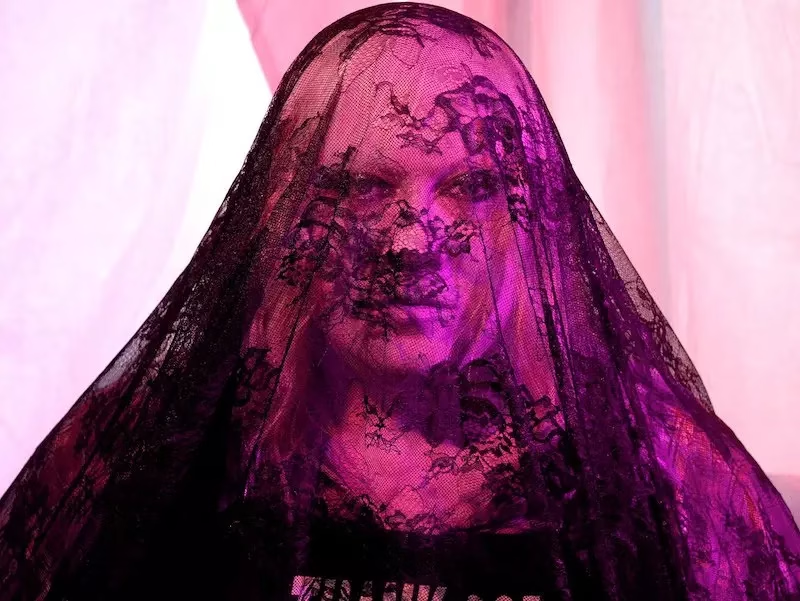
Antony and the Johnsons are no more: long live ANOHNI and the Johnsons.
From their 2000 self-titled indie debut to three albums on Secretly Canadian, the chamber-pop ensemble — led by the mononymous singer — has plumbed themes of gender transition, ecological collapse and much more to emotionally throttling effect.
Together, these albums built a universe — with Candy Darling, Lou Reed, Japanese butoh dancer Kazuo Ohno, and many more tortured, hopeful, unforgettable characters as its denizens. (If you haven't heard 2005's I Am a Bird Now and 2009's The Crying Light in particular, ameliorate this immediately — and brace yourself.)
After 2010's lower-key but still satisfying Swanlights, ANOHNI put the Johnsons to bed for more than a decade, and took a hard left turn with her experimental, electronic 2016 debut solo album Hopelessness.
With the newly christened band, she's back to a string-laced, jazzy aesthetic — once again alongside the Johnsons — with My Back Was a Bridge For You to Cross, released July 7. As mellow and accessible as it is, there's plenty of the old anguish and grief in songs like "It Must Change," "It's My Fault" and "Why Am I Alive Now?"
Here's a brief overview of what ANOHNI has been up to in the 13 years since the last Johnsons album.
ANOHNI Released A Live Symphonic Album
In 2012, the group released Cut the World, a live collaborative album with the Danish National Chamber Orchestra, recorded in Copenhagen.
Suitably incisive, Cut the World featured a healthy array of tracks from all four of Antony and the Johnsons' albums, from self-titled's "Cripple and the Starfish" to I Am a Bird Now's "You Are My Sister" to The Crying Light's "Epilepsy is Dancing."
Cut the World also featured a new song of the same name, as well as a spoken-word piece called Future Feminism. Therein, ANOHNI argues against a patriarchal model of society in the service of one of her integral themes — healing the earth.
The Group Soundtracked A Charles Atlas Film
For another semblance of an Antony and the Johnsons mixtape, check out the group's soundtrack to Atlas' 2014 film Turning, which features key tracks like I Am a Bird Now's "Bird Gerhl" as well as captivating deep cuts like The Crying Light's "Daylight and the Sun."
They Also Continued Performing Live
Despite having no new releases five years after Swanlights, the group continued performing in Europe and Australia into 2015. This included a benefit for the Martu people of Parnngurr in Western Australia, in the community's effort to stop the construction of a uranium mine near their community.
ANOHNI Went Solo
In 2015, ANOHNI shed her deadname for good, explaining that she had assumed the name ANOHNI privately "for years." Her first offering by her lonesome was the following year's Hopelessness, a hurled cherry bomb with sick-and-tired laments about climate change ("4 Degrees"), drone warfare ("Drone Bomb Me") and the policies of a certain prez ("Obama").\
\
ANOHNI has also released tracks apart from Hopelessness, like 2018's "Miracle Now" — which features an accompanying video featuring trans performance artist Page Reynolds — and covers of Bob Dylan's "It's All Over Now, Baby Blue" and Nina Simone's "Be My Husband," all of which she released in 2020.
ANOHNI And The Johnsons Returned — And Honored Their Namesake
Antony and the Johnsons' original name derived from ANOHNI's birth name and Marsha P. Johnson, the revered activist who fought in the 1969 Stonewall uprising against anti-LGBTQ+ policing in New York — and was tragically found dead in the Hudson River under mysterious circumstances.
Under their updated name with ANOHNI's moniker, the band reunited for their first project in 13 years — and with the return of the Johnsons came a further tribute to Marsha. My Back Was a Bridge For You To Cross is emblazoned with Johnson's visage. Coupled with the music — which hones in on the blue-eyed soul side of the band's aesthetic — it has a full-circle effect.
"For me, it is an honor to represent Marsha here," ANOHNI explained in an Instagram post with the album cover, which features an image of Johnson. "This record cover, the most important of my career, commemorates the restoration of connections and neural pathways between generations, past and future."
On My Back Was a Bridge For You To Cross, ANOHNI positions herself as such connective tissue — in the lineage of queer musicians, in the ongoing fight for ecology, in the battle for human rights.
But as always, she renders these lofty subjects bracingly personal — and such expressions are best transmitted with her old collaborators by her side.
Black Gold At 50: How Nina Simone Refracted The Black Experience Through Reinterpreted Songs