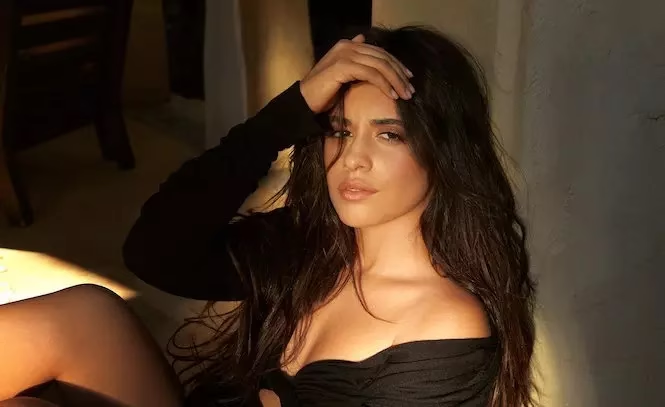
March 3 is always a big day for Camila Cabello, but this year was particularly special. Not only was she celebrating her 25th birthday, she also announced her third album, Familia — a project she called "my whole f***ing heart."
The day after, she teased the LP with a new Ed Sheeran collaboration, "Bam Bam." A lighthearted breakup song with (very specific) lyrics alluding to her recent split from Shawn Mendes, it was easy for fans to assume that Familia would be an album of heartbreak. But upon the album's arrival on April 8, they quickly realized that couldn't be further from the truth.
Sure, there's a few songs touching on that particular split (especially the final track, "everyone at this party"), but for the most part, Familia is a celebration of life — and, most of all, an homage to Cabello's Latina roots.
More than half of the album has Cabello singing in Spanish, and its lyrical themes vary from fiery romance ("Quiet") to crippling anxiety ("psychofreak," a collab with WILLOW). Whatever the topic or sound, each song on Familia is a representation of the fact that Cabello is feeling better than ever.
"I just feel like myself," she tells GRAMMY.com. "[This album process] was a lot more grounded, and I feel like you can hear that in the music — it really is an unfiltered me."
Ahead of Familia's release, Cabello sat down with GRAMMY.com to share how the album helped her find inner peace, how she's grown over the last 10 years, and why the Familia process was the most genuine yet.
You told Zane Lowe that this album was "a tool for me becoming a more well-rounded person." What is it about this music that makes you feel that way?
I think [on] my previous albums, my focus was, "How can I make a great album?" Obviously, I was honest and tried to get to the root of me, and what felt true to me, but there was also a lot of pressure. A lot of what I felt was pressure and anxiety — and not just in the studio. I was just anxious in general, and was having a tough time mentally.
It's like this album was a tool for me feeling better, and for creating real, genuine friendships and connections with my collaborators. It's about being vulnerable.
What felt different about this album compared to your previous releases?
In my previous albums, I felt like I had something to prove. I felt like I wanted to prove that I was a good songwriter, I wanted to prove that I had good ideas. So in the room with other songwriters and producers that I respected, I felt like I just wanted to show them that I was good.
I didn't feel any of that this time around. I was just like, "I don't really care. I'm just going to be myself. I'm going to make choices melodically, lyrically, that feel interesting to me." It was a lot more grounded, and I feel like you can hear that in the music — it really is an unfiltered me. There's no walls of any of that other, like, ego stuff up. So that's why it was the most fun experience, and what I think is my best work so far.
This is the first time you've collaborated with Scott Harris, one of Shawn Mendes' closest collaborators. What do you feel like he brought to your creative process?
I remember voice-memoing him in my house in Miami, he was about to come over and we were gonna just write in my bedroom. We wrote "Quiet" and "Boys Don't Cry" in the first two days [when] it was just me and him.
I told him exactly what I just told you. I was like, "I feel like, in the studio, sometimes I get anxious. I want to prove that I'm good. And I just want to be open and honest." I would journal every day, I would read them out to him, we would talk about it, and then we would write. So it started off with that intention.
Was there a certain song or a session you had for this album — or even something that wasn't even album related — that felt like a turning point for you in getting to a place where you can be that vulnerable?
I think that vulnerability really cemented, and I feel like I really matured as a writer, the day that I made a "psychofreak" with Ricky [Reed] and Scott. [Ricky] had this track — I started doing this thing after working with this artist Remi Wolf, where I would freestyle and word vomit, stream of consciousness into a mic. We weren't even like, "What are we going to write about today? I have this idea for a song." It was just like, "Cool, I love that. Let me see what comes out."
[With] "psychofreak," I felt really, really vulnerable. I felt really icky talking about those things, because they were real anxieties that I had about intimacy, and literally what I was talking through in therapy at that time. To say that, and then leave from the booth and go back into the room, and for my collaborators to be like, "Yeah, this line was really good, talk to us about that" was really hard. It was really hard, and felt embarrassing, and vulnerable.
It was a few days after that I was like, "Oh wow, I just made one of my favorite songs, if not my favorite song ever." That's when I feel like that trust between me and my collaborators was cemented, like I could say anything. And it's really f***ing scary, but it feels good to get that out. It also results in, what I feel, is really good writing. That song was a big turning point.
You feature a variety of artists on Familia, from Ed Sheeran to Maria Becerra to WILLOW. How did you determine the right collaborators for this project?
I mean, I've had the same vision for my collaborators. I was just like, I want to work with other artists, and I don't want it to be like, you know, them over there and they send the files — obviously, sometimes it has to be that way because of schedules and whatever. But for example, Willow came over for "psychofreak" and [we ordered] some delicious vegan food, it was nighttime, we had some shots. It was me, Ricky, her and her friend in my house.
I just was like, I want to connect, I want to hang. I want it to be fun, and fun for everybody. I want it to feel genuine. With Ed, same thing — we're genuinely friends. And Yotuel, he is somebody that my family loves so much, and he is so important to the Cuban community. It didn't feel transactional. It felt very real.
This year marks both the 10 year anniversary of when Fifth Harmony formed, and five years since you officially launched your solo career with "Crying in the Club." When you think back to the Camilla who auditioned for The X Factor 10 years ago, and maybe even the Camila who you were upon going solo, how do you feel like you've grown professionally?
The girl that auditioned for X Factor is actually really similar, in a lot of ways, to who I am now. There was just this passion, vulnerability and excitement that I feel like I kind of regained — and I sometimes lost in the middle.
Writing-wise, so many different influences came together for this album — Sally Rooney, SZA — in my writing style, in my melodic style, and my lyrical style. I feel like I really have come back to what kind of turns me on about my craft, and about songwriting and making music.
How do you feel you've grown personally?
I feel like there was a lot of hard-earned wisdom. I don't have a lot of wisdom, because I'm 25, and I have a lot to learn. Something kind of stupid and silly is, I feel like things that used to make me really nervous don't anymore. And that feels really great. Like [previously] before I would do a performance, I would literally be like, almost fully blacking out [from nerves]. Now I can actually enjoy myself, which is less exhausting.
This album brings in the most Latin influence yet. I figured that probably plays into you feeling so good about this album, but it probably also comes from you being at the place you're at, and feeling so like yourself.
Definitely. I think it's all about finding my way. Honestly, I feel like I kind of lost my way a little bit in the middle of those 10 years.
This [album] has been finding my way back. A big part of that is my roots, and my heritage. I want to spend the most time in Latin America and in Mexico because it just makes me feel like myself. I just feel like myself.
10 Artists Who Have Stood Up For Women In Music: Taylor Swift, Lizzo & More