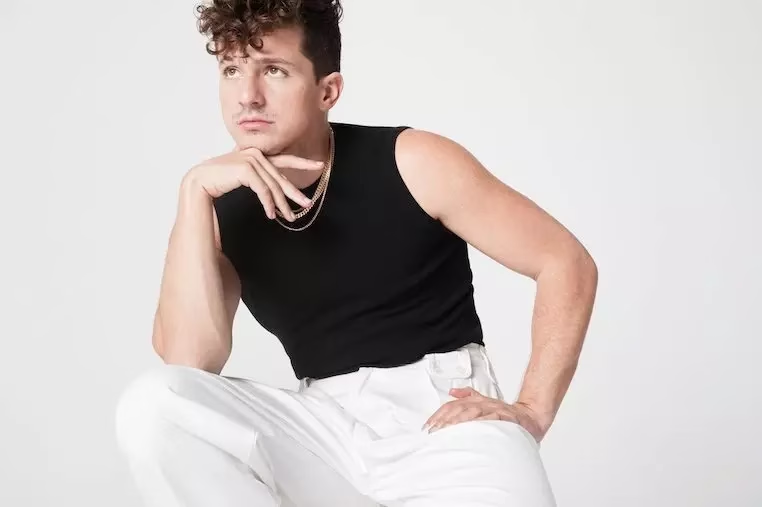
At the end of 2019, Charlie Puth heard the words no artist ever wants to hear: "your music sucked this year." Even worse, they came from Elton John.
Puth had released a trio of one-off singles throughout the year, and his third album — the follow-up to his acclaimed 2017 set, Voicenotes — was in progress. But after John's comment, the New Jersey native shifted gears and took full ownership of the music he was making — and now, he's arguably bigger than he's ever been.
Charlie, Puth's new-and-improved third album, arrived Oct. 7. To say it was a highly anticipated release would be an understatement, specifically in TikTok terms. He teased the track list on the viral video-sharing app two weeks before the album's arrival, and as of press time, that video has 47 million views.
Puth utilized TikTok as a marketing tool for Charlie, but in a way that, as he puts it, "[fans] feel like they wrote the music with me." The singer/producer began letting fans in on his creation process with lead single "Light Switch," in which he cleverly flips the sound of an actual light switch into a romantic metaphor and, more impressively, a catchy beat. That video immediately took off, and Puth began teasing other Charlie tracks as they came together, garnering millions of views on each one.
TikTok and Elton John are two huge pieces of the Charlie puzzle, but certainly not the only ones. As Puth suggests, the album is simply a musical mirror — one that shows he's the happiest he's ever been.
"I don't really think you could assign any particular genre to this album because it's almost chaotic, like my mind is," he explains. "I just tried to make the soundtrack of my own mind."
Puth broke down all of the inspirations behind his third album, and explained why calling Charlie his "most personal album" isn't as cliché as it may sound.
Elton John
He was the wake-up call [that let me know] that I just had to produce the music. It has to be me producing the album.
It's not like I'm opposed to working with other producers. I worked with two other producers when I made "Stay" for [The Kid] LAROI and [Justin] Bieber. But for my music specifically at this point in time, it just made sense.
The last two albums of mine lacked a bit of cohesion. So it was really important that I handled all the instrumentation this time around. I just involved too many people in those couple of songs [in 2019], so I scrapped the project and really tapped into what I was going through and feeling. I put my feelings first.
His Busy Mind
I don't really like talking to people about my problems — I like to try and solve them myself. I believe that I have it within me to figure things out with the help of music. I almost called this album Conversations With Myself for that reason. At the end of the day, I was like, I should just name the songs after myself, because they're my personality to an absolute T.
Like on "When You're Sad I'm Sad," there's these strings and this piano. It's so melodramatic, and it's just like, "Oh, dude, go take a walk." That's very indicative of my personality. And then "Light Switch" [is too, with] the quirkiness of the lyric.
I'm not trying to be the cool guy anymore. I'm trying to show my personality off. So "Light Switch" is that, in a way. It's almost theatrical. I'm very, you know, pizzazz and jazz hands and just hyper — like, I'm drinking three cups of coffee at all times.
"I Don't Think That I Like Her," it's almost like [a] 2022 "Penny Lane." My love of jazz and very rich-sounding, David Foster-like chord progressions are present in that song — and lyrical angst.
I'm basically saying that I'm dramatic and musical. [Laughs.] I'm a theater kid that turned into a pop singer.
@charlieputh I Don’t Think That I Like Her- out this Friday. 🥩
The TikTok Community
I was going through two different types of breakups [when I began writing Charlie]: I had left my original label, [which] felt like a little bit of a breakup business-wise. And romantically, [I was] going through a breakup. Those two things had nothing to do with each other, yet felt so similar — manipulation, and feeling like you constantly need to be in a state of proving yourself.
In a very boring, long-winded explanation, I [since] resigned to my original label. [But at the time], I thought I lost my key person at the label that I would run everything by. I had a little bit of a freak-out thinking I don't know what is good anymore, but I actually had it within me the entire time. That's what I discovered on this album, and kind of why I turned to TikTok — for approval, almost.
I really do live for people's reactions. And what better place to get those reactions than playing music in a live setting? But, you know, [during] the pandemic, we didn't have any live concerts. So I turned to the internet for a new way of performing. [I thought,] This could be an interesting way to have people overly acquainted with the music before it comes out, then they feel like they wrote the music with me.
I used to think I had to act like Prince and not let anybody into my musical world. I flipped the script and let millions of people into my process. That felt exciting to me. Humans are the best recipe for me making a song, and people just happen to be in the mass at one place right now.
When I made "Light Switch," which was the first single off the album, it was so different than records like "Attention" and "One Call Away," that I was still in a state of is this good? So I turned to the internet, and I got a resounding thumbs up by getting, like, 10 million unique plays in one evening. I got a foam finger the size of Dodger Stadium telling me that I could proceed to make that song.
It's not like everything has to have this grandiose reaction for me to have the ability to put it on my album. That's the wrong mentality — any artist should just put out whatever they're feeling. But it's just worked for me.
@charlieputh I’m freaking out wtf just happened….. 💡
Mundane Noises
Another thing that people can take away from listening to this album is that anything can be made into music. Like, the sprinkler that I'm looking at right now that's watering a little portion of dead grass on my lawn, I know that it's making a pitch. I can't hear it right now, but I'm looking at it thinking, What would the instrument be that would be most similar to that sprinkler? That's how my mind works — that's been happening since I was 8 years old — and that's what I did throughout this entire album.
There's a song called "When You're Sad I'm Sad," which is about not being able to leave something that you've become so dependent on. There's a lyric in the second verse that goes, "I can hear the tears in your eyes when you say 'please come and get me.'" I received a call from someone one time where — you know when you can tell that someone's upset about something over [the] phone? When humans cry, there isn't an audible sound that comes out of your eyes, and I just made a mental note of that. When I had the "here" and "tears" rhyme, I just made the entire song — I reverse engineered it.
The Music He Grew Up With
I was influenced by the feelings that me and my friends got when we listened to albums. I remembered the first time my friend played "…Baby One More Time" by Britney Spears in 1999. I was in his basement trading Pokémon cards, and my musical mind wasn't all the way there yet, but I just remember that feeling of warmth and shock — I had never heard anything like it before.
I always remember that feeling of hearing something for the first time — like when I heard "Bad Romance" by Lady Gaga for the first time. Those types of feelings I tried to capture, and I wanted to make my own songs that someone else could listen to and have a similar reaction to.
Simply Having Fun
I found myself through chord changes. I discovered who I was by going to Conway Studios in Hollywood, and documenting the process for millions of people to see. I was putting up a wall before, and now there's no wall. I'm having the most fun I've ever had.
I've always felt like I needed to fill a void. Like, we've got to have the uptempo record or we have to make sure we have a mid-tempo song — I had those little things in the back of my head. I never really put myself first [on previous albums]. This is the first time I'm putting myself first.
I don't really think about music in terms of success. I think of it in terms of "How many people can I affect with my message?" That's what I meant when I said I feel like I'm the "biggest I've ever been" — not from my own ego, but I have more of a reach.
I've hit my most successful peak so far by being myself. If you're truly just yourself, you can be your most successful you.
Oversharing
Everyone has a unique story, and I want [people] to hear one of my songs and be like, "I've never been able to explain this feeling, but Charlie described it perfectly with a little melody attached to it."
I want people to take this album as a whole and know the two different types of so-called breakups that I went through, and know that I am not impervious to normal feelings. I'm just like everyone — I just happen to play the piano and make songs about my feelings.
I aspire to be an artist that can surprise-drop an album like Beyoncé or Taylor [Swift] or Drake, where every song hasn't been heard and everyone is eagerly [waiting] — like the anticipation for Rihanna to follow up her 2016 album. But, you know, I started with wanting people to be excited about two songs. Maybe they'll be excited about a surprise drop from me one day, but for now I'll overshare.