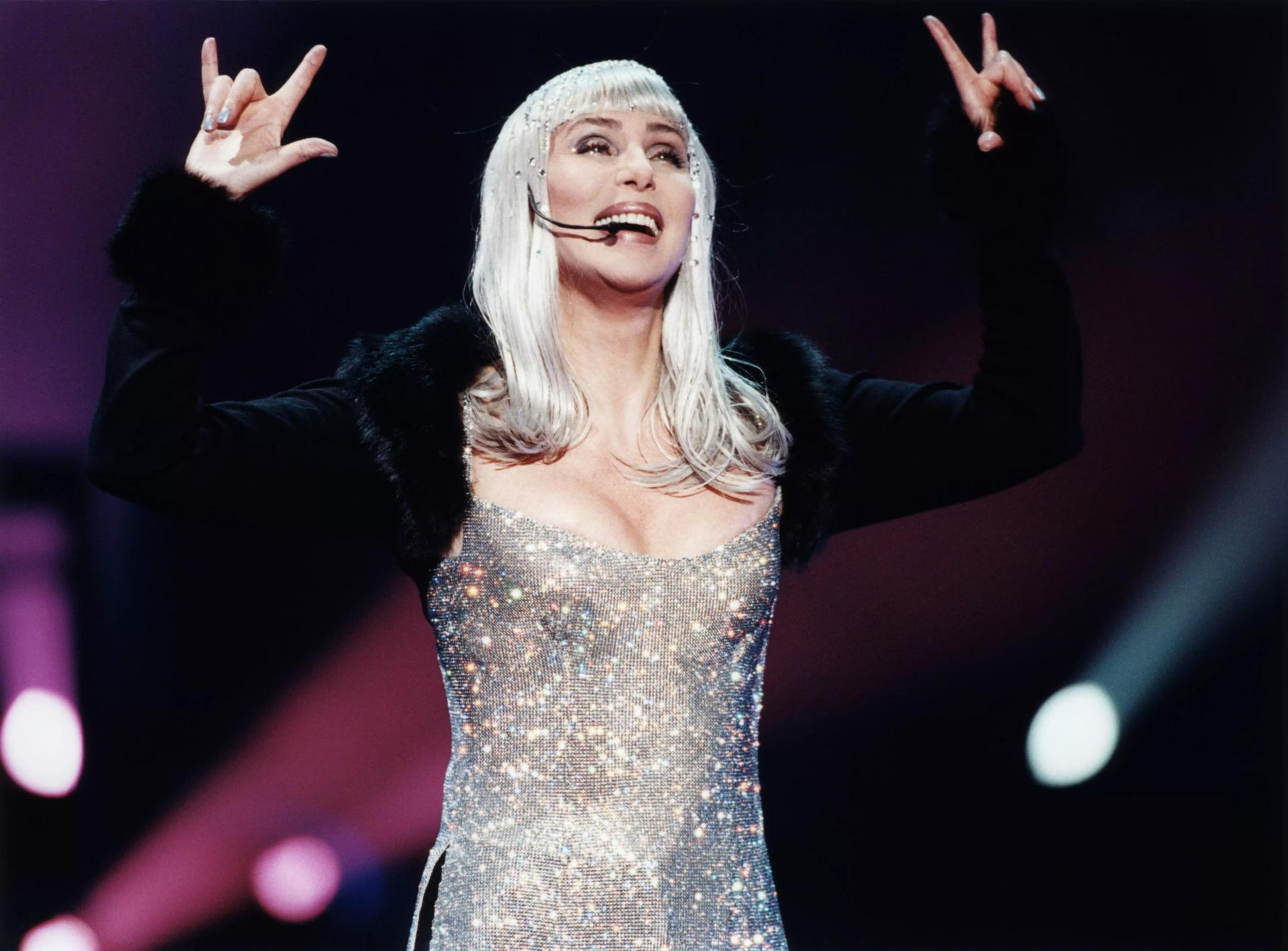
The incomparable Cher had already achieved iconic status long before she dropped the title track from her 22nd studio effort, Believe, at the tail end of 1998. After all, this was an artist who'd forged one of the most successful pop duos of the '60s, scored a record-breaking trio of number ones in the '70s, and reinvented herself as an MTV goddess in the '80s. Not to mention her contributions outside of music: the hit variety shows, Broadway runs, and Hollywood moonlighting — the latter of which saw her win an Oscar.
But the success of "Believe" was still unlike anything else Cher had achieved during her illustrious 35 years in the business. It reached No. 1 in 21 different countries across the globe (including a four-week stint at the top of the Billboard Hot 100 in the U.S.), sold 11 million copies, and cleaned up at everything from the International Dance Music Awards to the Ivor Novellos. For a good 12 months, it was practically impossible to avoid hearing its dance-pop beats, lovelorn lyrics and, of course, that famous robotic vocal effect.
But "Believe" didn't just significantly impact Cher's already glittering career — it also changed the face of pop music as we know it. From inspiring other divas to get their groove on to pioneering a piece of now-ubiquitous studio technique, take a look at 10 ways "Believe" impacted pop.
It Smashed Multiple Chart Records
It would almost be quicker to list which chart records "Believe" didn't completely obliterate. The song spent 21 weeks atop Billboard's Hot Dance Singles Sales, and was still in the Top 10 a full year later. It was also crowned the year-end No. 1 on both the Dance Club Songs and Hot 100 charts. And it produced the longest-ever gap between chart-toppers on the latter — 33 years and seven months, to be exact — as Cher's first No. 1 on the chart came in 1965 with her Sonny Bono duet "I Got You Babe."
"Believe" was just as successful across the pond, beating George Michael, U2, Culture Club, and Alanis Morisette in a famous five-way battle for No. 1. And with 1.8 million copies sold, it's still the U.K.'s highest-selling single by a female performer.
It Inspired Several Divas To Dance
Cher had initially resisted Warner UK label boss Rob Dickins' idea to pursue a dance direction, reportedly arguing that the genre wasn't conducive to "real songs." It's unlikely many of her peers took much persuading, however, after witnessing the monumental success of "Believe."
In fact, pretty much every pop diva on the other side of 50 seemed to take to the dance floor over the following 12 months: see Diana Ross' "Not Over You Yet," Tina Turner's "When the Heartache Is Over," and Donna Summer's "I Will Go With You (Con Te Partiro)." Madonna (Confessions on a Dancefloor), Kylie Minogue (Tension), and Cyndi Lauper (Bring Ya to the Brink) have all since proved middle age and dance music needn't be mutually exclusive terms with entire albums tailor-made for the clubs.
It Finally Gave Cher A Grammy
It seems hard to believe that Cher had to wait until the turn of the millennium to pick up her first GRAMMY. The pop veteran had previously been nominated alongside then-husband Sonny Bono in the Best New Artist category in 1966. The pair also received a nod in the Best Pop Performance by a Duo or Group in 1972 for "All I Ever Need Is You," the same year Cher was recognized as a solo artist with a Best Female Pop Vocal Performance nomination for "Gypsys, Tramps and Thieves." But on all three occasions, Cher went home empty-handed.
The star finally emerged victorious in 2000, however, when "Believe" won Best Dance Recording. (The song and same-named parent LP had picked up nods for Record of the Year and Best Pop Vocal Album, respectively, too). Peter Rauhofer was also crowned Best Remixer of the Year for his work on the track under the guise of Club 69.
It Paved The Way For An Exciting '00s Hit Factory
Nine different people, including Cher herself, are given songwriting/production credits on "Believe." But the most interesting behind-the-scenes name is Brian Higgins, the man who penned an early version of the track a full eight years before it was released. A virtual unknown when the finished product finally arrived, Higgins would go on to shape the following decade of British pop music thanks to his pioneering work as part of the production powerhouse known as Xenomania.
Best-known for guiding the career of their ultimate muses, Girls Aloud, the team also carved out weird and wonderful singles for Sugababes, The Saturdays, and Alesha Dixon.Pet Shop Boys, Kylie Minogue, and Saint Etienne were just a few of the more established names who turned to Xenomania for hit-making assistance, too.
It Made Cher Relevant Again
Cher looked to have been consigned to heritage act status before "Believe" came to the rescue. She'd only scored one U.S. Top 10 hit in the 1990s ("Just Like Jesse James") and that was at the very start of the decade; her last studio effort, covers album It's A Man's World, had peaked at a lowly No. 64 on the Billboard 200. But Cher isn't known as a comeback queen for nothing. The Believe campaign not only saved her from the musical wilderness, but it also kickstarted the most consistent, if undoubtedly sporadic, chapter of her career.
Indeed, although "Strong Enough" and "Song for the Lonely" are her only Hot 100 entries since (No. 57 and 85, respectively), 2001's Living Proof, 2013's Closer to the Truth, and 2018's ABBA tribute Dancing Queen have all reached the top 10 of the Billboard 200. And while Cher was always a powerful live draw, the Believe era took things to new heights: 2002's long-running (and misleadingly-named) The Farewell Tour, grossed $200 million across a whopping 325 dates to become the highest-grossing concert series by a female artist at the time.
It Proved Age Ain't Nothin' But A Number
Bette Midler, Aretha Franklin, and Tina Turner had all previously reached the top of the Hot 100 in their forties. But no female artist had ever achieved such a feat until "Believe" came along. Cher was aged 52 years and nine months when the dance-pop anthem took her number one tally to four in March 1999. And while the annual return of "All I Want for Christmas Is You" saw a 53-year-old Mariah Carey surpass this milestone in 2022, Cher can still lay claim to being the oldest chart-topping woman with a newly released song.
The star will have to score a fifth, however, if she's to break the all-time record: Louis Armstrong was three months shy of his 63rd birthday when he knocked The Beatles off pole position with 1963's "Hello Dolly."
It Introduced The World To Auto-Tune
According to Pitchfork, a remarkable 99 percent of all contemporary pop music utilizes the pitch-altering recording technique known as Auto-Tune. And that's pretty much all down to The Cher Effect. Although designed to subtly correct a wayward vocal, the producers of "Believe" decided to make it blatantly obvious that studio trickery had been at play, transforming one of pop's most easily identifiable voices into that of a wobbly android.
Cher had to fight to keep the song's unique selling point, telling unconvinced label bosses they'd have to remove it "over my dead body." And her instinct proved to be right. The pioneering use of Auto-Tune was undoubtedly the catalyst for the song's phenomenal success, ultimately paving the way for everyone fromLil Wayne andT-Pain toDaft Punk andBlack Eyed Peas.
It Became A Pop Culture Fixture
You know a song has entered the nation's consciousness when it's been parodied by Matt Stone and Trey Parker. But South Park's incomprehensible version of "Believe," which appeared in season 3 episode "Two Guys Naked in a Hot Tub," isn't the only way in which the chart-topper has permeated pop culture over the past 25 years.
It was also given the spoof treatment by MADtv, has become a lip-sync battle regular, and featured in the star-studded medley in Eurovision: The Story of Fire Saga. More recently, it was mashed up with "The Muffin Man" by Adam Lambert for a That's My Jam performance that went viral.
It Brought Back Crying At The Disco
Cher had asked many questions through the medium of pop during her illustrious career: "Am I Blue?" "Does Anybody Really Fall in Love Anymore?" "How Can You Mend a Broken Heart?" But it was undoubtedly "Believe" on which she posed her most pressing. "Do you believe in life after love?," she sings in the famously Auto-Tuned chorus, a clever turn of phrase which set the song up as the '90s answer to "I Will Survive"; follow-up single "Strong Enough" would go even further by essentially borrowing its string section.
The "crying at the disco" anthem had largely fallen out of favor since Gloria Gaynor's heyday. But "Believe" proved once again it was possible to pour your heart out and throw some shapes at the same time. Robyn ("Dancing On My Own"), Pussycat Dolls ("Hush, Hush"), and Madonna ("Sorry") are just a few of the artists who appeared to be taking note.
It's Become A Part Of The Modern American Songbook
What do tween collective Kidz Bop, punk rock supergroup Me First and the Gimme Gimmes, and Swedish synth-pop songstress Anna of the North all have in common? They've all put their own spin on the dance-pop masterpiece that is Cher's "Believe." And they're not the only ones, either.
In 2023, DMA's rendition wascrowned the all-time best cover to emerge from Aussie radio station Triple J's feature Like a Version.Manchester Orchestra,Lucy Dacus, and Jessie Ware have all interpreted the smash hit in their own distinctive ways over the past 18 months, too. And it's become a talent show staple thanks to ballad versions by the likes ofAdam Lambert,Jeffery Austin, andSheldon Riley. Should the Great American Songbook ever get modernized, then "Believe" is a shoo-in.