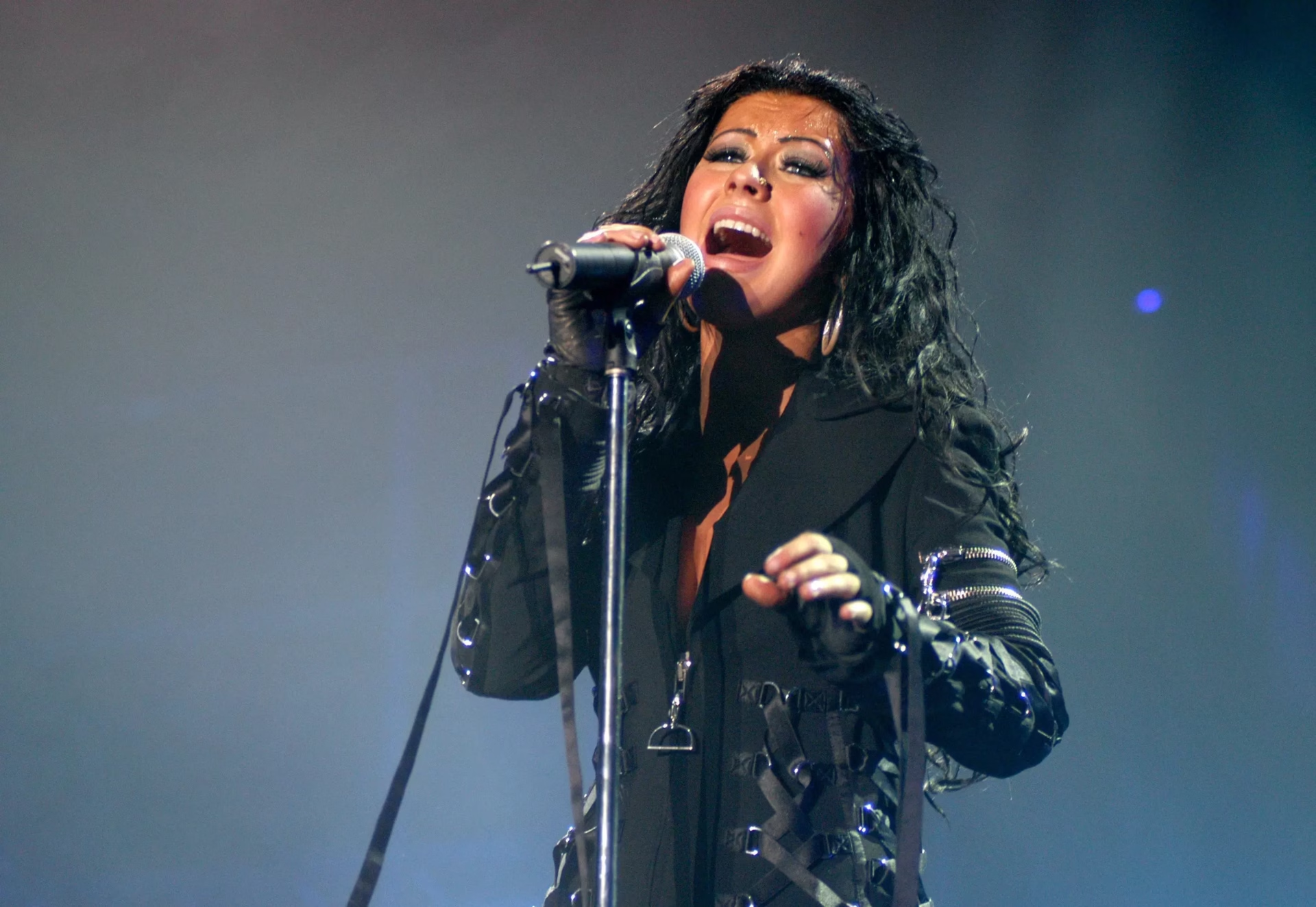
When Christina Aguilera began working on her second album, Stripped, she had what every pop star dreams of: multiple No. 1 hits, a No. 1 album, a headlining tour. But she was unhappy, and Linda Perry could see that when they got in the studio together.
Perry is the sole songwriter/producer of "Beautiful," which is not only one of Aguilera's biggest hits to date, but one of the biggest self-acceptance anthems of her generation. And though Aguilera didn't write the song, she knew it fit perfectly within the narrative of Stripped.
"I'd always been given a schedule, and an agenda, and told the places I need to go, how I needed to dress," Aguilera says. "It was a machine, and at that point in my life… I just felt like there was so much inside of me that I didn't get to say and that I wasn't able to share, and I wanted to connect deeply with my fans."
That's the urgency — and also, the insecurity — that made Perry realize Aguilera was the perfect singer for the "Beautiful" narrative. And that's likely why "Beautiful" has connected so widely for so long: it's as authentic as songs come.
"Beautiful" was released as a single on Nov. 16, 2002, and quickly became a touted part of her discography. Along with topping multiple charts, the track earned Aguilera both a GLAAD Media Award in 2003 and a GRAMMY for Best Female Pop Vocal Performance in 2004. Twenty years later, "Beautiful" still serves as an anthem for anyone struggling with self-acceptance — one that has arguably become more meaningful than ever.
As the song celebrates its 20th anniversary, GRAMMY.com spoke with Aguilera, video director Jonas Akerlund, GLAAD's Anthony Allen Ramos and Trans Lifeline's Myles Markham about the impact of "Beautiful" and why its message is still important today.
"It really did change my whole concept of what 'Beautiful' really meant."
Perry was very protective of "Beautiful" because of the importance of its message. She had previously previewed the song to Pink for the Missundaztood sessions, however, ultimately decided to keep it for herself. And as Perry told American Songwriter in 2021, she initially didn't see Aguilera as a fit for the song when they first met at Perry's home studio.
"I was just thinking, I'm looking at this hot chick, that's got everything going on, at least that's what you think, and she's wanting this song about singing about being beautiful? How vain is that?" Perry said.
Even so, she let Aguilera record a demo. Just before they got started, Aguilera told a friend who was in the studio with her, "don't look at me" — and that changed everything. "I realized this beautiful girl, that's riding high on the charts, everybody knows her, is just as insecure as I am," Perry recalled. "It really did change my whole concept of what 'Beautiful' really meant."
As Aguilera admits herself, she was "feeling a lot of things" on that fateful demo day, but Perry helped her dig into those feelings and ultimately realize that it was okay to not feel perfect.
"[Linda] really did an amazing job at breaking me free of that mental pressure that we all can have in striving for our best possible selves," Aguilera says, "and embracing the vulnerability in the fact that what we do might not be perfect, but in actuality, it is, and it makes us unique."
The song's recording holds true to that sentiment, as the demo version was what was released — complete with the "don't look at me" at the beginning.
"I never would have even kept the vocal that was on there," Aguilera says, "but [Linda] really pushed me to do so. I didn't punch into it and perfect it in any way, and I had kept things on it I would never normally live with. But I did embrace the honesty of it, because it was the sentiment of the song — to really tap into what you feel insecure about. But in all actuality, it's the flaws and seemingly the imperfections that are super rare and beautiful."
"The video for 'Beautiful' did a really unique thing for the time and genre."
The official music video for "Beautiful" premiered a few weeks after the song was released as a single. The four-minute clip sees Aguilera huddled in the corner of an empty home, her solitude his juxtaposed with clips of people feeling a similar sense of disconnect via body dysmorphia, gender non-conformity, same-sex relationships, and racial suppression.
While sexual fluidity and gender non-conformity weren't necessarily new phenomenons within pop visuals — take Madonna's videos like "Justify My Love," or George Michael's video for "Outside," which recreated his arrest for soliciting sex from an undercover cop — it did mark a first for Aguilera's generation of pop stars. Britney Spears' "Overprotected" and *NSYNC's "Pop" contained similar themes of feeling overwhelmed by everyday life and wanting to break free from other people's expectations, but until that point, none of Aguilera's peers had a song or video that fought society's expectations quite like "Beautiful."
"Back then, music videos were all about selling albums," Jonas Akerlund, who directed the "Beautiful" video, says. "Nobody gave a s— about a message. So the fact that Christina and a few other artists actually brought attention to something more than just an artist singing a song was amazing. And that suited me, because I always wanted to make an impact with my videos. I love her for that, and I'm proud I was a part of that."
"The video for 'Beautiful' did a really unique thing for the time and genre, and that was to break down the binary between things like disgust and desire, self love and self hatred," Myles Markham, Development Coordinator for Trans Lifeline, adds. "[It] really opened up a conversation of what it could mean to be yourself against the expectations and pressures of a patriarchal society."
"It was such an important part of who I was becoming as an artist and who I was as a person."
The song's self-acceptance message, as well as the LGTBQ+ representation in its video, earned Aguilera the Special Recognition award at the 2003 GLAAD Media Awards. "Beautiful" has become an unofficial anthem for the LGBTQ+ community, in part because it "explored gender expression in a time when this type of representation was rare," as GLAAD's Vice President of Communications & Talent Anthony Allen Ramos suggests.
In her acceptance speech at the GLAAD Media Awards, Aguilera implied that the impact of "Beautiful" was exactly what she hoped. "This song is definitely a universal message that everybody can relate to — anyone that's been discriminated against or unaccepted, unappreciated or disrespected just because of who you are," she said. "It was so important to me that I support the gay community in this sense."
For Aguilera, the Stripped era was all about getting a message across and freeing herself of the narratives and comparisons that were forced upon her. While the album was liberating for Aguilera herself, she wanted to make an impact on others who were dealing with similar feelings. Most importantly, she wanted to be raw and honest, through both her lyrics and her visuals — and "Beautiful" did just that.
"Jonas came through sharing such a heartfelt sentiment of honesty, and not just making it stereotypically beautiful," she says. "Bringing up really hard conversations and instilling hope was such an important part of who I was becoming as an artist and who I was as a person."
To this day, Akerlund says he still has people thanking him for making the "Beautiful" video and sharing stories as to why the video was impactful to them. He also proudly keeps a collection of fan letters he's received over the years.
"I'm from Sweden, and back then, I didn't really understand what an impact these kinds of [videos] could have," Akerlund says. "I thought it felt like the most natural thing to incorporate all these elements into the story [of 'Beautiful']. I didn't really think too much about it, but it was amazing to see the reactions."
"It's the same universal message in all parts of the world."
On the 20th anniversary of Stripped this October, Aguilera shared a new video for "Beautiful" — a "2022 version," which touched on the ways technology has infiltrated society, particularly how it has affected younger generations. At the heart, many of the themes in the original video are mirrored in the new visual — body dysmorphia, mental health issues, and unrealistic beauty standards. All the while, their internal struggles are magnified as their lives are on display via social media.
"The original 'Beautiful 'video set out to bring awareness and a sense of compassion in the face of judgment, criticism, and outside opinions," Aguilera wrote in an Instagram post upon the release of the 2022 Version. "It still carries an important message to remember our core values outside of what's being fed to us…to find a sense of balance and accepting ourselves for who we are."
"Beautiful" remains one of Aguilera's signature songs and a staple in her setlist. She says she still feels a sense of pride seeing fans sing the song back to her at her concerts, especially those who bring their kids "to the table and the conversation."
The song's message remains evergreen and intersectional. From its raw, unedited vocals, to the forlorn piano chords, to its groundbreaking video, "Beautiful" encapsulates the feelings of loneliness many people felt in a time when gay rights were still in limbo, and before conversations surrounding mental health became table topics.
"Beautiful" continues to help people find comfort, and reminds listeners that outside forces, as Aguilera sings, "won't bring us down." That lasting connection is what Aguilera loves most.
"To be able to perform ["Beautiful"] on stage and see people of so many different ages and walks of life — and to know that it represents something very different for each person, but in actuality, it's the same universal message in all parts of the world — it's just really beautiful to see that in person, in real time," Aguilera says. "To know that it meant so much to so many people is just the greatest reward, ever."
'Spiceworld' At 25: How The Spice Girls' Feminine Enthusiasm & Camp Became A Beacon For Queer Youth