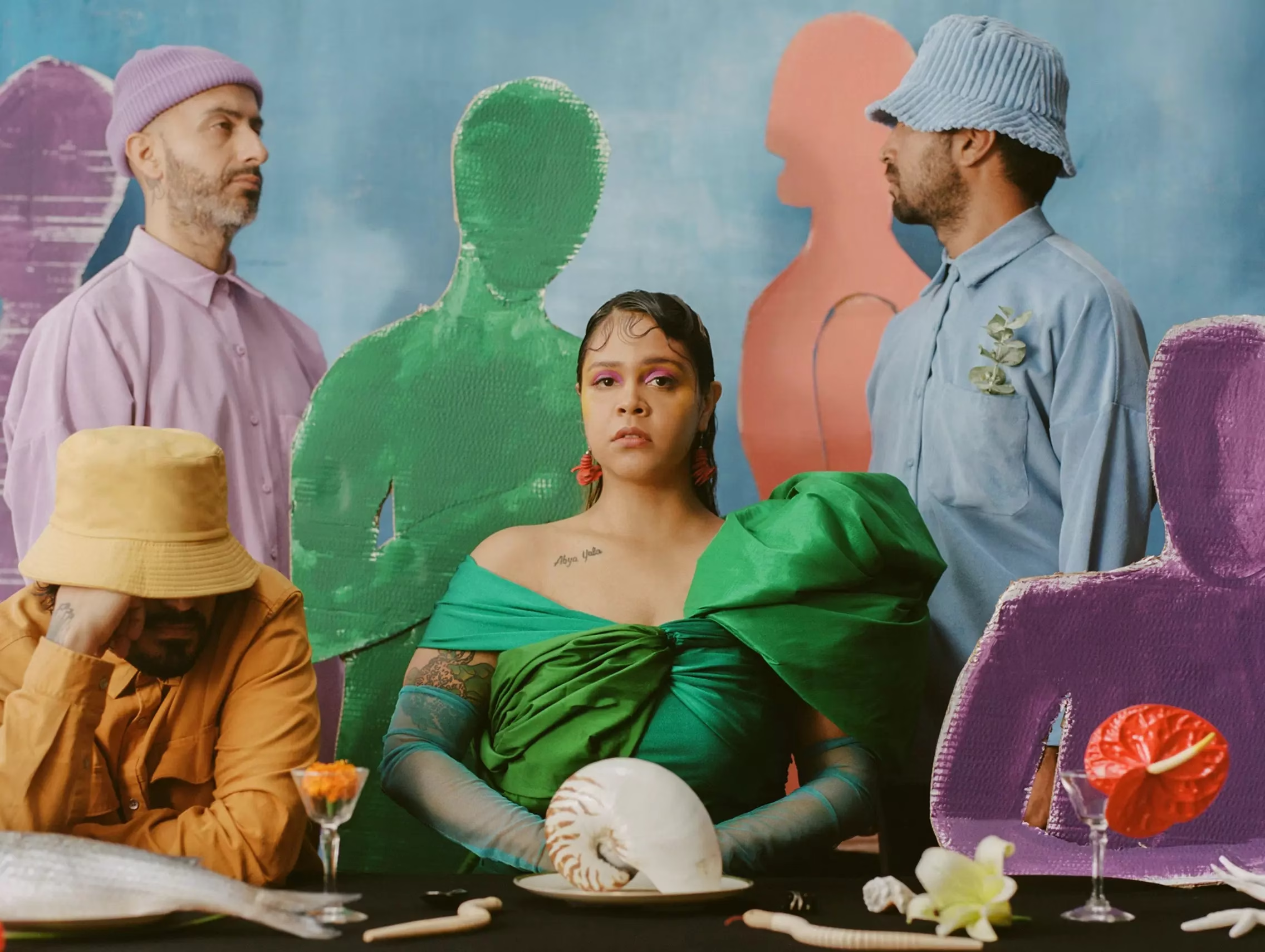
Combo Cimbita is a mystically tinged melting pot of musical influences. A quartet of Colombian musicians who met in New York, Combo Chimbita combines soulful Afro-Caribbean beats, hazy psychedelic moods, a touch of funk and the soaring, chant-like vocalizing of lead singer Carolina Oliveros
Their latest album, IRÉ — out on Anti- on January 28 — overflows with passion, crisp sonics and shimmering textures. IRÉ is ambitious in its sociopolitical scope, more expansive and lush than anything this idiosyncratic band has done before, it is the first great Latin album of 2022.
Oliveros and guitarist Niño Lento es Fuego spoke with the Recording Academy about the nomadic making of IRÉ, their love of opera and heavy metal, and their desert island records.
Your music is seeped in a stark, deep mysticism. How do you generate that energy so effortlessly?
Niño Lento Es Fuego: I’d like to be able to explain it, but honestly I can’t. It’s something that we don’t control. Originally, the name of our band wanted to evoke the format of tropical combos in salsa and other Afro-Caribbean formats. That was our initial objective, but then the music decided to follow a different direction. It informed and guided us, and every album ended up being a mystical journey. IRÉ references a sign in santería. Ahomale (2019) was about a mystical character we created. Abya Yala (2017) was about the running of jaguars. If you follow the albums in chronological order, you will discover a story that’s being told. They’re all connected.
Carolina: I think life makes you express yourself in a particular way. Your experiences, everything that you eat, hear and see. Our mystique was created in an organic way, [with] each member of the band putting their own experiences on the table. Nothing was forced. We let ourselves go, as we became conscious of a collective vibration. The flavors, colors and sounds that emerged naturally from within. This mysticism promotes a vulnerable curiosity, an ambiguity that motivates us to question everything around us.
The current sound of Combo Chimbita is fully formed and incredibly sophisticated. What were your musical beginnings like?
Carolina: I grew up in a big family in Barranquilla, on the Caribbean coast of Colombia. Because it’s a harbor city, a lot of different genres kept pouring in, and the culture of the big sound systems was ever present. There was a lot of salsa, cumbia and vallenato. My mother and grandfather were guilty of my infatuation with the arts — when I was very little, my grandfather would sit me down and sing boleros and rancheras. When the power went off and there was no light in the house, my mother would rock me and sing her favorite baladas. The memories remain.
I was attracted to painting and my family offered their full support: they bought huge easels, canvases and paints. It was my passion, but when I graduated from high school we had no money for college, so I spent a couple of years doing nothing. I listened to a lot of heavy metal — black metal, gothic stuff — and when I practiced capoeira for a couple of years, I developed an interest in the process of music making. So I finally went to art school and studied opera singing. At the same time, I became the lead singer with a goth-metal band. So I was studying opera during the day while being onstage with a band for the first time.
After graduation, I moved to New York and devoted myself full time to my craft, finding fellow artists who connected with my ideas. Music has always been present in my family, but I was the first one who took the risk of turning it into a profession.
Niño Lento Es Fuego: I’m from Bogota, just like [drummer] Dilemastronauta and [bassist] Prince of Queens. I grew up exposed to a lot of tropical music and the Joan Manuel Serrat records that my father played at home, but my friends and I were heavily into the Colombian punk scene.
Then I migrated to Queens, where I met some of my bandmates. We started collecting vinyl and cassettes, and found ourselves immersed in the salsa, Haitian and Jamaican music scenes that permeate the city. The free concerts around New York — like seeing Femi Kuti live before knowing who he was — had a deep influence. We also traveled to Cape Verde, found people collecting cumbia records over there, explored some of the musical connections between Africa and the Caribbean.
I’m also a percussionist, so I can play a bit of bullerengue and traditional music. All those influences mixed up together make the band’s DNA — I believe our shared experience as migrants makes it easier when it comes to identifying the musical connections.
There’s a strong element of psychedelia in many of your songs. Is Chimbita a psychedelic band?
Niño Lento Es Fuego: It was never our intention. Perhaps because we use synthesizers and electric guitars, and we experiment with sound, people may think that. Afro-Caribbean music has some crazy synths, and Peruvian chicha uses the guitar in a very particular way. More than psychedelia per se, our music evokes the use of those instruments in that context. Also our lyrics speak of dreams and cosmovisions — definitely not earthy stuff.
The making of IRÉ and its beautiful videos involved a lot of traveling. How did you decide on Puerto Rico and Colombia?
Niño Lento Es Fuego: On our last album, we did some videos in Puerto Rico and even played a concert there — a joyous experience. When the pandemic started, ANTI-, our label, suggested we release a single. Everything was shut down at the time, and we were meeting once a week at public parks just to talk about future projects. We quickly decided that we wanted to make a full album instead of one single, and also work with local people in Puerto Rico. It was like an escape for us.
First we spent two weeks in Arecibo, quarantined together in a house by the sea. We wrote 12 songs there, and then moved to Spectra Recording in Aguadilla — the home studio of producer Habish Rosario, who is now part of our creative family.
Carolina: We connected with Puerto Rico in such a magical way. I think any band would love the privilege to spend a month on the island, having a house to ourselves and writing an album with the tranquility of being entirely free from any pressure. We looked for this opportunity in the middle of the pandemic, when we realized that the only alternative was moving to a place where we could be distant and safe, but at the same time connected as a band. Puerto Rico opened that door for us, and it was surreal to wake up every morning listening to the sounds of the sea, the birds and the iguanas. All of this is reflected in the album, which understandably is very different from the previous ones.
Niño Lento Es Fuego: ANTI- wanted us to make some videos, so in May we went to shoot in Cali, Colombia. On April 28, a huge political turmoil had erupted, and we arrived in the middle of it. I had never seen Colombia like that. Young people, the Afro and indigenous communities were demonstrating on the streets in complete harmony. The spirit of solidarity was palpable in the air. This energy ended up being part of the four videos we made during that trip.
Carolina: Colombia was a challenge, because for a while it looked like we weren’t going to be able to come through. When we planned the trip, none of the demonstrations had happened. We postponed for a week and then decided to go anyway. Shooting those videos was much more meaningful because of that. It’s always awesome to connect with our homeland. There are artists doing some incredible work over there.
Since your music encompasses such a wide array of influences, I need to ask: which three albums would you take with you to the proverbial desert island?
Niño Lento Es Fuego: That’s the most difficult question [laughs.] First I’d have to mention La Pestilencia — the hardcore punk band from Medellín — and their 1989 debut, La Muerte... Un compromiso de todos. Another amazing album is Canción Animal, the 1990 classic by Argentine rock band Soda Stereo. The third one would be from Colombia: Batata y su Rumba Palenquera — an amazing record.
Carolina: Tough question. First I would have to mention one of my idols: Puerto Rican salsa singer Ismael Rivera. His compilation Maelo... El Único is great. Sango’s 2020 album SANGOZINHO has had a great influence on all of us as a band. A Mulher Do Fim Do Mundo, the 2015 session by legendary Brazilian singer Elza Soares showed me that I’m not as crazy as I thought when it comes to taking big risks on my vocal performances. Finally, there’s always a song by Cape Verdean band Bulimundo in my playlist. Same applies for folk group Canalón de Timbiquí and their 2019 release De Mar Y Río. There are so many great albums out there.