Music can be a salve, a companion, a fount of euphoria. But is that enough? It gave brilliant and complicated souls like Scott Weiland, Chester Bennington and Chris Cornell a tether to the world and cemented them in history, but their inner struggles nonetheless claimed them.
That's where MusiCares comes in, and why Dave Navarro — who knew all three of those rock legends — works with them. Together, they pull music colleagues out of the maw of addiction, depression and other menaces. Navarro wouldn't be able to access that storehouse of healing, though, without a liberal helping of gratitude.a
"Billy comically brought up show 47 on a world tour, and I know what he means by that," the six-time GRAMMY nominee tells MusiCares — referring to musician, producer and Billy Idol sideman Billy Morrison, who's dragging on a cigarette in the next Zoom window. "That's when you're just kind of in the trenches and the doldrums of it all."
Gavin Rossdale at Above Ground 2019. Photo: Jim Donnelly
When Navarro feels unmoored, he looks at a taped message on his pedalboard: "You get to do this." "I need little reminders for myself of just how much I have to be grateful for," he says in a nimbus of vape smoke. "But I'll tell you one thing: when we do the Above Ground shows, I don't have to read that thing one time. because that transformative magic is happening live on stage."
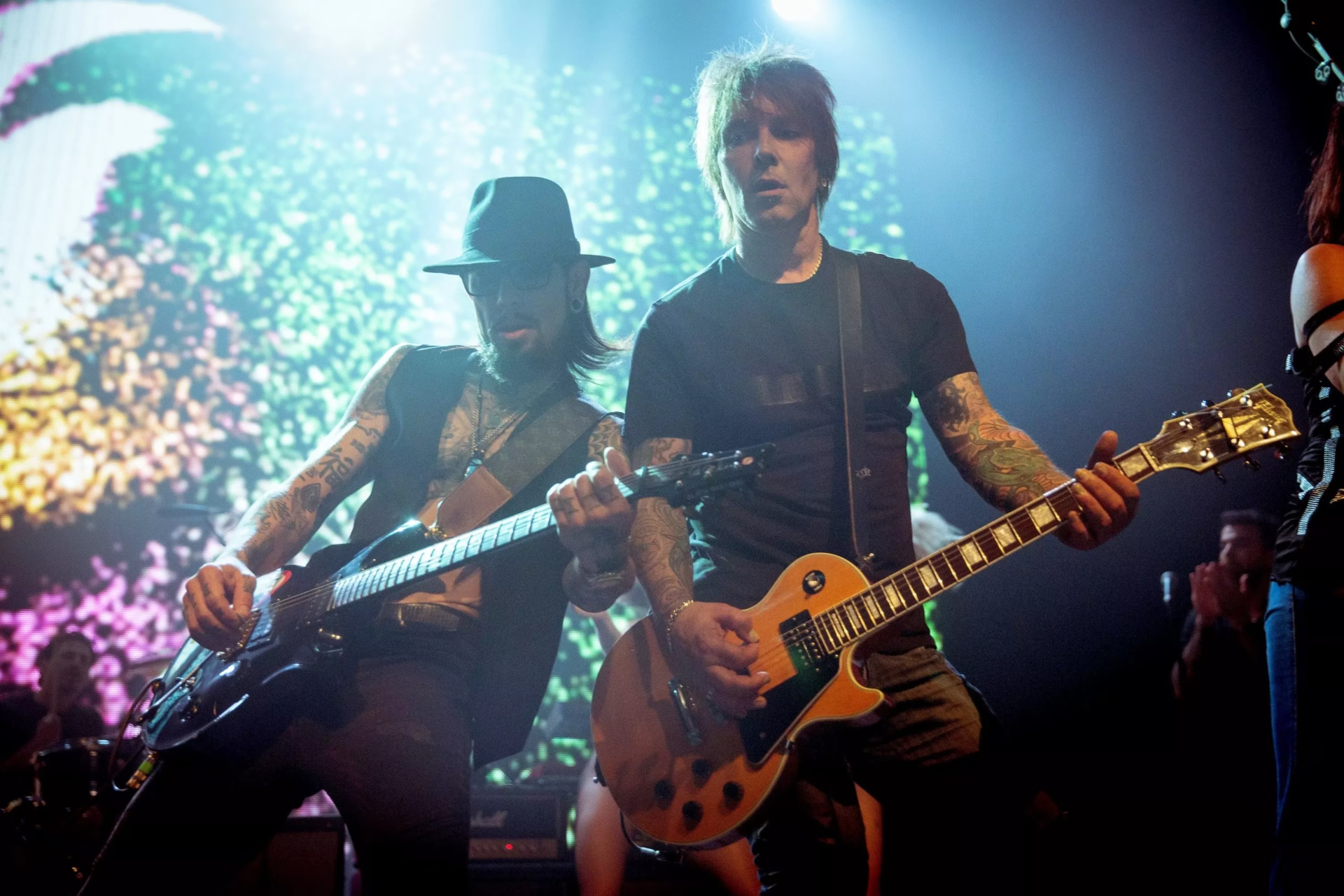
That magic is about to transpire again. On Dec. 20, Navarro and Morrison will bring their annual Above Ground concert back to Hollywood's Fonda Theater for a third round (they had to skip last year amid the pandemic). The premise is that they corrall famous friends to cover albums in full — this time around, it's Lou Reed's Transformer andthe Sex Pistols' Never Mind the Bollocks, with Corey Taylor, Perry Ferrell and more. Purchase tickets here.
Navarro and Morrison caught up with GRAMMY.com to discuss the origins of Above Ground, the joys of digging into classic LPs in full and the central message of their work: it's OK to ask for help.
<style>.embed-container { position: relative; padding-bottom: 56.25%; height: 0; overflow: hidden; max-width: 100%; } .embed-container iframe, .embed-container object, .embed-container embed { position: absolute; top: 0; left: 0; width: 100%; height: 100%; }</style><div class='embed-container'><iframe src='https://www.youtube.com/embed//jbhDFjPbud4' frameborder='0' allowfullscreen></iframe></div>
This interview has been edited for clarity.
What can we expect from the third Above Ground concert?
Billy Morrison: Look, Above Ground started like everything Dave and I start — with a conversation on a plane based around our mutual love of Adam and the Ants. We were just larking around, going, "Wouldn't it be cool if we could play that album?
In that same month or six-week period, we lost Chester. We lost…
Dave Navarro: Chris.
Morrison: Chris. And we recently lost Scott Weiland. And Dave has been very, very much a mental health advocate for a long while now, dealing with his own traumas.
Dave Navarro: What are you talking about?
Morrison: What? Your own trauma. The stuff you tweet about!
Navarro: [Scoffs jokingly.] I don't have Twitter! Twitter, that archaic device?
Morrison: You know what I mean!
Navarro: Wasn't that, like, 2007? Anyway, go ahead.
Morrison: He was spearheading mental health awareness. We've both been connected with musicians who also are huge figureheads of mental health and suicide prevention. And it just came: "Why don't we do this annual event where we get the joy of picking two iconic albums that you can't hear [live, in full] anymore?"
The idea is, you go to a concert and you get the top three songs off of each album. And we've been very pure about picking albums and playing the whole thing. Even the strange left-of-center tracks that are often on albums.
That turned into Above Ground one, and Above Ground three is just the natural extension of that minus a year because of COVID.
<style>.embed-container { position: relative; padding-bottom: 56.25%; height: 0; overflow: hidden; max-width: 100%; } .embed-container iframe, .embed-container object, .embed-container embed { position: absolute; top: 0; left: 0; width: 100%; height: 100%; }</style><div class='embed-container'><iframe src='https://www.youtube.com/embed//abLitpdW59s' frameborder='0' allowfullscreen></iframe></div>
Navarro: Billy and I play in a band called Royal Machines, and we also had a band called Camp Freddy. Both bands are essentially the same band. And Royal Machines is a group of musicians who love playing music, who loved the songs they grew up on.
We play those songs, and we have a special guest per song. We have a different singer every couple of songs, who comes out and does a song with us. Or, a great guitar player comes out and plays.
I think we've been doing that for — what, 20 years?
Morrison: Yeah, 20 years now.
Navarro: So Above Ground was an extension of that, in a way, because we kept the same model of having friends and musicians — players that we would love to reach out to.
Some of them say yes; some of them say no. But we collect as many people that we can find interested in the event and just throw a big celebration of the music that we all loved.
In Royal Machines, it's usually a song or two from a band, but they're hits, because you want to keep the house moving. You want to keep the party moving. So it's hit, hit, hit, hit, hit.
And Billy's right. We were talking about our love for Adam and the Ants' Kings of the Wild Frontier. That's one of the first records that took me a little bit out of the heavy metal genre and into the post-punk genre, if you will. And then I went backward, did my research and that was my conduit to all things goth, all things punk.
Billy being from England and having a huge understanding of the genius of Adam and knowing our shared love of Adam, I called him one day and said, "Wouldn't it be wild to play the entire album with two drummers all the way through and learn every single nuance on that thing?"
We got into it, and it was a mindf*** in terms of what those guys were actually playing and learning those songs and doing them correctly. But we did, we got together, we did that. And we also chose — this is for Above Ground one — The Velvet Underground & Nico. Which was also a monumental album to try and deconstruct and break into and figure out what's going on.
So, apart from the mental health aspect, one of the things we love in addition to raising funds and awareness is having the ability to get into these records and pull them apart and look under the hood. We become better players as a result of it.
Morrison: Oh my god. The tonality of some of the instrumentation on all the albums we've chosen is so left-of-center to where Dave and I both usually are.
When he stands on stage with Jane's Addiction, he sounds like Dave Navarro. And I stand on stage with Billy Idol and I have my Billy Morrison chunk tone. The joy for me is: Dave comes over to my studio and we are listening to guitar tones on little tiny parts that are in the right speaker and going, "OK, you use this guitar through this amp and just do this."
We take recreating in the albums very seriously to the point where, this year, we have a three-piece horn section. We have strings; we have a keyboard player. I mean, we will get whatever we need to do to totally recreate the record.
Which I think, sets [us apart]. No offense to cover bands; I'm in one of the biggest cover bands in the world. But this is more than a cover band.
<style>.embed-container { position: relative; padding-bottom: 56.25%; height: 0; overflow: hidden; max-width: 100%; } .embed-container iframe, .embed-container object, .embed-container embed { position: absolute; top: 0; left: 0; width: 100%; height: 100%; }</style><div class='embed-container'><iframe src='https://www.youtube.com/embed//Wcj4U0DohPk' frameborder='0' allowfullscreen></iframe></div>
Navarro: It's an extension. But it made perfect sense for Billy and me to team up on this because we've been doing covers for so long. The idea of getting into the entire vinyl LP front-to-back is an experience that has been lost in the worldwide culture at this point. We wanted to celebrate that as well.
So that's why we do two albums that are very opposing and contradictory yet fit together very well in the same way. Kind of like a Kubrick film in terms of how we select our albums. So this year you're getting Lou Reed's Transformer and you're getting Never Mind the Bollocks, Here's the Sex Pistols.
Only the stone classics, it seems!
Navarro: Well, the ones that I think — if I'm being honest, and correct me if I'm wrong — are albums that have shaped who Billy and I are.
Morrison: The process of picking the records is quite a long one, because I'll pick an album that means so much to me, but it doesn't mean that much to Dave. And I'm not going to mention the album, because…
Navarro: You can! No, you can!
Morrison: But then everybody's going to pressure me to actually do it.
Navarro: But you said yes! You said yes!
Morrison: Because I love you!
Navarro: I wanted that experience for you! To me, it was a gift!
Morrison: David is a huge Pink Floyd fan. And part of the Above Ground experience is we bring in way more production than any theater gig should have, including oversized video walls — all kinds of stuff. And Dave said, we need to do The Dark Side of the Moon.
Now, I am not a Pink Floyd fan. I'm just not.
Really!
Morrison: So, you've got to remember — one of my first memories is Johnny Rotten walking on stage in a T-shirt that says "I Hate Pink Floyd." And the Sex Pistols are the band that changed my life. And so, even before I ever heard the band as a kid, Pink Floyd was not cool.
Now, I am obviously a grown adult. And Dave is expanding my Pink Floyd dictionary, if you like.
Navarro: We just couldn't get it done by December 20.
Morrison: The deal is not sealed by 2021, but who knows? 2022 might bring that out.
Dave Navarro and Jack Black at Above Ground 2019. Photo: Jim Donnelly
To bridge the conversation into mental health, can you guys tell me about your connections to Scott, Chester and Chris?
Navarro: We both knew all three of those guys just through the work we do.
Morrison: Scott Weiland actually fronted the Camp Freddy band that we had for a year. He was the frontman. Dave, I know, was close with Chris. We were both close with Chester. We had Chester get up with us as one of those guests that Dave was talking about. Chester would always say yes when I or Dave called him. So, we were close.
Navarro: We were very close, and I attended both of those funerals back to back. And what a walloping we all took that year. Chester was always just a constant professional — upbeat, happy to help. Held the door for the catering guy. He was just the humblest, nicest guy. And then when he got on stage, he was just unstoppable.
So, those deaths really hit us hard. Chris's death hit me really, really hard because he and I used to do speaking panels for kids in rehabilitation programs and talk to them about, like, "Hey, we're out here, we're doing this stuff sober on tour and it's doable and we're having a great life."
We were trying to carry that message, because one of the things you've got to do in recovery is to carry the message — whatever type of recovery it is.
Scott, of course, I've known for 20 years, ever since Stone Temple Pilots came out. As Billy said, he was a member of our band for a while. And that was another loss too. They call it drug addiction, but there's something underlying that's underneath drug addiction, if we want to get into it.
So, we felt that since MusiCares was a force and has a reach as vast as it does — they also handle drug addiction and mental health issues — that's the umbrella that we felt that we would want to give back to, to help support people.
MusiCares has gotten people into hospital beds, both Billy and I know, for nothing. People who couldn't afford their own treatment. People who couldn't afford their own care. People who couldn't take care of themselves got taken care of. That's what they do.
Morrison: I think the personal experience that both Dave and I have had with MusiCares made it an easy choice.
Plus, as Dave says, the reach and the voice that they have is definitely a force. I've made a phone call to someone at MusiCares at 10:00, and the person who was dying was in treatment by 6:00. No questions asked, no money.
Those deaths that we talked about — the positive that came out of that for us — was a conversation that was revealed to Dave and me.
Or, it just articulated something that we had thought collectively for a long time about our traumas and our PTSD and depression and addiction issues that we've both been vocal about.
Navarro: Very.
Dave Navarro and Juliette Lewis at Above Ground 2019. Photo: Jim Donnelly
Morrison: What it boils down to is that we have a responsibility to say it's OK to ask for help, because underlying a lot of all of those issues that people suffer from is a stigma that tells us it's wrong to be depressed. Or we don't talk about depression. Or trauma is something that we lock away and don't ever articulate.
Navarro: A lot of family systems teach their children growing up that that's how you live. And I will say, he's right.
I feel like we are at a turning point in society where those issues are being taken seriously. You hear way more about mental health awareness, care, treatment and so forth than you did maybe five years ago. It's become at the forefront. It's a movement of people that just want to see other people having their best human experience.
Both Billy and I have suffered with our drug addictions and so forth. I believe that my drug addiction was rooted in trauma from when I was a kid, and at a certain point for some people like me, it's no more about treating the drug addict side of me.
We've done this; let's get in here. Let's get into the trauma, because that physically lives in the body. That can hold somebody frozen for decades.
Morrison: Dave is right that there is positive forward motion in the mental health space these days. Which is fantastic for us, because it means whatever collective voice we have and we put together for our event is all part of the greater good around the mental health space.
Navarro: I think it's nice for people to see that — sure, it's Billy and I, but there's a lot of artists that join us that people really, really look up to and love and have followed and admired for years.
Billy Idol is one of them. Perry Farrell is one of them. Taylor Hawkins [was just inducted into] the Rock and Roll Hall of Fame [with Foo Fighters], so we'll have a Hall of Famer up there.
Every one of these names has either been through it, seen it, dealt with it, gone through it or experienced it, lived it like Billy and I have. One of the tenants to the principles that we practice is that you can't keep it unless you give it away.
And we like to give it away in the form of messaging that says, "Look, even the people who you think have it all together and have the ideal life, even they feel like you do." So, let's even the playing field here.
We're just all human beings trying to have a human experience, and everything is OK if we just wait for the next breath and let it be OK.
<style>.embed-container { position: relative; padding-bottom: 56.25%; height: 0; overflow: hidden; max-width: 100%; } .embed-container iframe, .embed-container object, .embed-container embed { position: absolute; top: 0; left: 0; width: 100%; height: 100%; }</style><div class='embed-container'><iframe src='https://www.youtube.com/embed//lNtNqhy1CJE' frameborder='0' allowfullscreen></iframe></div>
Morrison: Dave and I not only play the guitar, but produce the whole thing from start to finish. And the beautiful thing that happens with us is that we'll get a response from someone that neither of us knows.
Jack Black would be an example. The last time we did this, two years ago, Jack Black came forward and wanted to be involved, and was involved — [he] got on stage and absolutely killed it. He didn't do that because he wanted to get on stage and sing "Suffragette City"; he did that because he responded to the message that they just articulated.
So the beautiful thing for us is, we see all those other people out there that want to go, "Yes, we agree with this." Let's level the playing field, like Dave said.
Navarro: You also have to consider that the types of people who choose this line of work for a living are the kinds of people who need a lot of attention. So, there's certainly an undercurrent among all of us that we can all identify with. Most people don't need a thousand people screaming back at them to feel OK about themselves.
So, we come out and we share very intimate, personal stuff in a general way, and on a global level that hopefully can reach somebody who's struggling.
I mean, I had a friend of a family member kill himself two days ago because he got into an argument with somebody. So, obviously, the argument isn't the killer, it's the years of untreated, whatever it was that led to that decision.
I'm seeing it more and more. We saw an increase in drug addiction and suicides during the beginning of the pandemic. And now we're seeing an uptick in both of those things as the world is starting to come back together, because people are having a hard time wrapping their heads around getting back together.
Everybody is built differently, and their trauma lives in different parts of their body. Certain things are a trigger for one person, but they're not a trigger for another person.
So, we're here to say that not only can you live with those triggers, but you can have a happy and fruitful life with those triggers and not have them hijack your central nervous system and dictate your entire existence.
Dave Mason On Recording With Rock Royalty & Why He Reimagined His Debut Solo Album, Alone Together