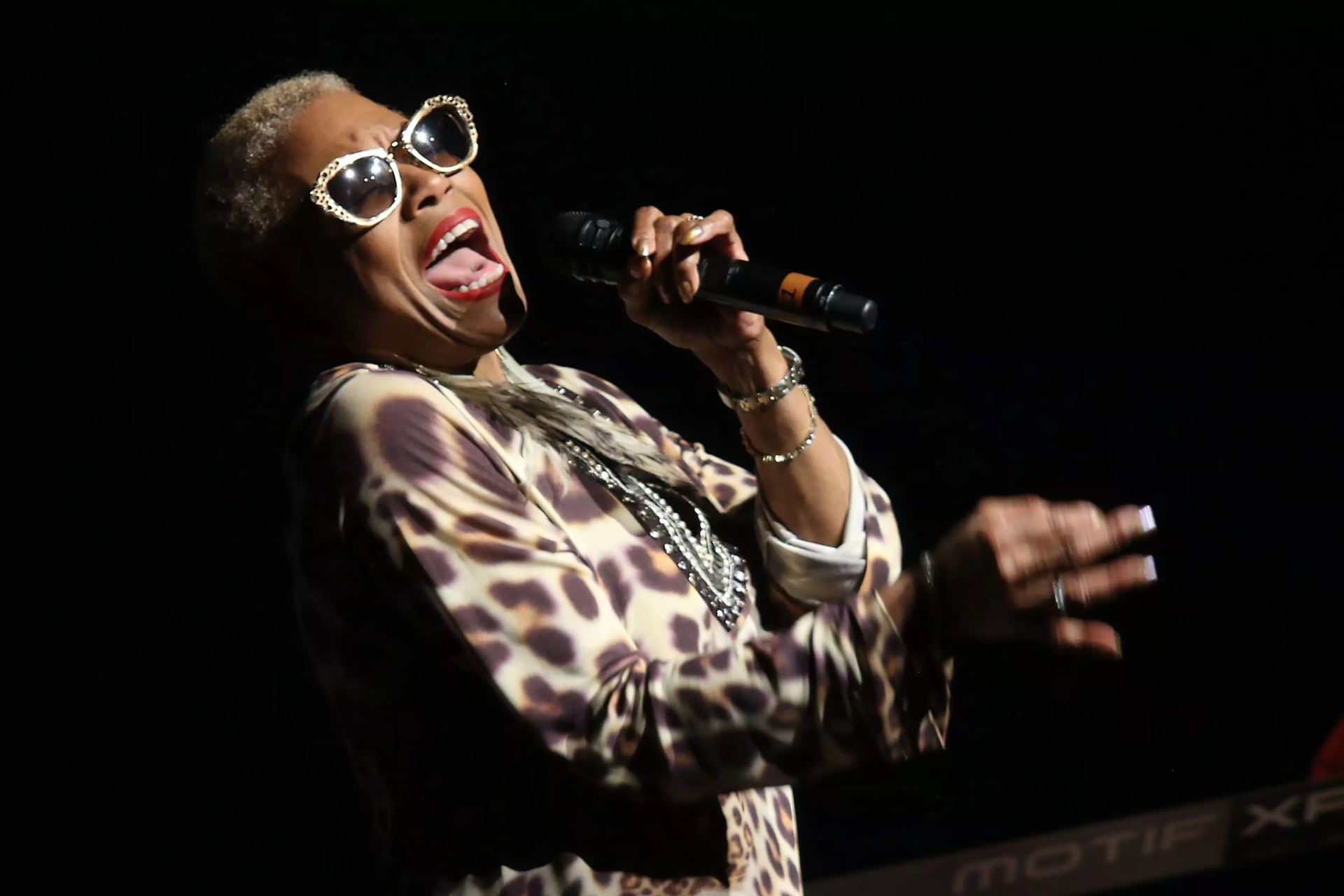
Presented by GRAMMY.com, Living Legends is an editorial series that honors icons in music and celebrates their inimitable legacies and ongoing impact on culture. In the second edition, GRAMMY.com spoke with Dee Dee Bridgewater, a GRAMMY-winning jazz vocalist and NEA Jazz Master who has shattered stylistic boundaries across her five-decade career.
Dee Dee Bridgewater's life and career are defined by unshakeable values she holds paramount: personal integrity, professional autonomy and artistic borderlessness. But in a music world full of schmoozing and sycophantism, this can be a double-edged sword.
"Mine is a lonely road. I don't have a lot of friends in the business. People are standoffish with me because I say what I feel," she tells GRAMMY.com. "I just don't have a lot to say to people unless we're going to have an intimate conversation between two individuals."
It's this quality that makes her an impactful mentor to young women in the jazz business, particularly through her Woodshed Network program. It also makes her a hell of an interview — furious, poignant, always in the pursuit of equality and justice.
Bridgewater is currently approaching the sixth decade of her career, and she's just about seen it all. Not only has the two-time GRAMMY winner worked with pioneers from Sonny Rollins to Dizzy Gillespie to Thad Jones: she's set the standard for how a jazz singer can be self-sufficient and unbeholden to genre constraints.
And as a Black woman in a space frequently dominated by white men, Bridgewater has seen it all at this point. But rather than let it embitter or stall her, she's resolved to teach young women how to stand tall and proud in the face of discrimination, humiliation and any other adversities they may face.
GRAMMY.com had an in-depth conversation with Bridgewater about her most recent album, 2017's Memphis… Yes, I'm Ready; how she learned to deal with critics; and the hard-won lessons she imparts to her mentees.
This interview has been edited and condensed for clarity.
I've found that music steeped in the blues tends to have longevity. I wonder why music with those roots becomes sort of bulletproof.
That's an interesting question. I don't know that that's totally true, but you can find the blues in a lot of different musical forms — and it's not just jazz or hip-hop. You can find it in rock music and country music. Country music, to me, is blues.
In my music, I don't really consider it to have a lot of blues in it. My most recent album, Memphis… Yes, I'm Ready, was dealing with songs from Memphis, and a lot of those songs were blues-based. But in my repertoire of recorded music, maybe I will throw in a blues, but my music doesn't necessarily have blues-tinged form.
The blues is just very accessible music. When you get into blues lyrics, it's dealing with everyday problems that people have. I think that's what makes the music really identifiable. That, and the combination of the fact that the music is simple, so it's easier to access, I think.
I was just having a conversation about jazz and where jazz music has gone, and how it's become this more elitist music. My conversation was with another woman who's Black, like myself — or African-American.
I was saying to her that one of the reasons that I did Memphis… Yes, I'm Ready is that I wanted to see more people like me in the audience. I wanted to see a reflection of myself instead of seeing a predominantly white audience with a sprinkling of Black people.
I think jazz has categorized itself out of the mainstream like classical music has. A lot of the younger jazz musicians and vocalists alike — I consider us all musicians — have opted to do music that has more accessibility by putting in hip-hop, electronic music or all these other forms that can allow the music to reach a broader audience.
But when you think about jazz music today, unfortunately, you do not think about seeing Black people. Which is really unfortunate.
I find it also interesting that no matter what kind of music one does as an artist, if one has established oneself in a particular category of genre of music, then all the music that artist does becomes immediately whatever that genre is.
So, my Memphis… Yes, I'm Ready album was not able to fall into a category because in the jazz category, they said it was most definitely not jazz. But in the R&B category, they said "It's old-school R&B, so we can't really fit in." Of course, it wouldn't compete with who the new R&B artists. It wasn't American traditional, so it wasn't straight blues.
A lot of people that came to those concerts in the first couple of years were very upset. You could see they were visually upset. They'd be crossing their arms with scowls on their faces. And by the end, everyone would be standing and dancing. Now, that repertoire is my most in-demand repertoire for jazz festivals. Go figure!
My question about playing the blues wasn't necessarily because I think you play blues music, but that some old-school artists consider them one and the same. Lou Donaldson once told me, "Playing jazz is about playing the blues."
I've always been interested in more musical exploration. I haven't really concerned myself with categories and genres. I've just tried to do things that interest me and please me, because I feel that if they do, then they'll please the public that comes to see me. As I produce myself and have my own label, I have the [opportunity] to do so.
I haven't felt inspired, though! I haven't felt one iota of inspiration. Mm-mm. I've been very blown away by the political environment in our country. I spent the first four or five months appreciating being at home, and I didn't realize how exhausted I was because I constantly toured.
I'm just now starting to have some creative juices flowing. It's very interesting — I've started, when I go out, writing poems. I haven't written poetry since I was in college! But I've written four pretty good poems. I'm just starting to get into trying to do anything musically.
I'm probably going to have to do a new album of Memphis music, because I have been getting a lot of requests for that repertoire. And I'm going to want to do new stuff, because I'm tired of it. And probably, in February, we'll start rehearsing new songs that I want to put in.
It seems like no matter which musical context you find yourself in, you don't want to be defined or confined by anything.
I received a lot of criticism early on in my career — in the late '80s, in particular, when I started to go back into the jazz world. I was living in France at the time, and the French did not like that I would change repertoires and genres with each album I'd do. I was heavily criticized until they said, "Oh, this is just how she is."
I've been one of the rare singers who's been able to go all over the place. People are always saying, "We don't know what she's going to do next, but it'll be interesting, because her stuff is always interesting."
Then, I established myself as a good live performer, so I have a lot of people coming to my shows saying, "I've never listened to her music, but my friends tell me, 'Oh my goodness, go see her. She's a great performer — whatever she's doing, you're going to love it.'"
And I like that. I'd say I'm probably in a rarer position than my vocal counterparts. And having lived in France for 24 years, I was able to establish myself in a way that other American musicians had not been able to.
To me, the job of a music critic is to guide listeners to something they'd enjoy. At a certain point — especially as it concerns genres — it can devolve into a destructive function.
Yeah, that's been an issue. I used to write critics when they would give me a negative review. I'm well-known for my letters. [Laughs.]
But now, I don't care. I can read something and say, "Well, they're all up in their feelings," as we say now. They weren't really interested in what they heard or saw. They were more interested in expounding on whatever's inside their heads and trying to promote themselves as writers.
I don't really deal with critics anymore. With my work, you know — I started professionally 50, 60 years ago. I just do whatever it is that I feel like doing, and I know that I have a strong enough fanbase — if you want to call it a fanbase — and a strong enough reputation as a musician and performer that people want to come and see me anyway.
I'm interested more right now in mentoring, so I'm doing more of that. I've got a mentoring program with my daughter who does my management, Tulani Bridgewater-Kowalski. It's called the Woodshed Network, and we're going into our third year [in Feb. 2022]. Up until this year, we didn't speak so much about it because we wanted to see if it was going to really have legs and stand on its own. It's something that seems to be working, and we're really happy with that.
It's for women or female-identifying individuals. It's going well, and it's not about the music. It's about the business of music and establishing one's career and understanding all the various aspects of having a career — how to go about getting a career started and maintaining it. We're trying to create a community where women can network with each other and, so far, it's been really, really nice.
I'm sure you're getting opportunities to tell younger musicians things you wish you would have known when you were younger. Who were your mentors in the music business?
When I was starting out in the music industry, all my mentors were men. Thad Jones, of course. Dizzy Gillespie. Clark Terry. Dexter [Gordon]. Sonny Rollins.
Females — not so much mentoring as kind of shepherding me and allowing me to express myself on their stages. In that way, I had people like Nancy Wilson invite me up on their stage. Carmen McRae. Sarah Vaughan.
I did spend some time with Ella Fitzgerald after she had been decorated in France by the Minister of Culture. I went to the American embassy and we spoke at length about her career and the things she had suggested for me to do.
There was another woman who was very supportive of me and helped me out a lot personally, and helped me get gigs when I was trying to establish myself. That was Rita DaCosta.
And Betty Carter was a mentor. I was Betty Carter's puppy dog when I first moved to New York. Betty told me a lot of things to do and not to do, and any dates she had in New York or Brooklyn — anywhere — I'd always go, sit at a table, pay my way, and study her. I worked with Danny Mixon, because they were married and I wanted to get as close to Betty as I could.
I'd say that probably all I am as an artist and performer came from watching Betty. She told me I needed to have ownership of my music and produce my own stuff. I did.
Betty was someone who gestured a lot and moved a lot on stage, and for a jazz singer, you shouldn't do that. But I just loved her physical movement and how she could get so involved and twist and turn her body and do all these facial gesticulations when she sang. I don't know — I was just mesmerized by her.
Betty taught me to be fearless, you know? And not to worry about what people had to say about me and just go on and be myself.
It seems that you were attracted to being an entertainer — not obfuscating that part of what you do.
Well, I would say that I consider myself to be an artist, so I'm always trying to explore and go in new directions. I liked to say for many years that I wanted to model myself after Miles Davis. You never knew what Miles was going to do next, and I never understood why a singer would be expected to stay in one particular lane.
And I still don't like that. It's a choice of yours if you want to explore this one particular avenue and that's what you want to do. I respect that. But for me, I'm more interested in musical inspiration. I'm a Gemini, so I liken myself to — Miles Davis was a Gemini. Prince was a Gemini. I like my Geminis.
I hope that I will be exploring things until I don't have the voice, or until my body gives out, or until they both give out, or until I just leave this earth. And that's it.
I'm really about trying to lift the image of women in jazz, but not in a way that I'm going to hit people over the head. I'm just trying to push forward with myself without making a lot of noise. I'm just trying to do the things I do — the things I believe in — and I'm really trying to champion women. They need championing. I think I'm at a place in my career where no matter who I work with, I always want to provide a platform for any musicians that work with me.
In which ways do we still have a long road ahead as far as elevating women's profiles in this music?
First and foremost, a lot of women need to have equal footing. I still see a tendency with jazz magazines — when they do musical reviews on a female singer's albums — they compare that singer to another singer.
When I see a critique by a jazz journalist — generally men — and they critique an instrumental album, they get all into how that individual, that group is doing this, that and the other. And they don't do comparisons.
I hate that there's still this kind of macho notion that women cannot coexist with each other. We can't have singers with very different voices and be allowed to do the thing we want to do. Paying more attention to that than we do musicians [is important], but we just don't get the same respect.
It's better, you know? There seems to be a more conscious effort to allow a female musician to coexist in the same way as her male counterpart. And we are beginning to see bands that are more integrated with men and women. But we've got more to do in those areas.
But let me say this: I'm very excited that Jazzmeia Horn is nominated for Best [Large Jazz Ensemble] Album, and that she wrote all her arrangements — because people kind of see her as a singer. That's one of my babies. She's got her own label now. She's producing herself.
She's making some wonderful strides, and I think she's going to break some glass ceilings and people are going to start paying attention to her. They are already — because she's uncompromising. She's doing the thing she believes in. She's fighting for herself. She's standing tall — regal — and just doing her thing, and I love that.
The whole thing, I think, as an artist, is being an individual. Being unafraid to stand up and be who you are. I don't want to be like anybody else! And I don't want somebody to be like me, or try to be like me! I'm really a supporter of people finding their own, unique voice and emphasizing their uniqueness. That's what makes it interesting.
It's incumbent on my fellow music writers to not pigeonhole or marginalize women artists, but allow each one to have a limitless capacity for self-expression.
Yeah, just like our male counterparts. This goes into the whole societal thing — look, it's a bunch of men trying to do away with us having our abortion rights. Really? You motherf***ers! And I will say that. Who the heck are these people? I just don't understand.
This country has to get away from the s*** it was founded on. There's so much that this country has refused to deal with, and it permeates the arts. It permeates every aspect of our lives. So, when you get into jazz — and you've got to throw away all of this elitist bulls***.
Jazz music has become international music. It is music that is played around the world. And there are great musicians wherever you go. And it doesn't matter what the sex is!
It seems that since this last administration was in, they've been able to roll right back to where it's all about the white man being in control. I feel it's out of fear, because they know they're losing their grip. Because our world is turning into a beige world.
I feel like in the jazz world, there’s desperation because the music and the people involved in the music are no longer this old guard. Why do we keep giving awards to people who are dead? Really? Really? Have you noticed that?
I think it's all about change and fear by those who have been in control — that they're going to lose control — and doing everything they can do to maintain that control. But! It cannot continue. And it won't continue.
You mentioned elitism in jazz. From your vantage point, when did it tip over from being music for normal people — to enjoy, to dance to, to socialize to — into something locked in an ivory tower?
I can't speak to that. I'm not a jazz historian. I don't know when it happened. I just know that it's happened. I'm not that person who can discuss those kinds of things. I'm not that person who can discuss albums and who played on those albums and how they played on all of that.
I am that person who concerns myself with what I'm doing based on the relationships I've had with other individuals, and the people who have helped to shape me based on my appreciation of those artists. I'm the person who's tried to make a way for themselves no matter where the direction is going, with whatever it was I was doing. That's always been my concern. How am I going to keep pushing my artistry, keep my integrity, but at the same time, also do it to the best of my ability?
I say to young people when I do masterclasses: "Whatever you do, you want to be proud of that thing. If that thing's going down with a sinking ship, you'd better be proud that you built that ship, you sailed that ship — even though it hit rough waters." Being as uncompromising as you can possibly be.
You've got to be unafraid to be alone. Mine is a lonely road. I don't have a lot of friends in the business. People are standoffish with me because I say what I feel. I try to be honest. I just don't have a lot to say to people unless we're going to have an intimate conversation.
It's unfair that we allow someone like Miles Davis to be the mysterious lone wolf marching to the beat of his own drum without letting women occupy that role. I admire that you're a no-BS person with no interest in hobnobbing or glitz or whatever.
I mean, I'm trying now to hobnob a little where it concerns the mentoring program I'm doing [in case] I meet someone who's interesting.
All the mentors that are involved in our program are also all females. Because it's important to see yourself in the room. It's important to see people like you. It's important when you're aspiring to do something — even for you — to surround yourself with successful individuals that have similar interests to yours.
That's also something that isn't very prevalent. As my own producer, when I go in to have conversations with whatever label is distributing me — because that's another thing! I have a label called DDB Records. Whenever my albums come out, they're on my label, distributed by whatever label does my distribution.
But I own all my masters. It's my label; I've had other people sign to my label. But when a journalist gets ready to critique, they say, "Oh, here's Dee Dee's album out now on Sony Records." They totally disregard that I produced it. So, I still have to fight for that! I still have to write in and they make the correction later. But the damage is done!
There's also the disrespect of the musicians you hire to deal with. I'm not going to go out with some half-a**ed individuals, no matter who I'm playing with. I have been known to fire somebody on the stage if they don't have their stuff together. I have docked musicians who have played with me and didn't think they had to learn my stuff.
They think, "Oh, I'm just going to play with this singer." I send them arrangements and give them live recordings, but they don't pay attention. They think they can come on stage and just wing it? I'm about precision. So, yeah, I'll fire people. I will call you out if you don't know what you're doing.
I don't have time. I've worked too hard to get where I am and have the reputation that I have. I've built this reputation over many, many, many, many, many years. I'm not going to have some lazy-a** punk come on stage and not do their job.
Was it a long process to develop your integrity and sense of self?
Heck yeah! Of course. I went through many, many years when I was starting out where I could read a review and just boo-hoo. And then I would think I wasn't worth it.
Then, it dawned on me: you can let them know what they've done to you.