When Håvard Ellefsen surveys the world he helped create, he finds himself at a loss.
The irascible Norwegian artist, who records as Mortiis, can't explain why the grandiose, metal-adjacent subgenre he helped forge in the '90s, now known as "dungeon synth," "crawled out of the grave" after more than a decade of relative inertia.
Nor can he wrap his head around the plethora of sub-sub-subgenres — of highly variable degrees of sincerity and craft — that threaten to send it right back to the tomb.
"There's a thing called cozy synth? Dino synth? What the f—?" Ellefsen incredulously asks GRAMMY.com. "I mean, are you just taking the piss? If I want to f—ing get into dinosaurs, I'll talk to my 11-year-old son. He's into them and knows more about them than I do. I'll watch Jurassic Park!"
To him, dungeon synth means something — and the current crop of copycats and dilettantes saturating the internet threatens its integrity.
But what is it, exactly?
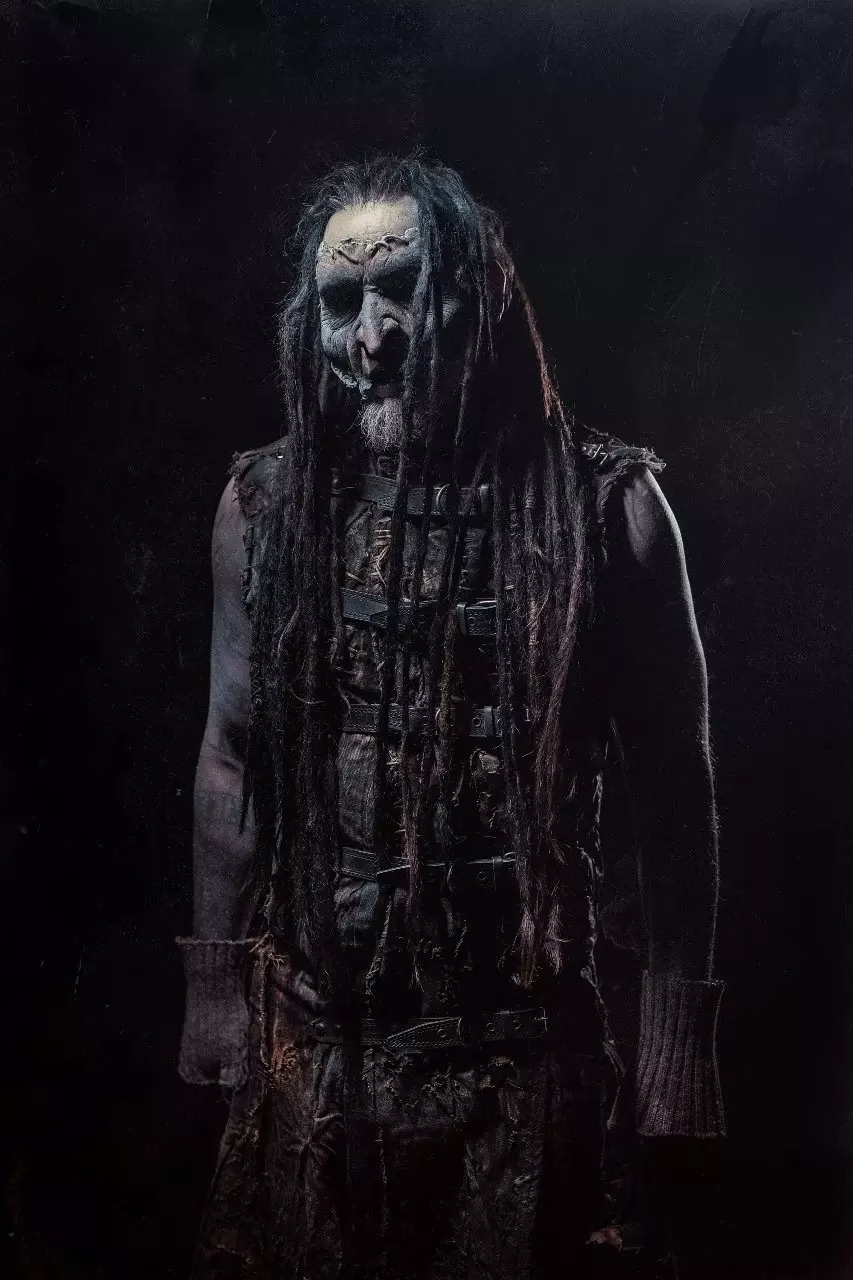
*Mortiis. Photo: Ekaterina Gorbacheva*
Think of the brief atmospheric interludes on black-metal albums, stretched to sprawling lengths. Think of chainmail and swordplay. Think of a half-remembered soundtrack to an MS-DOS version of The Lord of the Rings that may have never existed. (Although Ellefsen rejects this characterization, and clearly states that he has never pursued this in his own music, the younger guard interviewed for this article wholeheartedly embraces it.)
Above all, dungeon synth is profoundly transportive, deeply felt, shamelessly escapist, and sometimes uncomfortably earnest.
"For me, dungeon synth is the music that you hear in your dreams," says John Hartman, who runs Lightfall Records and performs under banners like Temple of the Fractured Light and Majesty of Oceans. "It's music that's so beautiful, you can't touch it."
While grunge reigned, the music now known as dungeon synth quietly sprang up in Europe and America alike. Bard Argol, who declines to use his real name for this article, also played a prominent role in forging this style; he founded the label Dark Age Productions in Minnesota all the way back in 1994.
But he, too, is perplexed as to where this subculture is headed.
"What the f— is this s—?" Bard Argol asks GRAMMY.com, citing the recent introduction of something called "hot dog synth." Wayfarer, who crafts immersive and expansive works as Fen Walker and Frost Clad, cites an album-length "dungeon synth" tribute to Guy Fieri, the goateed meme king of Diners, Drive-Ins and Dives fame.
"There's one guy who put out a pizza record," he adds. "It's really getting ridiculous."
"The Low Barrier"
To a degree, dungeon synth's old guard can roll with the trolls — or even troll them back. Bard Algol recently released a T-shirt emblazoned with a 17th-century illustration depicting a man with a peg-leg playing a keyboard. (The caption: "Uncomfy Synth.")
But on the main, they're concerned about where the music is headed. Because at press time, dungeon synth is in danger of becoming diluted beyond recognition — and, as a result, ruined.
If this renaissance falls apart completely, it will probably be due to Bandcamp's tagging system — where bad actors can call anything dungeon synth and get away with it. "The low barrier is starting to show," Hartman says.
To be fair, not all of the offshoots are provocative slop. For instance, the somewhat infamous 2019 eponymous debut by Grandma's Cottage has its defenders, on something of an ASMR level. Just as dungeon synth at its best can galvanize you to ride into battle, Grandma's Cottage can transport you to a shag rug by a crackling fire, munching ginger snaps.
But under dungeon synth's expanded umbrella, albums like that are the exception, not the rule.
"Grandma's Cottage and Diplodocus — I love both of those, but they spawned a slew of imitators that started saturating the Bandcamp tag," says Ross Major, who makes dungeon synth as Malfet and runs the Pacific Threnodies label. "It got tiresome for people to sift through so much of that to find needles in a haystack.
"The avalanche from 2018 to 2021," he concludes, "seems to have slowed."
A Guild Worth Joining
If the current dungeon-synth wave recedes for good, it'll be a shame. Because beyond the quality of the music at its best, the community has a lot to be proud of.
During the pandemic, the visual-forward subculture (think atmospheric, fantasy-driven, and otherworldly) progressed from a steady climb to an explosion. Suddenly, a plethora of new followers were watching — and holding forth on — highly theatrical performances on Twitch.
With the world locked inside, these online "sieges" and "skirmishes" acted as a haven for all kinds of people not oriented toward the mainstream — neurotypical and neuroatypical; gender-conforming or non-.
"It feels amazing when we all get together, because we're all a bunch of nerds," Major says of post-vaccine, in-person gatherings like Northeast Dungeon Siege in Worcester, Massachusetts. "Most people that we encounter on the street are not going to 'get' what we're into. And it's awesome that it appears to be such a haven for that."
So, how can dungeon synth overcome its defects tinue to grow in a healthy and sustainable way? Maybe finding an answer begins with understanding where the music came from.
Which brings us back to Mortiis.
Into The "Dark Dungeon"
In 1992, Harvard Ellefsen was fired from Emperor — the symphonic black-metal royalty who went on to make masterpieces like 1994's In the Nightside Eclipse and 1997's Anthems to the Welkin at Dusk.
The next day, he walked to a music store, toted home a Roland keyboard, started making music, and began recording in early spring 1993 — thus laying the groundwork for Mortiis.
He'd planted the seeds for that sound a while ago. While Emperor was unquestionably dark, they achieved that darkness through conventional pop and rock instruments — guitar, bass and drums. Ellefsen wanted to get to that place through unorthodox methods.
This meant he bent his ear to outré acts outside the scope of metal — his biggest inspirations being Berlin School artists like Tangerine Dream and solo Klaus Schulze. Gloomier acts like Coil, Throbbing Gristle and Dead Can Dance were also in the mix. (Likewise, Bard Algol drew from a diverse array of inspirations early on, metal or otherwise — from Tangerine Dream's soundtrack to the Ridley Scott film Legend to first-wave black-metallers Venom, Bathory, and Beherit.)
"It [all] fit right in there next to Diamanda Galás or something, which was crazy, f—ing disturbing performance art," Ellefsen adds. "All of that stuff inspired me to do something that was different."
All these influences and more inspired Ellefsen to record the first Mortiis demo at his parents' house. Today, he looks back on an illustrious, three-decade career that has spanned many left-field subgenres, from dark ambient to industrial rock.
Mortiis' early output, as well as recent works like 2020's Spirit of Rebellion, typifies dungeon synth — even if the label was attached to his music retroactively. The closest he got to that tag was calling it "dark dungeon music"; a phrase he named his label after in the mid-'90s.
Around that time, fellow dungeon-synth architects Depressive Silence, Neptune Towers, and Wongraven emerged as well: Wayfarer calls acts like those "starter-pack dungeon synth." ("We all have that origin, it seems like," he says.)
Ellefsen may have a reputation as a curmudgeon among a few. But although he may aim his guns at poor Grandma and her cottage, he stops short of castigating the new guard outright.
Instead, he wonders about the well that younger musicians are drawing from.
A Disconnection From The Past?
Because Ellefsen drew from all over the dark-experimental map, the result was a nutritious mix of inspirations — which ultimately made his music satisfying and rangy.
However, "I'm not sure if the kids today are inspired by these things," he says. "Or if they're more into video games; I see that a lot." (Elsewhere, he calls the video-game-influenced component "corny.")
It's true that dungeon synth provides a suitably fantastical soundtrack to "Dark Souls" and its ilk. But for Major, this wasn't an end to itself; it came from an internal directive to "make personal music always."
"I love playing 'Skyrim,' and the 'Elder Scrolls' music is so beautiful to my ears," he says. "I like thinking about knights and fantasy, but also the deep forest and magic and the things I personally like. Maybe there'll be a few people who feel the same."
"Some people don't like the comparison to video game music, but I think it's at this rate, it's unavoidable," dungeon-synth musician Francis Roberts tells GRAMMY.com. "It's a big piece of how I got into the genre."
Gaming aside, Ellefsen questions the amount of effort that some contemporary acts put into their works, calling some of the cover art "deliberately sloppy."
"My feeling is that there's something a little tongue-in-cheek about it, even though some of the folks probably would not acknowledge that," Adam Matlock, who records dungeon synth as Erszébet, Dust Seeker and other monikers, tells GRAMMY.com. "But it gives it [that quality] where it doesn't feel cynical."
"I don't really care, because I don't make the rules," Ellefsen says about the frivolity he perceives in today's dungeon synth. "But when I started out, I was really f—ing serious."
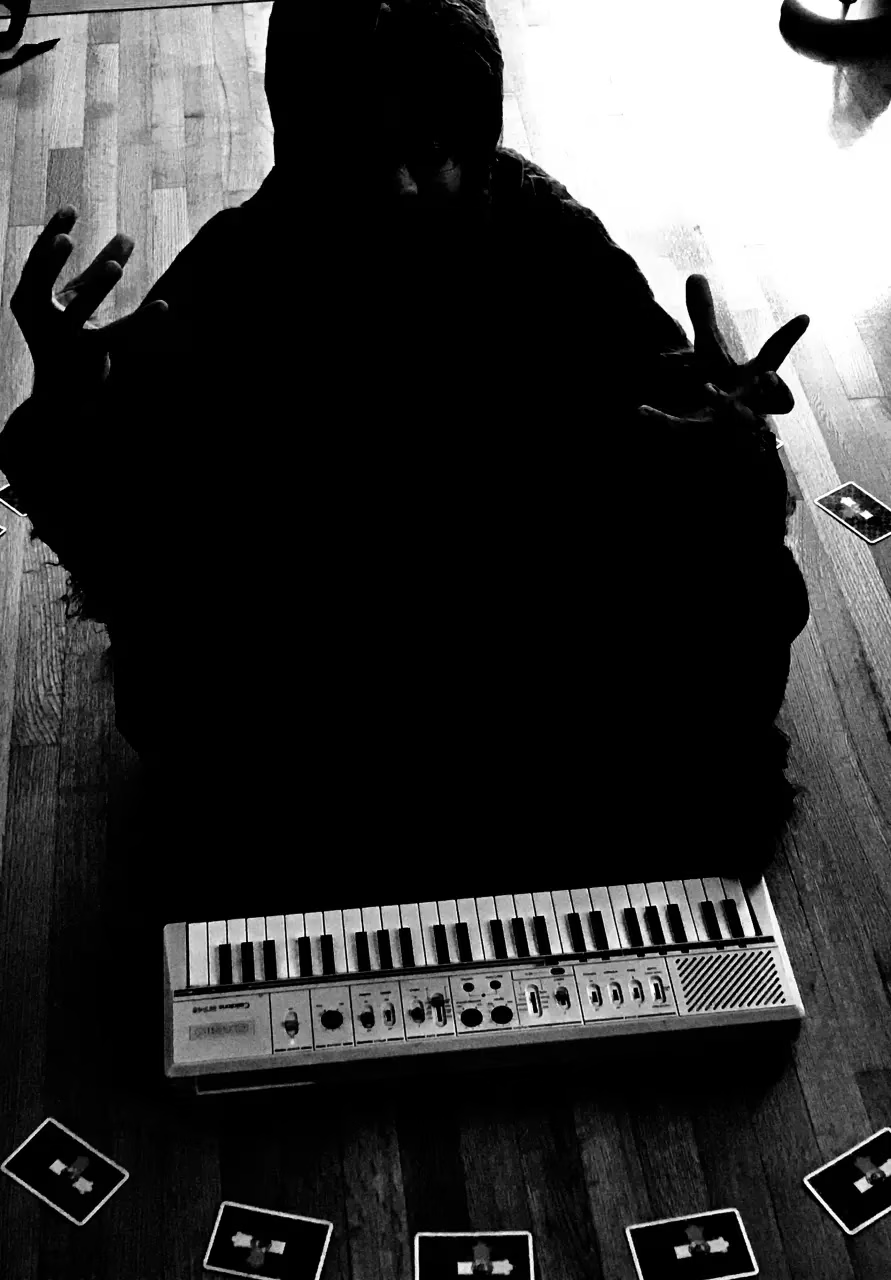
*Adam Matlock. Photo: Eliza Caldwell*
There is one glaring reason why dungeon-synth neophytes might disregard their roots. Because one of the building blocks of the music was the infamous Burzum.
In the early '90s, under that name, Varg Vikernes made foundational works of early black metal, as well as minimal, meandering synthesizer music — much of the latter while serving 16 years in prison for the arson of three churches and murder of his bandmate.
But these days, Vikernes is persona non grata in the metal world — in large part due to Neo-Nazi sympathies. Despite Burzum's influence on dungeon synth's development, nobody's going to sing Vikernes' praises and stay in the scene's good graces while they're at it.
"I wasn't going to mention Burzum, because the guy is nuts," Ellefsen says. (In a recent podcast, he called him "the biggest f—ing a—hole on the planet.)
That's a positive break from the past; half-baked, parodic spinoffs, less so. As such, it's worth highlighting artists who retrieve value from the past while discarding its refuse — and maintain bound to tradition without being beholden to it.
Keeping The Flame
Can dungeon synth's endless permutations come off as intimidating? That's natural, Wayfarer says, given the nature of its taxonomy.
"How many subgenres are there in metal? It goes on for infinity," he says. "You have all the -cores, and you have all the 'blackeneds'… it only makes sense that something born out of metal has a million subgenres."
These designations aside, what are the cornerstones of dungeon synth, past and present? Rather than fruitlessly search for the good stuff in a sea of spam, it's helpful to let the leading musicians offer some gateways.
Among Wayfarer's cornerstones of the form — from any era — are the Torchlight's supremely atmospheric The Long Quest and Guild of Lore's Storm Haven. Cernunnos Woods' Awaken the Empire of Dark Wood is "a very early release — very cool stuff." Casket of Dreams' Dragons of Autumn Twilight is "just fantastic — a big influence on me as well."
For Hartman, the quintessential dungeon-synth album is Spheres of Time by Solanum. "There is not a release that encapsulates that feeling of nostalgia, dreaminess and being in another world than Spheres of Time," he says. He also praises Fen Walker for "incorporating tribal and psychedelic elements."
"I always connect the best to the music my friends make, so it's hard for me to be very objective," Major says. That said, he's digging the Virginian artist Vaelastrasz; Vale Minstrel, who has a "more upbeat, medieval-bard-sounding style"; and Ulk, a project from the Netherlands on Gondolin Records.
"They're all themed around tortoises," Major describes of Ulk's releases. "But there's a combination. It's not terribly dark. It is lo-fi, but the playing and composition are very masterful. It's almost like if Claude Debussy had a Casio keyboard and an eight-track."
"It sounds egotistical, but I would say my own stuff was one of the more defining things of the era," Bard Algol says. To this end, he also cites releases by Valor, Equitant and the Soil Bleeds Black.
Preserving The Scene
Sometimes, it can seem miraculous that dungeon synth ever came back at all — much less became a sensation in the 2020s.
"The impression I get is that it was like some kind of old vampire that got stabbed and f—ing beheaded, and it's just been laying rotting for 25 years," Ellefsen says. "Now, it's back, crawling back out of the f—ing rotten ground, foggy and s—."
To this progenitor of the form, what's the best way to keep it going in a pizza-less, Fieri-less form — one with at least some fidelity to its roots? What would he tell a young person who loves this music, has applied a harpsichord patch to their microKORG, and wants to make dungeon synth themselves?
"The first thing I would say is that they don't have to use the harpsichord." Ellefsen continues, while clarifying that he's incorporated the sound into some of his work. "There's a lot of: Let's go to the medieval fair now and get dressed up and drink mead… there are so many other ways to create atmospheric music."
To Hartman, preserving the integrity of the form doesn't mean inflexible devotion to a predetermined aesthetic; it just means holding music to a certain standard. "Dungeon synth needs to start guarding its gate a little bit tighter — not a lot tighter, but a little bit tighter," he says. "It needs to be very honest and even helpful with its criticism of things."
This also might mean expanding the boundaries of dungeon synth — in a way that doesn't lead to trollish offshoots that uncontrollably replicate like cancer cells.
He brings up his Temple of the Fractured Light album called PSYOP Theory, about UFOs, the pyramid's eye, and other conspiratorial topics. "Then, someone was like, 'Oh man, conspiracy synth!' I'm interested!'" Hartman says. "No, this is not a new thing. This is not a new genre. Not everything needs 'synth' strapped to it like a rocket."
Nonetheless, he believes these adjustments alone won't staunch the bleeding: "I think the cat's out of the bag," Hartman says.
As several artists concede, attitudes within this very online community could also use some work — not only in tamping down the infighting inherent to every subculture, but being honest with oneself and others regarding the quality of the output.
"You don't really get any sort of honest criticism about your music. It's kind of passive-aggressive, in a way," Wayfarer says. Too often, he said he sends his works to others, and is met with "It's perfect."
"No, I'm asking you because I want you to tell me, 'Yo, that's off-time. That doesn't sound good. That lead's garbage.'" he continues. "I want to crystallize my work, and I need fresh ears to make that happen." He extends this frustration to dungeon-synth blogs, which too often simply ignore records they don't like rather than offering constructive criticism.
The elephant in the room comes up once again — albeit abstractly.
"It's the endless clash over ideology, national-socialist junk. And you think it's a no-brainer." Wayfarer says. "But it's more nuanced than that: OK, this album isn't about Nazis. It's about forests and it's about castles and vampires and mystery and whatever," he adds. "But the dudes making this music are total racist a—holes."
"We don't want your Nazi stuff in our music scene," Wayfarer adds, with a spirited "F— off."
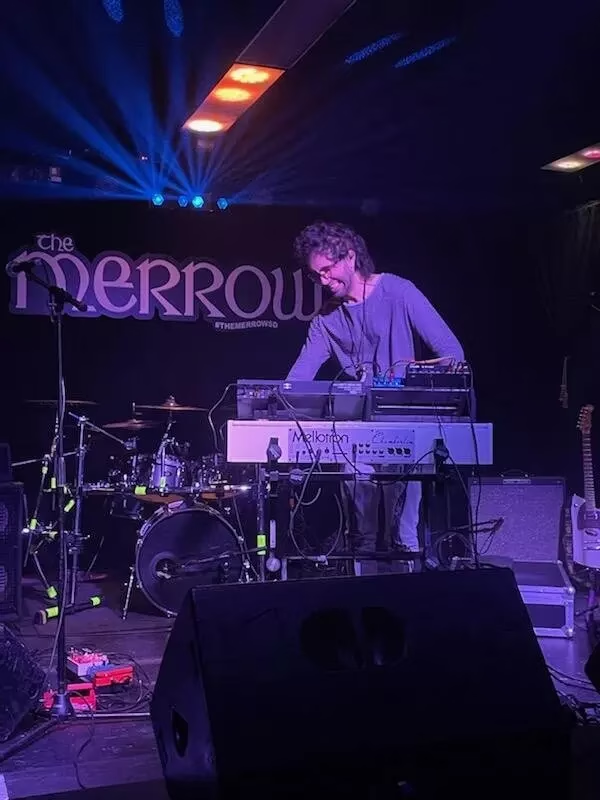
*Francis Roberts. Photo: Jaz Diaz*
Charging Into The Future
All this dissonance aside, there are encouraging signs that dungeon synth can continue to grow in a positive manner. For instance, Thorsten Quaeschning — Edgar Froese's appointed successor at the helm of German electronic pioneers Tangerine Dream — headlined the last Dungeon Siege streaming event.
"He does these improvisational sets, and apparently, he went on a deep dive and listened to a bunch of dungeon synth beforehand," Major notes. "And you could tell, because it was like Tangerine Dream with martial overdones. There were moments that sounded like timpani strikes, and little folkish melodies. It was so awesome."
Roberts wonders if this sort of crossover could extend all the way into the mainstream. Of all artists, Lil Nas X comes to mind.
"You hear all kinds of incredible songs built from samples you wouldn't expect. 'Old Town Road' is a great example of that — some obscure Nine Inch Nails B-side turned into the pop anthem of the decade," he says. "I could see something like that happening, where someone is making dungeon synth, and one of their friends is making beats for pop artists, and then one of those people blows up."
Although, he concedes, "that would probably be infuriating for the people that make this stuff."
It's worth noting that the Recording Academy recently expanded the GRAMMYs' Best New Age Album category into Best New Age, Ambient Or Chant Album, which could provide a platform for dungeon synth, or adjacent genres, to flourish on the world stage.
But whether or not that mainstream leap transpires, the fate of dungeon synth will rest on the shoulders of artists who bring creativity, flair, and emotional vulnerability to their craft.
Ellefsen, for one, is still evolving his craft and performing live, and supporting emerging dungeon-synth talent along the way.
This has led to wonderfully surreal moments, like Mortiis and Malfet packing out the Graduate, a now-defunct college bar in San Luis Obispo, a tiny college town off the 101 on the Central Coast of California.
And after lockdowns receded, Malfet performed in an even wilder venue for dungeon synth: the Raconteur Room, a tiny craft-beer-and-music joint in adjacent, rural Atascadero, where you'd usually hear the pluck of a capoed Ovation acoustic guitar.
Among the 50 or 60 attendees were Major's oldest friends — ones who had zero interest in, or awareness of, this niche, fantasy world. But after his performance, the folks who wouldn't know Old Tower from Erang were sold.
"It's a folk-rock bar. It's Atascadero," Major recalls in awe. "But when I finished, they were chanting: 'Dungeon synth! Dungeon synth! Dungeon synth! Encore!'"
"And I played an encore," he says.
Like Turnstile And Code Orange? 10 More Bands Expanding The Boundaries Of Hardcore