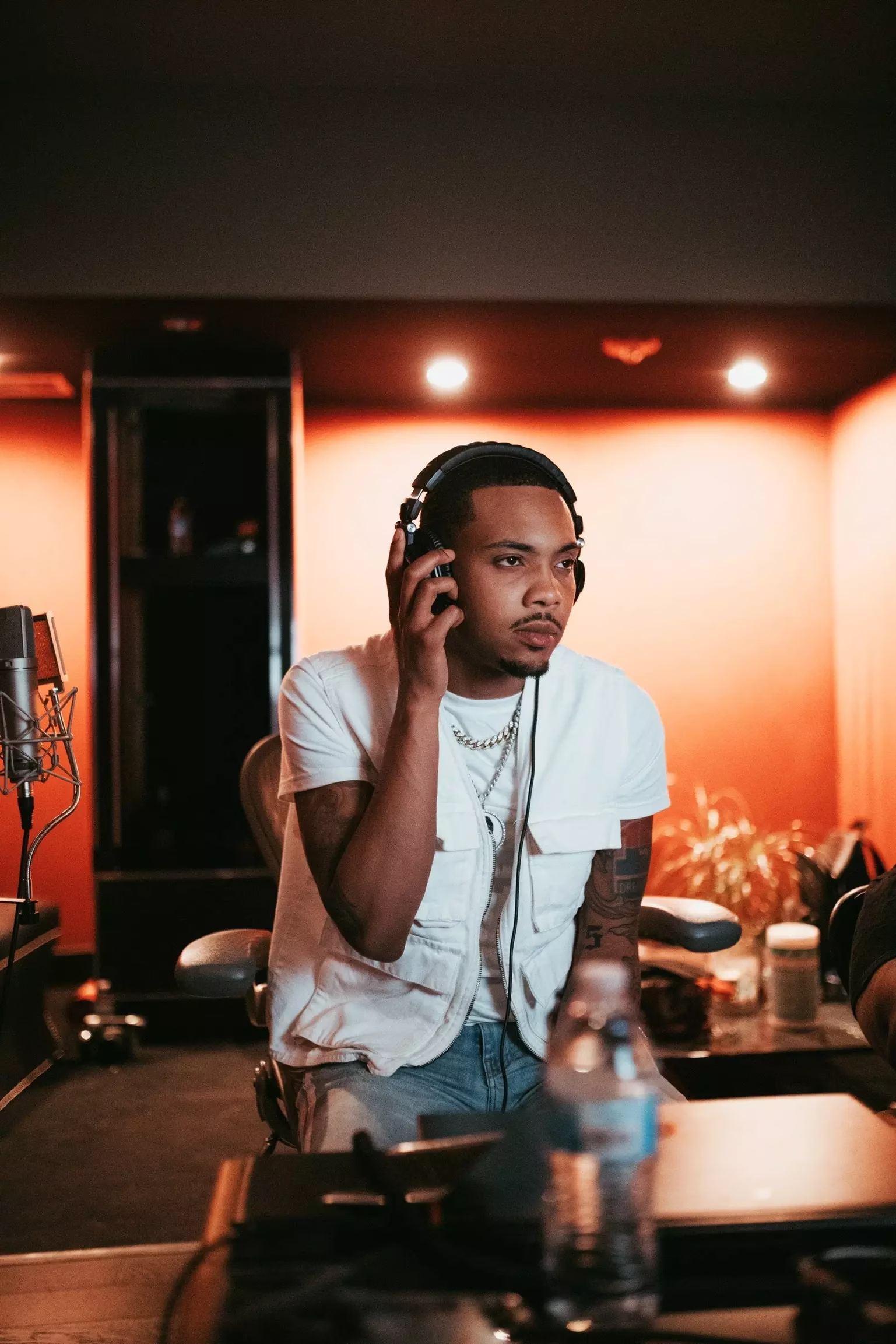
At 25 years old and arguably hitting his stride in his almost-decade-long career, G Herbo looks at his life with gratitude and pride. In the past year, the Chicago native celebrated his silver birthday, became engaged to Taina Williams, welcomed his second son and recently released his fourth studio album, 25.
However, speaking by phone with GRAMMY.com one day before the project's release, Herbo reflected on a time in his life when that wasn't the case.
"I wouldn't say I didn't appreciate life, but I wasn't afraid to die," he said of growing up in Chicago's Terror Town neighborhood. "It's crazy, but when I turned 25… I just appreciated life a lot more."
PTSD, Herbo's third album that dropped last year, was largely impacted by his mental health journey after being diagnosed with post-traumatic stress disorder, or PTSD. On 25, Herbo continues his trademark grittiness and visceral storytelling about his past, but with a new sense of fulfillment and hope as he reflects on who he is at 25: a successful artist, fiancé and father of two.
Here, Herbo talks about his collaborators' and family's impact on 25, his long-awaited joint album with Lil Bibby, upcoming mental health initiatives and more. Read the full interview below.
Your album is called 25 and you turned 25 years old last year. What is the significance of that age to you?
It's a special number to me because turning 25, where I come from, is a big milestone. A lot of my closest friends didn't live to see 25 years old; some of them didn't live to see 18 or 21. My younger brother [Lil Greg] died before his 25th birthday, so nothing in life is promised.
It's crazy, but when I turned 25, I felt more mature instantly. I just appreciated life a lot more. I've been doing music for about 10 years now, I started doing stuff when I was like 16 years old, and all the trials and tribulations that I went through shaped me into the man that I am today. I went through a lot of emotions making this album and I hope my fans appreciate that. I wanna motivate everybody that listens to think about life a little differently and make plans, because I didn't get where I am by coincidence. It was a lot of hard work, a lot of adversity. 25 is kind of like an O.G. in a sense, but I'm still young. I've got so much in front of me to accomplish. So, that's why naming my album [25] was important.
You hit several milestones this past year; you're engaged, you're now a father of two. How did being a fiancé and dad influence this album?
It inspired me a lot, especially being a father. I get up every day and it's not only about me. You can't be selfish when you have kids, they depend on you so much, and I've gotta make sacrifices and take a lot of time away from my family. So, it's about creating balance and understanding. It's not about what I wanna do or what I have to do anymore. I'm inspired and completely motivated [by them] in every aspect of my life.
Your son Yosohn's voice is heard on "Cold World." What made you want to do that?
That song is actually one of my favorites on the album and my son, you know, he's growing up. I just asked him questions and he was able to do it off the top, it wasn't scripted. He's always in the studio with me. We were just chilling, and I wanted people to get that rawness of: I have a son. I have a life that's depending on me. Hearing his voice on there around the stuff that I'm talking about, it gives you that surrealness.
Read: Polo G Talks 'Hall Of Fame,' Fatherhood And His Plan To Be Legendary
You've got a lot of dope features on this album. You and Polo G always have a great chemistry, what's that like being in the booth together or sending verses back and forth?
Mostly we're in the studio together. That's my boy, so it comes out naturally. We're both great lyrically, so I feel like we feed off each other's energy and talent when we're in the studio. Even if we do send records back and forth, we're still giving it our best 'cause we know we're two of those artists that are gonna go hard every time.
We've got a real friendship and I think that's the beauty of our working relationship–we're cool with each other. We get in the studio, chop it up, everything's not always about music with us. When we do rap with each other it's always Chicago-style, too. We're aiming for what we know people at home are gonna like.
How did you and Rowdy Rebel link up?
Me and Rowdy, we've been locked in for a while. He's a good dude. We used to chop it up before he went and did his time and I've always supported his music. I did a "Computers [Freestyle]" back in 2015, and we've got a lot of mutual friends. As soon as I recorded ["Drill"], he was the first person I thought of, like, "I've gotta get Rowdy on this record." So, I reached out and he came to the studio. He was literally fresh out of prison at that time.
Could you see yourself collaborating with Bobby Shmurda?
Oh for sure, it's a given. I mess with Bobby, too, so we're locked in. I think it's more so just about us all getting in the studio at the same time. Both of us are real busy right now. But I definitely wanna do something with both of them on the same track. That'd be crazy.
"I Don't Wanna Die" is such an impactful way to start the album. How were you feeling when you were making that song?
Southside, he kind of challenged me to do stuff like that. He produced it and when he sent it to me he told me, "You gotta go crazy on this." I think the sample and the kids singing, "I don't wanna die" over the beat, it kind of pulled me to talk about the raw grittiness of being in the streets and overcoming that.
There was a time in my life where I put my life on the line time and time again. I wouldn't say I didn't appreciate life, but I wasn't afraid to die. Feeling that way and feeling the way that I do now, I had to collide those two brains together because I'm not the same person that I was when I was 15, 16, 17, 18 years old. So, I just wanted to put all that in one track and let people understand that life is real out here, people are really losing their lives on the day-to-day.
On "Demands," you rap about racism, having to grow up young, trauma. That's another powerful track.
It definitely is. Normally, I don't really rap about stuff that's a trendy subject, I just get in the studio and speak my mind. I think that's why my music is the way it is. I speak from the heart every time. So, I didn't go into the studio thinking that I was gonna make one of those records. It had a lot to do with the production as well, Southside did that one, too. A lot of the production on this album moved me to speak about different things.
Check 'Em Out: Black-Owned Music Venues To Support Now
Earlier this year, Lil Bibby hinted that your long-awaited joint project No Limitations is on the way. Can you give us any details on that?
You know, Bibby's real indecisive when it comes to music. He's one of my favorite rappers, always gonna be one of my favorite rappers. That's another person where our friendship is so strong, we didn't really have to establish a working relationship. We grew up together, that's my brother.
We'll be in the studio chopping it up, reminiscing. So we gotta really lock in and say, "Let's record this project." Lock in for 30 days, or however long it's gonna take. That's one of those projects that I have to do, for the fans, for the culture. Bibby's got a lot of stuff going on, he's all the way in CEO-mode. So, I've gotta drag him to the studio.
Right, he's always talking about Juice WRLD's next album, too.
Yeah, he's doing what he needs to do as far as the label. There's definitely a Juice WRLD project coming soon. The next time you hear Bibby on an actual album or project, it'll probably be us two. I think our project will be the first thing he'll put out.
Along with launching your Swervin' Through Stress initiative last year, you also bought your old elementary school to turn into a youth center. How's that going?
Yeah, we bought one of the 50 [Chicago Public] Schools they shut down and we're in the second phase of [transitioning] that now. Once everything's up and running, we're gonna have psychiatrists, therapists–someone these kids can talk to in there every day. After launching Swervin' Through Stress, I wanted to put those resources back into the community where these kids feel comfortable, to have somebody there every day who's actually gonna listen and help come up with solutions to make your situation better. I'm very excited. I can't wait until the facility is done and we can actually have these kids in there.
When you started going to therapy, was that a foreign experience for you?
Absolutely, it was something new. As kids, we didn't really feel like there was someone we could open up to. There were people in the community that cared and lent a helping hand, but it wasn't something that was normalized. It was foreign to me, I didn't grow up that way, and when I started to go to therapy I had to get used to it.
Besides connecting with mental health resources, is music therapeutic for you?
Yeah, that was always my first form of therapy. Honestly, doing music helped me through so many different dark times. When I started doing music, I would write raps for me and the people who understood me and could relate. I didn't really think it was gonna resonate with the world the way that it did. It's been my biggest blessing, because I was able to take care of my family with something that actually helped me. I started going to the studio with stuff I wanted to get off my chest, but couldn't communicate verbally, and it turned into something beautiful.
Chicago hip hop suffered several tragedies last year; the city lost King Von, FBG Duck, Lil Greg. Are losses like that one of the reasons you advocate for mental health?
Definitely. Von, that really touched me. All the trauma and generational trauma that we experience in Chicago, it's normalized. It's so normal to lose people and for people to die at such a young age. My music has always been a product of that. When we're kids or teenagers and we get right to the streets, nine times out of 10 it's because that's all we know. We were taught as a child that that was all we had.
Last year, you were indicted on charges regarding an alleged wire fraud scheme. On "No Jail Time" and "Statement," you talk about the case and dealing with social media rumors, would you like to speak more about that?
Of course I'm innocent. I feel like on the internet, when you feed into that stuff and try to prove your point, it just makes the situation worse. And 90 percent of people on the internet don't really understand the situation. So like I said, music is how I express myself, and with social media, I just take the good with the bad.
For The Record: How Kendrick Lamar Rewired The Rap Game With His Debut Album 'Section.80'