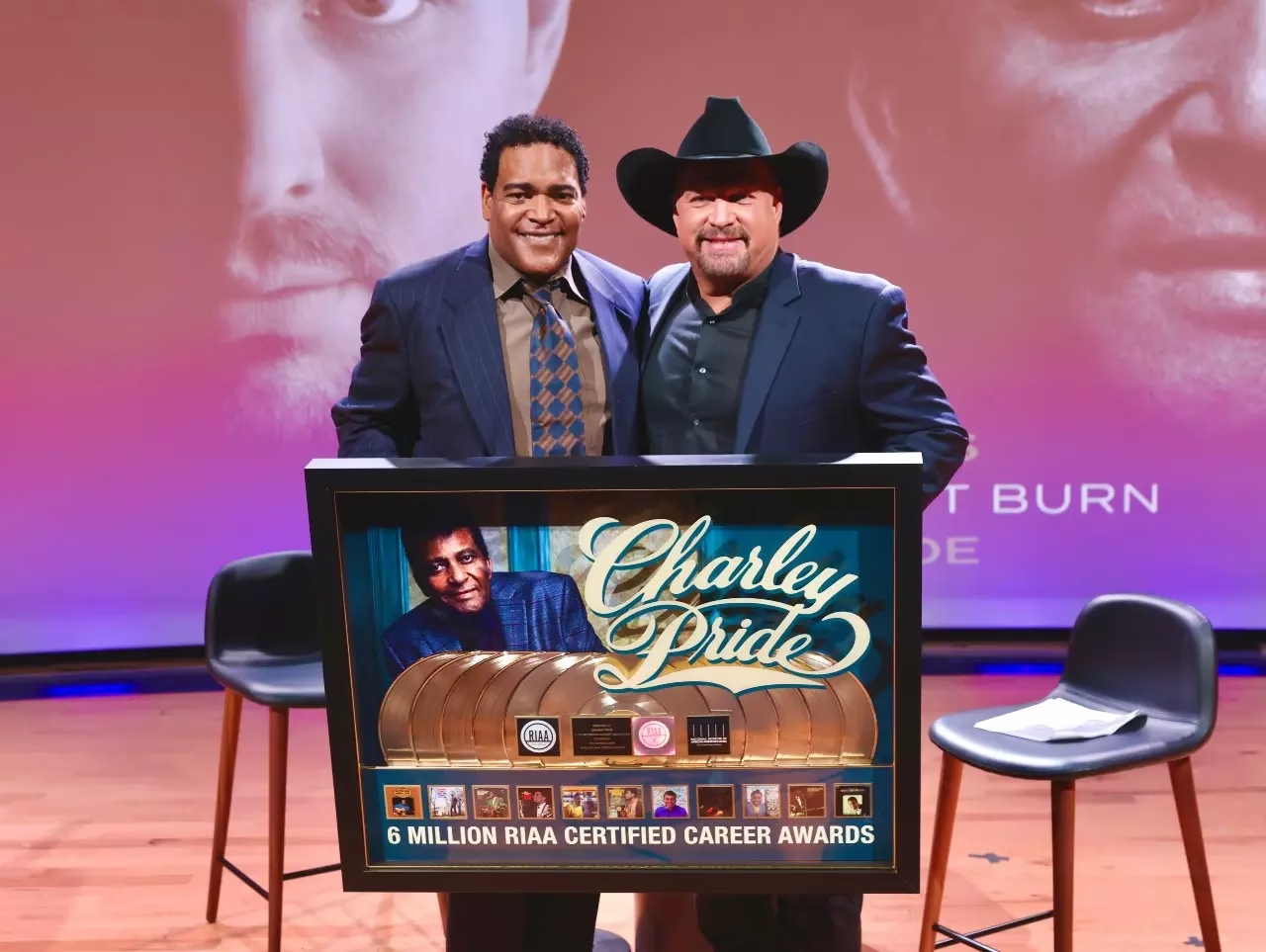
Garth Brooks is the biggest-selling solo artist of all time in any genre; Charley Pride was unfairly, bizarrely viewed as an outlier in country music due to being a Black man. But at the Country Music Hall of Fame in 1991, it was Pride who assured Brooks that he was meant to be there — not the other way around.
"You're at the CMA Awards as a new guy, man. You just try to melt into a wall somewhere," the two-time GRAMMY winner recalls to GRAMMY.com over FaceTime, illustrating his impostor syndrome. "And Charley Pride comes and seeks you out, with that beautiful gap-toothed smile. The first thing he asked Brooks? "Hey, you're an Aquarian, ain't ya?" — because he had researched his birthday in advance.
Such was and is the beauty of Pride, the country music icon and three-time GRAMMY winner. On Dec. 12, 2020, Pride passed away of complications from COVID-19, just a month after appearing at the CMA Awards. As the first anniversary of his tragic death loomed, Brooks took the stage on Oct. 25 at the National Museum of African American music, where the RIAA honored Pride with a posthumous Lifetime Achievement Award. There, Brooks paid homage to his fallen hero.
Read More: For Charley Pride, Black Country Music Was A Self-Evident Truth
This tribute included Brooks' renditions of songs made famous by Pride, including "Mountain of Love," "Kiss an Angel Good Mornin'" and "Is Anyone Goin' to San Antone." Regarding Pride's uncanny range, Brooks says the latter song is nothing short of an endurance test: "You just push the pedal all the way to the floor and try to hang on to that song for as long as you can."
All in all, Pride's gargantuan talent, whole-hearted humility and aw-shucks sweetness doesn't just make Brooks a fan: "I absolutely worship him," he says. And about the roadblocks Pride faced due to his melanin content: "How much bravery, how much courage, but how much confidence in yourself you must have to survive that and still have the attitude that you have!"
GRAMMY.com caught up with Brooks to discuss his appearance at the National Museum of African American music, what Pride means to him and his 2021/2022 touring plans — which, yes, will require proof of full vaccination to behold in person.
This interview has been edited for clarity.
It's crazy to me that Charley Pride got any grief for being a Black man in country music, when Black people invented that style of music.
It's funny, because when you say that — when you talk about Charley Pride and his music — the fact that he was a Black guy is nothing. It doesn't matter.
This is the statement that I made last night, and I need everybody to hear the whole thing: When it comes to Charley Pride being a Black guy, it did not matter. But it mattered so much that Charley Pride was a Black man.
So, in the places where it shouldn't matter, it didn't. And in the places it should matter, it did. One hundred percent. He walked that line so good. He seemed to be the only guy who really didn't have an issue with it, you know what I mean? It just seemed natural to him.
And what I loved about last night, too, when you talk about all artists that can sing any format, you're going to see them do this and that. He could have sung anything he wanted, but he chose country music. I absolutely worship him for that reason.
How did the night go? How did it feel to pay homage to the man?
It was cool. We started the whole night with, "Hey, look, when you talk about black and white" — especially with journalism. My major was in journalism, so I have this ultimate worship and respect for journalism. But in this time, journalism is looking for any kind of slip or anything they can to put the two against each other.
So, the first statement I said last night was, "This is all going to be about love — all about a man who was all about love. To listen to the heart and sincerity of two guys that loved one another." That immediately diffused the whole black-and-white thing.
And even though Alice Randall, a friend of mine who was doing the Q&A, touched on the black-and-white thing a couple of times, it was nothing in a poking kind of way, but more in a salute to a man.
Me and you are probably like this — I think we're all like this — our biggest enemy in our whole lives is going to be ourselves. It just is. We're the reason why we succeed and fall so many times. He had that same enemy, but after he cleared that hurdle, he was staring at a wall that most of us didn't have to stare at.
Again, that's another reason for my respect and love for him to go through the roof.
What internal hurdles are you referring to, as far as Pride is concerned?
We shoot ourselves in the foot every time. Our own ego. It's not just country singers; it's you, me, my wife, everybody. Our biggest enemy is ourselves. Our imaginations scare us out of doing a lot of things we should do, and our own ignorance [Chuckles] talks us into doing things we shouldn't do.
We all have those internal wars, but once you clear those and take a deep breath — "OK, I got through that part of my day" — he was staring at being a Black guy in country music. He was staring at a bigger hurdle than any of us who is not a Black guy in country music was going to face.
He always seemed to approach the topic with either indifference or humor, and he didn't have to do that. He could have rightfully felt victimized, but he chose not to.
Yeah, but his talent was also his strength enough to get through anything. In a controversy, it's going to come down to physical, always. It's when strength gets to have the upper hand. With him, any controversy is going to come down to talent: "Step up. You try to sing 'Roll On Mississippi' every night, because the lows are extremely low and the highs are extremely high."
I hate trying to sing that song [Laughs]. I did it last night to embarrass myself, to show everybody — because I'm pretty proud of my range. I don't know how that guy did it — and he did it every freakin' night! That's the crazy thing.
He was pretty much the quintessential country singer in every possible way.
Isn't that great? That's a great way to put it. And, oh yeah, he's Black! [Laughs.]
His voice disarmed people. It made me a fan. My mom loved "Kiss an Angel Good Mornin'"; that was her song. So, I already loved him before I knew anything about him.
Tell me about your history with Pride, coming up in the country world. What did he mean to you through the years, leading up to this night?
Well, you have your idols, your heroes. Buck, Haggard, Jones, Pride — that era of guys.
Then, you're at the CMA Awards as a new guy, man. You just try to melt into a wall somewhere, and Charley Pride comes and seeks you out. [Voice grows hushed.] With that beautiful, gap-toothed smile. And the first thing he says to you: "Hey, you're an Aquarian, aren't ya?" He knew everybody's sign. He knew everybody's birthday.
I was telling this story last night: One of my really, really sweet gifts that I did and do not deserve was, when you become a member of the [Country Music] Hall of Fame, for some reason, they'll trot out all the members right before the show starts. And for some reason — I don't know why — every year, Charley Pride and I sat together. It was just the order they put us in.
I couldn't figure it out, because it was never alphabetical, but I was always sitting next to Charley Pride. I just loved it, man. He was so much fun to be around and be with, and in between the awards, he'd tell you stories about the person who was there. He knew a lot about everything.
Including your birthday!
Yeah! And if he knew you, he'd know your birthday as well! That's just the kind of guy he was. He was great with numbers, and what an unbelievable memory.
If that's not enough, he would sit there and always kind of poke or touch you before he talked to you. He'd reach over and grab your knee and go [Sings] "I went to work for her that summer!" And you're thinking, "Charley Pride's singing a Garth Brooks song! It's so good!"
He made you feel like you belonged, and you don't. You're a new guy. Even if you're in the Hall of Fame, you don't belong with those names. But he made you feel like you do.
I love that you illuminated what a great singer he was by poking fun at yourself a bit.
He was also what I call an "against-the-wall" singer. He had this real push in his voice. That's how he jumped off the radio. So, if you're going to imitate Pride, get ready: It's going to take everything you've got in your chest to get it out.
Like, "Is Anyone Goin' to San Antone": You just push the pedal all the way to the floor and try to hang on to that song for as long as you can. And, again, knowing that this guy did this every night — "Mountain of Love," so many good, good things that this guy did.
I think my favorite part of last night was Dion, his son. Because the truth is, you're only a good person if your children are good people, because it means you're focused in the right areas, right? That kid is as sweet as his dad, as articulate as his dad. Not as outgoing as his dad, but more reserved, which makes you love him even more.
Beautiful kid, like his dad. I mean, when you look at him, you go, "Holy s***! It's Charley!" Charley is well-represented in the next generation by his son, and his son is not trying to be Charley Pride's son. Dion is trying to be Dion at the same time.
He understands the weight that's on his shoulders of representing his father and [his mother] Miss Rozene in such a way. He does it well.
Looking at the big picture, this part of music history still doesn't make sense to me: Why would a Black-founded style of music flip to where Black artists were seen as interlopers?
I don't know — I don't know the history all the way back like you do. I can just tell you this: There's a guy named Buddy Mondlock, and he's a singer/songwriter out of Chicago. He's got this song, and it's a beautiful song ["No Choice"], about why this guy did what he did.
So, let's talk about why Charley Pride ended up singing country music: Buddy Mondlock's song says, "He had no choice." It wasn't like, "I'm going to choose this or this." He had no choice, because his heart and soul told Charley Pride, "You're going to be a country singer. Not just a country singer — you're going to be one of the greatest ones ever."
What I love is that Charley never questioned his faith: "If that's what I'm supposed to do, then that's what I'm supposed to do. Well, here comes all the hell and high water that comes with being a Black guy being a country singer in the '60s."
Jiminy Christmas! How much bravery, how much courage, but how much confidence in yourself you must have to survive that and still have the attitude that you have! Never once did I hear him bitch about anything. He was one of those guys who said, "OK, if you're going to make my track twice as long, I'm going to roll up my sleeves and I'm going to run twice as fast."
You see that work ethic in Reba McEntire. You see it in Dolly Parton. You can see it in the greats out there: "Hey, if this is my road, then this is what I've got to do, because I have no choice, and I firmly believe that." I think Charley believed that as well.
I think you encapsulated your feelings on Pride well. What else is going on with you lately?
Nothing, man. In a pandemic, you're trying to do your best to be something good for society, so we're set on the stadium shows — kind of opened the dive bar tour back up a little bit, because those are going to be fully vaccinated. I think we're doing the Ryman; it's about 1,500 seats, fully vaccinated.
So, we'll do this probably until the end of this year, and then in '22 we'll start the last year of the stadium tour. It was supposed to end around the late summer of '22; that still is the plan. We've lost a lot of cities in the pandemic. It breaks my heart. There's some cities I really, really wanted to play in that we're just not going to get to.
But, hopefully, we'll finish up in '22 and figure out what we're going to do after that. Being married to somebody 10 times more talented than you makes you go, "Hey, what does she want to do, and do I need to be by her side when she does it?" So, we're going to have a conversation and see what we're going to do after the summer of '22.
Garth Brooks. Photo: Diana King
I appreciate you being so conscientious about vaccination. Some artists I won't name are jumping out saying, "I won't play there!"
[Laughs.] Hey, man, just remember: If it's not a law, then it's a choice. As much as you might respect or not respect people's choices, still: Be prepared for them to make that choice. So, until it becomes a law, that's all we can do.
So, to Nancy [Seltzer], my publicist, I said "What do I do?" She said, "You don't have to do anything. You don't have to tell people to do something. Just tell people what you've done." I'm fully vaccinated. The tour is fully vaccinated. That's how we roll. And I get it if that's not how you roll, but that's what we do.
Anything else you want to say about Pride or yesterday evening?
No. Since you're 40 years younger than me, anything you can do — and your generation can do — for Charley Pride, I would appreciate as a country music fan.
Charley Pride Honored With GRAMMY Museum Mississippi's Inaugural Crossroads Of American Music Award