Yahritza Martinez grew up hearing her father and uncle play música de tierra caliente, regional Mexican music played on violins, guitar and percussion from the states of Michoacán and Guerrero. Even as a child, she astounded her family with the potency of her crystalline, soaring voice as she sang along.
Now 16, Yahritza is one of a growing number of young Mexican and Mexican American women who are adding their own swagger and sentiment to regional Mexican. Together, they are having a profound impact on a genre that is experiencing phenomenal growth.
The regional Mexican music movement is clearly having its "Despacito" moment — as of April, 14 regional Mexican tracks appear in the Billboard’s Hot 100, after only landing on the charts three times since 1958. 2022 stats from Spotify place regional Mexican’s streams up 450 percent over the last five years — female voices are largely absent.
Regional Mexican is a general label that groups different styles of music incorporating the rural folklore of Mexico’s extensive geographies, often from an Anglocentric perspective. This can include styles such as banda Sinaloense, corridos, Sierreño, conjunto Norteño, corridos tumbados, and even mariachi, cumbia and son jarocho.
The difficulty female artists have breaking into the genre are multifold. In an industry discussion on the challenges of breaking female acts in regional Mexican, it was noted that 80 percent of the genre's consumers are male. However, the audience would likely be more gender-diverse if there were more regional Mexican songs written by women or for them — and that is definitely changing.
In April 2022, 15-year-old Yahritza became the youngest Latin artist ever on Billboard's Hot 100 chart — a record held for over 60 years by Ritchie Valens — for her heartfelt breakup ballad, "Soy El Único." Expressed from a male perspective, it was the first song Yahritza ever wrote, inspired by the heartbreak comments of other TikTokusers. The same year, Yahritza y su Esencia, a band formed with her brothers Mando and Jairo, received a Latin GRAMMY nomination for Best New Artist.
It's an equally astounding achievement that Yahritza y su Esencia broke into the infamously hyper-male regional Mexican movement. To date she is the only female voice (albeit in a family band) on the popular 50-song Spotify playlist Sad Sierreño, her particular realm of the genre.
A History Of Regional Mexican Music
The variants of Norteño (regional Mexican that originated in northern Mexico and the southwestern United States) play particularly important roles in the collective Mexican American soundtrack. And many of these are based on the corrido, narrative songs born in the 1800s. Throughout the War for Independence and then the Revolution, corridos narrated the triumphs of heroes, their battles, epic adventures and even their horses. These musical stories also came to extol the virtues and lives of admired community members, hard-working people and immigrant struggles — a notable exception being the Narcocorrido subgenre that glorifies the exploits of drug lords.
Yet, these songs — even when sung by women— always centered the male point of view and were frequently imbued with a toxic masculinity. As Maria Herrera Sobek, Professor Emerita in Chicana and Chicano Studies at the University of California Santa Barbara notes, even corridos that sung the praises of iconic women figures such as the soldaderas — the female soldiers and heroes of the revolution — did so from a masculine perspective.
"The Mexican ballad is really one of the very few, if not the only one, which is still a living tradition," Herrera-Sobek continues. Consequently, Mexican ballad forms will continue to evolve and reflect current circumstances.
In the mid-aughts, two subgenres began iterating on traditional ballads: Urban or trap corridos tumbados blended hip-hop, trap and Norteño. Elsewhere, nostalgic Sierreño folk music from Mexico’s northern mountain ranges, acquired a bedroom pop sheen and spread through social media, driving the popularity of so-called sad Sierreño, songs of amor and desamor.
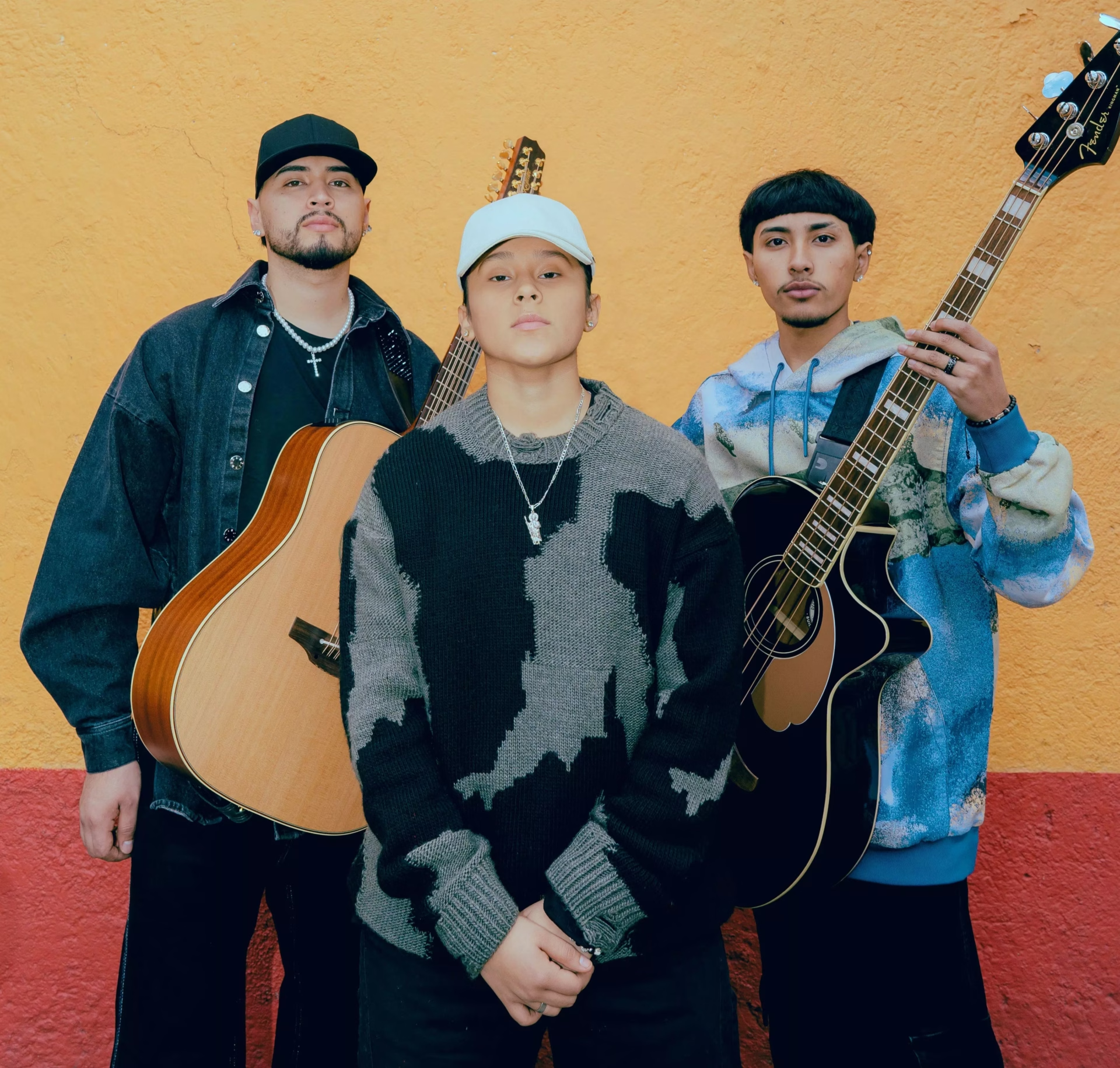
Yahritza (center) y Su Esencia | José Alavez
This new regional Mexican toggles between the urban and the emo, and has found Gen Z fans on both sides of the border. And while women were largely absent from those early urban corridos and sad Sierreños, they are now creating music that is unapologetically Mexican and female.
There are now four recording artists or bands that are creating a new narrative and centering female voices. By simply singing in styles which have long been defined by and created for men, artists like Yahritza y Su Esencia, Lluvia Arámbula, Ivonne Galaz and Conexión Divina are bucking centuries-old norms and codes.
Meet Regional Mexican Music's Mujeres
Zooming in from Argentina, where Yahritza y Su Esencia are performing at a conference, Yahritza declares that being a role model to other young women makes her feel grateful. "There's girls on my live that are like, 'I started playing the guitar because of you. I started singing because of you'," she tells GRAMMY.com. "'My confidence is now up because of you..' There was one girl that was like, 'you saved my life.'"
It wasn't an easy start, she notes. She was shy, a bit scared to sing, and worried about what people would say. But her potent voice, and the magic power of loading it with emotions, "helps me connect with so many hearts." With a soft smile she adds, "A lot of people say that I have an old soul."
Born in Oklahoma, 19-year-old Lluvia Arámbula is an accomplished requinto guitarist. She made a somewhat casual foray into regional Mexican music. "I just liked how everybody was doing the movement. And then I saw that there was no girls too, so I was like, well, let's do it."
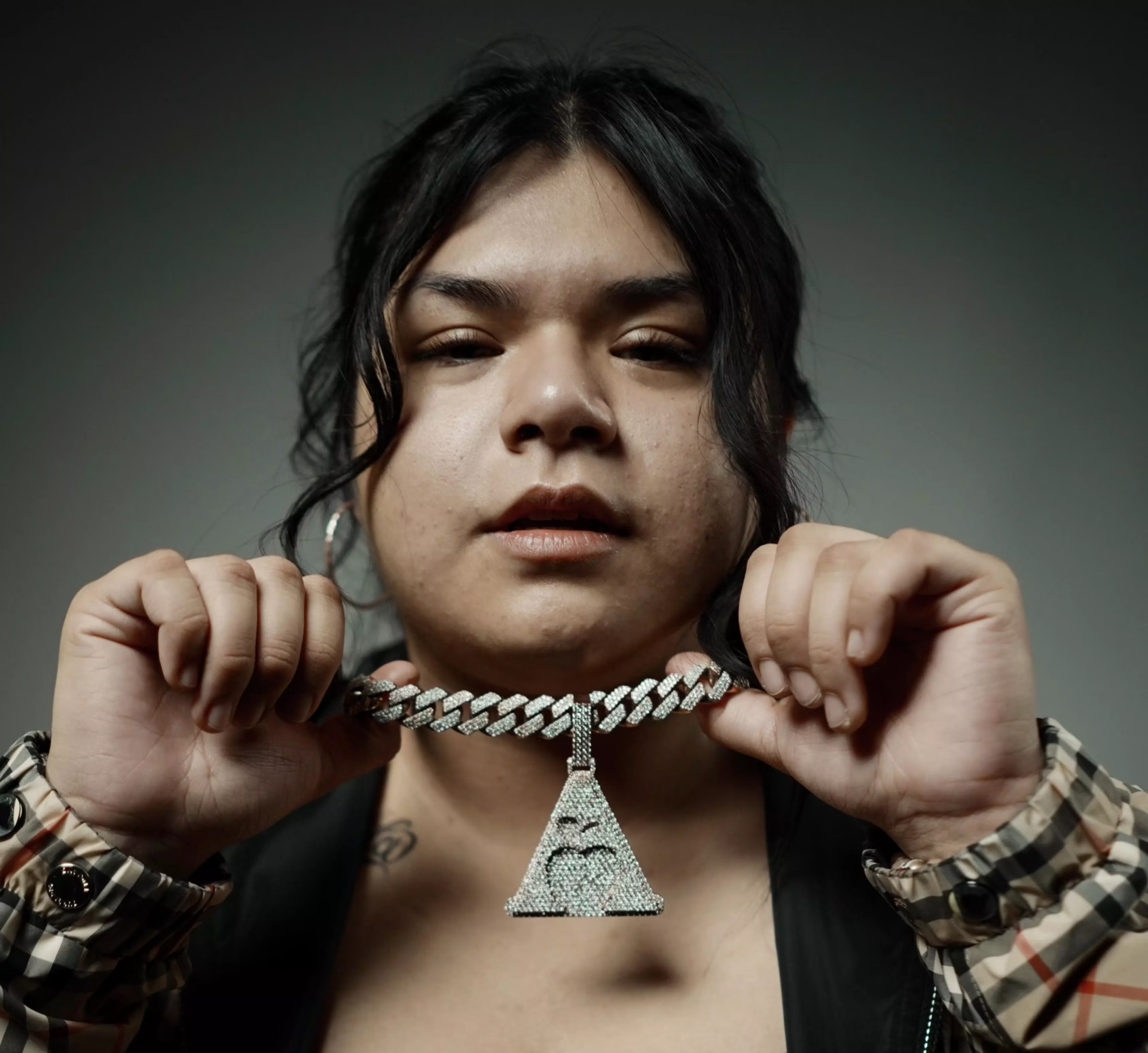
Lluvia Arámbula | Photo by Barf
Her first musical loves were Sierreño and corridos, but she didn’t want to make the corridos tumbados. She preferred a more upbeat sound, writing and singing what she calls "corridos alterados'' that boast fast, word-packed flows. Strong, direct emotions play into her music’s power, offering inspiration "about, going forward, never stopping."
Arámbula has also become a model for young women. "Girls ask me for stuff about my life so that they can do essays about me in school!" she adds.
And for Arámbula, going forward in the Regional Mexican genre also means ignoring the critiques. As she entones in her song " "La Reina," (The Queen), "Criticism is raining down, but that won’t make me stop following my dreams."
Ivonne Galaz, also 19, hails from Ciudad Obregon, the second-largest city in the state of Sonora and the second most violent city in the world. The state also has one of the highest rates of femicide in the land, so it is no surprise that Galaz is a vocal defender of women’s rights. In 2022, Galaz released a tribute corrido, "Vanessa Guillen" in honor of the Latina U.S. Army soldier slain by a male soldier (The song was also included in the Netflix documentary on Guillén’s life).
Galaz grew up back and forth between Mexico and the U.S., but notes she is "100 percent Mexican." Galaz is the first female signee to Rancho Humilde, the record label responsible for the ascent of many of regional Mexican’s stars, including corridos star Natanael Cano. The first song she ever wrote, 2019’s "Golpes De La Vida," was recorded with Cano and now has more than 5.5 million views on YouTube. In 2021, Galaz released her first studio album, Voy En Camino.
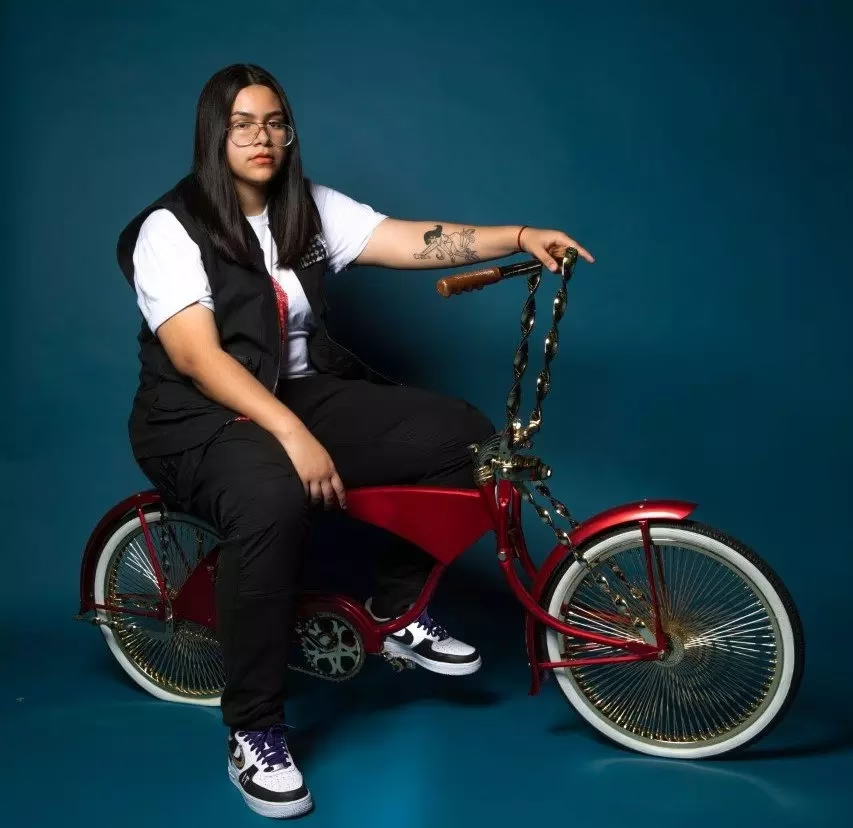
Ivonne Galaz | Courtesy of Rancho Humilde
Galaz's commitment to inclusivity appears throughout her music performances, where she switches pronouns in songs to make all feel welcome. "If you tell me, ‘I don’t feel comfortable with you identifying me as a woman’, I respect who you are and will never disallow your rules, how you dress, how you feel," she says.
Galaz also shrugs off criticism that she dresses like a man. "I’m not all about the little dresses," she says. "Girls told me on tours, that thanks to me, they took courage to dress the same way."
The trio Conexion Divina’s hashtags on social media tell their story succinctly and elegantly, indicating: their three instruments #bajoloche #requinto #guitarra, musical philosophy #mujeresqueinspiran #grupodemujeres (women that inspire, womens’ band), and the importance of representing Mexico #musicamexican #vivamexico #regionalmexicano.
Liz Trujillo, Sandra Calixto, and Ashlee Valenzuela are 18, 20 and 23 years old and grew up in California, Texas, and Arizona, respectively. Conexión Divina released their debut album, Tres Mundos, in April. The trio is the first ever all-women Gen Z Sierreño group, and the first Sierreño group to perform at the 2023 Coachella Valley Music and Arts Festival.
They met online and moved to L.A. where Trujillo was based, to make music together. As they explain on Zoom from L.A, they took their name in part from "Mujeres Divinas" (Divine Women), sung by the legendary Vicente Fernandez. But they didn’t want to be "like the cringey mujeres divinas," and they also wanted to make note of the online origins of their musical bonds, hence, the divine connection.
Self-taught musicians, they quickly realized that the regional Mexican music they loved was "all guys, no girls," says Valenzuela. They were often not taken seriously, but never let this hold them back.
The motifs on their guitars express their boundary-breaking perspective, with each instrument wrapped for each artist in their favorite color and something that represents them. Valenzuela chose the image of Poison Ivy for her guitar because "she empowers women in a different way. Because for me, she's a bisexual character, and I really related to her." Trujillo chose Ellie from the video game "The Last of Us," because as a gay character, "[Ellie] is just like everything that I aspire to be." The pink motifs on Calixto's guitar represent her femininity. "[I'm] the more girly one," she says.
The young women interviewed for this piece note the pushback for their choice of genre — especially, but not exclusively, from Mexico’s more traditional audiences. But they are not without role models.
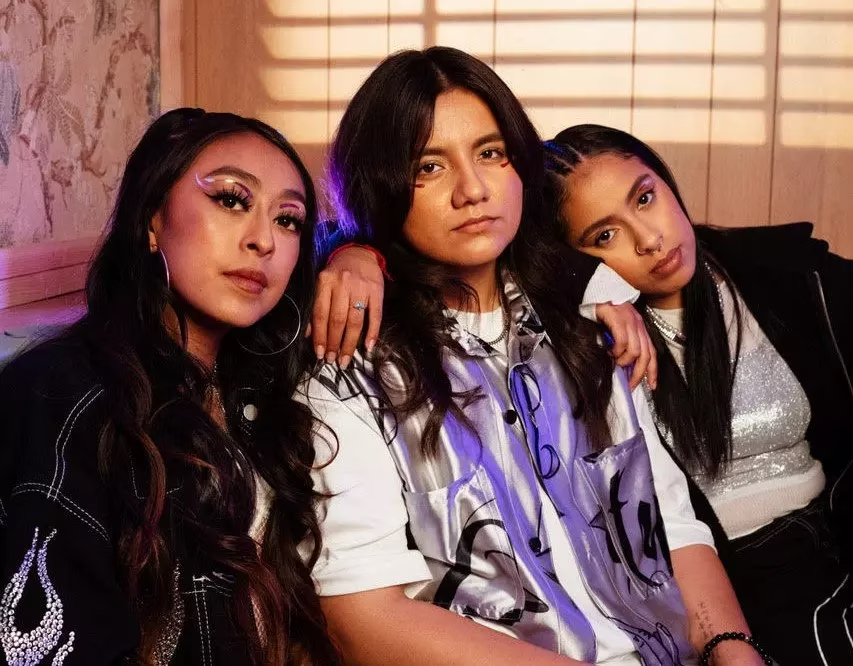
Conexión Divina | Camila Noriega
Rather, they further the musical path first forged by two female regional Mexican singers, who were born within a year of each other on either side of the border in the early 20th century: Texas’ Lydia Mendoza, whose "Mal Hombre" sang of a man who abandoned her (but hardly from a position of weakness), and ranchera diva Chavela Vargas, who came out at age 81. Both of these fierce artists left their mark on their genres and broke molds limiting women artists.
Mendoza shaped Tejano music and was first the genre’s female icon. In 1982, she became the first Texan to be awarded the National Endowment for the Arts’ National Heritage Fellowship Lifetime Achievement. Vargas, a globally beloved, pivotal figure in Mexican music and icon in the Spanish-speaking LGBTQ community, changed Mexico’s ranchera music with her unique interpretation and performance style.
This new generation of female regional Mexican musicians also noted the pioneering influence of Jenni Rivera, the fierce Paquita del Barrio, Gloria Trevi, Latin music’s first female rock star, Mexican no-holds barred singer Ana Gabriel, and beloved borderlands songstress, Selena. Collectively, they upended expectations for women in Latin music, while appealing to ever-broadening audiences — a trend the Gen Z regional Mexican artists are continuing today.
Using their music as an instrument to build the future, they express and foreground a binational, bicultural identity that has no need for the approval of the male gaze. In the lyrics of her anti-femicide song, "Ni Una Más" (Not One More), Galaz rejects a saying common to several Spanish-speaking lands, "Calladita te ves más bonita," or "You look cuter with your mouth shut." As she entones in another of her songs, "Empoderada," "That woman cannot be stopped. She knows what she is worth, always empowered."