Since the first GRAMMYs in 1959, The Recording Academy has awarded 67 songs with the golden gramophone for Song Of The Year.
One of the most coveted awards alongside Record Of The Year, Album Of The Year and Best New Artist, Song Of The Year honors "artistic achievement, technical proficiency and overall excellence in the recording industry, without regard to album sales or chart position."
In recent decades, the award has gone to smash hits like Beyoncé's "Single Ladies (Put a Ring On It" and Ed Sheeran's "Thinking Out Loud," served as validation for headline-making singles like The Chicks' "Not Ready to Make Nice" and Childish Gambino's "This Is America," and helped coronate new stars in the industry including Alicia Keys ("Fallin"), Lorde ("Royals") and Sam Smith ("Stay With Me").
"I am always interested, and have always been interested, in the Song Of The Year Category," says Brandi Carlile, herself a four-time nominee in the Category for songs like 2019's "The Joke" and 2022's "Right on Time." "I think it pushes the culture forward sometimes; I think, sometimes, it follows the culture when it's appropriate. And I also think sometimes it might give a truly great song a second wind or a breath of fresh air if everybody didn't get it the first time."
On Dec. 27, CBS aired "GRAMMY Greats: The Stories Behind The Songs," the very first primetime TV special ever dedicated to the Category's many winners — from Bruce Johnston and Michael McDonald and Kenny Loggins to Lady A, Adele and the late Luther Vandross — and the unforgettable songs that helped them take home GRAMMY gold.
Below, dive into five of the most interesting moments from the holiday special, including confessions and revelations from Billie Eilish, Sting, Bonnie Raitt, Mark Ronson, John Mayer, and more.
Billie & FINNEAS Detail Their Sibling Magic
As co-host Mickey Guyton pointed out early in the special, the 2020s are only halfway over, but one pair of sibling songwriters have already earned Song Of The Year not once, but twice during the decade. That's right: Billie Eilish and her brother Finneas O'Connell took home the award first in 2020 with the then-teenage pop phenom's breakout single "bad guy," then again four years later thanks to "What Was I Made For?," Eilish's delicate, heart-rending contribution to the Barbie soundtrack.
During the segment, the brother and sister opened up about the songwriting process behind their growing catalog of generation-defining hits.
"At this point it's become extremely 50/50," Eilish said, with O'Connell jumping in to add, "If we had to distill it down, the most common thing is I'm sitting at an instrument and Billie is singing a melody, and we're coming up with the lyrics at the exact same time. We're coming up with the lyrics like you're hitting a tennis ball back and forth."
And while Eilish still counts the 2020 GRAMMYs — where she swept all four major categories, as well as Best Pop Vocal Album — as "the most insane night of my life to this day," her elder brother pointed to the timeless quality of "What Was I Made For?" as one of the reasons the song is so special to them both. "To me, it was such a traditional piece of music we'd written," he said. "It was just a song that you might've heard 50 years ago. And that was exciting to me, to see that it had just as much value — that it was a form of art that had never lost any currency at all."
Mark Ronson Remembers Amy Winehouse
Amy Winehouse proved to be a once-in-a-lifetime talent when she burst into the global zeitgeist with her 2006 sophomore album, Back to Black. The record spawned hit singles like "Rehab," "Back to Black" and "Love Is a Losing Game," and went on to win the newly minted superstar five GRAMMYs in 2008, including Song Of The Year and Record Of The Year for "Rehab" and Best New Artist.
As producer Mark Ronson revealed during the special, the jazzy, tossed-off hook at the center of the GRAMMY-winning smash ("They tried to make me go to rehab, I said no, no, no") came directly from a then-healthy and sober Winehouse as they wandered around the Soho neighborhood of New York City. "Just the way that she said it, it had, like, this cadence to it, and it was a hook," he said. "It was just literally her walking down Spring Street and the hook came out of her mouth."
Sadly, Winehouse's personal struggles with addiction, as well as issues securing a visa, made it impossible for her to attend the GRAMMYs in Los Angeles. Instead, The Recording Academy organized a live satellite feed from London, allowing the embattled singer to perform a triumphant medley of "You Know I'm No Good" and "Rehab" and accept the most awards of the evening with a humble, wide-eyed acceptance speech for Record Of The Year with her mom by her side ("This is for London, 'cause Camden Town ain't burnin' down!").
The modern legend would tragically succumb to her battle with alcoholism just three years later, passing away from alcohol poisoning in July 2011 at the age of 27. And while Winehouse never completed a follow-up to Back to Black, her triumphant night at the GRAMMYs will always stand as a crowning moment in her legacy.
"It was one of the most emotional moments that I ever remember," said Republic Records CEO Monte Lipman during the special. "And so much of it was just watching Amy Winehouse deliver. And what I consider, arguably, her best performance. Because [of] all the trials and tribulations and adversity that she had to overcome, what she was dealing with, her own demons, her own addictions. And to bring so much joy and so much happiness in that moment, and I know she was so proud…"
Read More: How Amy Winehouse's 'Back To Black' Changed Pop Music Forever
Bonnie Raitt Reflects On Her Surprising Win
Nearly 35 years after her first win for Album Of The Year, Bonnie Raitt was something of an underdog going into the 2023 GRAMMYs. The veteran singer/songwriter had been awarded a Lifetime Achievement Award the year before, but faced stiff competition, as her 2022 single "Just Like That" was up for Song Of The Year against chart-topping hits by the likes of Taylor Swift, Harry Styles, Adele and more.
So the famous redhead insists her look of slack-jawed surprise was completely genuine when First Lady Jill Biden read her name as the Category's winner. "I actually covered my face walking up there because I didn't want them to read my lips. 'Cause I had to just frankly say, 'Can you f—ing believe it?'" Raitt quipped with a laugh.
"I wanted to write something that wasn't just about pain and suffering, but about the possibility that we all have to be redeemed," she explained about the uplifting ballad, which unfurls the tragic story of a woman who accidentally causes the death of her son in a moment of distracted driving, only for his heart to save the life of a stranger via organ donation.
In a roundabout way, Raitt's first-ever Song Of The Year win may have even inadvertently influenced President Biden sweeping policy changes to the United Network for Organ Sharing (UNOS), which occurred shortly after she received the award from his wife on the GRAMMYs stage.
"Maybe she went home and they played the song for her husband," Raitt speculates. "All I know is a couple of months later, he announced the overhaul of the system of organ donation in this country. So I don't know if it was directly related, or just coincidental, or in the zeitgeist…"
Sting Reveals James Bond's Connection To His Biggest Hit
Remarkably, Sting remains one of the few artists in music history to miss his Song Of The Year moment on the GRAMMYs stage. When "Every Breath You Take" was announced as the winner at the 1984 ceremony, the rock legend and his band, the Police, were on tour in Australia — in fact, the moment Sting got the news, they were all partying poolside with none other than Willie Nelson in Perth.
Given its enduring popularity, Sting is the first to recognize the dual-edged meaning fans take from "Every Breath You Take." "The song is my most successful song, it's also the most ambiguous song I've ever written. Some people think it's a romantic love song, other people think it's about a stalker," he acknowledged during the special. "And I never contradict either party, I think it enriches the song."
Come to find out, part of the song's element of mystery was partly inspired by the character of James Bond, as Sting was living at author Ian Fleming's Jamaican estate when he wrote it. "There is something of James Bond in that," the rocker continued. "You know, he is our guy. He saves the day, but he also kills people. So that kind of two-faced idea is something that intrigues me — and intrigues me to this day."
Hilariously, Sting also sheepishly confessed to sneaking a peek inside the envelope revealing the winner for Record Of The Year in 1994, just moments before he took the stage to perform "If I Ever Lose My Faith In You." The song was nominated for the major award, which ultimately went to Whitney Houston for her career-defining version of "I Will Always Love You."
"I didn't want that distraction," he said, of worrying during the performance about whether he was going to win. "So it was a great relief to me, and Whitney deserved to win, absolutely. But it allowed me to do my job properly."
John Mayer Revisits Breaking His GRAMMY For Alicia Keys
John Mayer won his first — and so far only — GRAMMY for Song Of The Year in 2005 for his fan-favorite track "Daughters." But even during the ceremony, he wasn't confident his "really circular composition" was most deserving of the prize.
"When Alicia Keys played 'If I Ain't Got You,' I remember watching it from my seat and going, 'That should win," the seven-time GRAMMY winner said. "It was a tremendous song, performed tremendously, and I went, 'That would be okay.' Maybe somewhere between 'I can accept that' and 'That should probably win.'"
Ultimately, though, Mayer took home the GRAMMY, and sweetly dedicated the win to his grandmother during his acceptance speech.
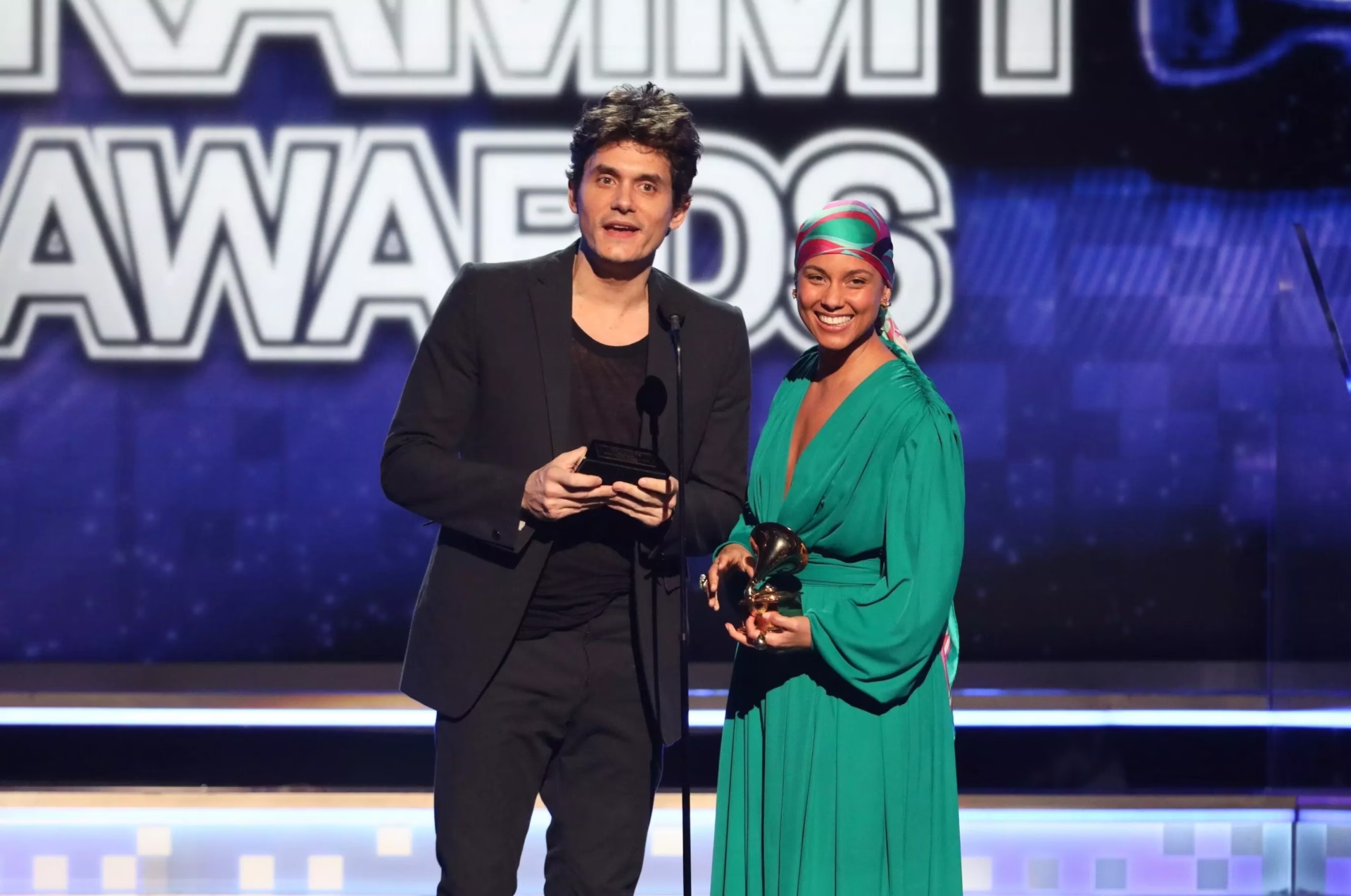
Fourteen years later, Keys playfully acknowledged her loss to Mayer while hosting the 2019 ceremony ("I ain't got that GRAMMY," she ad-libbed with a grin) before revealing that the Continuum singer actually broke his GRAMMY in two pieces and presented the top half to his pal, writing her name and song title on it. To complete the bit, Mayer joined Keys on stage during the 2019 telecast to reunite the two parts of their shared GRAMMY, joking, "This has got to be the coolest joint custody agreement in showbiz history!"
Looking back on his decision to share his big GRAMMY win with Keys, Mayer had no regrets. "When someone writes a really great song, songwriters win," he said with a smile. "There's an afterlife for a hit song — and it either gets thought of as sort of a time capsule for a moment or it carries on. Both Alicia's song and my song, thankfully, stood the test of time, and so I gave the top half of the GRAMMY to the right person."