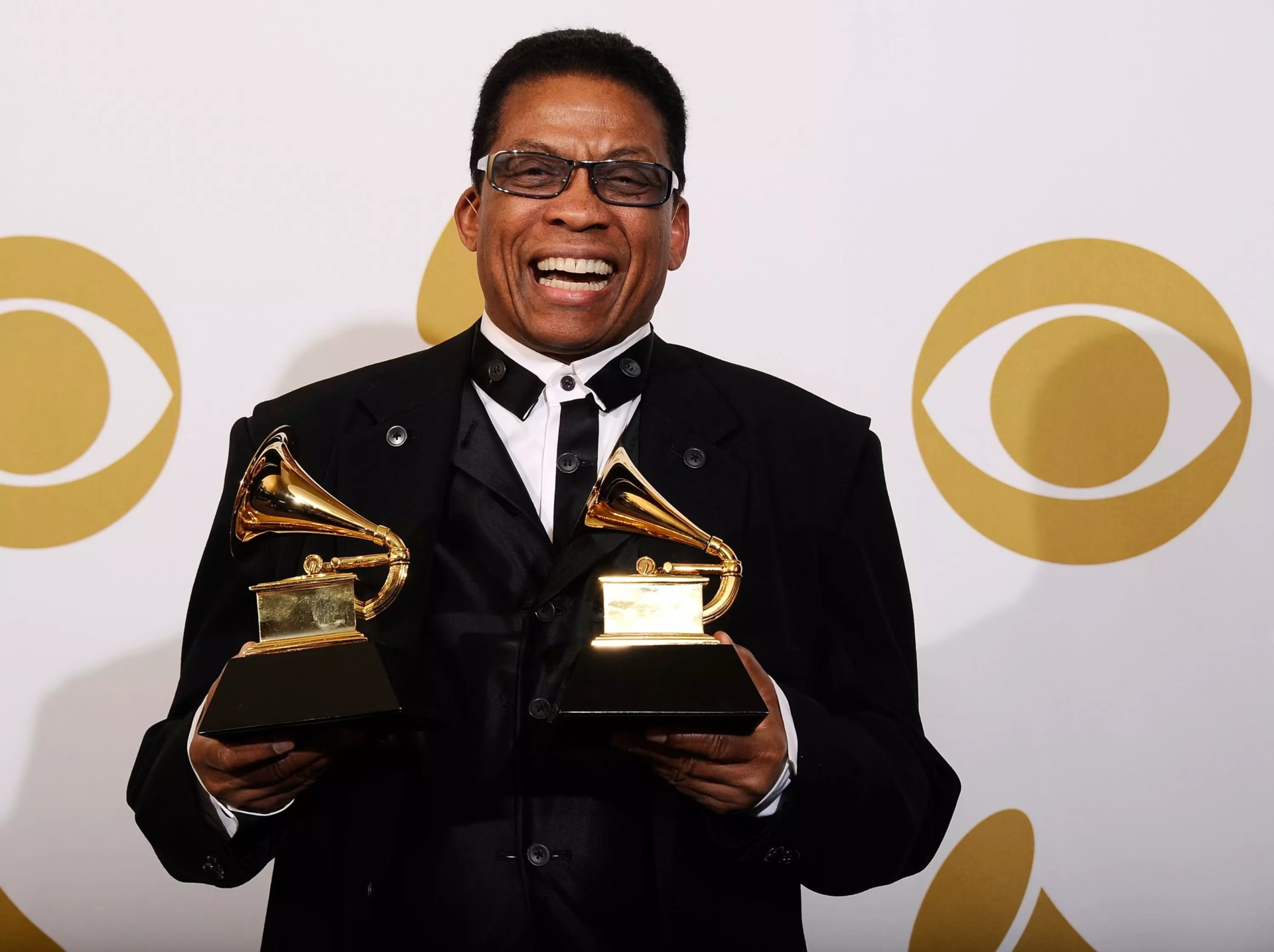
(On Nov. 4 Herbie Hancock will participate in GRAMMY U Off The Record With Herbie Hancock, an exclusive live Google+ Hangout On Air hosted by Flying Lotus.)
At age 11, piano prodigy Herbie Hancock won a performance competition sponsored by the Chicago Symphony Orchestra. The good news: His prize was to perform Mozart's Piano Concerto No. 18 with the CSO. The bad news: The orchestral parts went missing and Hancock would have to learn a new concerto or forgo his prize. In record time, Hancock learned Mozart's Piano Concerto No. 26 and his performance was ultimately a success. He was even asked for his autograph.
A few weeks later his piano teacher, Mrs. Jordan, took him to see Dame Myra Hess perform with the CSO. Surprisingly on the bill was Mozart's Piano Concerto No.18. "It would have been easy to feel suspicious, to wonder whether someone at the CSO just wanted to discourage the young African-American kid who'd surprised everyone and won their prestigious competition," Hancock explains in his new autobiography, Herbie Hancock: Possibilities. "But even at age 11, I tended to ignore possible racial slights … it was just my nature."
From vivid childhood recollections to tales of performing onstage or in the studio, racing up 6th Avenue in his AC Cobra alongside Miles Davis in his Maserati or floating down the Gambia River with Kermit and Miss Piggy, demonstrating an Ensoniq Mirage portable sampling keyboard, Hancock's book chronicles his fascinating career, a journey that has spanned seven decades and work with a cast of musical greats — from Benny Goodman and Tina Turner to Paul Simon and Carlos Santana.
In an exclusive GRAMMY.com interview, the 14-time GRAMMY winner discussed the most difficult part of writing his book, the improvisatory nature of classical music, why breaking the rules in music is important, and how misunderstanding Davis turned out to be golden.
What propelled you to write your memoir now?
[There are] some life lessons I wanted to share with others. I just thought this was the right time in my life and my career to do this.
What was the hardest aspect?
The hardest thing was talking about the addiction I had to crack at one time. Thanks to my family, who were very supportive of the idea that now is time to bring that out. It's a way of turning poison into medicine, which is a phrase we use in the Buddhism I practice. I might be able to help someone else by [saying], "Yes, I went through that too, so I understand."
You sit on the board of the Thelonious Monk Institute of Jazz, which is representative of a new organizing principle for the jazz world, one that draws on the European classical model of competitions, conservatories and a musical canon. Are Euro classical and jazz natural allies?
Classical music also began as improvised music. Bach, Mozart, Beethoven — all these people knew how to improvize. Improvisation is one of the things I'm very much interested in reigniting in classical musicians. The ability to improvise is an art that could really serve classical music very, very, very well. I also believe it will help attract a wider audience, not necessarily learning how to improvise in jazz but to improvise in a classical sense. When all is said and done, they will again become natural allies.
In your book you describe the disciplined analysis that came from applying your background in engineering to the challenges in your life. Did you ever apply that engineering mindset to chanting to discover how it works for you?
In a way that's already built into Nichiren Buddhism. I don't have to bring it over from science. This is not like any religion that I know of. We actually deal with the experiences that people have in their daily life. Their struggles, their highs and lows. And how to use Buddhism in order to continue to move forward no matter what happens. The practice of Buddhism, it covers a pretty wide territory. If you start thinking about scientific analysis, it's already built into it.
You went to Miles Davis for advice when you were feeling you had reached an artistic cul-de-sac. He supposedly told you not to play "the butter notes." But in his autobiography he tells a different story.
In Miles' book, he claims what he said was [imitates the soft rasp of Davis' voice] "don't play the bottom notes." I don't know whether he said bottom or butter notes. But the main point is whatever I heard, it stimulated me. What I heard was what I was supposed to hear because it changed everything for me in a very positive way. It's interesting how life presents these things to you. Through a mistake in hearing what Miles said I actually wound up gaining something that was very important.
Earlier this year you were named the 2014 Charles Eliot Norton Professor of Poetry at Harvard University. What did you try to convey with your Norton lecture series, "The Ethics Of Jazz"?
I wanted to do something that could really encourage people — especially students — to be fearless in exploring new things, new ideas, and not just stay in your own comfort zone, not just follow the rules that you were taught. Frankly, the people we study in school are not the people who followed the rules; they are the people that broke the rules. We don't know who are the ones who followed the rules because they didn't make a difference.
Your honors are legion, including 14 GRAMMYs, an Oscar, a Clio, the Kennedy Center Honors, and membership in the DownBeat Hall of Fame. Do you and your wife Gigi have to pay the cleaning service extra to dust all those awards?
[laughs].
(Dave Helland is a Chicago-based freelancer who writes primarily about jazz and country music.)