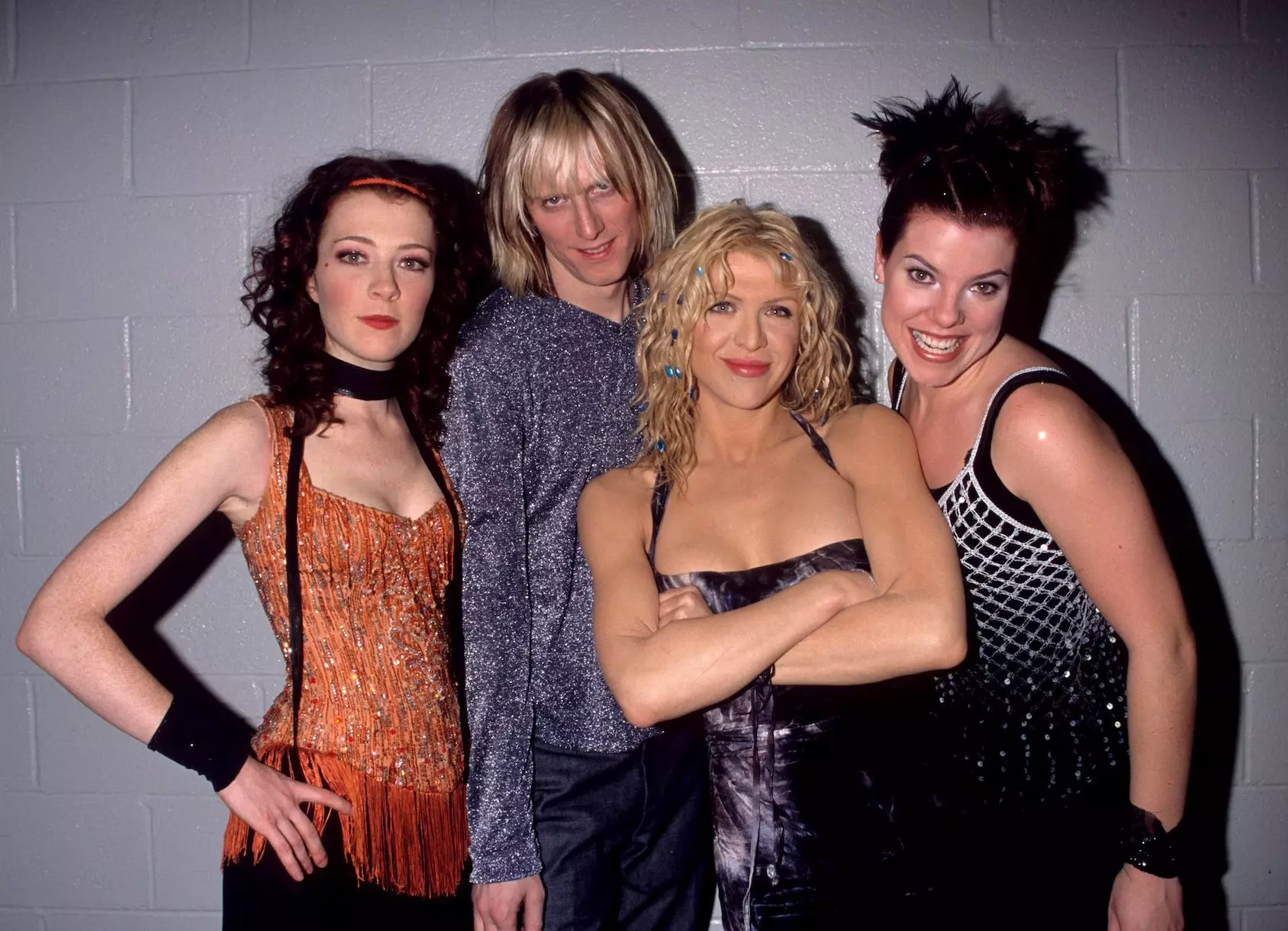
Upon the release of Hole's third album, 1998's Celebrity Skin, guitarist Eric Erlandson revealed to Spin the biggest worry he and founding member Courtney Love had in their early days: "that Hole could not be a mainstream band, and we wanted to be popular enough and sell enough records." Within the space of 12 months, such fears had unequivocally been put to bed.
Indeed, Celebrity Skin sold 86,000 copies in its first week to become the group's first Top 10 entry on the Billboard 200. It also picked up four GRAMMY nominations including Best Rock Album, spawned two Hot 100 hits and shifted more than 1.4 million copies in the United States alone. Suddenly a band whose first three singles were titled "Retard Girl," "Dicknail" and "Teenage Whore" had become part of the MTV elite.
In an era when pop was still very much considered a dirty word, Hole brazenly refused to be shackled by the music industry's self-appointed tastemakers. They pursued a sound which owed just as much to the harmony-laden soft rock of Rumors-era Fleetwood Mac as the caustic grunge of 1994 predecessor Live Through This. Their new set of collaborators indicated a shift, too: After initially courting Brian Eno, the quartet teamed up with Michael Beinhorn, the man who'd helped spearhead the careers of Red Hot Chili Peppers and Soundgarden ("probably the Michael Bay of record producers," drummer Patty Schemel wryly noted in her memoir). They also requested the services of Love's ultimate frenemy Billy Corgan halfway through recording to boost its hooky appeal.
This change in direction was no doubt inspired by the quartet's decision toreturn to Los Angeles, with Erlandson opting for Laurel Canyon, Schemel and bassist Melissa Auf der Maur residing in Silverlake Hills, and Love settling in Beverly Hills. But as hinted on its front cover — a slightly blurry Polaroid shot of the band standing in front of a burning palm tree — Celebrity Skin was no picture-perfect tribute to Californian life.
Take the title track, for example: Named after the voyeuristic porn magazine (and not, as Love once joked, because she'd "touched a lot of it"), "Celebrity Skin" fully embraces the idea that Hollywood is a place where dreams go to die rather than be fulfilled. "Oh, look at my face/ My name is might have been," Love sings on the second verse. "My name is never was/ My name's forgotten." Hammering the point home, its dazzling Gentlemen Prefer Blondes-inspired promo, firmly in keeping with the blockbuster tone, even had Love and Auf der Maur lying in open caskets.
It was a fitting narrative for Love, who had reinvented herself over the past four years from the rock scene's enfant terrible (in 1995 alone, she'd punched Kathleen Hanna, gatecrashed a Madonna interview and even attacked her own fans) to a respectable Hollywood darling. She earned a Golden Globe nomination for her performance as the titular pornographer's wife Althea in 1996's The People versus Larry Flynt, later partying with celebrity boyfriend Edward Norton on the Oscars' red carpet ("The most thorough transformation since Eliza Doolittle met Henry Higgins," wrote Time).
However, she was still keen to depict the state as a den of decadence which chews people up and spits them out. The driving power pop of "Awful," for instance, takes aim at the music scene's corruption of young girls, including Love's teenage self ("And they royalty rate all the girls like you/ And they sell it out to the girls like you"). "Hit Me Hard" (which references the Crystals' "He Hit Me (And Then He Kissed Me)") is a similarly tricky portrait of domestic violence in which Love envisages herself drowning — a theme which, partly influenced by the tragic death of friend Jeff Buckley, is prevalent throughout Celebrity Skin.
Interestingly, the album's theme was very much a last-minute decision. Frustrated by the direction of their early demos, Love decided it would be better to tie everything together with a concept, "even if it's fake." Yet, it was one which made sense with her new lifestyle.
"It was her Hollywood phase," Auf der Maur remarked, adding that the frontwoman's daily routine consisted of chain-smoking Marlboro lights, auditioning and heading to the beach with her personal trainer at the ungodly hour of 7 a.m. The title track is unarguably where all these elements coalesced to perfection.
The most striking thing about "Celebrity Skin," though, is how it leaned into the super-sized pop metal sound Hole and their ilk were supposed to have made obsolete. Its crunching riffs could easily have been lifted from Motley Crüe, Skid Row or any other group from the height of Sunset Strip excess. (And while Love firmly denied rumors Corgan was the true mastermind behind the record, she was more than happy to give him credit on the title track.)
It's hard to believe this is the same band whose 1991 debut, Pretty on the Inside, reveled in a challenging, and often cacophonic, mix of noise-rock, art punk and sludge metal. Yet they still pull off the pop-metal sound. Indeed, "Celebrity Skin" not only scored Hole their first No. 1 on Billboard's Alternative Airplay chart, but it also earned two GRAMMY nominations, for Best Rock Performance by a Duo or Group with Vocal and Best Rock Song. And the fact it's since been covered by the Glee Cast and Doja Cat — not to mention being subjected to the slightly creepy AI treatment, too — further proves just how much it crossed over.
Second single "Malibu," both the best and the biggest of the band's career, also found a place on radio stations that previously wouldn't have touched Hole with a bargepole. Originally penned with Stevie Nicks in mind, the melodic slice of AM rock doubles up as a desperate plea for a drug-addicted boyfriend to seek sobriety before it's too late. Contrary to popular belief, however, it was inspired by Love's first boyfriend Jeff Mann, not, late husband Kurt Cobain.
In fact, Celebrity Skin only occasionally touches on the Nirvana frontman's passing — despite being the band's first chance to address it on record (Live Through This came out just a week after the tragedy). Macabre track "Reasons to Be Beautiful" includes a subverted line from Cobain's suicide note ("It's better to rise than fade away"), and almost feels like Love is writing her very own ("Love hangs herself/With the bedsheets in her cell"). And towards the end of the album, Love delivers a thinly veiled attack on Cobain's Nirvana bandmates Dave Grohl and Krist Novoselic — who she'd soon become embroiled in various legal battles with — on "Playing Your Song." ("You trusted everything/They sold you out.")
If all this sounds a little angst-ridden for a record specifically designed for the masses, Love and Co. help sugarcoat things with an array of blissful vocal harmonies, shiny guitar riffs and singalong melodies perfect for driving down the highway. Craig Armstrong, then best known for his BAFTA-winning score for Baz Luhrmann's Romeo + Juliet, also provides some beautifully elegiac strings on "Dying" and closer "Petals," a bittersweet reflection on the fleeting nature of relationships and life itself.
It's not all dark cautionary tales and meditations on grief, either. "Heaven Tonight," an ode to a "sun in the form of a girl" (which some believe is Love's daughter, Frances Bean Cobain), is possibly the sweetest thing Hole ever recorded. And although "Boys on the Radio" eventually becomes another cutting riposte to men in suits, it initially looks back fondly at the days when Love used to seek solace in her pop idols (bizarrely, her teenyboppers of choice were the tartan-clad glam rockers Bay City Rollers).
Sadly, Celebrity Skin was also the album which literally broke Hole. After wearing Schemel down with weeks of punishing studio time, Beinhorm managed to convince the band that session musician Deen Castronovo would be a better fit; Love later admitted regret over listening to the producer and essentially ruining the drummer's life. Erlandson would also describe the making of its 12 tracks as "insane," and by the time the Hole name was revived for 2010's Nobody's Daughter, Love had assembled a whole new line-up, a move she later acknowledged was "a mistake" that cheapened their legacy.
Despite all the contention, there's been much talk of a Celebrity Skin-era reunion, Schemel included, since. In 2014, Rolling Stone wrongly reported Love's solo single "Wedding Day" had emerged from a recording session with all four members, although the singer did reveal that they'd spent time playing together again. And five years later, they all apparently enjoyed rehearsal time at, rather aptly, the Hollywood Walk of Fame. But should they fail to nail down anything else in the studio, Celebrity Skin is one hell of a highly polished swansong.
The Twin Halves Of 'Mammoth II': Wolfgang Van Halen's Sorrow And Jubilation