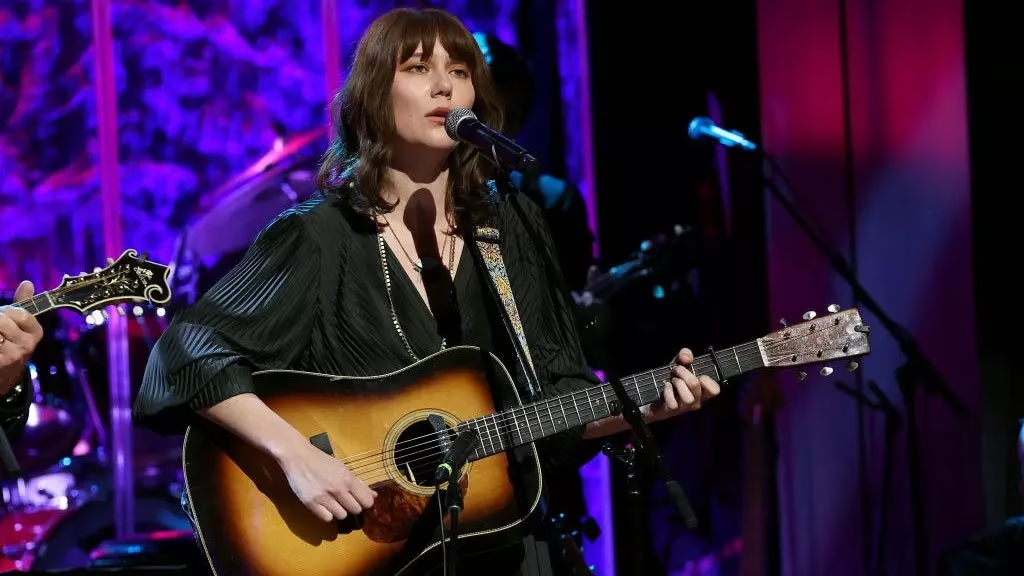
Molly Tuttle has bluegrass music running through her veins. The California-born artist first picked up a guitar when she was 8 years old, and was a regular fixture with The Tuttles & AJ Lee, the family band fronted by her father, prior to breaking away to pursue a solo career.
Today, Tuttle is a revered bluegrass guitarist; and the first woman to win the International Bluegrass Music Award for Guitar Player Of The Year in 2017 — an honor she won the following year as well. A string of other awards have followed come as the 30-year-old continues to break new ground and build upon her already impressive musical legacy. At the 2023 GRAMMY Awards, Tuttle is nominated for Best New Artist and her Crooked Tree for Best Bluegrass Album.
While first three projects included country, folk, pop and punk sounds, Tuttle returned to the sweet string music of her youth on Crooked Tree. Over its 13 tracks, Tuttle oscillates between Hazel Dickens-esque bluegrass and Lynn Anderson-inspired California country to tell stories of pride, paving your own path, and making room in your "Big Backyard" for everyone.
The sonic move resulted from longing for the communal nature of bluegrass music during the dog days of the pandemic, leading her to — as she often has — include as many friends on the project as possible. Crooked Tree, Tuttle's third album, features everyone from Old Crow Medicine Show’s Ketch Secor to Billy Strings, Gillian Welch, Sierra Hull, Dan Tyminski and Margo Price.
With plans to return to the studio again in 2023, there’s no telling who she’ll bring in to join her next. GRAMMY.com sat down with Tuttle to discuss how music makes her feel more comfortable in her own skin, and what she thinks of being labeled a trailblazing woman in bluegrass.
Where do these GRAMMY nominations stack up with your other awards and career accomplishments to date?
It’s a highlight of my career to be recognized by the GRAMMYs. The bluegrass GRAMMY is something I was really hoping I’d be nominated for; I grew up in the bluegrass world and felt like it was finally time to make my first real bluegrass album. I’ve always loved the bluegrass community, so that recognition really does mean a lot to me.
To also be nominated for Best New Artist in a general category is something I wasn’t really expecting but am humbled by. It can be a hard, discouraging life on the road touring all year, but things like this make me smile and feel like I’m on the right track.
You’ve mentioned in the past the impact that Hazel Dickens, Alison Krauss and other groundbreaking women in bluegrass have had on you. What are your thoughts on how you fill that role for many in the present?
There’s several songs on [Crooked Tree] that were directly inspired by people like Hazel Dickens and Gillian Welch, who actually ended up singing with me on the song “Side Saddle.” Those were my early songwriting heroes. This record was a big return to my roots and coming back to the music that I grew up listening to.
Even though artists like Hazel Dickens were very outspoken in their work, I feel like most people don’t think that bluegrass tackles progressive subjects like feminism and worker’s rights. She was one of the first women to lead her own bluegrass band and sing about these issues that meant a lot to her and were still very taboo at the time. It was, and still is, very inspiring to me.
I feel the same about Gillian Welch and her knack of creating songs that sound timeless but at the same time are relevant to who she is as a person. I’m always going back and looking for inspiration in both of their music as a way of honoring and carrying on the tradition of their trailblazing ways.
Bluegrass, and music in general, is often a male dominated world. Is that the dynamic that you’re touching on in your song “Side Saddle”?
On that song I’m channeling the feelings of playing the guitar and, more specifically, how the guitar world is so male dominated. The song is about being a cowgirl and feeling like you have to adhere to a standard set by men to prove yourself worthy in a man’s world. That’s how I often felt…like there was always this extra attention on me and people picking apart my playing in ways they never did with male guitarists.
When I was starting out I felt like the guys I played with were always taking these big musical risks that I didn’t feel the same liberty to take because of all the extra attention on me and my playing. If I made a mistake, the stakes were always higher. I don’t feel that constant pressure to have to prove myself anymore. The people I surround myself with now are always very supportive. I feel like I’ve created a world where I’m more free to take risks and make mistakes like anyone else.
What have you done, and what would you like to see done to make bluegrass a more welcoming place for women, people of color and other marginalized groups?
There’s been a big push in recent years to make the space more inclusive. A lot of my friends and I will talk about how queer people, people of color, women, we’ve always been a part of this music, but we haven’t always been recognized and treated equally within its circles.
I’ve done a lot of work with Bluegrass Pride, an organization which started in California that now hosts events nationwide with the mission of making bluegrass music welcoming to everyone. Organizations like that not only change people’s perspectives about what bluegrass is, but they also help everyone already within the world of bluegrass feel more seen, included and uplifted.
I understand Crooked Tree was inspired by your paternal grandfather. How has he influenced you, musically and otherwise?
A lot of my early musical memories, like hearing my grandpa play at my first bluegrass festival, inspired the music on this album. I dedicated the project to him because without him I don’t know that I’d even be playing music.
My grandfather played the banjo and was a rural farmer in Illinois, which is also where my dad grew up. He taught my dad how to play everything from the fiddle to the mandolin, guitar and banjo. They’d regularly play, travel around to bluegrass festivals and listen to the Grand Ole Opry together.
After college, my dad ended up moving out to California where he planned to begin working in finance until he stumbled into a music store in Palo Alto. It led to him teaching banjo and eventually all bluegrass instruments. He was my first guitar teacher, something that likely wouldn’t have happened if my grandfather hadn’t taught him all those years before.
I wanted this album to honor [my grandfather] with music that I know he’d love if he were still around. I actually drove up to Illinois to visit the old farm with my grandmother, which was very nostalgic. Once I got back to Nashville, I ended up writing the song “Flatland Girl” that Margo Price joined me in singing on for the record.
You initially planned for Crooked Tree to have more of a poppy sound before recasting it as a bluegrass record. What circumstances led to that shift in sound?
Early in the pandemic I was experiencing a creative lull due to the shock of no longer being able to tour. It led to me recording a cover album, …but i’d rather be with you. I started to get back into writing, but I was still having a hard time feeling inspired and didn’t know which direction I wanted to go in next.
At first I thought I’d continue pushing outside of the bluegrass and Americana box since the cover album leaned more toward the pop end of things. I started writing songs with a bunch of different people but none of them seemed to fit together into one cohesive group. The longer the shutdown went on, the more I started to miss festivals — especially bluegrass festivals, and the communal nature that had you playing on stage one minute and around a fire in nearby campgrounds the next. It made me realize that it was finally time to make my first real bluegrass album to pay tribute to the music I grew up with.
Once I decided that was okay, I was no longer scared of being pigeon-holed as a bluegrass artist. Immediately the songs started pouring out, leaving me really inspired. From there I found friends who also loved writing that music like Ketch [Secor of Old Crow Medicine Show], Melody Walker, Becky Buller and Mark Simos. Those four people are who I wrote the whole album with.
For nearly a year and a half I struggled to figure out what I’d do next musically. Then, in the span of a few months, I suddenly had a full album of songs.
My favorite song on Crooked Tree is the title track, which focuses on embracing our differences and insecurities rather than letting them weigh us down.
That’s a tune that I wrote with Melody that touches on our mutual feelings of growing up and being different from those around us. For me that inspiration stems partly from losing my hair. At a young age I was diagnosed with alopecia areata and my hair has never grown back. I’ve been completely bald my whole life and have been wearing wigs since I was 15. Even prior to that, though, I always felt like I stood out. I wasn’t able to fully embrace that and not be ashamed about wearing a wig until my early 20s.
It’s a personal message that I’ve always felt was important for me to portray in my music. I feel like everybody has something that makes them feel different, so my goal with the song was to show why it’s worthwhile to embrace those things, because ultimately it’s what makes us the unique individuals we are.
What has music taught you about yourself?
Music has taught me how to be with and express myself. When I was a kid, I was so closed and didn’t feel like I had anyone to talk to about what I was feeling inside. Music for me was a safe place where I could express my feelings, which has led to me being more comfortable with those tough feelings and communicating them to others.
Music is also a way for me to connect with people. For me the best part of music is when I hear a song that someone else wrote but I have the same exact experience as them, which really helps me to connect with that person. It’s a way for all of us to better understand that we’re not alone.
Margo Price Finds Freedom On New Album, Memoir: "I've Never Felt This Happy"