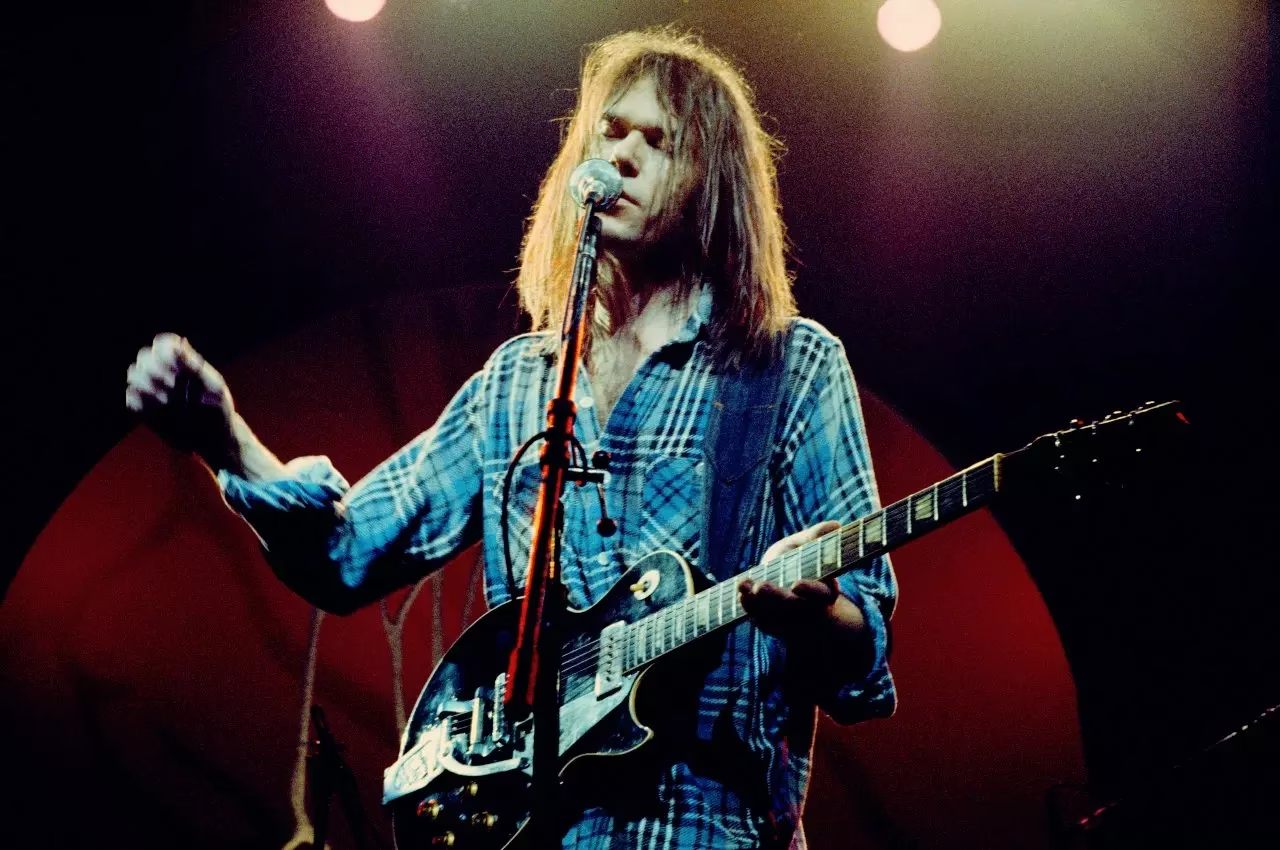
In the mid-2000s, Neil Young dropped an artifact at fans' doorsteps that was strange even by his standards. It was a new album, Chrome Dreams II — a sequel to that titular album from 1977. The wrinkle? That album didn't exist.
Well, not officially. While perplexed consumers wondered if they'd been unwitting recipients of the Mandela Effect, Chrome Dreams was a known quantity to the heads.
As Jimmy McDonough explained in his 2002 biography of Young, Shakey, Chrome Dreams was an acetate — a proposal of what his next album could be. It even had a cover: a sketch by producer David Briggs of the front end of a '55 Chrysler, blending into a woman's face.
But Chrome Dreams wasn't to be; what the public got was 1977's rowdy, eclectic American Stars 'n Bars. Despite containing the classic "Like a Hurricane" among other luminous deep cuts like "Star of Bethlehem," American Stars 'n Bars feels more like a mixtape than a proper album. McDonough himself called it a "haphazard snapshot."
As part of a deluge of archival releases, Chrome Dreams is finally available in its original form as of Aug. 11. Despite being shelved, most of Chrome Dreams' 12 tunes made it to the public, in one form or another; many of them became bona fide Young classics.
Five tracks destined for Chrome Dreams made it on American Stars 'n Bars, including "Star of Bethlehem" and "Homegrown." "Pocahontas," "Sedan Delivery" and "Powderfinger" appeared on Rust Never Sleeps two years later. A handful of others would surface on various albums, culminating with "Stringman" on 1993's Unplugged.
Now that Chrome Dreams II has a I, a tantalizing question arises: if this album came out as planned, how would Young's discography be fundamentally altered? In some instances, it wouldn't be too far gone. In others, everything would change.
From Homegrown to Hitchhiker to Toast — from 1975, 1976 and 2000-2001, respectively — Young's long-shelved, recently revealed albums have proven to be inextricably linked to the ones we all know.
As such, they provide fascinating windows into his creative process — as well as what-ifs to puzzle over. Here's a guide to every song on Chrome Dreams, and how Young's discography would change if they were initially released in this form.
"Pocahontas"
We've heard this non-overdubbed "Pocahontas" before.
In 2017, Young released the stunning Hitchhiker, a document of a single session in 1976, when Young terminated a tour with Stephen Stills, celebrating the 10th anniversary of their band Buffalo Springfield.
Under a full moon, he holed up in Briggs' Malibu studio with various intoxicants, and ran through some recent songs, alone and unadorned. Despite the bracing intimacy of this setting, Reprise executives shrugged it off as a collection of demos.
If "Pocahontas" had been released on Chrome Dreams, could it still have appeared on Rust Never Sleeps, perhaps in a different format? Unlikely, as that was an album of new material; a tune from just two years prior would have been a sore thumb.
A Rust Never Sleeps without "Pocahontas" would be one with a crucial chunk missing; it's one of the most evocative songs he ever penned, bar none. And it's difficult to think of a potential replacement on its level.
"Will to Love"
The inclusion of "Will to Love" on American Stars 'n Bars accentuates that album's aggressively piecemeal vibe.
There's no analog for "Will to Love" anywhere in his catalog. A seven-minute ballad recorded in front of Young's crackling fireplace, the lo-fi oddity recounts the journey of a trout upstream as a cosmic metaphor. (Critics remain divided; some believe it's one of his most majestic songs, others dismiss it as an indulgent mess.)
On Chrome Dreams, "Will to Love" fits a bit more snugly amid the acoustic material; on American Stars 'n Bars, it's an ugly duckling.
Without five Chrome Dreams tunes on it — three of them the most substantial on the album — American Stars 'n Barscould have succeeded, and perhaps been more consistent, as an album of barroom-ready ragers.
"Star of Bethlehem"
"Star of Bethlehem" was slated for a previously shelved album: Homegrown — recorded in 1974 and 1975, unreleased until 2020.
Because that album didn't see the light of day, the inclusion of "Star of Bethlehem" on Chrome Dreams — and on his 1977 compilation album Decade — would arguably leave its history unaltered.
"Like a Hurricane"
Whether this Young classic was released on Chrome Dreams or another '70s album would be beside the point.
The legacy of this majestic rocker isn't its inclusion on American Stars 'n Bars, but its windswept majesty — especially live. (Its versatility, too; the solo rendition on Unplugged, performed on pump organ, is unforgettable.)
"Too Far Gone"
On Freedom, Young's late-'80s comeback album addressing Reagan-era urban decay, "Too Far Gone" is a throwback; he'd originally recorded it in 1975, with Crazy Horse guitarist Frank "Poncho" Sampedro on mandolin.
The song, about the fallout from a chemical-fueled tryst, fit Freedom like a glove; it works perfectly along seedy yarns like "Crime in the City (Sixty to Zero Part I)." Freedom could have been basically intact without it, but its messaging would lose a personal edge.
"Hold Back the Tears"
Fitting with the rest of side A, the version of "Hold Back the Tears" on American Stars 'n Bars has a lovesick, rootsy quality, deepened by Linda Ronstadt and Nicolette Larson on backing vocals.
On Chrome Dreams, it's starker and more eye-to-eye — just Young alone, harmonizing with himself, a little keyboard and percussion filling out the soundfield.
Both versions are terrific, but if this demo-like take was the released version — without Ronstadt and Larson behind him to really sell it — something would be missing.
"Homegrown"
In any form, "Homegrown" is a mirthful, stoned trifle; paradoxically, it would have served as the title track to one of Young's most revealing and personal albums.
The Chrome Dreams version — the one with Crazy Horse — is the one available for decades on American Stars 'n Bars; whichever album it appeared on would be irrelevant to its legacy.
That said, the version initially slated to appear on Homegrown is a wonder — on that later take, Young's backed by Tim Drummond of the Stray Gators, go-to lap slide guitarist Ben Keith, and Karl Himmel, who frequently backed Young throughout the decade.
Where the Horse version of "Homegrown" is a goofy romp, the later version is slippery and strange, befitting an ode to marijuana; if that one had come out, it may have stuck in the craw more.
"Captain Kennedy"
The version of "Captain Kennedy" on Hawks and Doves is the same one on Hitchhiker and Chrome Dreams — they all come from that single, stony session with Briggs.
Excised from the lumpy and politically contradictory Hawks and Doves, it would be a pleasing enigma — Young's crack at a faux-traditional folk ballad, inspired by the real-life mariner Lou Kenedy.
On that 1980 album, though, it takes on shades of patriotism and nationalism, especially near tunes like the proletariat anthem "Comin' Apart at Every Nail."
In that jingoistic context, the uninitiated listener might even think it's not a seaman's ballad at all, but an extended metaphor for a certain doomed president.
"Stringman"
One of the primary revelations of Chrome Dreams is a studio version of "Stringman," one of Young's most emotionally incisive songs.
He wrote it for producer and Stray Gators pianist Jack Nitzsche, who was undergoing an agonizing divorce. Young takes a birds-eye view of the trauma, examining the trauma through metaphorical lenses: a sergeant laying down his weapons, sun-kissed lovers rendered as smut.
On Unplugged, with years under his belt, Young delivers with maximum pathos and gravitas.
But if this earlier version had been in fans' ears, it could only have enriched "Stringman"; it'd be a clinic in how a song can develop an emotional patina with age.
"Sedan Delivery"
Fitting for an album that begins with an evocation of Johnny Rotten, Rust Never Sleeps is charged with a flippant, punky energy for its latter half.
Accordingly, the version of "Sedan Delivery" out since 1979 is far more uptempo than the one on Chrome Dreams. As such, it tends to blur into the sonic violence of its lovably lunkheaded neighbor, "Welfare Mothers."
This more natural tempo and execution suits "Sedan Delivery," and allows space to absorb its harebrained lyrical images; if the world knew it like this, perhaps it'd be more than a race to the end of Rust Never Sleeps.
"Powderfinger"
Is "Powderfinger" more powerful as an acoustic or electric song?
Most fans regard the latter with something like religious awe; it's the ultimate marriage of Young's penetrating songwriting with the string-popping frenzy he demonstrates with the Horse.
But there's a case that the solo version on Chrome Dreams and Hitchhiker has just as much impact, just from a different angle.
The Young classic's about a young man attempting to protect his family from an approaching gunboat; when the arrangement can breathe, the story takes on weight and dynamism.
Indeed, when the shot rings out, and the protagonist's "face splashe[s] in the sky," Young's hushed delivery renders the image that much more darkly unforgettable.
Maybe the answer to the above question is a toss-up. But the acoustic version "Powderfinger" provides a crucial side-window into this magnificent song.
"Look Out for My Love"
The hypnotic fan favorite "Look Out for My Love" has a way of getting under your skin; it's an unquestionable highlight of 1978's Comes a Time, and does a mesmerizing job as the closer to Chrome Dreams.
"Look Out for My Love" is exquisite by its own merits; the only difference would have been that Comes a Time would lose a pendulum-like classic.
If the world knew and loved Chrome Dreams, the point of Chrome Dreams II would have clicked immediately — its acoustic-electric yin-yang is spiritually in dialogue with these songs.
But that's Young — if he didn't work in mysterious ways, we'd all want our money back.
In a way, his younger self is his primary collaborator these days; he's on a mission to preserve fleeting visions and headspaces of yore. And in return, his fans have a will to love.
Songbook: Inside Neil Young's Latest Decade And Change, From Americana & Psychedelic Pill To Barn & World Record