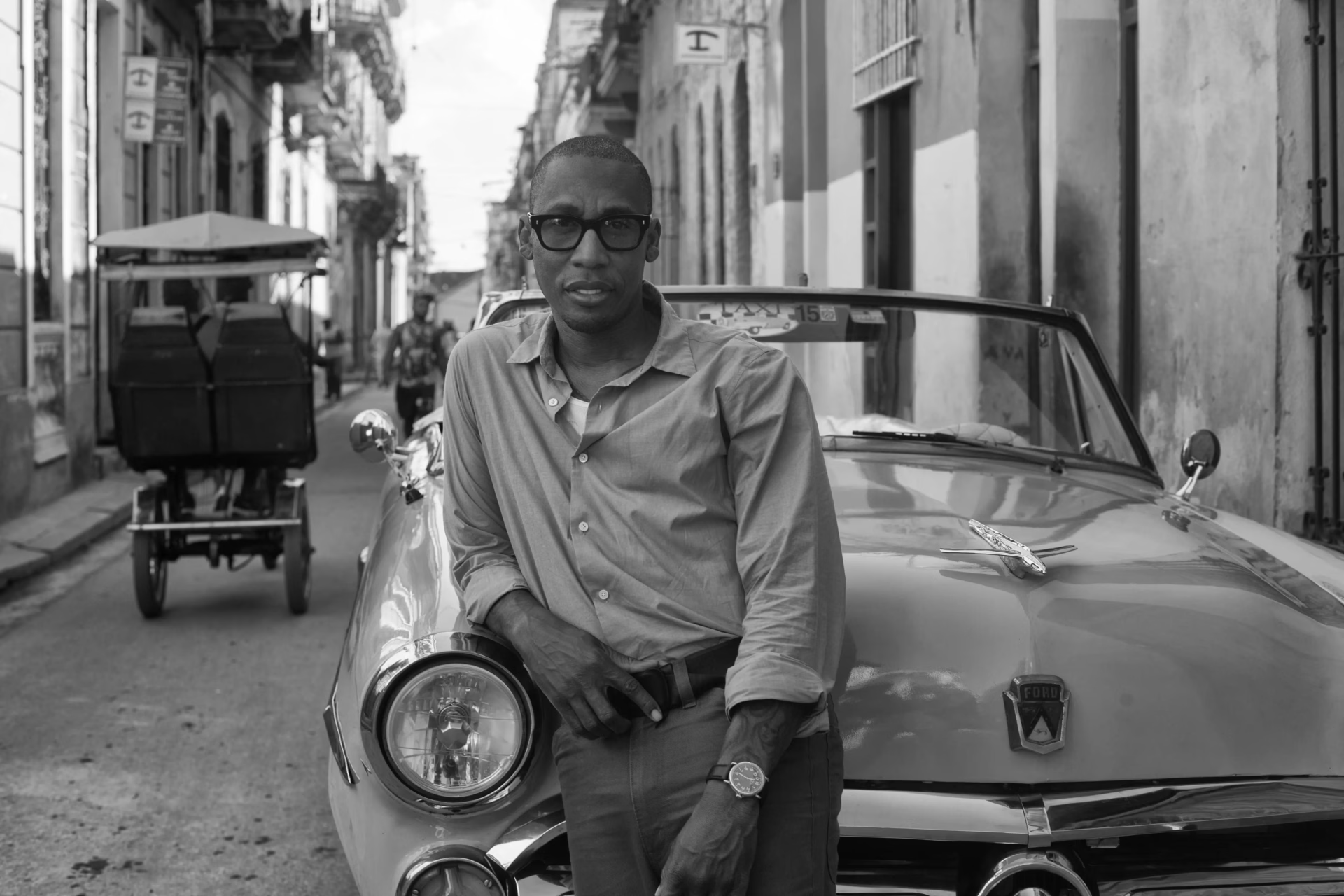
In a secular sense, Raphael Saadiq has been born again. Born Charles Ray Wiggins in Oakland, Calif., the singer/songwriter adopted his current nom de plume in a gesture that seemed to symbolize the metamorphic aspirations of his career.
<iframe width="560" height="315" src="https://www.youtube.com/embed/Iif2UhFBZdM" frameborder="0" allowfullscreen></iframe>
Emerging nearly 30 years ago as frontman for the chart-topping R&B trio Tony! Toni! Toné!, Saadiq nimbly pivoted into a solo career that has thus far yielded four critically acclaimed albums. He's also produced recordings for a range of hit makers, including Whitney Houston, Mary J. Blige, D'Angelo, and more recently, Solange. And now, he's transitioned into scoring with the hit HBO series "Insecure" and the documentary Step.
On the heels of his Oct. 6 performance at the world-famous Hollywood Bowl with Maxwell and Jazmine Sullivan, we caught up with Saadiq to discuss the addition of TV and film scoring to his résumé, working with Solange, where he keeps his GRAMMY, his style, favorite TV shows, and his go-to L.A. restaurant.
Congratulations on your recruitment as composer for the HBO series, "Insecure." Can you describe your scoring process.
I just look at the characters like Issa Dee and Lawrence [Walker], and frame out what I think the characters are. After that, you just go into the [studio] knowing you've got to get a job done. Musically, I just want to keep the flow going, because it's a great story, a strong point of view from a woman’s voice. It’s great that [I] get a chance to write music for people where I have to still prove myself. I like the process … it's nice to actually stay home and work sometimes, you know?
<iframe width="560" height="315" src="https://www.youtube.com/embed/NyxhiqIDdps" frameborder="0" allowfullscreen></iframe>
You scored the feature documentary Step. Was the process different than scoring for TV?
It was a little different, because it's one big piece. It's not episodic like "Insecure," so you have to marry everything at one time. I would get raw footage, and I would translate the emotions the footage brought out in me. You have to let the dialogue be the vocal, that's how I look at it. It's not very easy, but it was interesting because the story reminded me of some of the girls that I grew up with. Their innocence … brought out a lot of different emotions for me to listen to.
How did you come to be involved with Solange's album, A Seat At The Table?
We had already been talking for years about making music together. I always liked that she wanted to do her own thing, no matter what — just finding herself. She had actually finished working on a lot of the album, so she asked me to help her put it all together, sonically. The process never felt like work. I just remember talking to her, and all of a sudden we had this product, a finished record. It was perfect for me, because she did a lot of the heavy thinking.
What do you recall about recording her GRAMMY-winning single, "Cranes In The Sky"?
I remember playing drums. I remember Solange really liking the drums and the chords. Sometimes, I work on musical ideas that other people never pick up on. That's no [criticism] on them, but I love making music for me. But every once in a while, you meet the kind of people who feels the same way you do, and Solange … she heard it. She was like, "I love that!" She wrote that amazing top line over my part. She has the ear.
Can you name a recent song you weren't involved in that really impressed you?
I'd have to say "Alright" by Kendrick Lamar. That song helped me get through a whole lot. It's very solid musically, the instrumentation. To Pimp A Butterfly — that whole album was like that to me. I can still listen to that entire album.
You won your first GRAMMY with Erykah Badu for Best R&B Song for "Love Of My Life (Ode To Hip Hop)." Where do you keep it?
At my mom's house. She's in Sacramento. She has all the gold albums from the Tony! Toni! Toné! days, and from other people I've worked with. From what I hear, people will walk into the house and say, "That's your son?" And my mom, She’s like, "Yeah … that's him with Obama!" She won't do it in front of me. I'm like, "Mom, don't be bragging about anything, because people are not happy for you!"
<iframe width="560" height="315" src="https://www.youtube.com/embed/dNk3R23Twgw" frameborder="0" allowfullscreen></iframe>
What’s your favorite Los Angeles restaurant?
My Two Cents. Everything is good, and it's clean and healthy.
You are quite the clothes horse. Who's the biggest influence on your style?
When I was about 9 years old, my mom worked in housekeeping. She used to take care of this Asian family, and they would give me clothes, like Mohair sweaters and stuff. That's where I learned my fashion from, this older Asian man in the family. I like to have pieces. Since I don't have that many clothes, I can't make any mistakes in my closet. Everything [coordinates].
Aside from "Insecure," what's your favorite TV show?
"Game Of Thrones." I like the stories of the families. I like stories of betrayal, because there's so much of that in life. I also like "Narcos" and "El Chapo." I can watch any Latin crime show. I grew up around dope dealers in Oakland, so by watching these TV shows I can see all the inner-workings, all the negotiations between the guys, the women, the drug dealers, the DAs, the government. I can see how the whole circle works, not just the street level.
Speaking of "Insecure," what are you insecure about?
I'm insecure about being famous. I never really wanted to sing, or be up front. I've never wanted to live next door to people that are famous, or live behind gates. I've never wanted people to treat me like I'm famous, so I make sure that doesn’t happen. No matter how much money I ever make, I'm always going to keep it basic. Maybe it's because of the way my parents raised me.
(Bruce Britt is an award-winning freelance writer whose work has appeared in The Washington Post, USA Today, Detroit Free Press, San Francisco Chronicle, and other distinguished publications. He lives in Los Angeles.)