Japan and Jamaica are island nations a world apart — over 8,000 miles and one international date line in distance. And while the average listener may not see a natural connection, the countries share a deep musical bond that's the result of Jamaica's chief cultural export: reggae.
The power of reggae, and its broad reach, is undeniable. "We're talking about an island that spent 100 years under the yoke of colonization, and then in the 20th century, it colonized the whole world,” Jamaican British DJ and historian Don Letts once told me. That Jamaica's freedom sounds would travel more than halfway around the globe should be no surprise to any reggae fan.
Japan is known for its attention to detail when it comes to musical subcultures, whether it's an appreciation for rock 'n' roll or Chicano identity and lowrider soul. But Japan's reggae scene is particularly commendable for its breadth – in addition to a roster of homegrown artists, there are reggae cruises, festivals, many events, and international acts tour the country regularly – and history, which goes back to the mid-1970s. A 2020 report from the BBC noted that there were more than 300 reggae groups or sound systems in country, whose land mass is roughly equivalent to the size of California.
Today, Japan's reggae community is as nuanced and layered as that of any other genre with a subcultural affiliation. Reggae music — or a version/relation thereof, be it ska, rocksteady, dancehall or dub — can be found in every Japanese prefecture, in large cities and more rural towns. There are more mainstream J-reggae groups and pop artists who employ the genre's conventions; a sizeable underground of independent artists, collectors, DJs and fans are simultaneously dedicated to promoting and preserving OG sounds as they are the Japanese version.
But the Japanese fascination with and take on reggae music goes far beyond novelty. It's the result of decades of study, an increasingly connected global economy, and unique multi-cultural interplay.
"It still amazes me how deeply Jamaican music resonates with people in Japan," says Zendaman, a 25-year-old dancehall DJ from Iwate prefecture. "In a country as materially wealthy as ours, why are so many people struggling with loneliness and a sense of isolation? I think reggae stirs something essential in us, something human. It reminds us of love, resilience, and the power to survive."
The Harder, And The Farther, They Come
While Bob Marley's infamous 1978 Japanese tour sent the country ablaze, Japan's first encounter with reggae largely came in the form of the 1972 film The Harder They Come, starring Jimmy Cliff. The movie resonated with Japanese hippies and members of the counterculture, who were "really intrigued by the Rastafarian characters in the film and…explored the music a little bit deeper," professor and author Marvin Sterling told Afropop Worldwide.
Learn more: How 'The Harder They Come' Brought Reggae To The World: A Song By Song Soundtrack Breakdown
Marley was not the first Jamaican artist to come to Japan. That honor belongs to the Pioneers, whose 1969 single "Long Shot Kick De Bucket" hit No. 1 on the Jamaican charts and also helped popularize reggae in the U.K. The Pioneers did a multi-week tour in the country in 1975, even recording an album for exclusive release in Japan.
"We would do interviews — newspapers, magazines and on television," says Pioneers singer Jackie Robinson, adding that the language barrier proved to be no issue for fans. "Japanese fans were crazy and polite. And, like, accepting. We really quite enjoyed Japan."
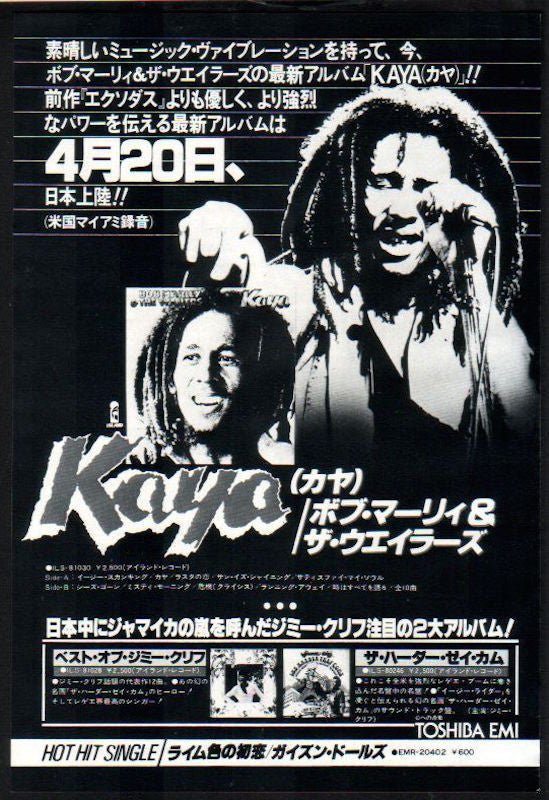
When Bob Marley toured Japan four years later, the country's reggae craze truly began. "Marley's 'rebel spirit' captivated them during his first tour," Jeremy Freeman, an American DJ and owner of Deadly Dragon Sound System currently living in Tokyo, told sound system and record label Dub Stuy. "His dreadlocks, his revolutionary thinking seemed in such opposition to the prevailing conformist culture of Japan at the time."
If Marley and the Wailers helped free fan's minds, they were also good for local business. Their tour was highly reported on and promoted by Japanese record company Toshiba-EMI. During this tour, Marley also met Japanese percussionist Masahito "Pecker" Hashida, who recorded two albums in Jamaica in 1980; each album featured prominent Japanese and Jamaican musicians playing together. Marley and the Wailers also became good friends with psych-rock singer Joe Yamanaka. After Marley died in 1981, Yamanaka fronted the Wailers for five years, recording three albums with the band.
An essay by Time Capsule Records' Anton Spice & Kay Suzuki notes that, by the mid 1970s, many professional musicians from Tokyo were also performing at U.S. Army bases where they would have absorbed a wide variety of Western music. The military's Far East Network of radio and TV stations would have similarly propelled music from around the world, including reggae.
"These Weren't Authentic Reggae Records…And That's The Point"
Around the time of Marley's visit (and certainly after) Japanese musicians began picking up "distant signals from Jamaica and the U.K., and reshaping them in unexpected ways," says Kay Suzuki. Born in Japan and currently residing in London, Suzuki is a producer, DJ, musician and historian who curated Tokyo Riddim, a compilation series exploring Japanese reggae between the late '70s and mid-'80s.
Interest was piqued via reggae-tinged music by the Police, acts like UB40, female vocalists, and even television, Suzuki notes. The resulting music "was weirdly polished, emotional, and commercial… but it still carried that rhythm," he continues. "These weren't authentic reggae records in the traditional sense, and that's the point." What Japanese reggae of the era lacked in authenticity, it made up for in earnestness.
By the mid-1980s reggae DJs and singers were popping up throughout Japan, many of whom were performing roots reggae and dub. Interest in dancehall and soundsystem culture — which was gaining popularity worldwide — was amplified by legendary speaker designer Tetsuo Nagaoka, whose influential book became crucial reading for speaker builders of the era. Yokohama-based artist Rankin' Taxi built Japan's first sound system in 1984 and, by the end of the decade, would be joined on the scene by groups like Mute Beat, Cool Runnings, Nahki (who sang in Jamaican Patois and connected with legendary Jamaican singer/producer Sugar Minott), and Fishmans. Other groups, such as Tokyo Ska Paradise Orchestra, performed two tone and other avenues of ska music.
All of these J-reggae progenitors, most of whom had roots in Tokyo's underground, had distinct Japanese identities. Speaking to Dub Stuy, Riddim Chango label co-founder Hiroshi Takakura noted that a lack of Caribbean musicians living in Japan at the time led to music with a distinct sound. "Many reggae and dub bands in the early days were also influenced by...jazz, hip-hop, etcetera, so the sounds of those bands are more diverse."
In addition to record labels, record stores and underground reggae magazines, the mid-'80s saw the beginning of reggae festivals in the country. When Jamaica's Reggae Sunsplash festival expanded to a tour in '85, Japan was among its destination countries; Nahki organized Japansplash festival that same year. The country-wide tour featured both Japanese and Jamaican artists on the bill, among the latter were Dennis Brown, Gregory Isaacs, and Marica Griffiths. Nakhi would later become one of the first Japanese artists to head to Jamrock, where he recorded with producer Prince Jammy.
The Golden Age Of Japanese Reggae
Just as American hip-hop (which, broadly, grew along the same timeline as reggae music) saw its golden age in the '90s, Japanese reggae hit its apex in the last decade of the millennium. Major groups like Audio Active and Dry & Heavy debuted and found their stride, while labels such as Overheat began releasing original music. Reggae-specific bars and venues catered to a growing population of reggae lovers, while Jamaican artists toured the country to great success.
Japanese-language reggae music began to take various forms: J-reggae saw pop acts use the more commercial side of the genre as broad inspiration and influence, and a dedicated underground kept focus on roots, dub, and dancehall. A crucial figure in the dancehall scene was Yamato City-raised Mighty Massa, who debuted his influential sound system in 1994 and — alongside other producers — soon created unique dub plates. Those dub plates would not only rock Japanese clubs, but be played by DJs from the U.K. to Jamaica and beyond. Massa later opened a record store in Sano City called Rock & Shake.
"You don't often hear people play something you made yourself," Massa said of one of his early releases. "The sound came out just the way I wanted it, so I thought maybe I could do more. I think I've been doing it ever since, undeterred."
Just as Mighty Massa's music took flight from Japan to the world, sound system crew Mighty Crown brought the country's dancehall culture to a global audience. Formed in Yokohama in the early '90s and eventually relocating to New York, Mighty Crown rose through the dancehall clash ranks to become World Clash champions in 1999 — the first Japanese crew to do so.
"They are the sound system that opened the door for non-West Indian sounds to be recognized and accepted in the global sound clash arena," Mighty Crown's manager, Garfield "Chin" Bourne, told Dancehall Mag. The group "raised the bar [for] cutting dub plate specials…. Mighty Crown's creativity was next level."
Following this massive upset, sound system culture in Japan flourished. Systems including Fujiyama, Red Spider, Blast Star, King Jam and Ryuganji Hi-Fi blasted all avenues of Jamaican music — from roots to dancehall and ska. The '90s also saw the arrival of reggae singers such as Chieko Beauty, who gravitated around Tokyo bar/venues such as Pigeon and Club 69, and numerous bands, including Little Tempo. Not coincidentally, the number of Japanese tourists visiting Jamaica increased nearly 400x between 1980 and 1995.
"Mighty Crown changed the whole concept of the reggae scene in the world and in Japan," Japanese reggae artist Ras Kanto said in an interview. "Even the Japanese pop artists have a few reggae or dancehall tracks on their song lists. When young people go out to the club, dancehall and reggae is always played."
Japan's love of reggae exploded in the new millennium. Japanese dancer Junko Kudō won Jamaica's dancehall queen competition in 2002, igniting a country-wide interest in dancehall music and movement. This period saw acts like Shonan No Kaze, Moomin and Pushim top charts, while Mighty Crown's first appearance at the massive Yokohama Reggae Sai festival drew tens of thousands. The annual One Love Jamaica Festival held its first event in 2004 and has brought lovers of reggae music and Jamaican culture together ever since.
"While most of the [Japanese] reggae music fans don't understand the lyrics of the dancehall music they learn the manners, ways and dances of Jamaican dancehall," Kanto continued. "The Japanese reggae scene developed as an original culture so people support the scene."
Although there's an element of mimicry to some Japanese acts, much of the country's reggae output is rooted in a deep respect and desire to learn. "In Japan, there is a methodology to craftsmanship and study. It involves a lot of repetition and duplication of existing masterworks, and gradually by mastering the past something unique and individual evolves," Freeman, the American DJ, noted.
To wit, Zendaman traveled to Jamaica alone at age 18 and lived in country for nearly five years; "I trained in the streets and dancehalls, learning directly from the culture while documenting everything on social media," he says. There, Zendaman performed in rub-a-dub sessions with legends like Capleton, Elephantman, Luciano, Tarrus Riley, and Toots & the Maytals; he has twice graced the stage at Jamaica's legendary Sting show.
"That recognition made it clear to me that the work I had been doing was truly building a bridge between cultures," he says. "I've always believed in singing on Jamaican soil, feeling the soul of the music through my body, and then bringing that spirit back to Japan. To try and recreate reggae without ever stepping foot in Jamaica feels, to me, like a lack of true cultural respect."
There's also the not-so-small matter of linguistics. "Expressions of English and Japanese are different," Japanese roots reggae band Youth of Roots tells GRAMMY.com. "Japanese is a very delicate language. So we choose the right words to spread roots messages to Japanese."
'Nuff Respect
While reggae is not quite the cultural juggernaut it once was, Japan's wide-ranging reggae scene continues to thrive. Throughout the country, you'll find roots reggae acts like Youth of Roots, dancehall artists including RUDEBWOY FACE, young ska-reggae groups like Tokyo's the Berserkers, lovers rock singers such as Asuka Ando, and groups who meld dub, reggae and pop like ASOUND.
Kay Suzuki — whose London-based Tokyo Riddim Band includes three Japanese women from different generations and a rhythm section led by Don Drummond's great-nephew — says reggae has become embedded in Japanese local identity. Where more commercial reggae is often linked to rural or youth scenes characterized by bold fashion and dancehall mimicry, there's also an enduring underground of roots selectors, sound systems, artists, and small bars dedicated to the music.
Adds Youth of Roots: "Each sound system has their unique color. We have U.K. style sound systems, Jamaican dub club style… And we have plenty of sound systems and singers and deejays of modern dancehall style. Everyone enjoys their own reggae vibes."
The reggae and dancehall scene — perhaps the most popular avenue in contemporary Japanese reggae culture — is "all about independence" and largely outside of the major label ecosystem. "It's not about chasing fame or commercial success; it's about expressing our way of life through music," Zendaman notes. "This approach creates tight-knit communities, especially in places like Senshu and Kishiwada in Osaka. There, reggae culture is deeply rooted, intertwined with local traditions like the Danjiri festival."
Japan's interest in reggae is so deep that there are now second-generation reggae artists. ASOUND vocalist ARIWA is the daughter of Sayoko, who collaborated with GRAMMY-winning Jamaican musician Beenie Man. Kishiwada-based DJ Jr. Santa is the son of Fat Santa, a dancehall artist active in the '80s and '90s.
Founded by a father and son duo from Kanagawa prefecture, Youth of Roots formed after a particularly inspirational trip to Jamaica in 2014. The quartet tells GRAMMY.com that reggae music allows them to "get free and [feel] redemption. Playing reggae music is tuning in to truth and unit[ing] with brothers and sisters." While Youth of Roots' music shares the essence of uplift and lyrical cadence of traditional Jamaican roots, "we have also Japanese Shinto spirit and Buddhism spirit; they can be connected with Rastafari culture."
The group shouted out a handful of crews, parties and events in Japan who they are affiliated with as a showcase of the country's wide-ranging reggae community: DJ Jah Works (OGA), the group Itak Shaggy Tojo (members of Rockers Far East crew), and DJ/organizer/sound system Yard Beat. They also point to several sound systems: Jah Rising Sound System, Pressure High Sound System, Jah Iration Sound System, and Emperor Hill. Asuka Ando nods to the Strictly Rockers party hosted by Ichihashi Dubwise in Shibuya and Zendaman highlights the two-day RUDEBWOY CAMP event.
Dancers, DJs and soundmen who travel regularly between Jamaica and Japan hold nightly dancehall events in Tokyo and Osaka clubs, Zendaman adds. "There, the newest dancehall tunes are being played almost in sync with the Kingston streets."
Japanese reggae fans — particularly collectors of vintage records — live in a musical mecca. Japan has approximately 6,000 record stores, nearly triple the number of those in the U.S. within a fraction of the footprint. Even Tower Records, which has been defunct in the U.S. since 2006, has 76 stores in Japan as of 2023.
"Reggae had a presence in virtually every mainstream store in the city, in addition to the niche stores focusing on vintage vinyl," according to an academic paper for the University of Michigan. In Tokyo, vintage and contemporary reggae records from Japan and beyond can be bought at Coco-Isle Music in the Shibuya neighborhood, at Nat Records and neighboring Dub Store in Shinjuku, and many other locales. Stone Love sound founder Winston "Wee Pow" Powell once estimated that 90 percent of Jamaican record stock could be found in Japan.
Japan continues to welcome Jamaican musicians — both contemporary and living legends such as Johnny Osbourne, Sly & Robbie, and Ernest Ranglin — as well as a variety of modern American groups. Los Angeles' the Aggrolites and Hepcat both toured the country, with the latter releasing an exclusive Japanese 45". The Slackers have represented New York reggae and rocksteady in country several times.
This broad musical climate continues to influence musicians. "Our parents were music lovers and would play reggae and dub music for us," say members of ASOUND."There is an impression that reggae from various eras, styles such as roots and dancehall, is loved by people of all ages."