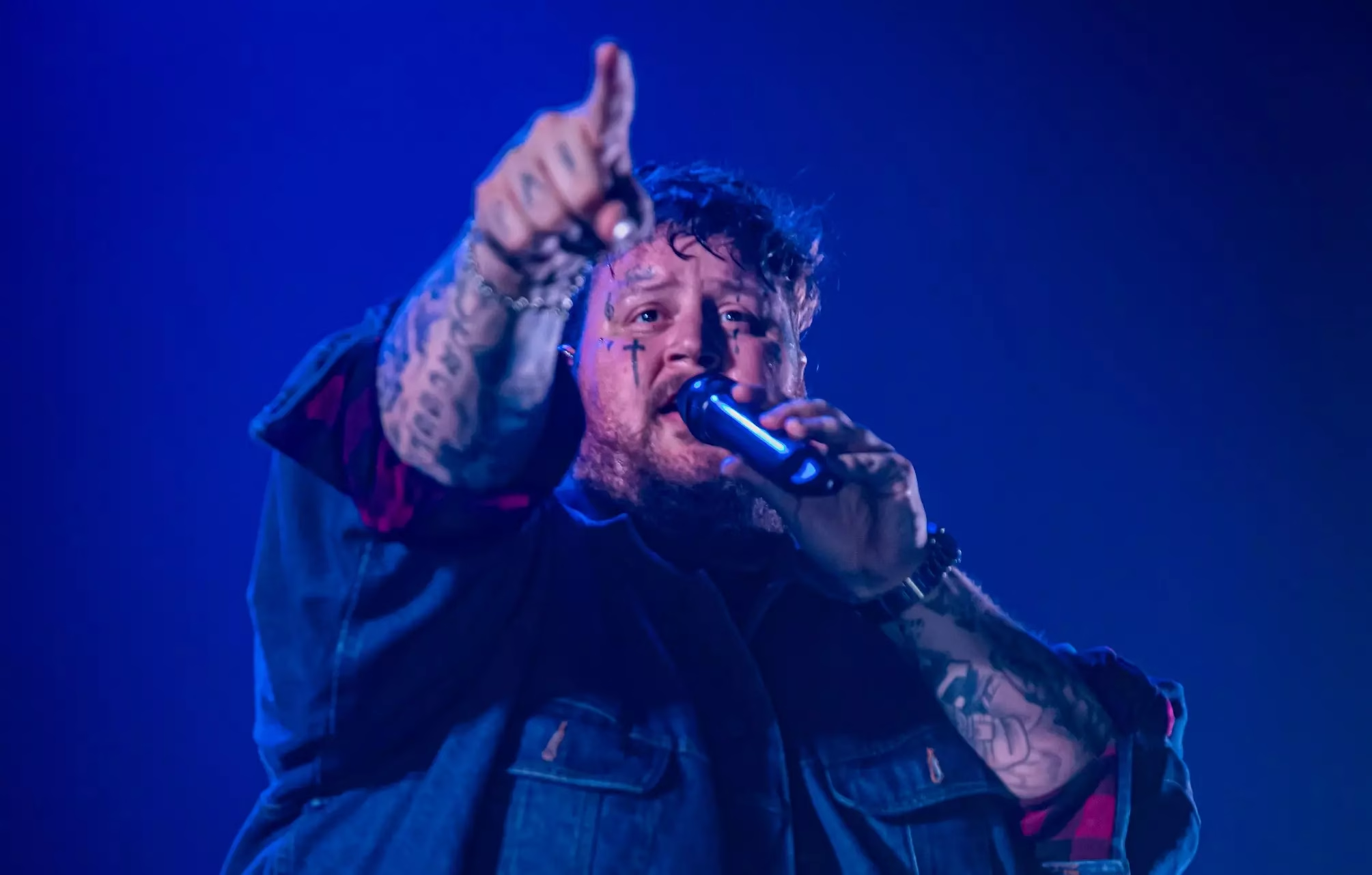
When Jelly Roll first attended church with his daughter, Bailee, he wasn't looking for salvation. But while sitting in a church pew, he realized the story of his own relationship to redemption and religion was one he needed to share.
"Outside of religion, the idea of being able to be redeemed is just a great idea. The idea that who we were is not who we are is so powerful," Jelly Roll tells GRAMMY.com. "At that moment, I was like, 'I want to write a conceptual album, that kind of outlines my journey of religion, my journey of spirituality, my journey of redemption, my journey of wrongdoings.'"
Born Jason DeFord, Jelly Roll spent a decade in and out of federal prison, and was incarcerated when Bailee was born in 2008. Her birth was a turning point for the singer, who started his music career as a rapper in 2011. But the Antioch, Tennessee native always loved country music, and when he realized he could sing, he tried his hand at writing country songs.
What followed is Whitsitt Chapel, Jelly Roll's first full-length country album. Named after the church where he was baptized at 14 years old, the LP is a self-effacing, honest and gritty dissection — and at times, condemnation — of his own life story and complex relationship with religion. Whether he's imploring "somebody save me, me from myself," on "Save Me" or reflecting on what it means to show up, in "Hungover in a Church Pew," Jelly Roll's kind of religion is one of understanding, forgiveness and growth.
Expanding on the rawness of his previous LP, 2021's Ballads of the Broken — which earned Jelly Roll his first No. 1 hit with "Son of a Sinner" — Whitsitt Chapel introduces Jelly Roll as one of country music's most intriguing rising stars. His honest accounts of his struggles — backed by compelling, gritty vocals and driving country-trap beats — transform his live shows into gripping performances, creating an almost church-like atmosphere for fans and the singer himself.
Speaking to Grammy.com on the day Whitsitt Chapel came out, Jelly Roll discussed making his latest album, his hopes for justice system reform and his own journey to redemption.
Well, first off, happy album release day. How are you feeling today?
Oh, thank you. It's better than a birthday. It's like having a prom that you're the king of. I never went to a prom, but I'm assuming this is the feeling.
You sold out the Ryman Auditorium this week for your release show. And I've heard a couple of people describe that show as feeling like going to church. I'm curious what it felt like from your side of things.
You know, man, I love that people compare this to going to church. Because I feel like that's how we try to make all concerts. I always say my shows are a little bit of hip-hop, a little bit of rock, a lot of country, and a little bit of a back road tent revival.
We mix up all the old stuff and the new stuff. So by default, there's a lot of genre crossing. But the back road tent revival is just kind of the theme of the whole project. It's this old fashioned "let's go to church, let's get a little rowdy, let's get a little hellfire and brimstone in here." And any good Sunday sermon has highs and lows, moments you cry, moments you're happy, moments you're scared, moments you're excited, and we just try to recreate that in the show.
Did you feel as though you were up there preaching?
I think the music does the preaching, I just talk. You know what I mean? I think the music's the sermon, I'm just the deacon.
When did you actually start rapping and sharing it with people?
I probably wrote my first rap when I was 10, maybe 11 or 12. And I shared it with my family immediately. Like didn't hesitate. The first rap I wrote sucked really bad. And I ran downstairs with great pride, people gathered around the kitchen table, and I watched them act like it was decent.
As family does. So then, how did you make the switch to do country music?
I always wanted to do country music because I'm just such a country music fan. And I feel like "three chords and the truth" was always the premise of my music. I just didn't know I could sing. If somebody would have told me I had a cool singing voice when I was 20, I couldn't imagine where this thing would be at now. I was, like, in my mid-30s when I found out I could sing.
I was doing karaoke and we were doing Bob Seger, "Old Time Rock and Roll." I came off stage. And a producer was like, "Man, you got to do a song where you're singin'." And I was like, "I would have done that 20 years ago if I thought I could sing, I'm a bad singer." He's like, "Not what I just heard." I started working at it, and you can see that I've got this album Whitsitt Chapel is the first time you can hear how comfortable I am with my voice.
The songwriting and everything, the music evolved. The way I say it is, the music followed the man: the man changed and then the music changed, this big old lug of human ions has just been dragging the music along with me, wherever I've ended up at the mic.
After that moment doing karaoke, you put out "Save Me," which I think of as your bridge to country music.
That was the big bridge, that was 2020, and that was the moment it started coming together. But you want to talk about great links as a singer — I had to relearn how to sing "Save Me" this year. This is the first time I ever told this story. When I first learned how to sing "Save Me," it was as high a register as I could sing, I was reaching for every single note. Now I can sing octaves above that. Now that I'm singing higher, I had to learn how to settle back into what the actual key of the song was.
That sounds like a bit of a surprise.
It was interesting. I didn't realize how off I had gotten over the last year or two. But it's been fun. It's been cool. Because I'm learning, I'm still new to this. I think that's why I'm so excited too, is that I'm just really understanding a little more about the theory of music. I'm understanding chord structure better. I'm understanding keys, octave, pitch, control. These are things I had no clue of when I did "Save Me."
Are you studying music theory as part of this transition?
No, I'm just playing a little guitar when I can, doing a lot more acoustic stuff. My daughter plays a little piano, a little guitar. So I'm just trying to soak up everything I can.
I think religion can do a lot of different things. And it's pretty central to Whitsitt Chapel. Can you talk to me a little bit about your relationship with religion?
I'm really, really, really kind of against religion. I'm not very religious at all. But I definitely believe in spirituality. I had this thought, how I look at church and how I see church now is different than I ever seen it. I realized that it's a bunch of people going to a place as an attempt to build community, seek forgiveness and be better.
And when done right, I don't care what your thoughts are on Jesus, God, Allah, any of that stuff, this is an incredible concept, right? That people go here with the idea of doing better, being better, and community. And looking at that as an adult — because I had a long time I was mad at the church, I think they kind of depicted Jesus wrong at times — but understanding and going back to it, I see what the spirit of it is.
But then you also write lines, like "I only talk to God when I need a favor." Can you rectify for me the real tension in that line, with what you just told me?
Well, it was sitting in the back of a church one day and listening to worship music. And just not being able to relate with it and where I am with my walk and spirituality. And you look at it from that perspective, and you're like, "What is my connection, how would my song to God sound?"
And I feel like it's, "I only talking to God, when I need a favor. I only pray when I ain't got a prayer." The third line in ["Need a Favor"], to me, is the most powerful line, "So who the hell am I, who the hell am I to expect the saving?" Just think about the word "expect" in that line, the entitlement of that. It was just being honest about how I view the church, and then there's my personal walk with God, and they're definitely different. So to me, it was trying to create that music with that spirit.
So then how do you come to name this album for your childhood church?
Well, it started when I went with Bailee to her church. So Bailee's my daughter, she was 14, when she started going to the church, she had alluded to wanting to get baptized. [I thought], well, I should go see what kind of cult she's going to, because that's kind of how I looked at church at that time. And then I went, and I was reminded of the genuineness that can be in those walls, too. I was reminded of the humanity and the compassion and the forgiveness, the love and the community, more than anything watching her and all of her friends there.
And I had started thinking about where I was at when I was 14. I'm going to a little church, too, on a little back road on a hill, there's just these little parallels. Bailee experienced and dabbled in marijuana for the first time, I caught her recently. Around the same age, I was dabbling in marijuana and trouble. It was just reflective.
And then you start thinking about redemption. Outside of religion, the idea of being able to be redeemed is just a great idea. The idea that who we were is not who we are is so powerful. At that moment, I was like, "I want to write a conceptual album, that kind of outlines my journey of religion, my journey of spirituality, my journey of redemption, my journey of wrongdoings." [It's] my take on all these things from a 14-year-old kid getting baptized at Whitsitt Chapel to the 39-year-old man that just watched his 14-year-old get baptized.
And I think 14 was a pretty big year for you, at least a complicated year for you. Your daughter's 14, what impact did that have on you?
That's what made me want to jump to action. The same year that I got baptized, I got arrested, and that started what would be a 10 year cycle of incarceration in and out. And she's in a way better place. She's so much better than I could have ever been at that age, or probably will ever be. But that was what drug it up too, because I know these are the years. I talk to people all the time. They're like, "What do you think the most important years of parenting are?" I say "Every day. But if there's a window, it's 14 to 18."
And at the Ryman show you talked about going back to Whitsitt Chapel to talk to your pastor. What happened when you went back, and how do they feel about you naming the album after it?
It restored my faith in stuff. They pulled my records and sent a picture over of my handwriting, The 14-year-old Jason asking to be baptized — you have to fill out a card. And this church has kept that record for 24 years. Crazy, right? So at that point I'm like, I want to meet 'em, can we go love on them a little bit? I wanted to go sit down and meet with Pastor Ken, and meet with the rest of his staff.
I'm anxious to hear what they think of the whole album. I played them a few songs that they loved. Their exact words was "Man, we're just glad he's thinking of us. We're thinking of him, we love him. We're praying for him. We're proud of him."
My goal in the next couple of weeks is to surprise them, pop by on a Sunday. Maybe I should go this Sunday.
There is a certain something to that timing isn't there?
Yeah, there is something ironic about that.
Now that you've released a country album, do you fully see yourself as a country artist?
I definitely consider myself a country artist. 100 percent. My wife once told me that even if I sing "Amazing Grace" anywhere north of Ohio, she said people would say I was country. She's like "You might not think that you sound country when you sing, but I'm from Las Vegas and you sound country. When you're singing songs around the house, like a Katy Perry song or something around the house being goofy you sound country." My wife's always picked on me about it.
Well the joke might be on her, if you're putting out a country album now.
Ain't that great? She loves it. My favorite thing she does is when she talks in my drawl, when she does her husband impression, it's the best.
Who did you write these songs for?
I wrote these songs for anybody that's dealing with the duality of life. Back to that Sunday service, I've went out and overserved myself, many a Saturday. Many a Sunday morning, I still woke up and showed up, and that's the duality of man.
It's kind of "Son of a Sinner" again. It's always about that somewhere between being right and wrong, because I think that's the exact place I live in. I know my heart's pure. I know my spirit's right. I also know that I make really politically incorrect jokes. And party sometimes, and I'm a little silly and outrageous. But I also know that my heart is to be a man of service and to help people. So I write for those kinds of people, the struggling poet of the broken man. Always trying to be the voice for the voiceless.
And you really end the album in that spot, "Hungover in a Church Pew," right?
Yes, that was important in the album that way, because I needed that. Because there's moments where it would sound like "The Lost": "I've been known to find my kind of people/ They ain't at home underneath church steeples." But even through this whole journey of this album, all "Hold on Me," my struggle with alcohol, my love song to my wife, "Save Me," "Need a Favor," "Dance with the Devil." Even after all that, I still found my way to that kind of upbeat, mid tempo, hungover "sunbeam down on that stained glass window, the preacher man preachin' that fire and brimstone." So to me, it was cool, because I was like, "I heard your fire and brimstone." I'm always looking for redemption.
And that middle of the road too, one foot in two places, right?
Exactly.
I'm curious about more of your backstory. You're really open about being a convict. And it's something that's central to your identity. I'm curious about the choice to keep that in the forefront of your identity.
Well, I'm reminded of it all the time. So I think that what my goal now is while I'm being constantly reminded that I want to remind people that you can change. I tried to buy a house four months ago, and I was turned down because of my felonies. I'm still dealing with it today.
I think it's more now about just trying to bring attention to the cause, to have some sort of justice reform. My felonies that are inexpugnable, that I got whenever I was 16 years old. You know, I wasn't thinking like a man that should have that held against it him for the last 20-some years.
So what do you want people to understand about that?
I think that we need to just re-examine the juvenile system, if we're focusing our efforts on discipline or rehabilitation. And I think that goes into the drug addiction pandemic in America, too. Are we properly focusing our attention on rehabilitation? Are we finding alternate means yet? Can we accept that the war on drugs was a war that we lost? My story is just an attempt to bring attention to those topics. And my thing is, I don't think it's a one-size-fits-all for everyone. Like, even down to my felony, I think that these things should be on a case by case basis.
You ended up donating your proceeds from your recent Bridgestone Arena show. Was that to a variety of youth programs or to the juvenile detention center where you were incarcerated?
We built a studio at the detention center where I was, we also granted some scholarships to some local high school students. I didn't want to limit the at risk youth to just incarcerated kids. Because I believe that there's kids that are at risk that haven't made that decision yet, but also don't know how they're gonna go to college. I want to help those problems as well.
What's your hope for what that money can do?
My hope is that it can create a safe space for kids to create music and express themselves. But this is bigger for me as far as like, I have a 10-year plan here that I want to change. I want to open group homes, eventually, I want to open aftercare programs, community centers. I want to bring other trade work into the juvenile facility that I was at. I started with music because it's what I know. But I'm hoping to bring barbering in and welding in, whatever I can bring in to help these kids realize that they might have another way to go about it.
Is that because of how far you've come?
I think it's because of how far I've came, and the ability to give back. I want to help. Who are you if your life has changed this dramatically, and don't try to help?
Do you feel like a different person than when you started making music?
I'm such a different person. You can hear it in the music. You can see it in the testimony. Hell, I'm proud to say I'm better today than I was a week ago. I've consciously made decisions and choices and realized things that I fell short on. I do self inventory every day.
It's just the idea that I learned through different programs, the concept of looking back at things and everyday doing a self inventory check: "Was I nice? Did I care? What did I do that didn't feel right? Did I say something I regret saying? Did I not call somebody? Did I not say something I should have said?" It'll keep you grateful. It'll also keep you humble. Because sometimes the inventory is just, "What am I grateful for? What's happened in the last 24 hours that I'm grateful for?"
Well these last 24 hours might have a few things for you to be grateful for.
Whooo, these last 24 hours are packed. It's going to carry me to the weekend. I'm now allowed a couple of f— ups. Nah, I'm kidding. It's that balance, right? "It's like okay, I've earned a night of recklessness."
Well, Sunday's coming, right?
Amen.
Meet Bailey Zimmerman, Country's Biggest New Star Who Still Can't Believe He's Famous