Living Legends is a series that spotlights icons in music still going strong today. This week, GRAMMY.com spoke with John Cale, a singer, songwriter, multi-instrumentalist and founding member of the Velvet Underground who has steadily built his solo discography for more than half a century. His new album, Mercy, is available now.
Back in 2018, John Cale strolled into the Velvet Underground Experience, an exhibition in New York City's NoHo neighborhood, and gazed upward at a massive projection at Lou Reed's face for several seconds. This writer was there, and the memory lingered — as did its attendant questions.
What must it be like to be chiefly known for what you did as a very young man, for all of two years? To boot, after decades of a storied solo career — including classics like 1973's Paris 1919 and 1982's Music for a New Society — what is it like to have people chiefly want to talk about the Velvets? On top of that, was there any perception among its members that what they were doing was important — much less momentous, and pivotal for popular music?
"I had some theoretical ideas as to why it was important," Cale tells GRAMMY.com over the phone from Los Angeles, where he resides. "I thought if I put together the music that Lou and I would do — which was out of tune slightly, but getting somewhere — the idea of what the music was going to be was going to have an effect. Not only on the avant-garde, but on a lot of other different styles.
The impact of the Velvet Underground on alternative, punk and experimental music has been litigated and relitigated — most recently, in Todd Haynes' fantastic 2021 documentary The Velvet Underground and Ignacio Julià's illuminating 2023 book of interviews, Linger On.
Where do you go from there, with Reed; Nico; manager, producer and cover artist Andy Warhol; and founding Velvets guitarist Sterling Morrison no longer with us? Cale remains a potent creative force, so he keeps hurtling forward. His new album, Mercy, is one of his very best — aurally immersive, lyrically wise and filled with facilitative guests, from Weyes Blood to Laurel Halo to Animal Collective.
"I was angry," Cale says of his mindset while writing songs like "Noise of You," "Story of Blood" and "Not the End of the World." More specifically, "I was angry at the number of people in positions of power that should have known better and didn't." Thus, Cale remains a truth-teller as well as a thoughtful collaborator and vital innovator — and it's all there in the music.
GRAMMY.com caught up with Cale to discuss the origin of Mercy, the young rapper that's influencing him lately, and what the remainder of 2023 holds for him.
This interview has been edited for clarity.
Whether political or personal, what raw materials went into Mercy?
Well, it was happenstance more than anything.
I was on tour in São Paulo, and I was getting on a plane to go home, and by the time I landed in LA, everybody was under strict lockdown. I'd already written the bulk of the album. So, I came back and was thinking: What is it I can add to this, and maybe ignore the lockdown for a minute and get on with some useful stuff?
Two and a half years later, I was still working on the structure and the noise of the album. I went straight back into it and added some other musicians. I was really glad I did, because [of] the variety of the musicians I found — I mean, I'd worked with them for the Velvet reunion concerts and other places.
So, there was Laurel Halo; there was Actress; there was Weyes Blood, Sylvan Esso, Animal Collective, and Fat White Family. And the songs benefited from all of that interruption.
Reading the lyrics, I was captivated by their heavy, overarching topics. You seem to have a bird's-eye view of everything.
Well, I was angry. I was angry at the number of people in positions of power that should have known better and didn't.
Regarding pandemic mitigation?
Pandemic mitigation, and distorting the truth. Disinformation, conspiracy theories, guns — so much hate. And we were really badly in need — and still are — for people to speak the truth, to help heal this mess and get to the point where redemption was possible. I thought, Well, that's what it is. Strain your soul.
Having been born at the top half of the '40s, do you remember another time when things were this nuts?
Well, I was born at the end of World War II, so it had something going on there that when you got out of it, you thought, Well, I'm glad that's over. Maybe now we'll go learn some common sense. And here we are, 60 years later; we still haven't learned it.
Can you describe the aural aesthetic you pursued for Mercy? I was struck by how enveloping it was from the beginning. It's maximal, but not busy.
That's true. I didn't want it to be busy.
Usually, I write songs from an improvisational point of view. I start with a rhythm, and I improvise the biggest part of the song and then simplify it. Because most of the stuff that I listen to is hip-hop, and I learned a lot from their style and their awkwardness. It was really instructive to me.
I only listened to certain kinds of hip-hop, and the further out they got, the better I liked it. There's a California style, and there's the Bronx. I can't say that I tried to imitate what they were doing, because I couldn't. I mean, I've got a Welsh accent, and that'll stop you in your tracks.
Tell me more about your improvisatory roots, back in the Velvets days when you played a lot of viola.
I don't play as much viola as I used to in those days, but that instrument was really what started me off. I was playing in orchestras from the time I was 12 or 14, and I used to improvise in the most awkward of situations. When you think of what the viola is famous for… not much!
I thought you'd be telling me you were really into Albert Ayler or Ornette Coleman or something.
Oh, yeah, yeah, yeah. I also loved listening to U.S. radio; the broadcaster came from D.C. I used to listen to Radio Moscow as well. It was full of those hard-to-find jazz musicians — I mean, Miles and Gil Evans and the entire "new jazz."
I used to go down to the Village and listen to all those guys playing there. I would go several nights a week to see Gil Evans and how his arrangements were really rich.
They were splendid, if you know what I mean by the use of the word "splendid." They had luxurious arrangements with several bass clarinets — not the simple, improvised pieces. These were chord-oriented and very rich. Yeah, they were something I learned a lot from.
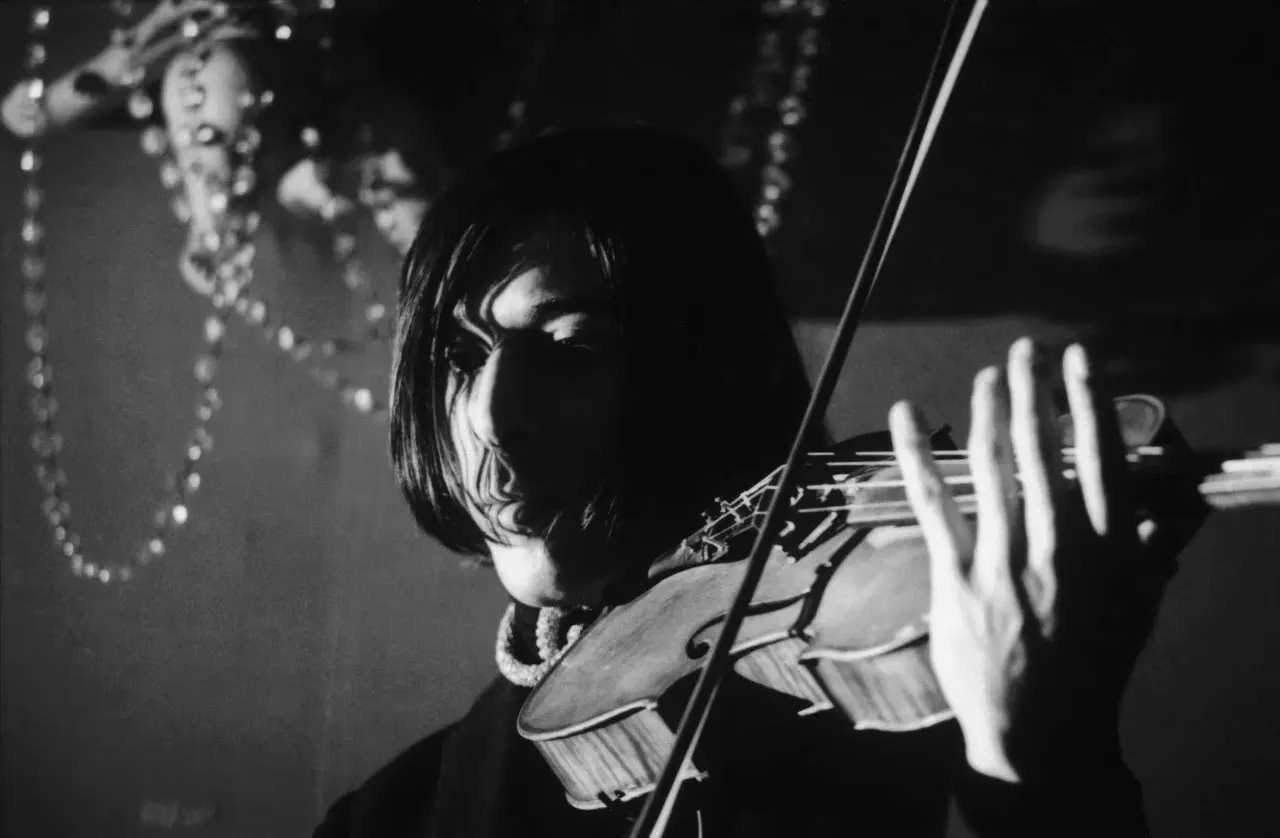
*John Cale performing with the Velvet Underground in 1966. Photo: Adam itchie/Redferns via Getty Images*
You characterize yourself as being an awkward improviser early on. When do you feel like you really came into your own in that regard?
Last year, when I finally got this album under control.
Really!
Yeah. I mean, it really took a while, and it's kind of insecure. But when you start writing songs from the rhythm point of view first, you get to the end a lot faster — and it's a very exciting kind of journey, the progress to the end of the song.
That's what this album represents more than anything: what comes first? Do you put the melody down first? Do you put the rhythm down first? I put the rhythm down first. And as soon as you put the rhythm down first, you're in hip-hop.
Tell me a little more about what draws you to hip-hop. Which artists speak to you?
Earl Sweatshirt. A lot that didn't fall into any particular category. They drifted a bit; they drifted in their own thoughts. And I didn't mind that at all.
I'd love to go through the tracklisting and get your insight on each tune.
"Mercy": I had to decide whether I was going to lay myself open to pseudo-religious methodology, and Laurel Halo was similar. I met her in Australia on a tour, and she was a very trance-like synthesist.
"Marilyn Monroe's Legs": I wanted to write a song about Marilyn Monroe, but I didn't want to mention her name in the song. It has a certain obscurity to it; I wanted that song to have abstractedness.
"Noise of You" was something I wrote as an atmospheric piece. With all the melodies and choruses going in it, it really reminded me of Central Europe — of Prague in wintertime. Every time I played that song, I couldn't get away from the idea that this is the Charles river. When I first went to Prague, it was a difficult period, but it straightened itself out.
Then, there's "Story of Blood" with Weyes Blood. [She] has this passionate voice that really fits in, and carries the melody and emotion really well. "Time Stands Still," with Sylvan Esso — I loved them from when I first got used to them. I loved the way that they do melody and rhythm. They had some really beautiful phrasing.
"Moonstruck" is something that came late in my day. I'd not written a song about Nico, because I'd worked on a lot of her records, but "Moonstruck" is how I imagine her style would be. When she approached songwriting, it was because a big influence on her was Jim Morrison. She put much of it together in that style. Jim was making a point of saying, "Do the words first. Do the poetry first, and then the music will come." So, "Moonstruck" was something I reflected on.
"Everlasting Days" with Animal Collective was a very, very useful way of using several different harmonies, like the Beach Boys — four-voice harmony. This was a fun track to work on with them.
"Night Crawling" was about what I remembered from those days when CBGB's was carrying on. It was one of those cases where you really want to work with somebody so much that you don't get the opportunity.
"Not the End of the World" was my way of dealing with the serendipity of life. You got a problem? Yeah, well, get over it and get some work done. That's always the way I've found life since the Velvet Underground — to be a continuum. Because really, I was always into work. Andy [Warhol], Lou [Reed] and myself, we all had that poke in the eye that comes from doing good work.
So, you have "The Legal Status of Ice" by Fat White Family, and they were a rambunctious lot. As close to having a punch-up as anybody. "I Know You're Happy" has [Colombian-Canadian singer/songwriter] Tei Shi on it. And "Out Your Window" is a little bit of a look back at the Velvets. The piano part does.
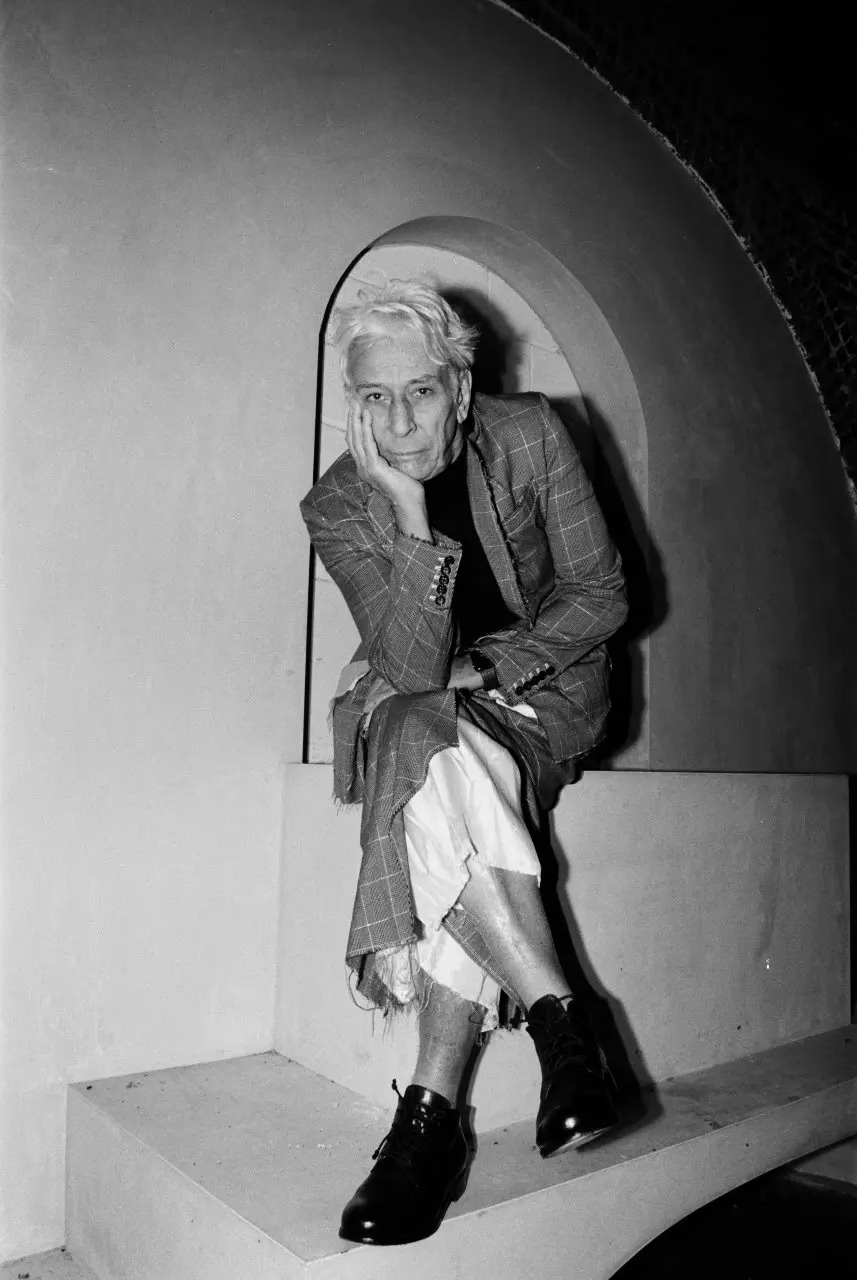
*John Cale. Photo: Marlene Mariano*
Aside from Mercy, what's the remainder of 2023 looking like for you?
A break! The two-and-a-half years that I put into this album — before I could leave the album, I came off the road and started getting used to daily life without performing. And deciding that it was smart to write as many songs as I possibly could and get them done fast, because you've got this nasty little monster around.
So, that's what I did. By the time I went back on the road, my engineer and I looked at the list that we had. There were something like 70 or 80 songs on there, and I thought: Good job.