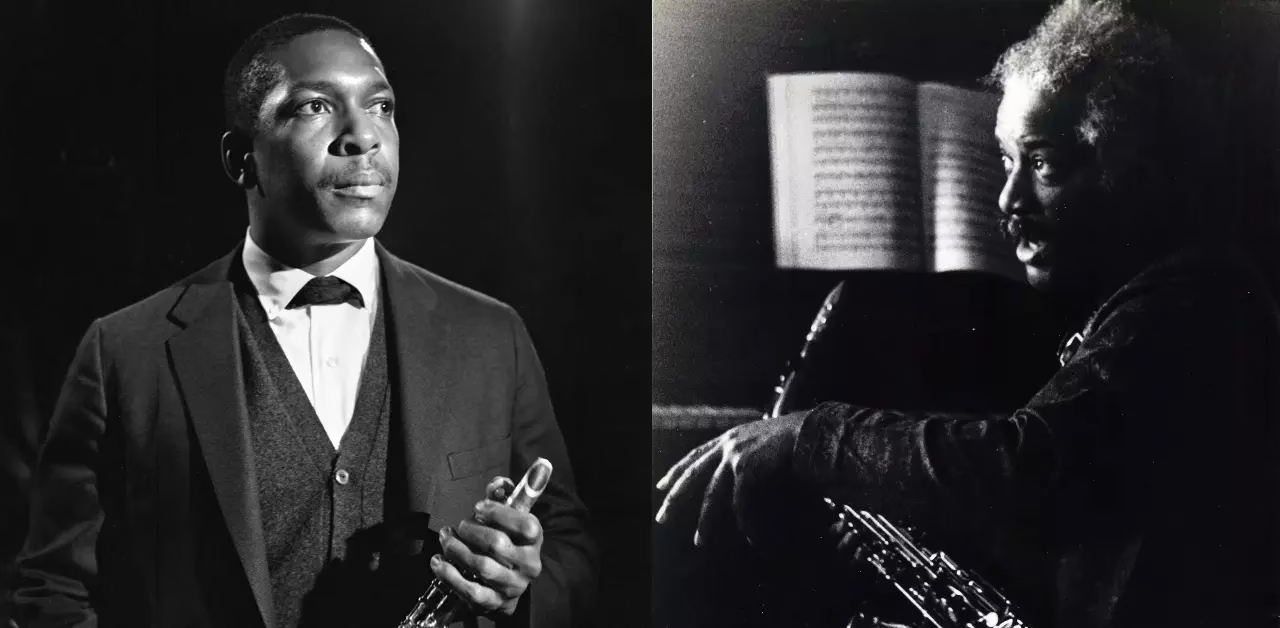
Steve Griggs was dumbstruck at what he was hearing. For the past several years, he'd been on a crusade to learn more about Joe Brazil, the mysterious name on the back of John Coltrane's Om, credited as playing flute. The journey led him to Joe's widow Virginia's home — where Joe had died in 2008. There, she invited Griggs to sift through a massive collection of reel-to-reel tapes Brazil had made throughout the years.
"I kind of felt overwhelmed — almost paralyzed," Griggs tells GRAMMY.com. "Like, how do I approach this volume?" He decided to start with Joe's recordings of his close friend, Coltrane. One, marked "Saturday, Oct. 2 — A Love," caught his eye, due to its temporal proximity to the legend's famous Live in Seattle album. "There was no documented performance of A Love Supreme," Griggs notes of that period. "I was like, 'Oh, maybe he taped the record or something. I was skeptical: 'A Love?' What?"
But when Griggs put on the tape, it gradually dawned on him: He was hearing "Psalm," the solemn closer from A Love Supreme. He flipped the tape over, and there it was: The famous fanfare from opener "Acknowledgement." This finding took his breath away: Until then, there had only been one known live recording of Coltrane's monumental suite, his statement of spiritual intent. Here was a major document, and no Trane scholar knew it existed on the planet.
Virginia struck a deal for Resonance Records co-president Zev Feldman to acquire the tapes — partly so they'd "stay out of the hands of nefarious bootleggers," as Feldman tells GRAMMY.com. Due to Resonance's longstanding relationship with Verve Label Group and Impulse!, they were able to get it in the hands of the proper rightsholders at Universal Music Group.
Now, this recording that Griggs says "might have gone in a trash can" can be cherished by jazz fans the world over. A Love Supreme: Live in Seattle, which was released Oct. 22 via Impulse!/UMe, features a polished version of that very tape in full — bigger, rawer and wilder. It shows that the jazz legend sought to test its edges, reconsider its components, scramble its equilibrium. A Love Supreme wasn't just a classic record: It was alive.
And if not for Brazil — a saxophonist, community hub and consummate documentarian who many jazz scholars aren't aware of — we wouldn't be able to enjoy this music today.
Joe Brazil. Photo courtesy of the Joe Brazil Collection.
"To me, there are two heroes of this recording, once you get beyond the musicians themselves," Mark Stryker, a jazz historian and columnist who authored 2019's Jazz From Detroit, tells GRAMMY.com. "Joe Brazil, for having the foresight to record that afternoon, and Steve Griggs, who brought it to the world, those are the heroes to me: Two saxophonists living decades apart in Seattle."
But Brazil was not merely capturing a famous musician, like a taper at a Grateful Dead show. As a recordist, musician and man about town, he was part of the "marrow" — Stryker's word — of the Detroit and Seattle jazz scenes. He also enjoyed a warm friendship with Coltrane, an intimidating figure to some. And after the saxophonist's death, Brazil was a passionate and unconventional music educator.
"If we didn't have this album — even if this didn't exist — Joe Brazil's life mattered," Stryker says. "It mattered in jazz in the way that so many lives in jazz mattered. And it's worth taking a minute to think about that."
As with the story of any life — especially one as magnificent and underreported as Brazil's — it's helpful to start at the beginning.
Roots In Detroit
<style>.embed-container { position: relative; padding-bottom: 56.25%; height: 0; overflow: hidden; max-width: 100%; } .embed-container iframe, .embed-container object, .embed-container embed { position: absolute; top: 0; left: 0; width: 100%; height: 100%; }</style><div class='embed-container'><iframe src='https://www.youtube.com/embed//28FDmhoAV0M' frameborder='0' allowfullscreen></iframe></div>
Griggs has spent a decade researching Brazil in the role of an "unpaid storyteller," and his findings are available to all. His Joe Brazil Project, which has been quietly accumulating on Blogspot since 2012, is a trove of historical goodies, from a Brazil family tree to a script for a Brazil-centric play to a photo of a cigarette burn on Brazil's piano — courtesy of Coltrane.
The blog also contains a timeline of Brazil's early life, and it goes something like this: Joe Brazil was born in Detroit in 1927, and went on to study saxophone at the Detroit Institute of Music and Conservatory of Music. Straight out of high school, he joined the army and played in a band called the G.I. Jazzmen of Geiger Field — named after where he was stationed, outside of Spokane.
Like many musicians in the incredibly fertile '50s jazz scene in Detroit, Brazil worked in the automotive industry — specifically at Chrysler, as a toolmaker and inspector. Being part of that burgeoning middle class allowed him to buy a house for his mother, with the help of his brother. After she died in 1951, he outfitted the basement with a bar, chess boards and a baby grand piano.
This hang-space attracted Detroit's best and brightest, like saxophonist Sonny Red, trumpeter Donald Byrd, pianist Barry Harris, bassist Doug Watkins, and drummer Roy Brooks. Even national touring artists like Coltrane and Miles Davis — who played together in Davis' First Great Quintet — passed through to jam and shoot the breeze.
"I had been to his house before and I played at some of those sessions," saxophonist Charles McPherson tells GRAMMY.com. "I know he was a guy that documented things — a lot of Detroit players, and people who would come through Detroit working with other people." (Plus, as Coltrane scholar Yasuhiro Fujioka explains to GRAMMY.com, Detroit was a suboptimal place to score drugs, which made it a destination for musicians hoping to get clean.)
Brazil's involvement in Detroit's music scene didn't end there: He dragged a somewhat cumbersome German tape recorder to clubs like the Blue Bird Inn, the West End and the Rouge Lounge.
"He was moving around and kind of greeting people. He was an MC of sorts," journalist, author and activist Herb Boyd tells GRAMMY.com of one such night at the Blue Bird. "At the same time, he was a host with the most, in terms of also documenting the occasion."
As Boyd points out, Detroit offered few club opportunities for young players, so they often congregated in homes. "It was very unique in that sense, because we had single dwellings and you had control of your basements and upstairs and attics and what have you," he says. "People could come by and you have an opportunity to sharpen and perfect your study of the music."
Joe Brazil's house in Detroit. Photo courtesy of the Joe Brazil Collection.
In 1958, Coltrane stopped by Brazil's place to jam with him and Joe Henderson; their rendition of "Sweet Georgia Brown" from this day is floating around on YouTube. Coltrane went on to become a frequent visitor whenever he and Davis were in town. As Griggs speculates, Brazil's ability to meet people on their level endeared him to Coltrane.
"People were intimidated by [Coltrane's] prowess," Griggs says. "Even back in Detroit, Roy Brooks and other musicians were like [Breathless voice] 'Coltrane! Coltrane! Coltrane!' They were making a big deal out of him. And it's appropriate to make a big deal out of him, but he's also a human being who's really curious and wants to know what everyone else is doing."
And in 1961, while most Detroit musicians headed eastward for New York, Brazil went the opposite direction — westward, to Seattle, to take a new job at Boeing. Despite this, his relationship with Coltrane didn't end there.
A Rendezvous In Seattle
<style>.embed-container { position: relative; padding-bottom: 56.25%; height: 0; overflow: hidden; max-width: 100%; } .embed-container iframe, .embed-container object, .embed-container embed { position: absolute; top: 0; left: 0; width: 100%; height: 100%; }</style><div class='embed-container'><iframe src='https://www.youtube.com/embed//f7mCw-s8SDg' frameborder='0' allowfullscreen></iframe></div>
Two years after the move, Brazil enrolled at the University of Washington to study math and computer programming. He also soaked in the local jazz scene, performing with greats like saxophonist Charles Lloyd and bassist Rufus Reid.
"He was a character, for sure," the twice-GRAMMY-nominated Reid tells GRAMMY.com from his home in Teaneck, New Jersey. "He had that kind of energy; he could manifest all kinds of things and it was fun playing. I was learning tons about music I didn't know about."
Rufus Reid and Joe Brazil. Photo courtesy of the Joe Brazil Collection.
By 1965, Coltrane had released A Love Supreme, a record which made him a bona fide jazz star. "He's headlining wherever he wants to, whenever he wants to, clubs, festivals," GRAMMY-winning Coltrane scholar and author Ashley Kahn tells GRAMMY.com. "And he's making bank for it."
"But at the same time, he's taking that moment of what we would look upon as success and not slowing down," he adds. "In fact, he's increasing the tempo of his drive and saying, 'I'm going to keep experimenting."
That year, Coltrane's quartet — pianist McCoy Tyner, bassist Jimmy Garrison and drummer Elvin Jones, outfitted with tenor saxophonist Pharoah Sanders and second bassist Donald Garrett — rolled into Seattle to perform a weeklong residency at the 275-capacity Penthouse club.
Coltrane paid engineer Jan Curtis out of pocket to record the results, and the volcanic performance on Sept. 30 became 1971's Live in Seattle. Wanting to keep the vibe going, the group decamped with Brazil the next day to Camelot Sound Studios in the Seattle suburb of Lynnwood to record Om, one of Coltrane's furthest-out works. On the album, Brazil plays one of Trane's wooden African flutes, making Om the only known recorded collaboration between the two.
"The music sounded crazy. People were chanting, drums bashing, horns squealing," Griggs wrote of discovering Omon his blog. "I couldn't pick out any recognizable melody or form. It sounded like freedom — spirits unleashed. Emotive motifs turned up to 11!"
For the performance the following day, Oct. 2, alto saxophonist Carlos Ward sat in. After an opening performance by Brazil and his ensemble, he patched his recorder through the club's two-channel recording system. Right then, he captured this teeming, multitudinous version of Coltrane's suite.
"The fact that he was there to record it came as the fruition of this long life led in music up until that point," Stryker says. "He was really embedded within the core of the musician's life and the social and cultural fabrics of the cities in which he lived."
After Trane
<style>.embed-container { position: relative; padding-bottom: 56.25%; height: 0; overflow: hidden; max-width: 100%; } .embed-container iframe, .embed-container object, .embed-container embed { position: absolute; top: 0; left: 0; width: 100%; height: 100%; }</style><div class='embed-container'><iframe src='https://www.youtube.com/embed//bWWnXOc9Y3Q' frameborder='0' allowfullscreen></iframe></div>
In 1967, Coltrane died of liver cancer at only 40, bringing his insatiable progression to a screeching halt. And, as Griggs speculates on his blog, the death hit Brazil hard, drawing the blueprint for the rest of his life — especially given that Martin Luther King, Jr. would be assassinated the following year.
"This existential reckoning may have urged him to pass information on to the next generation," Griggs writes, noting that Brazil went on to teach music locally at Seattle Community College, Washington Middle School and Garfield High School.
His teaching career took an abrupt turn from there: In 1968, a black student union and the Black Panthers occupied the University of Washington's president's office, demanding the formation of a Black studies program. Fully aware of Brazil as a community member and Coltrane associate, the union demanded the school hire him as a faculty member at their school of music.
At UW, Brazil used his unpolished, personable teaching style to bring jazz pioneers, like Dizzy Gillespie and Herbie Hancock, eye-to-eye with students. "He felt that the important point about the music was one-on-one relationships," Griggs says. "That's how the music spreads."
Cannonball Adderley and Joe Brazil. Photo courtesy of the Joe Brazil Collection.
While Brazil had a special way of communing with students, his unvarnished approach — chronically late, flouting academic decorum — flew in the face of academic mores and stoked derision from other faculty members.
"He was very street, in a certain way, and that didn't fly in an institution that was modeling itself after a European conservatory," Griggs says. "Perhaps they were jealous that he was connecting so well with students. The students were so happy to be in his class, but he wasn't credentialed like the rest of the faculty. He was Black. He didn't have degrees."
Despite breaking down barriers in academia, Brazil was ultimately not granted tenure, and was eventually replaced by Milton Stewart, another Black professor from the University of Michigan — who, Griggs says, weathered even more abuse than Brazil did.
Read More: Giant Steps At 60: Why John Coltrane's Classic Hard Bop Album Is More Than A Jazz-School Worksheet
Before and after leaving the University of Washington in 1976, Brazil became even more involved with his Seattle community, teaching students and inmates — often at little or no cost — and founding a nonprofit music school called the Black Academy of Music. The King of Sweden, Carl Gustaf, presented him with a service award in 1976.
"My life has taken a number of directions, but all seemingly with a purpose," Brazil wrote at one point. "Along the way I have come in contact with some remarkable people. Most have had some positive impact on my life. I have also come in contact with many racists and bigots.
"I feel the information that I share about my life," he added, "may help to bring about some awareness that will bring us earthlings a step closer together."
Zooming Out From Brazil
<style>.embed-container { position: relative; padding-bottom: 56.25%; height: 0; overflow: hidden; max-width: 100%; } .embed-container iframe, .embed-container object, .embed-container embed { position: absolute; top: 0; left: 0; width: 100%; height: 100%; }</style><div class='embed-container'><iframe src='https://www.youtube.com/embed//CmDbJ8TrQe8' frameborder='0' allowfullscreen></iframe></div>
Sadly, Brazil is no longer around to tell his story: In 2008, he died at 80 after a history of heart problems. And while his story is fascinating enough to warrant a biography — Griggs has been trying to write one for a while — Brazil's relative marginalization speaks to the unwritten history of this Black, American idiom.
"My understanding is that Joe was a good musician, but he wasn't a great musician and he didn't record," Stryker says. "In jazz history, we tend not to remember people that haven't recorded." But, he stresses, even those who weren't in jazz's Mount Rushmore — and even those far from it — indisputably impacted the musicians, communities and cities they were part of.
"If we didn't have this album — even if this didn't exist — Joe Brazil's life mattered."
—Mark Stryker
"If you step back and you look at Joe's life in the broader sense of the history of jazz, you see someone who had an extraordinarily fulfilling and influential role in the communities where he lived," Stryker adds. "He was at the center of action in some ways in Detroit, and in Seattle he began to play an even larger role."
Now, with A Love Supreme: Live in Seattle out in the world, neophytes, fans and scholars alike can take a moment to appreciate the little-known figure who captured this music for the world.
"It's natural that everybody's going to gravitate to Trane and the story and the recording and all that," Stryker says, surveying the mostly Brazil-less ocean of reviews and features about the long-lost recording.
"But I would've thought that someone before this," he adds, "might have thought to take a step back and talk a little bit about Joe."
Joe Brazil. Photo courtesy of the Joe Brazil Collection.