An industry darling paying tribute to the land of the free in what's arguably the most prestigious room in said country. The title: American Symphony. Does this sound dry, erudite, staid? Nothing could be further from the truth.
This is Jon Batiste we're talking about, he who exudes creativity, thoughtfulness and charm with every piano trill, with every shout-out to Duke, Nina, Billie and Louis, with every impish, camera-ready grin. Even sans piano, his hands tend to dance, fingers extended southward, his locks projecting in all directions.
And on Sept. 22, when Batiste strode, clad in royal blue, down the aisles of Carnegie Hall's Stern Auditorium to its Perelman stage — which those four progenitors graced — his mind was visibly whirring. (Even in his ride to the gig, he was noodling on a synth, mulling over ideas.)
still composing on the way to @carnegiehall pic.twitter.com/gjpYD07Mwo
— jon batiste (@JonBatiste) September 22, 2022
After the standing ovation ceased, it was time to behold a new kind of American symphony — not a bland, flag-waving one, or one that papers over the strife and ugliness and outright horror of the nation's founding.
No, this one has banjoists and steel drummers and Afro-Latin percussionists and Indigenous vocalists and drummers. It has a hefty-looking modular synth. It has screams and police sirens and disembodied conversations. It has ominous, decaying runs at the bottom of the piano's register.
This glorious cacophony acts as the answer to Batiste's questions in the show program: "What if the symphony was invented today in America? Who would participate in the modern American orchestra? What would it sound like?" And as the five-time GRAMMY winner and 14-time nominee explains, those prompts sent him on this composerly journey more than three years ago.
Batiste was supposed to debut American Symphony back in May, a month after he swept the 2022 GRAMMYs, including a golden gramophone for Album Of The Year. After the maestro contracted COVID, the show got kicked forward to the beginning of fall; perhaps that extra time enabled him to further tighten the screws.
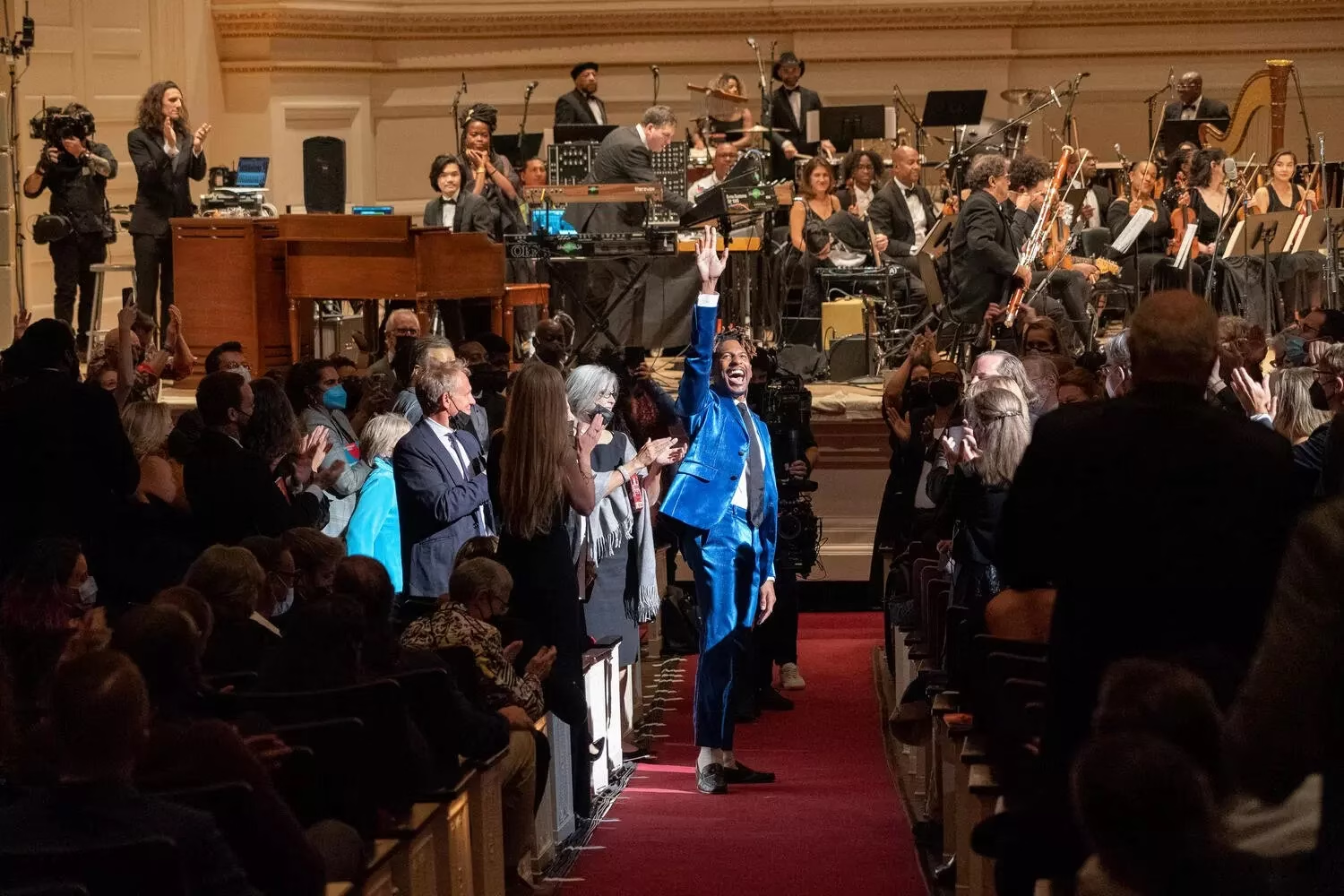
*Jon Batiste performing at Carnegie Hall in 2022. Photo: Stephanie Berger*
Because even during the parts where American Symphony seems to float like mist, it's tightly written and conceived. And due to its force of imagination, musical economy, and sheer diversity of sounds and ideas, there wasn't a dull moment in the performance's intermission-free two hours.
Subdivided into an overture and four conceptual movements — titled "Capitalism," "Integrity," "Globalism," and "Majesty — American Symphony takes the masked, black-tie-clad audience on a journey through the United States' manifold, oft-contradictory nature through music that majestically heaves, tormentedly deliberates, and joyously soars.
Using the monumental collaboration between Duke Ellington and Billy Strayhorn as a lodestar ("They consistently synthesized cultural lineages through the lens of a pluralistic and noble worldview," Batiste writes), he captures America's cultural multitudes through an intertwining of a vast range of African diasporic traditions — Caribbean, Brazilian, Yoruba, Haitian, Creole.
And given that New Orleans represented a nexus of these influences, the performance felt like a jubilant tribute to the Big Easy — Batiste grew up in Kenner, a suburb of New Orleans — while framing it as a wellspring and living source of American excellence.
By putting the Black experience front and center, Batiste rendered American Symphony realistic, not jingoistic. The symphony balances interpolations of patriotic mainstays like "Battle Hymn of the Republic" with songs invaluable to the civil-rights movement, like "We Shall Overcome" — all with musical suggestions of disharmony and struggle shadowing the margins.
The overture suggested a form taking shape from welter and waste, Book of Genesis style. As its vast diversity of instruments and traditions commingled, the composition swirled semi-shapelessly, until it coalesced into melodies and motifs. This isn't meant to evoke pre-colonialization American continent being, absurdly, some kind of blank slate; the conspicuous Indigenous elements drove that crucial point home. Rather, it suggests a budding republic.
In the maestro suite.
tonight is the night.
Premiere of American Symphony.#BatisteNo1 @carnegiehall pic.twitter.com/TUvlGDRYrn— jon batiste (@JonBatiste) September 22, 2022
In the program, Batiste cites "essential elements of the American democratic system" and "the U.S. Constitution as a reference point," stressing that "this score is a living document that will evolve over time." Likewise, the audience felt the American experiment evolving, experiencing growing pains, and reckoning with the stains of its past. And great blasts of percussion punctuated it like cannonfire.
"Capitalism" focused on "the building of cities and structures that have long since shaped the way we relate to one another and to the land." Incorporating a din of clashing electronic tones — and giving way to shimmering, Phillip Glass-like clusters of notes from the composer's Steinway — this movement shattered any preconceived notions that this would be some kind of American Revolution exhibit.
This blurred into another counterweight — an educated guess would place this in "Integrity." (The movements weren’t announced, and didn't always begin and end in straightforward fashion; often they blurred into each other.) Fiddlers suggested nascent country music, the everyday citizen, the Great Plains.
"Don't give up/ Don't give in," a gospel section sang, waried yet calming and resolute. Soon after came the clap-alongs, the exhortations, the benedictions, which kept American Symphony from ever tripping into anything lecturing or tiresome or polemical. Most everyone was on their feet.
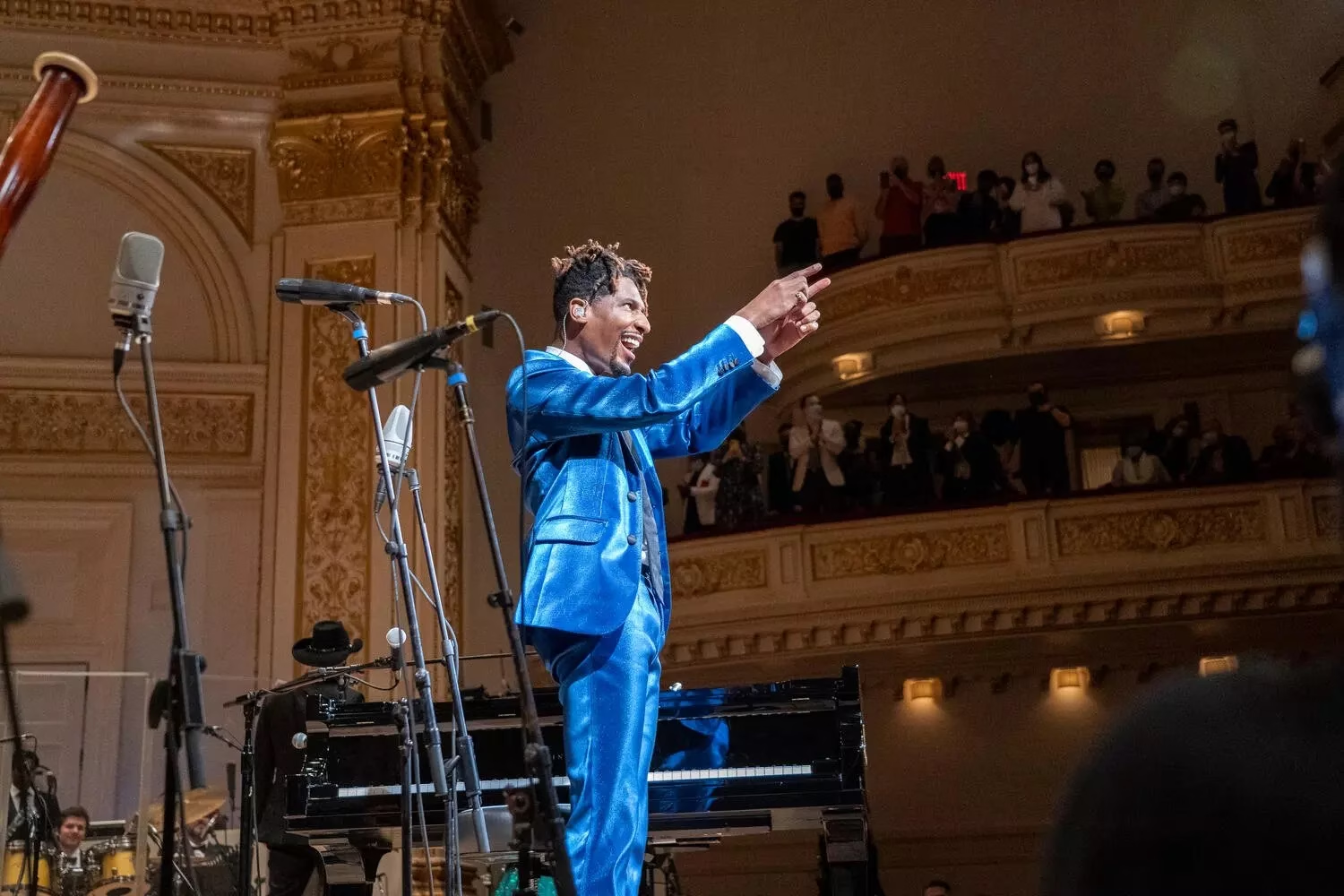
*Jon Batiste performing at Carnegie Hall in 2022. Photo: Stephanie Berger*
After a tranquil and diffuse middle section where the intermission might have been slotted, American Symphony went lighter on signifiers and heavier on simple, strong flavors, threading wheedly synth lines into splendorous strings. Batiste kept the proceedings in something of a Goldilocks zone — charmingly ramshackle and kitchen-sink, but never sloppily so.
Following the piped-in sounds of children reciting the Pledge of Allegiance — ending with "Amen" — American Symphony concluded with an orchestral tantrum that could make one's heart leap in their throat. For an encore, Batiste took to the piano, concluding with a "Star-Spangled Banner" full of jazzy, winking syncopation and substitute chords.
If the performance seemed to weave around genre distinctions, or traditional ideas of what a symphony is, that's no accident at all. After all, this is Batiste we're dealing with; at this juncture, he's possibly mainstream music's most public and voracious omnivore.
"I don't even think genre exists," Batiste told GRAMMY.com back in 2021, upon the release of his last album, WE ARE. "Self-curation and the free exchange of information and content creates a lack of genre adherence. That kind of diversity and access changes listening habits and changes the way people perceive music."
Perhaps that's the most lasting effect of American Symphony at this stage, before it evolves and mutates and sharpens itself — like the highly variable nation of its namesake.
Without hectoring or over-explaining or shoving a reading list at you, Batiste's ambitious suite can rewire your thinking and sharpen your gaze as a citizen. All while capturing the essence of this incalculably messy yet stubbornly optimistic home of the brave.
Jon Batiste Talks New Album We Are, His Brain-Breaking Itinerary & Achieving "Freedom" From Genre