During an in-depth conversation with Julian Lennon, this journalist submitted that it's not 1968, but 2022. Meaning, it's important we collectively treat him not as some figment of the distant past, but an artist and human being in the now. To this, Lennon wholeheartedly agreed.
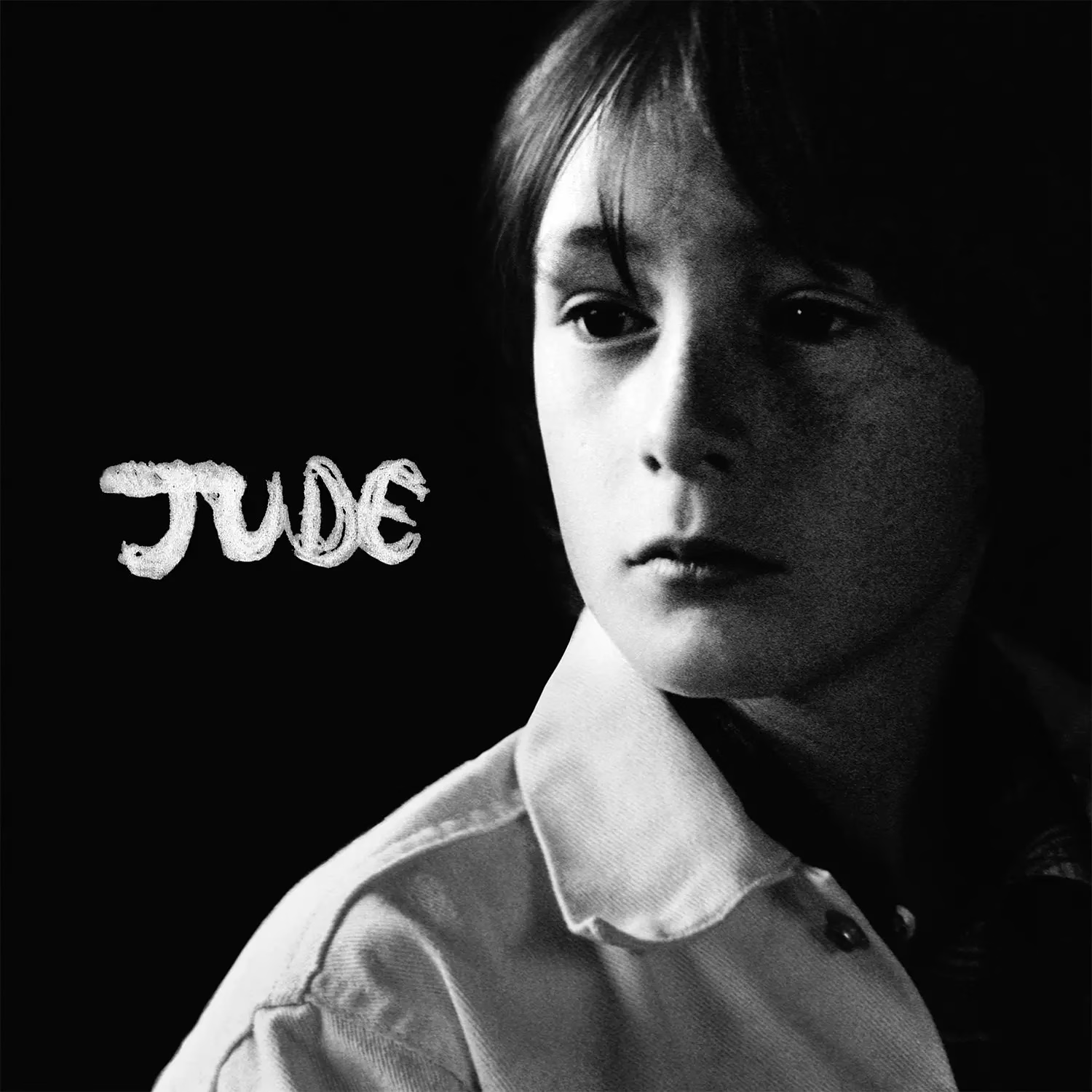
But the fact remains that he called his brand-new album Jude — and even put his childhood self on the cover. That was for a very important reason: recently, he turned a corner in his mind and heart.
"I've reached that point now where I can breathe, and I'm OK with it all. It's all good," Lennon tells GRAMMY.com, looking vibrant and relaxed on Zoom despite weathering, in his words, "promo from hell." He adds that he finally broke his moratorium on his father's ubiquitous peace anthem, and sang "Imagine" in public to benefit Ukraine: "That was just the icing on the cake."
"I'm just making sense of it all," the GRAMMY nominee says. "I'm part and parcel of this steam train. I'm not getting off it, so I might as well enjoy the ride."
That ride just got seriously interesting. On Sept. 9, Lennon released Jude, which acts as both a potent self-examination and an embrace of his past — which, as a Beatles scion, had its share of extremes. Just to recap: Paul McCartney wrote his coaxing, strengthening, galvanizing "Hey Jude" — a song of still-startling emotional clarity — to comfort young Jules after his father's divorce from Cynthia Lennon. ("Hey Jules" was the working title.)
As an adult, Lennon has both weathered a multitude of ups and downs in the music industry — all while expressing himself via paths less trodden. In recent years, he's made eco-centric documentaries like 2020's Kiss the Ground and 2021's Women of the White Buffalo, auctioned off NFTs of Beatle memorabilia and pursued his stark, evocative photography.
And despite swearing off participation in traditional release models on major labels, BMG made him an enticing and holistic offer — one he ultimately accepted. This led to his first offering in 11 years, and on songs like "Save Me," "Freedom" and "Love Never Dies," he established aural and conceptual links to the past while charting a path into his future.
Read on for an in-depth interview with Lennon about how Jude came to be, his complicated relationship with his namesake, and what he thought of Get Back.
This interview has been edited for clarity.
Tell me about your psychological state while making your first solo album in more than a decade. Was there any trepidation? Any insecurity?
It's a bit of a weird one, because initially, I wasn't going to do another album. I thought: I'm done with years of working hard emotionally on these albums with nobody really getting to hear anything. So, this is why I ventured off into the land of photography, documentary filmmaking, and children's books, and focusing more on the White Feather Foundation.
Because I didn't know where music was at. I've got to say, the landscape had changed so much over the last 10 years, as well. I thought, "Well, if I do anything again, I'll just do a couple of singles or EPs and just put them out there for the pleasure of doing it."
It's in-built. It's innate. It's unlikely I'll ever stop doing music — because mostly, also, I still work and sing on other people's projects all the time anyway. It's just that not many people get to hear or see that side of things that I've done.
The whole thing about this album is that it comes in two stages. One is Hartwig Masuch, the boss of BMG. Over the course of six months to a year, he met friends of mine — one in America, one in Russia. My name came up, and he said to my friends, "If Jules ever wants to do any music again, tell him to get in touch with me."
Just to interject, I was working with Leica cameras, and I had to go to Berlin for an event. I knew that Hartwig and BMG were based in Berlin. I didn't have his details, and I just thought, "I should check this out — what it's all about."
How did you find Hartwig from there?
I found him on social media, and I just said, "Hi, Jules here. I'm coming to Berlin. Got time for lunch?" I didn't expect a response, but he did. So, I went over and had lunch with him and then met everybody at BMG. I liked him a lot. He made me feel comfortable about the idea of working together with a label, which was an absolute no-no in my book after my previous experiences.
But he was a real lover of music, and you could see that. You could feel that. He was a big fan, too. He'd always thought that I never got my fair share, so to speak. I'd never been supported or sponsored enough to be seen and heard properly. He wanted to make that happen.
The other thing that was key in this was, he said: "Listen, if you do come on board, Jules, we will try our utmost to get all of your albums under one roof with a reversion back to you at the end of it." That alone was something that made me very, very interested.
What was the other factor that inspired you to get back on the horse?
The other part of the story is, my business manager in the UK retired. He'd had boxes and boxes and boxes and stuff in his basement. He sent it over to me, and most of it was financial files. But a couple of boxes were old reel-to-reel tapes and DAT tapes! Every format since the '80s that you could imagine — and there were lots.
I went through all of this stuff. Some of it was demos for [1984's] Valotte and "Too Late for Goodbyes." Songs that I'd forgotten all about. Anyway, my dear, dear friend Justin Clayton and I — I've known him since I was 11 years old; he co-wrote material on the first album; we went on world tours together — he had a great memory.
So, I brought him into this, to go through the tapes and see what was there. And he'd also taken an engineering course, so we were going to dive deep into what was in all these boxes. And the first song that came about was "Every Little Moment." I listened to it and went, "Well, f— me. This sounds great!"
I was worried that the old material was going to be lost, because tapes, if you leave them out, can really degrade and fall apart. But we were lucky; we did this process called "baking," where they take all the old tapes and digitize everything.
Anyway, the song was in good shape. Real good shape. Literally, we felt that we just needed to upgrade some production elements of it. Obviously, the '80s and '90s were big on drum machines, so I wanted to change that immediately. I got some live players on the track. I only changed the vocal on the chorus, and that's the track.
Same with "Not One Night." The vocals were done in my guest bedroom in my little bungalow in L.A. 30 years ago. Apart from that, all the other songs on the album are broken up into different decades. It's just a collection of songs that never sat quite right on other albums or projects that went before, but were still, in my mind, valuable enough. They deserved a home.
From there, how did things progress with Hartwig and BMG?
Again, Hartwig was the one who said, "Let's do a record." I said, "No, I just want to do singles and EPs. It's going to be easier on me. Less pressure," blah-blah-blah. But as we went through all this stuff, I started playing him stuff. We got to five or six songs, and he flipped. He said, "Jules, this is an album." I said, "No it's not! It's not an album! It's singles and EPs!"
Anyway, by the time we got to seven, eight, nine, I'm going, "Alright, if it's sequenced properly, it could be an album." At the end of the day, I said, "Alright, it does work as an album." BMG loved it, and I said, "Let's go for it, then. Why not?"
I was fortunate enough to get [Mark] "Spike" Stent to mix it. I think he's the one who really brought the glue together and also took it up a notch. I say what he did to the album is he did a Nigel: he turned it up to number 11. He just took all the work that we'd done and gave it that breath of fresh air and punch that everything needed to solidify it and put it all together — and for me to feel comfortable putting it out there as an album.
I appreciate that Jude isn't overproduced; it's actually very sparse in some ways. Can you talk about how you wanted the sound to come across to the listener?
Well, I've got to say, Justin and I started this project in my home studio here. Then, the dreaded Covid hit, and he had to go back to England. Now, I hadn't done any type of engineering for a long, long time. But I was twitching to get back to work, to continue the process of this project.
So, my experiment, if you will, that I did on my own, was the song "Freedom." I fell in love with the whole soundscape of "Freedom." And I just said: This [song] feels, to me, where I hear this album sitting, in many respects. It needs to feel like the old-school journeys we used to go on when we bought a great album back in the day, where the soundscape took you somewhere special.
"Freedom" was the beginning of that journey. That's where it all really stemmed from, for me. I felt like the album needed to have that sense of space. It's quite raw, but there's quite a bit of production on it. But I agree with you: it's not overproduced. It breathes.
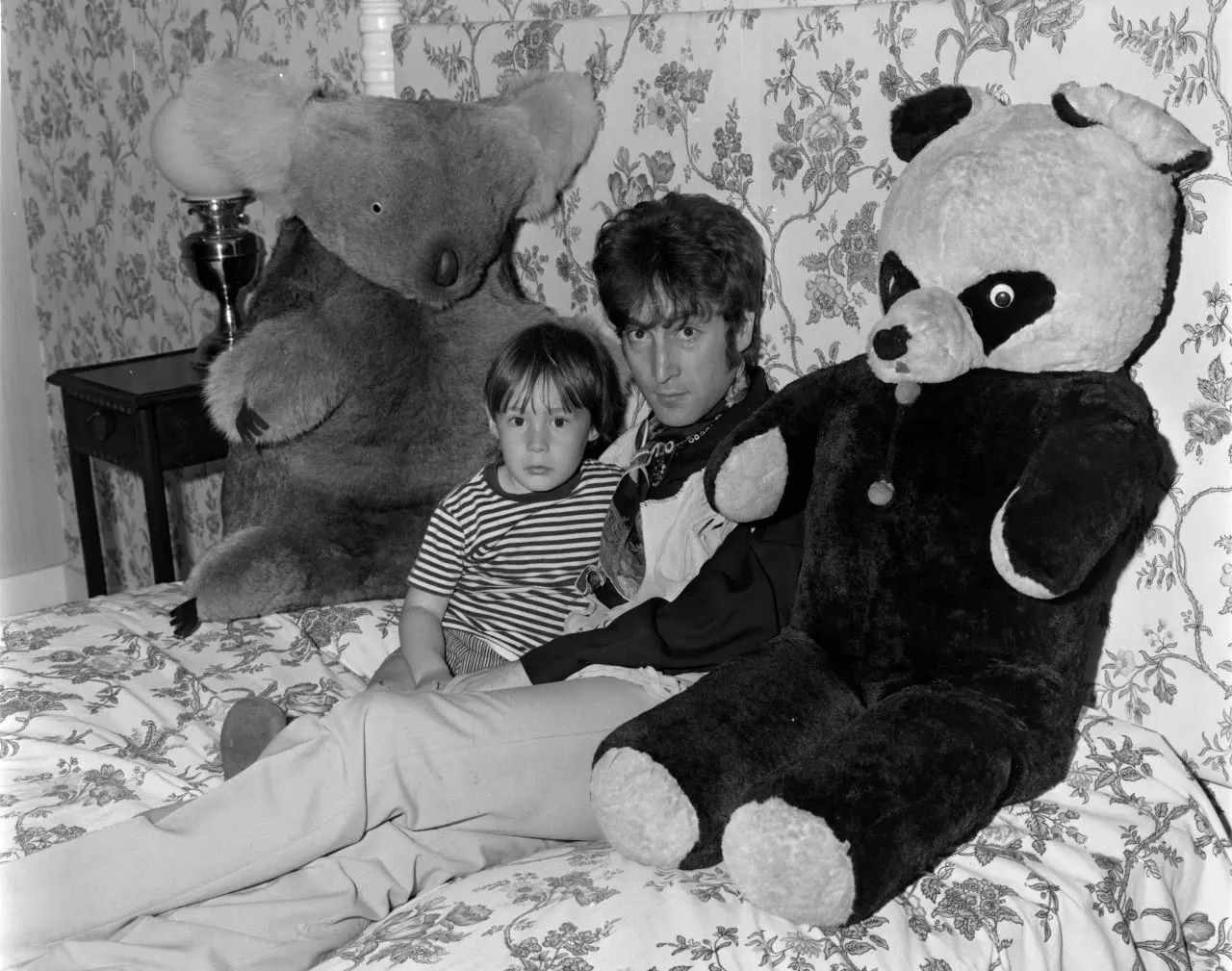
*John and Julian Lennon in January 1968. Photo: Keystone Features/Getty Images*
I'm going to make an educated guess that, at other parts of your career, it wouldn't have felt as natural to call an album Jude, with your childhood self on the cover. It seems as if now, it feels appropriate to wholeheartedly embrace that part of your life that so many people globally know you for. Can you talk about reaching that point?
[Hearty laugh] You are right! I don't really know where it all came from, except that, with the whole COVID thing, I've been going through a whole face-yourself, look-in-the-mirror, "Who are you? What are you doing? Are you happy or sad? Where are you going with all this s—?" [process]. That was the main focus, and believe it or not, a lot of the songs dealt with that.
Also, because I've been doing NFTs with Beatle memorabilia, and the original lyrics for "Hey Jude" had been a focus at one point. Then, I started thinking about the lyrics and what they represented — the "weight upon my shoulder" and blah-blah-blah.
I thought about that, also, with the Get Back film, which I was blown away by. Sean and I saw that and we just fell in love with Dad again, because we saw a side of him with Paul and the rest of the band where he was a cheeky monkey, to say the least. Cynical, smart, goofy, fun, talented — you name it, throw it in there, he had it all. That reminded me of how I remembered him as a kid — being just that.
Read More: There's Not Much Left To Reveal About The Beatles' End. Let's Use The Get Back Doc As A Manual For Moving Forward.
So, it was the culmination of so many things. And the other thing that really, I guess, was the stamp on the seal, was, initially, my birth name on my passport was John Charles Julian Lennon. When I went to the airport, through security, or this, that, or the other, people wouldn't always recognize me and they'd go, "Oh, John Lennon! Haaa! That's funny! Are you related?" A gazillion comments.
That would always make me feel incredibly anxious, because I'd always been called Julian. These moments at security checkpoints, the passport, "John, John, John" — I was sick of it. So, in 2020, I changed my name. But I still liked the J-C-J-L — the rhythm of my initials — and I respected my parents' decision to give me those names. But I wanted to be me, finally, so I just switched "John" and "Julian." And when I did that, it was like a whole weight came off my shoulders. I felt, "I'm finally Julian! I'm finally Jules, or Jude!"
It all made sense to me that this was just a reflection of the past. It was about how far I'd come, or I'd grown, and how I feel, quite possibly, now, more balanced, more focused, more at peace, and with purpose than I'd ever been in my life before. It just seemed like the right thing, and the right time. Getting to a point where I can just say, "Ask me anything! I don't care anymore!"
Whether your answer falls under the umbrella of the Beatles or your old man, which songwriters are your lodestars — the ultimate combiners of words and melodies?
That's a tough one, because it's so varied, and music leans in so many directions, depending on what genre they are, as well. Keith Jarrett, musically, speaks to me massively. Steely Dan…
Such a Keith Jarrett fan.
The Köln Concert — I'm done.
Zero 7's Simple Things was a great album — I would take that on a desert island as well. Billy Joel… listen. The reason I kind of worked with Phil Ramone was because of Billy Joel's earlier work. I love bands like America. There's so much great stuff out there. New stuff, not so much. I'm a fan of Foo Fighters. I like what Dave does, lyrically and musically. It's really, really strong — excellent stuff.
The list goes on. It's impossible! There's so much great stuff out there!
What are you working on, musically or extramusically? What are your next steps?
Well, I'm doing promo from hell for the next few months. I have been doing this [gestures to Zoom] for just weeks now! I'm going insane! I'm going to lose my mind! But I'm hanging in there, and I've got a break coming up, which I'm thankful for.
But, September and onward: performing, promo, TV shows and stuff like that. Getting up there and trying to sing a few songs. Aside from that, more photography work. There are more collections and projects coming out that I'm involved with.
Documentary-wise, the last one was Kiss the Ground on Netflix, which was — without being modest — one of the best docs out there, because it actually turned into a platform for people honoring and trying to change the world right now. White Feather Films, I just started, so that's a whole other [deal] — like I don't have enough work.
And then, the White Feather Foundation has a lot of ongoing projects that we keep following through with. And the list goes on! Probably more books of some sort are coming up. We'll see how that goes. When I have time, by the way! When I have time! I'd like a break, that's what I'd like! Maybe I'll get one by Christmas, if I behave.
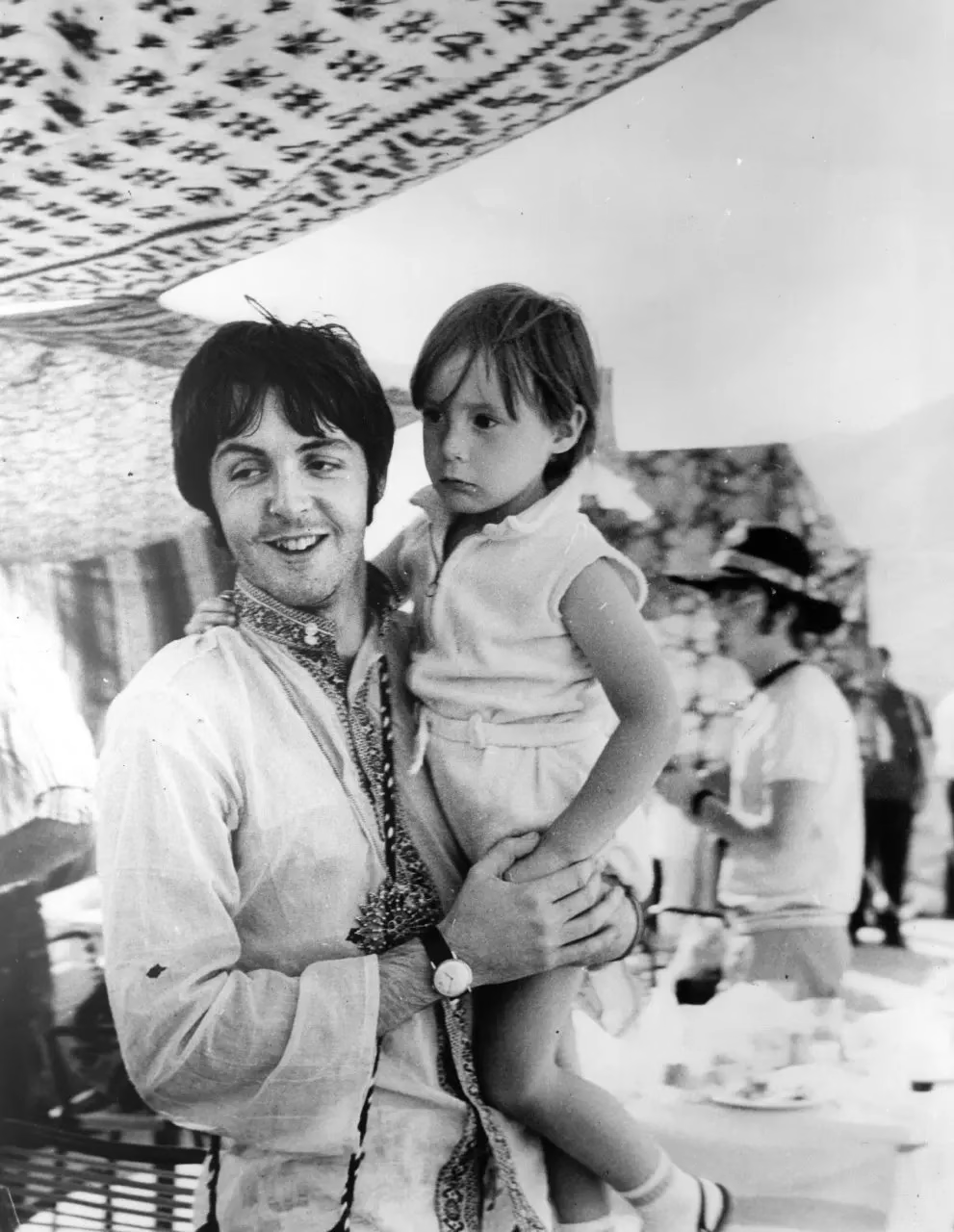
*Paul McCartney and Julian Lennon in 1967. Photo: Central Press/Getty Images*
I think the most natural endpoint for the interview is to the last song on the album, "Gaia." Can you tell me about that tune, and collaborating with Paul Buchanan and Elissa Lauper?
Of course. Listen: how that came around is, I saw this band called Snarky Puppy.
Big fan!
They're amazing! Amazing! Anyway, I befriended a couple of the guys — Michael League and Bill Laurance. And Bill came up to my place and we started working on some tracks that will end up on something down the road; we never ended up quite finishing them.
But while he was there, I was commenting on how much I loved his solo album, which was called Cables. There was one song on there — the title track — that I mentioned to him. I said, "I hear this differently!" And when I explained it to him, he didn't get it, which I thought was weird for a predominantly jazz guy.
I said, "Listen, just play on the little white upright, and I'll play and sing what's on my mind." He played it and went, "Oh, I get it!" I said, "Just, do me a favor before you leave. Put it down on tape and I can fiddle with it later."
I kept hearing a French voice in my head. A French woman's voice from the '30s, '40s or '50s. Very broken up, like on an old radio or TV. I was scrolling through social media, I heard this voice and went, "F— me! That's her! That is her!" I wrote to her and found out she lived 20 minutes away. What! Twenty minutes away!
So, I sent her the song idea. She fell in love with it. I told her what I was looking for, and she wrote some lyrics. The idea was that it's a song between Mother Earth and humanity, disguised as a love song. She literally did the thing where she took her iPhone and did the spoken word in front of a bunch of speakers, listening to the music. I heard it back and said, "That's it!" So, I edited it into the song.
What about Paul Buchanan?
Paul Buchanan, I had wanted him to write the bridge, but he wasn't in that headspace. So I said, "Just sing it for me!" He said, "Jules, there are no studios up here around Glasgow. Everything's closed." I said, "Listen: You got an iPhone?" "Yes." "You got headphones?" "Yes," "Sing it six times for me into your iPhone and send it to me."
I edited his six pieces together and made it sound like it was a real mic. Then, Spike made it even better. Then, Elissa, the girl, said, "Do you mind if I write some other words?" I said, "Go ahead!" So, we worked on it together and she sent me her lyrics. I was blown away, because I never, in a million years, would have come up with her verse. It was typically French — very, very French.
The song has a bit of a unique arrangement. It does its own thing; I guided it a little bit. And I just thought it was the perfect end to the album — especially after "Stay." I didn't want to finish the album with "Stay," and "Gaia" seemed to be the perfect exit for this particular album.
I've been plagued by the number 11 for a couple of years. So, I said, "Right, well, I'm going to have 11 songs on the album. What are you going to do? Whether you believe in that or not, I figured, "Why not?"