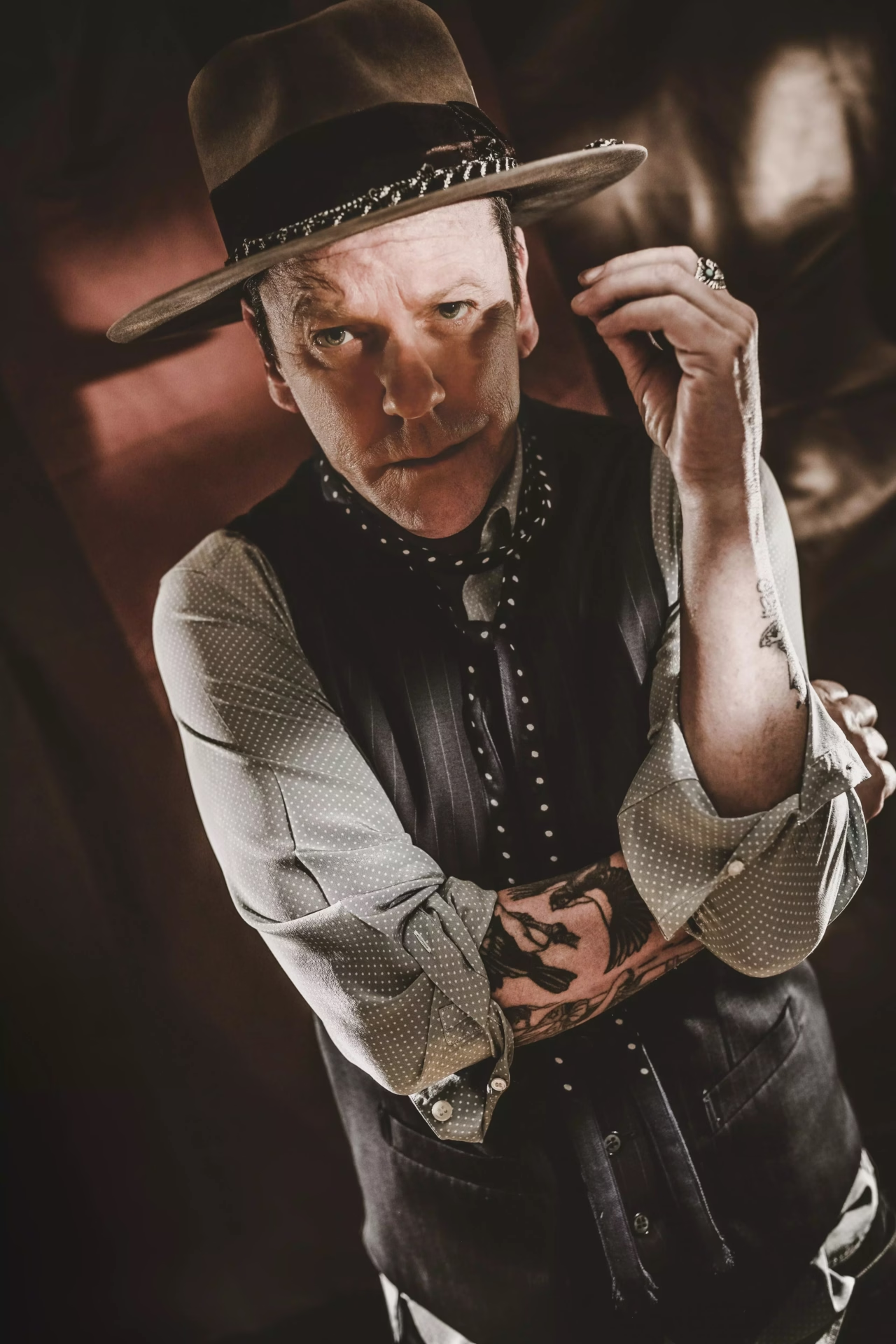
In his 30-plus-year career as an actor, Kiefer Sutherland has mastered the art of playing someone else. Whether it was counter-terrorist agent Jack Bauer in the hit TV series “24," the leader of a vampire gang in the cult classic The Lost Boys, or, most recently, as U.S. President in Designated Survivor, Sutherland has built an award-winning career as an actor. But one role that’s taken him by surprise is that of Kiefer Sutherland, the musician.
"I thought my 30 years as an actor onstage and on camera would help me," he says during a phone interview while on set in Los Angeles. "I realized [when playing live] … that there was no character that I had that was separating me from the audience. The joke I'll make is that on my best day, I'm not Jack Bauer. Not even close. But there was always that character."
Sutherland admits he was a bit nervous to play his songs live, songs that revealed personal stories about his own life. But the audience response from the approximately 300 live shows that he and his band have played since 2016 is what inspires him to keep going.
"I was really taken aback by the generosity of people," he adds. "What I found was people really wanted you to do well. And they wanted you to be good. And I found that to be one of the most generous exchanges I’ve experienced in my life. And then being able to tell a lot of the stories was one of the most freeing experiences in my life."
Sutherland’s experience on the road has inspired much of what you’ll hear on his recently released sophomore album, Reckless & Me, a 10-track rollicking collection of songs that were born to be played live. And that's just what Sutherland intends to do with them as he prepares to head back out on the road with his band for a string of U.S. and European dates kicking off May 30 in Texas. Before he heads out on the road again, the Recording Academy caught up with Sutherland to discuss what inspired the songs on his new album, which artists inspired him, and why he decided to launch his music career now.
<iframe width="620" height="349" src="https://www.youtube.com/embed/Es3atSSY9bY" frameborder="0" allow="accelerometer; autoplay; encrypted-media; gyroscope; picture-in-picture" allowfullscreen></iframe>
Reckless & Me came out April 26. But before you released your debut album, 2016’s Down in a Hole, you said you never intended to release an album. You were writing songs for other people. But it was producer/musician Jude Cole who really encouraged you to release them on your own. I'm wondering now, with the second album out, did you know that you would put out a second album after that first one?
KieferSutherland: I did not know that I was going to put a second record out. I loved the process of making a record and Jude was my best friend and it was a really nice way for us to spend time together. And as you said, I just had some songs that I thought maybe I could send off and someone would be interested in doing them. Jude was the one who really pushed me to make the record. I was so acutely aware of the stigma of an actor doing music and just really didn't want to enter into that fray. … So, we [recorded five songs] and I loved the way [Jude] was making them sound. And I said, "Yeah, let’s make the album." And so, we did. Then what really changed for me [is] how much I’ve enjoyed the writing process, especially with other people. It’s really exciting when you’re with someone else and you start to kind of bounce off each other and feed off each other. I loved that process and I really love, although I felt really quite out of my depth with, the record-making process and that’s where Jude's excellence really stands out as a producer and as a musician.
But [going on tour] was one of the most liberating experiences I've ever had. In the last two-and-half years we've done anywhere from 250 to 300 shows. I did that while I was doing "Designated Survivor," so basically any day off I had we were playing. I love my band and I love the experience of going from town to town. But most importantly, … the songs that I had written were personal. I wasn’t making up stories. All of a sudden, I was telling you really personal stories from my life. And some of them aren't flattering. So, I was nervous about that at first. Especially given the first 40 shows were in bars … [where] no one really wants to listen. But we were playing a show in Ann Arbor, Mich., and the audience was seated. And for the first time I was kind of really honest about where I was at when I wrote this song, what I was going through, why I wrote it, and why I think it might matter to you. And their response was amazing. It was one of the most generous things I’ve ever experienced and so it really encouraged me to do more of that.
How did the process, in terms of songwriting, change when you were thinking about Reckless & Me?
Sutherland: The second record was really finding songs that I wanted for my set. And what I find interesting about that is I wrote towards a goal. And then I also got songs, like for instance "Open Road," [from] Jude Cole. It's one of my favorite songs and it’s his. He wrote that on a road trip that we took to Savannah, Georgia over 20 years ago. And for nostalgic reasons, I really wanted to do that song, and because I love it. [And on] "Something you Love," the chorus for that was Jude.
"Something You Love" is one of my favorites.
Sutherland: That chorus is one of my favorites too. [Jude] was writing it I think for an EP or an LP that he was making for himself. But he wasn’t happy with the verses. And he said, "Hey, maybe we can work on this together." And for whatever reason I wrote the first verse really quickly, and then we kind of worked on the second verse together and then noodled around with the chorus. And then he let me have the song for the album, which I was so thrilled about because [I related to] that chorus in such a heavy way.
<iframe width="620" height="349" src="https://www.youtube.com/embed/ncwoWxFMwgY" frameborder="0" allow="accelerometer; autoplay; encrypted-media; gyroscope; picture-in-picture" allowfullscreen></iframe>
You've been very forthcoming about being aware of the stigma that exists with actors pursuing music careers. But I know that you’ve been involved in music for quite some time. You were taking violin lessons at age 4. You started honing your guitar skills at age 10. So, to me, it’s like a longtime music fan pursuing their career in music.
Sutherland: In 2010 Jude and I had a record label called Ironworks. Just as the music industry was kind of imploding and reinventing itself, we started a label. Primarily because we saw … so many great artists that weren't getting signed, that really should have been signed. And so, we had a great studio and we just decided to make songs and records. [During] that tenure there, I got to watch a lot of really fantastic artists coming in and out and they were always writing. Some people would start with a lyric, or some would start with a chorus. You would learn tricks that once you’ve got this one piece, this is what you now have to do. When I wrote songs before it would be like the sky had to open up and something had to fall in [my] lap. But once I started to gain some sense of structure from this person or that person, and primarily Jude, I started writing more. And finally got to a place where I started to like a lot of the songs I was writing. And 10 years later, that's how this started.
So, it was more than a fan. I would say I was a super-fan of music and musicians. Because I watched what they had to go through to just simply get a record out. And it's different for actors. You can get a small part in a show and no one might know your name, but we've got a really good union and you can make a living doing that. It’s not the same for musicians. It’s certainly not the same for songwriters. So, I've always admired the sacrifices they've made.
Do you think that becoming a recording and performing musician changed the way you view or approach your acting career?
Sutherland: Being able to tell stories and feel comfortable in my own skin telling the story honestly about where I was coming from, why I wrote the song, [and] why I might relate to you – I enjoyed that so much. We had been touring for a year and a half, almost two years, by the time I started "Designated Survivor," and I think because of that experience, I allowed myself to probably put more of my own person into that character than maybe any other I had before. I always thought that acting onstage for as long as I have was going to influence my ability to perform music onstage, and it ended up being the opposite.
You mentioned growing up listening to artists like Boston, AC/DC and Aerosmith. And your songs definitely have a rock 'n' roll feel to them, but with a good dose of country and Americana. I’m curious how you gravitated toward writing more in this vein?
Sutherland: Those bands that you described, oddly enough, I was like 4, 5 or 6 [when I was listening to them]. I was listening to everything that my brother was listening to. And then he gave me music, everything from the Jackson 5 to Elton John. When I got a little older, Stevie Wonder. When I got even a little [more] older, Marvin Gaye. So, it was a really wonderful mixture. But the first music that I remember relating to as a young teenager, the first 45 I ever bought, was "Hollywood Nights" by Bob Seger. There was a real country feel in the sense that he wrote a really straight lyric. It was a story that you could follow. But he played it in a rock 'n' roll arrangement.
Then I started roping on the USTRC roping circuit as a cowboy. And I would travel around with a lot of cowboys for almost 10 years. And that’s when I got into country music. They would all play their cassettes. Most of them were mixed tapes. So, they had everything on it from their favorite Johnny Cash song [to] Waylon Jennings, Merle Haggard, Kris Kristofferson, [and] Willie Nelson. I just fell in love with those artists.
<iframe width="620" height="349" src="https://www.youtube.com/embed/H7lUCghDJ7w" frameborder="0" allow="accelerometer; autoplay; encrypted-media; gyroscope; picture-in-picture" allowfullscreen></iframe>
It’s the storytelling and the authenticity, right?
Sutherland: The joke is it’s three chords and the truth. But if you take it really seriously…it’s never less than five chords and not easy chords. But the lyric is straight. And the lyric is direct and it's honest, whether it's flattering or not.
You’ve mentioned that now, compared to 15 or 30 years ago, you're in a place where it's not as important to you what people might think. What changed over those years? Was it growing up and becoming more comfortable putting your stories out there?
Sutherland: It’s absolutely growing up. In my 20s, not that I'm not sensitive now, but I was really sensitive [then]. And it took enough to get through all of the rejection as an actor the idea of trying music and getting through that…go get me the gun and I'll take my own hat off. [Chuckles.] And confidence. When I first met Jude Cole, he was a guitar gunslinger. He played so well I just put my guitar under the bed for almost two years. And over time I brought it out because I missed it. Being able to spend as much time with other musicians at Ironworks taught me a couple things that made me feel confident about writing about something specific. And then again, I have incredible respect for Jude and his musicianship. And his taste. And that meant a lot to me when he said, “I think you should record these songs for yourself.” None of this would have happened without him.
To Lift Up Young Writers, Dave Eggers Is Auctioning Autographed Setlists