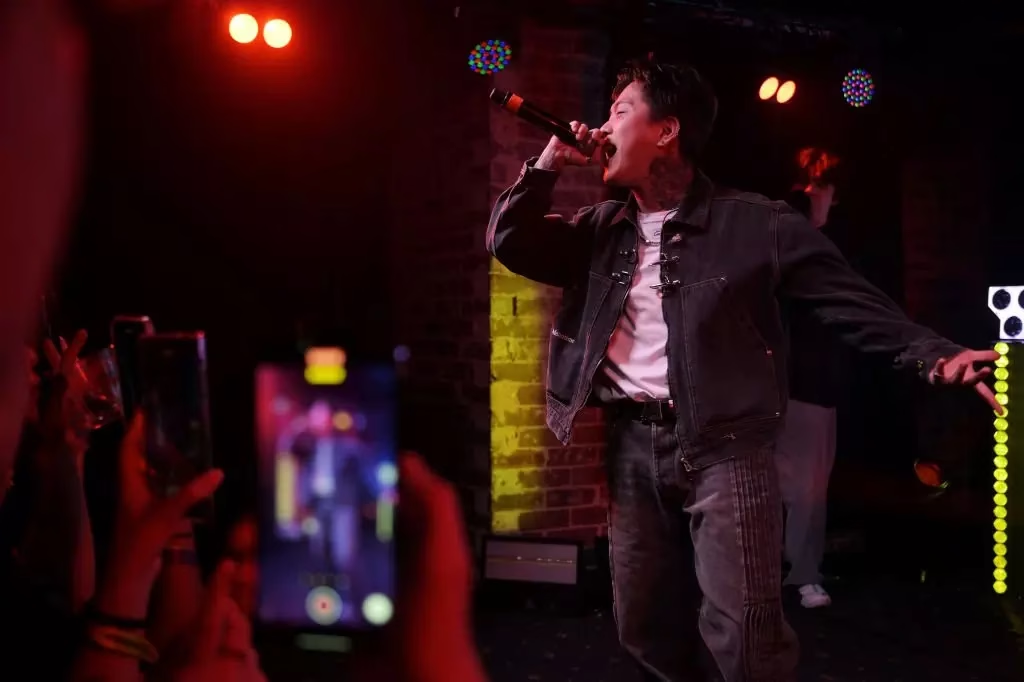
Despite popular misconceptions, Korean music hasn’t always thrived on the glittering giant of K-pop. Even as the genre went mainstream and set the blueprints of the company/trainee system, South Korea has boasted a network of independent acts in a variety of genres.
In fact, when it comes to finding artists outside of the K-pop spectrum, one is almost spoilt for choice. To wit, Korea's rock spirit is alive and well, and labels like Illionaire Records, AOMG, and H1GHR Music became the flag-bearers of hip-hop and R&B. These independent, alternative artists often had unconventional beginnings. Where mainstream pop traditionally favors an insular and straightforward approach, Korea's alt artists often make music based on amalgamation of genres and inspirations.
The growth of "alternative" genres can be largely attributed to the success of TV shows like "Show Me The Money," which popularized hip-hop and R&B, eventually launching names that have now become mainstays in the genre. South Korea’s sophisticated digital infrastructure has made it easier for independent acts, labels, and collectives to bring much-needed diversity and experimentation to the Korean music industry.
Below, GRAMMY.com has rounded up some rising alternative acts in Korean music. Each has spent the last few years slowly but steadily turning themselves into champions of a new independent era.
Jinsol Woo
You might not know the name Jinsol Woo yet, but you may have heard of the accessory brand OHTNYC. For years, Woo was the creative force behind OHTNYC — with pieces found glittering on stars like Olivia Rodrigo, Keshi, Felix from Stray Kids, and BIBI.
In 2022, Woo stepped into the musical spotlight, dropping his debut single "Internet Love," a medley of contrasting dreamy visuals and pared-down trap. He followed that up with his debut EP Attachment. Woo approaches music with the same wild fervor and liberation that reflects in his eccentric designs, drawing liberally from motifs of a young, digital age and visuals that belong more in a home-shot virtual diary than the airbrushed pages of a magazine.
Huh
"He doesn’t have talent, he should just study / Now that I’ve made it, they try to suck up to me / How do you feel?" Huh spits on his track "HDYF," released shortly after he placed second on the popular Korean music show "Show Me The Money." The song was a bit of long-overdue catharsis: Previously known as Rose De Penny, Huh started out as an independent rapper on season eight of "Show Me The Money" in 2019, but was eliminated early on. He returned to the show the following season, only to experience the same fate.
But Huh is nothing if not persistent. By the time he made his third appearance on the show — he finished second, coolly claiming that was his goal all along — the 24-year-old rapper had come to be known for his tenacity, fiery candor, and attitude. Those traits became the base for scathing clapbacks like "HDYF" and introspective tracks like "926," (from an album of the same name) which provided an inverted picture of South Korea’s oppressive rat-race corporate culture by showing an artist’s average day.
In 2023, Huh’s vision landed him a place on Spotify’s RADAR Korea list.
LØREN
Even if you’ve never heard LØREN’s own music as a singer and guitarist, chances are you’ve heard the artists he’s produced. By the time he took off his producer hat and released his debut EP Put Up A Fight in 2023, he’d spent nearly a decade affiliated with YG Entertainment.Under the entertainment behemoth, LØREN made music for the likes of G-Dragon and wrote several songs for BLACKPINK (eagle-eyed fans will also recognise him as the male lead in the group’s music video "Lovesick Girls").
But where LØREN’s work for other artists stayed ensconced in the territories of hip-hop and pop, his own music carries the imprints of his roots in grunge and punk rock, the latter of which he called a "dead" genre in South Korea not too long ago. Call it perseverance or simply naiveté (though, knowing his sense of humor, he might lean towards the latter), but the singer’s music isn’t just about rebellion for the sake of it. Between sandpaper guitar riffs and defiant lyrics, LØREN is brining a much-welcomed grittier aesthetic to the otherwise glittery skylines of K-pop.
Dvwn
Just like the quiet time of day his name is inspired by, Dvwn is known for his somber, soothing, introspective melodies fit for the wee hours of the night. His sensitive storytelling and rich instrumentation — the result of melding an array of genres like lo-fi, jazz, and smooth R&B — have turned him into an indie icon, but they also stand as testimonies of his humble beginnings and persistence to explore and expand.
Dvwn started uploading music to Soundcloud in 2017, dropping his debut EP, Panorama, a year later. He was contacted by KOZ Entertainment founder (and renowned rapper) Zico in 2019 and Dvwn's sophomore EP, It’s Not Your Fault, followed. The EP was nominated for the Best R&B and Soul – Album at the Korean Music Awards, one of the most prestigious music accolades in the country. The singer/songwriter has since picked up writing and composing credits for artists like SHINee, Big Naughty, Zico, NCT Dream and more, turning his laid-back style into a signature genre.
87Dance
Named after the BPM and genre of the first song they ever wrote, 87Dance was formed by childhood friends Betheblue and Park Seong-ho. While they released their debut EP Palchilldance (the pronunciation of their name) in 2019, the band's popularity soared following the release of their 2022 track "How can I forget you girl."
Released right on the tails of a retro resurgence in South Korea (largely prompted by the wildly successful K-drama "Hospital Playlist"), the song’s seamless blend of moody grooves, funk, and new-tro (new retro) became an instant hit. Since then, the band has become a staple on the Korean indie scene, known for their fluvial tracks and engaging storytelling.
BIG Naughty
"Three years, I’ll be big in Korea," a fresh-faced, 15-year-old BIG Naughty proclaimed on "Show Me The Money" in 2019. Now, at 20, one wouldn’t be too surprised if he claimed to be clairvoyant. BIG Naughty’s indomitable drive and unique sing-song rap caught the attention of H1GHR Music, and he’s called it home since.
While hip-hop and R&B may have propelled him to fame, BIG Naughty never pigeonholed himself into making any specific type of music. On "Bravo," from his 2021 EP Bucket List, he effortlessly flows from one bar to another, but on later singles like "Vancouver," he swaps out the polished, suave sound for a rougher rock one.
The singer/songwriter is keen to refute any labels. "I’m not a rapper, an R&B singer, or a band," he told the Korea Herald in 2022, making the BIG Naughty sound as surprising and diverse as the man himself.
Jiwoo
Before officially debuting as a soloist under Colde’s label Wavy, Jiwoo had spent considerable time as part of the R&B Collective WYBH and as a DJ, rapper, and hip-hop producer working under the moniker Hayake. His 2019 solo debut EP Maison established a surprising new mellow identity as a solo artist.
A self-proclaimed man of details, Jiwoo’s sound is decidedly understated, focusing on building an all-encompassing atmosphere through intentional layering and complex sound effects rather than conventional progressions. On the EP's "Comme des Garçons," Jiwoo whispers in low tones against a moody, bare-bones arrangement. On the single "ANTIRIVER" — the title track from an EP released a year later — he married jazz and R&B with an eerie, distorted rock framework.
0Wave
While they have a more direct connection to K-pop — member VIIN is a former member of the K-pop group Treasure — 0Wave are more of a musical collective than a K-pop group. As of late, the quintet are honing their R&B and hip-hop influences.
On their solo releases, members Aiboy, Yukon, VIIN, MODS, and wooseojun each have a distinct sound — spanning everything from pop covers, to hyperpop, to hip-hop — which they use to transform their work as a group into a playground of genres. "Hey," from their debut *EP\[off the wall\]*, carried heavy trap influences, while later singles like "bad hab1t" brought a lighter, '90s hip-hop and R&B-inspired sound with old-school visuals to boot. As a result, every release is as surprising and diverse as the next one.
Zior Park
"I’m still f—ing Christian / though I’m wearing new Christian," Zior Park screams on his EP Where Does The Sasquatch Live? Pt. 1. The EP is his first foray into exploring how individual identity develops — despite resistance and questioning — in the face of collective conformity. Even a cursory glance into his work, however, reveals that he’s somewhat of an expert at this.
Park has spent the past few years developing an eclectic artistry that rejects normality, embraces eccentricity, and celebrates diversity. On "Queen," for example, he powerfully rebukes societal double standards, which wants something authentic yet dismisses differences as abnormal. On "Through The Darkness," he extends a helping hand and kind word to those struggling.
As arresting as his music videos are (which are often inspired by Alice in Wonderland or Willy Wonka’s chocolate factory), Park wins with his acute and empathetic observations of the human psyche. Through music, Park demonstrates the need to just be oneself and be understood openly.
10 Korean Rock Artists You Should Listen To: Crying Nut, Silica Gel, Jannabi & More