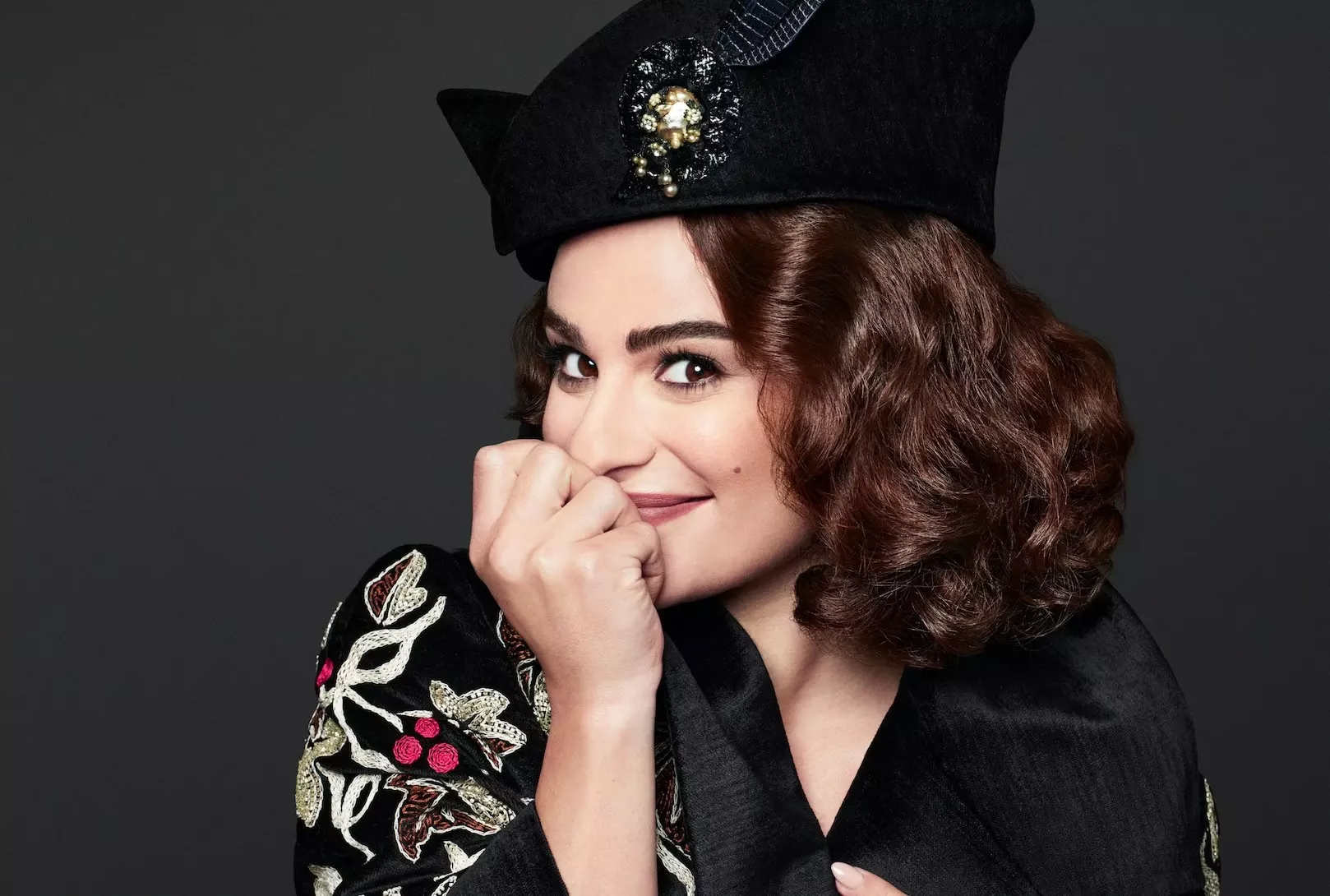
Lea Michele is achieving that often elusive dream: the role of a lifetime. The popular musical theater actress and singer, who is best known for starring in the hit series Glee, will be taking the stage as Fanny Brice in Funny Girl starting on Sept. 6. It's a role that she and many of her fans have long waited for her to portray.
"A dream come true is an understatement," Michele declared on Instagram in July. "I'm so incredibly honored to join this amazing cast and production and return to the stage playing Fanny Brice on Broadway. See you September 6th."
It's a full-circle moment for Michele, who has cited Funny Girl's original star, Barbra Streisand, as her role model. It's also a tall order: Streisand won a Best Actress Oscar for the 1968 film adaptation, and until this year, no one has dared to revive the role because of her stellar and daunting vocal performance.
But even before hitting the Broadway stage as Ms. Brice, Michele has already proven she has what it takes. She capably tackled Streisand's showstopper and signature tune "Don't Rain On My Parade" during a pivotal moment on the first season of Glee, then repeated her performance live at the 2010 Tony Awards. By Glee's fifth season, her character of Rachel Berry — who sung a few Funny Girl songs throughout the series — moved to New York City with the dream of starring in said musical and landed the part. (But soon after, Rachel gave up the role for a television show that tanked.) Now, the actress is finally getting to play Fanny in real life.
It's a truly meta moment. But the road for Lea Michele to Funny Girl has been long and not without its hurdles. The casting has also generated controversy, likely due to accusations of bullying by former Glee castmates as well as the abrupt exit of the revival's originally casted star Beanie Feldstein. Regardless, Michele's casting in Funny Girl is giving the revived musical a new lease of life on Broadway — and achieving one of Michele's lifelong goals.
It all began in late 1995. Lea Michele started her career as a child actress on Broadway at just 8 years old, first appearing as a replacement for Young Cosette and Young Eponine in the original production of Les Misérables. After a year and a half in that role, she soon landed her second stage gig as the Little Girl in a Toronto production of Ragtime, followed by another year of the role on Broadway.
"Coming into Ragtime, I had a pretty good foundation that Les Miz gave me and then I was able to work with Audra McDonald, Marin Mazzie, Peter Friedman and Brian Stokes Mitchell," Michele told Broadway World in 2007. "They are the most amazing actors in my opinion on Broadway and they just taught me everything that I know now."
After taking time off for her junior high and high school education, Michele bounced back to Broadway in 2004 and landed the role of Shprintze, one of the five daughters of Teyve (Alfred Molina), in a two-year revival of Fiddler On The Roof. Accepting the role was a major turning point, as she opted to decline attending NYU in order to chase her Broadway dreams. In November 2006, she landed the ill-fated female teen lead of Wendla in the hit musical Spring Awakening, a role she played until May 2008. While the cast drew acclaim for their roles, Michele told Harper's Bazaar in 2011, "I didn't get a [Tony] nomination like the boys did, which was a big learning experience for me."
Then Glee happened. Michele had met the show's creator and showrunner Ryan Murphy while working on Spring Awakening, and he wrote the part of Rachel Berry with her in mind. Not only did Michele ace the audition, but she even chastised the piano player for skipping a verse — very much in the vein of the pushy diva lead.
An unexpected phenomenon, the first two seasons of Glee made it a smash hit for Fox. The show focused on a glee club of talented outcasts who coped with the pressures of high school, as well as issues of diversity, inclusion, and numerous socially relevant topics. Glee averaged around 10 million viewers for the first two seasons, also spawning two platinum and three gold albums as well as two national tours. Perhaps the headline for a CNN story in November 2010 said it best: "The 'Glee' effect: Singing is cool again."
While Glee featured an ensemble cast, Michele's role of Rachel Berry became the standout, thanks in part to Berry's on-again, off-again relationship with Finn Hudson (Cory Monteith), the high school star quarterback who discovers a love of singing; Michele's eventual real-life relationship with Monteith (which started in 2012) added to their appeal. The show made a dramatic impact on Michele's career: She became a spokesperson/model for Dove, Nike, Candie's, and L'Oréal Paris, and appeared in commercials for Chevrolet, the HP TouchPad, Old Navy, Lyft, and ZOLA over the next several years.
But the Glee effect began to fizzle by its third and fourth seasons. And with Monteith's unexpected passing in July 2013, the show's future was even more in question. By Glee's truncated sixth season in 2015, it had plummeted to one-third of the original viewership. A Rachel Berry spin-off proposed by Murphy never materialized.
Amid coping with the devastating loss of Monteith and the waning success of Glee, Michele pushed on. She released her debut solo album, Louder, in February 2014, which included a highly personal song about Monteith's death called "If You Say So."
"Grief goes with you every day, whatever you're doing," she told Ellen DeGeneres in December 2013 while promoting Louder. "Whether there's great moments, when there's hard moments … I'd rather be at work with the people that I love who are going through the same." She added, "I'm trying to do my best for him, because that's what [Cory] would have wanted."
In the post-Glee years, Michele kept busy. She linked back up with Ryan Murphy for his black comedy slasher series Scream Queens, playing antagonist Hester Ulrich for both seasons. In 2017, Michele guest-starred on an episode of the Hulu anthology series Dimension 404, and she joined the cast of the series The Mayor, portraying the chief of staff to a struggling hip-hop artist who's elected to that office.
That same year, she released her second album, Places, which was more theatrical in nature than her pop-oriented debut. As Michele told NPR in May 2017, "it was important for me, with recording this second record, that I really connect with my true sound... I wanted a title that was sort of a call to all of that, and a call back to my roots."
Michele also semi-returned to her Glee roots with a headlining slot at Elsie Fest, a Broadway-inspired music festival co-created by fellow Glee star Darren Criss. The former castmates took their reunion one step further in 2018 for the co-headlining LM/DC Tour, which hit North America, the UK, and Ireland.
In 2019, Michele explored an array of projects: launching a health and wellness digital series for the Ellen DeGeneres Network called Well, Well, Well with Lea Michele; playing Ariel in The Little Mermaid: An Immersive Live-to-Film Concert Experience with Harvey Fierstein and Cheech Marin; releasing a holiday album called Christmas in the City; and then a starring turn in ABC's holiday TV film Same Time, Next Christmas. She also married businessman Randy Zeich.
In an April 2020 interview with Health, Michele was asked if ambition is part of her identity. "I work really hard; I pride myself on that," she said. "I've had a career since I was 8 years old. Glee was such a massive success, keeping that up is not the easiest thing. Having people see me as someone other than Rachel Berry — although I love and I miss her and the show — is a challenge. So I work hard to keep my career as strong as I want it to be."
But that year also brought controversy into her spotlight. After Michele made comments about the tragic death of George Floyd and her support of Black Lives Matter on social media, her ormer Glee castmate Samantha Ware shot back with a harsh rebuttal, accusing Michele of making her time on the show's sixth season "a living hell" ripe with "traumatic microaggressions" that made her question her Hollywood career. A few former castmates from past projects confirmed Michele's bullying behavior.
While Ware's tweet implied racism, when Variety later interviewed her, she clarified that she was not calling Michele a racist, but that she did play on her white privilege in knowing she would not be fired for bullying other people on set.
Lea apologized for her transgressions on social media. "Whether it was my privileged position and perspective that caused me to be perceived as insensitive or inappropriate at times or whether it was just my immaturity and me just being unnecessarily difficult, I apologize for my behavior and for any pain which I have caused," she wrote. "We all can grow and change and I have definitely used these past several months to reflect my own shortcomings."
The accusations led Michele to losing her partnership with HelloFresh, and ultimately resulted in a rather quiet period until November 2021, when she released a covers album dedicated to her son, Ever Leo Rich, who was born in August 2020.
The Glee controversy and her idle year are partially what made Michele's Funny Girl casting rather unexpected. But it was also the way it happened.
When Funny Girl finally returned to the Great White Way in April, producers originally casted Beanie Feldstein (Hello Dolly!) as Fanny and former Glee villain Jane Lynch in the role of her mother. (Michele even congratulated Feldstein in an Instagram comment, noting, "This is going to be epic!!") While the initial production started off well, mixed reviews and gradually waning ticket sales forced producers to make a choice as to how to proceed.
Re-enter Lea Michele. She and Broadway icon Tovah Feldshuh were announced to take over the lead roles of daughter and mother on Sept. 6. Though there was some backlash over her casting, the jump in ticket sales showed that it may be what the show needed: Many premium seats quickly jumped up to nearly $2,500 online.
Funny Girl is about real-life vaudeville performer Fanny Brice, who was not traditionally glamorous and was a big dreamer with self-deprecating humor and charm. In a Sunday Times magazine interview from 1969, Streisand said, "I just played Fanny Brice as a part — I never studied her whole life. I felt that we were so instinctively alike that I didn't have to work to get her, y'know."
Lea Michele seemed to relate. "I'm 5-foot-3. I don't look like a lot of other people, you know what I mean? I look like I'm 12," she told Harper's Bazaar in 2011. "How many managers told me, 'Get a nose job. You're not pretty enough'? But I proved them wrong." (She's mirroring the past in more ways than one — Streisand wasn't the first choice for Fanny Brice either.)
While many Lea Michele fans are elated by the prospect of this new Funny Girl incarnation, some are dismissive due to the revelations about her backstage behavior. Either way, it boils down to a classic American redemption story about building a second chapter in one's life.
It also offers a very meta moment for the performer. Along with following in the footsteps of her idol, her Glee alter ego conquered Broadway with Funny Girl (albeit very briefly). Can Lea Michele pull off the same trick in real life, but turn it into a star-making comeback? Places, everyone.
10 Must-Hear New Albums Out This Month: BLACKPINK, Noah Cyrus, Romeo Santos, Santigold & More