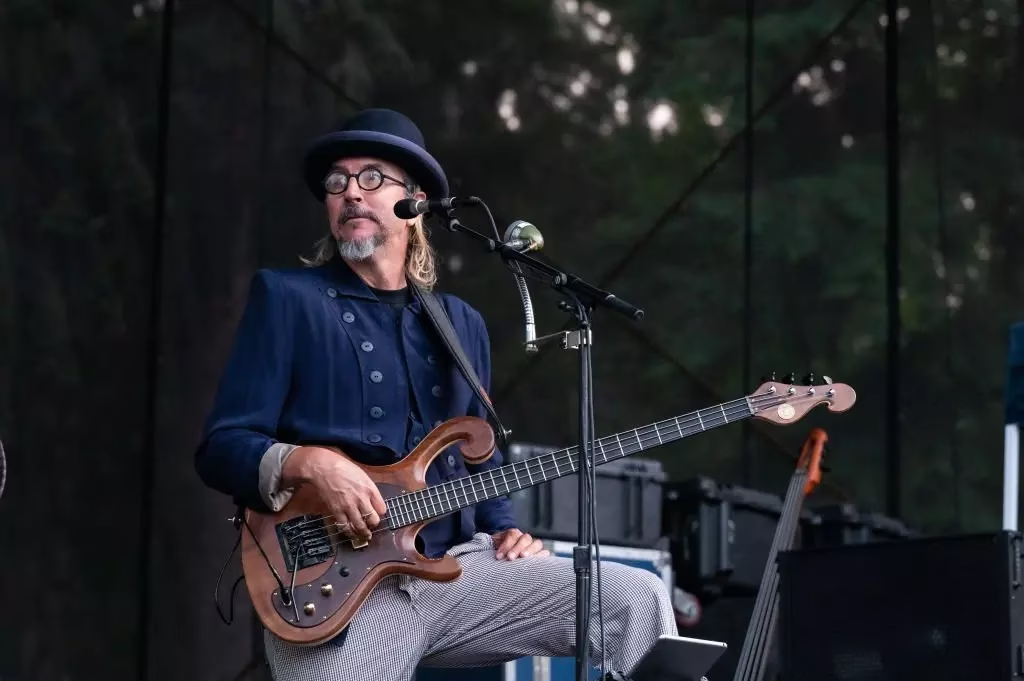
Les Claypool is one of the most unpredictably prolific artists in rock. At nearly 60, he maintains an ever-mushrooming array of side projects and supergroups, consistently stellar solo outings and, of course, staying active as the frontman and force behind the band that put him on the music map: Primus.
After nearly four decades, the rhythmically arresting rock group is as revered as ever thanks to the omnipresence of its intro and outro theme songs on Comedy Central's "South Park," which still airs nightly. Video game music placement, and quirky singles such as "Jerry Was A Race Car Driver" (from 1991's Sailing the Seas of Cheese) and "Wynona's Big Brown Beaver" (off 1995's Tales from the Punchbowl) ensure that Primus will always remain on the heavy-hitter list alongside bands alongside contemporaries like Jane's Addiction and Tool.
When Primus went on hiatus in the late '90s, Claypool stayed busy. He formed Oysterhead with Phish frontman Trey Anastasio and Stewart Copeland of the Police, and created the trippy rock show known as Les Claypool's Fearless Flying Frog Brigade. He recently resurrected the latter after a 20-year hiatus, and is currently touring the country.
Other groups of note over the years include Colonel Claypool's Bucket of Bernie Brains, formed in 2002 with guitarist Buckethead, Bernie Worrell and Bryan Mantia, and the 2012 bluegrass outfit Duo de Twang with high school friend and M.I.R.V. guitarist Bryan Kehoe. Then there's The Claypool Lennon Delirium, which came a year later and featured Sean Lennon (son of John Lennon and Yoko Ono). The pair released two studio albums, highlighting their psychedelic sensibilities and fresh take on prog rock. As Claypool tells it, bringing Lennon into the Frog fold for the current tour was a no-brainer, especially since the musicians love to get jammy together and happen to be in the midst of finishing a Delirium record.
Just as Primus paid tribute to Claypool's childhood favorites Rush during last year's A Tribute To Kings Tour, the Frog Brigade tour takes on a formidable favorite live: Pink Floyd's Animals, track by track in its entirety. Music from all of Claypool's projects including his and Lennon's work, will also be featured on the tour. Making for an even more all-star experience, the band is co-headlining certain dates with Jerry Harrison and Adrian Belew's Remain In Light Tour which features songs from the classic 1980 Talking Heads album of the same name.
Claypool spoke with GRAMMY.com about his different music projects, touring, and maintaining his wildly diverse musical world over the decades.
The Fearless Flying Frog Brigade is reunited after 20 years, and the tour has a lot of festivals on its schedule. At this point in your career, how do you like playing big festivals?
I like festivals. And I especially like the festivals where they have the people who make art out of glow sticks and whatnot. So I'm looking out at the audience and I see all these cool glow sticks. Things like jellyfish and stuff that are made out of glow sticks. Those are my favorite festivals — for lack of a better term, the more hippie fest shows, because I get a light show that I get to look at. People spinning fire and twirling things around — it's eye candy for me and it's very inspirational.
Speaking of trippy stuff, you're doing Pink Floyd's Animals, an album you covered 20 years ago. What made you decide to revisit it?
There was a big, big demand. My manager kept saying a lot of promoters were asking for Frog Brigade doing Animals again. So we had some time off from Primus and I decided to do it. And it's not just the Animals thing. It's also sort of a retrospective of my whole solo career and since Sean's with us, we're also doing some Delirium stuff, too.
Being a retrospective of your work, I was wondering how you go about choosing what to play. You have so many projects. Is it a different setlist each time or do you have a set selection of songs?
Oh yes, it's a different setlist every night. I just sort of mix it up. I mean, the Floyd thing is consistent, but we mix it up.
In terms of covering Pink Floyd — why Animals? Why not one of Floyd's other albums?
Well, when I first did Frog Brigade many years ago… Basically, Primus had broken up in the late '90s. We were, you know, too chickens— to say we broke up so we were "on hiatus" to keep the options open. And it scared the s—out of me. I was like, I have two young kids. I got a mortgage. What the hell am I going to do? My band is now gone.
And so I just loaded up some of my favorite musicians into this old Airstream motorhome I had, and we started driving up and down the coast playing bars. And one of the guys was Jeff Clemente, a keyboardist who now plays with the Dead. I said if I ever have a keyboardist in my band, I want to play "Pigs." So we've learned "Pigs" and I thought, let's just learn the whole album and then we don't need an opening band. We can do two sets. That's sort of how it all started.
Sounds fun. Have you played other Floyd albums before?
There's been bits and pieces of Floyd. We do a version of "Shine On You Crazy Diamond" and whatnot. But yeah, Animals was the first in its entirety.
Beyond the Delirium project, what is your relationship with Sean Lennon? Do you hang out and stuff?
He's like my brother. He's literally one of the family. When he and my daughter get together, they're like siblings, they peck at each other and make fun of each other. It's pretty amazing. I mean, we're beyond friends. He's like my brother. We're very close.
Sean was not in the original Frog Brigade lineup, right? How did you go about bringing him into it?
He was not, no. But because we have the Delirium together — and we're actually halfway through another Delirium of record — this notion of bringing Frog Brigade back came up, and I just said, 'Hey, would you be interested in doing this?' And he was like, 'Hell yeah.' So here he is.
You are playing Delirium material on the tour so that makes sense. What about the other musicians; were these guys all collaborators on your past projects? You have so many and so many people you like to play with.
I have Mike Dylan on percussion and vibraphone and marimba, he's been on a lot of my stuff, since Purple Onion. Paulo Baldi, I've played with quite a lot over the years. He plays with Delirium as well. Harry Waters is new but he's really been killing it. He's really stepped up.
The thing is, Primus is Primus and Oysterhead is Oysterhead. It's a set group of individuals. Whereas for me, when I do a Claypool project, whether it's called Frog Brigade, or Fancy Band, or whatever you want to call it, it's a revolving cast of characters. I was talking to Tom Waits one time about some of the musicians he's worked with over the years and he's like [makes growly Waits voice] "You know, it's like, a director doesn't always work with the same actors." And I thought, Well, that's true, you know, and that's what this is.
For me, it's whoever I have available to do the particular slot of time. Or whatever I happened to fancy for what we're recording. For example, there were a few records where I didn't use any guitar at all. I was not anti-guitar, but I was trying to utilize cellos and things like that as opposed to guitar.
You're considered one of the best bass players of all time. How do you feel about so many musicians and fans labeling you that?
I mean, that's a wonderful thought [laughs]. But, you know, there's always people that can do something better or an element of what you do better. And also best is subjective. You know, what one person likes isn't necessarily what another may like.
I see some of these guys as like, the "Baryshnikov of the bass" or the '"Michael Jordans of the bass." I'm like "the Evil Knievel of bass." I just go for it, and if I make it, I make it, and if I don't, I crash into the fountain in front of Caesars, you know? That's always been my approach. But it's wonderful being respected in your field no matter what you do.
I think that's why a lot of people respect you. Beyond the skill, it's the experimentation and the willingness to take chances and do something really different.
One of my favorite bass players of all time was Mark Sandman, who played a two-string bass with the strings in unison and he played it with a slide. He was the bass player for Morphine. Technically, he wasn't doing anything too crazy, but the expression, the way he could express himself and the sultry elements of his tone and everything, it was just magic to me. He will always be one of my heroes.
You famously tried out from Metallica and the story I heard was that they passed because they said you were too good.
Well, at the time, I think they just thought I was some weirdo. You know, me and Kirk [Hammet] went to high school together. In fact, Kirk used to sell me weed. I didn't know much about Metallica as I wasn't into the metal scene. I was doing all this abstract stuff but I knew Kirk's band was doing pretty well. I met Cliff [Burton] right before he passed because he had come to a show that we did with Faith No More. He was buddies with all those guys. He was very pleasant, very complimentary, and very nice. And so when he died, Kirk gave me a shout.
I showed up with two different color tennis shoes on, a braided mohawk and baggy skater pants. I just did not fit. I didn't fit and I'm there playing a bass that looked like a hunk of driftwood. I was sort of like an alien. But they have literally one of the best bassists there is right now, and one of the nicest people I've ever met in the music industry and that's [Robert] Trujillo. He's a great guy and a great player. He and I did a little thing recently for this short film my son made and it was very cool.
What's the short called? Is that something that fans can see?
It's called Precious Metals. It's a little thing we did for EMG Pickups.
I'll check it out. Robert's own son has taken his place on bass in Suicidal Tendencies and they just played at the Punk Rock Bowling Festival. It's nice to see musical legends like you two passing the torch!
If someone's kid was starting to get into music and their parents were telling them about you and your sound — other than Primus, what should they start with? What really reflects you best as an artist overall?
I mean, they all show different sides of me. A lot of people like the Delirium thing, because it's more psychedelic, and it's more, for lack of a better term, it's a little more palatable than other stuff. It's a little less left field. But, I mean, Tom Waits picked Purple Onion as one of his top 20 records ever. So I'm very proud of that.
Tom Waits declaring that for his Top 20 is obviously a huge endorsement.
That's a good feather in my cap. And he's an old friend.
So you can't pick one? You love them all?
Well, I think for my fans, and even for me as a fan, music is the soundtrack for your life and whatever you're going through in that period of time of your life, hopefully it's a wonderful thing. Music, like a smell, brings you back to that time in your life. So when I hear something off of Remain in Light by the Talking Heads, it takes me back to driving around in my friend's Pinto listening to that record back in the day.
Speaking of which, Jerry Harrison and Adrian Belew are opening up for you on some dates. How did that come about?
Yes. They have a band and they do various tunes of theirs and the Talking Heads. I just saw it for the first time last night, but it's very cool. Adrian is literally one of my favorite guitarists in the history of the instrument. So it's always amazing to see him play. We're playing together due to a little cross-pollination between our management and their management. It just seemed like a cool idea, so it's happening.
Back to your output, what should fans listen to right now that best reps your current vibe?
These records as we're making them, represent a slice of our life. And we're reflecting that in the lyrical content and whatnot. So it's hard to pick just because you're picking different portions of your existence. And there's stuff that represents a not-necessarily pleasant time in your life that might be easier to avoid.
But there are different things about different projects that stand out and shine for me. Purple Onion — I'm very proud of that one. That's a great record.
So right now you're focused on the Frog Brigade. But is it possible you'll revisit your other projects again? Do you just kind of go with whatever you're feeling at the time and never say never?
I always use the stove metaphor. I have all these pots on the stove and every now and again, I pull a certain pot to the front burner. Right now Frog Brigade is on the front burner. But I'm also in the middle of two records. Shawn and I are, I guess, two-thirds of the way done with our next Delirium record. And I'm working on some stuff with [Bluegrass artist] Billy Strings. So there's a lot going on.
Primus just released an EP not too long ago — the first new release in five years — called Conspiranoid. The title seems pretty timely with the state of the world, and contrasting views on everything. Can you tell us more about that?
I mean, it's pretty easy to interpret. I'm pretty much reflecting on what I'm seeing around me in conversations with people that I always thought were rational, who have suddenly turned terribly irrational. Primus did the tribute to Rush's A Farewell to Kings record in its entirety and the second time around playing it, I thought, we need some new Primus stuff.
But I think we're at the stage in our careers where people don't necessarily want a full-blown record. They don't want to come to a show and hear you pound a bunch of new songs at them. They want to see you do the old songs, but they might want to hear one or two new songs. So I said, "Well, let's do one new song — one long-ass song."
We wanted to do a 20-minute one but we ended up doing I think it's 11 or 12 minutes. So we had a single and I was like, "we're going to need another 12-minute song for the B side or two songs." So we did two songs. So it's really a single with three songs. Does that make sense? At the shows, you only have to hear a couple new songs, not five that make you go, ok now's the time to go out and buy a t-shirt or have a cigarette.
How do make new material more digestible for live crowds? Or do you even think about that?
I just think that depends on the stage of your career. Like with Delirium, right now we have two albums. We're working on a third album and we need more material to mix into through the night. People want to hear more material. But when you've been around for 30 years and you have 10 or 12 records or whatever, it's different. With Primus, we have a lot of material that gets neglected, stuff that people would like to hear and they don't necessarily want to hear six new songs in a set. Maybe two or three is acceptable. So my thought with our latest was let's just release a single, but then it became a triple because of the length.
Plus, nowadays, the way we all receive music is so different. My kids listen to Spotify and they're listening to songs. They're not even necessarily listening to full-length albums. Back in the80s and '90s with the CDs, they were making these 20+ song releases. In the '70s, when I was listening to my favorite bands, they were putting out albums that had maybe six songs. Like the Animals record we're doing; it's only six songs. So I think it got a little carried away with the long-ass CDs.
Right. There were double albums of course, but in general, it's a marked difference. And none of it really matters nowadays with digital music and TikTok and the like. But, do you think that you will ultimately release another Primus full-length album again?
I would imagine at some point in time, but what is a full-length album anymore? Yeah, six songs or 26 songs? Right now we are working on getting a bunch of old Primus live recordings out, and there's a Primus documentary being made right now.
Your fans will love to hear that. I'm sure your work with Comedy Central and "South Park" will get some screen time. Looking back 25 years later did you have any idea your theme song would become so iconic?
No. We didn't even think it was gonna get on television, let alone become a worldwide phenomenon. They've opened a lot of doors for creativity, Matt and Trey, and they still push the parameters and go way beyond what most people get away with. When we first got the offer to do it they were a couple of guys just out of college who made this little cartoon about the spirit of Christmas. We thought, We'll do that because it's cool. There was no real money involved.
So yes, it's a wonderful thing because both those guys are great guys and they're insanely talented. I love people that push the parameters as they do. I love looking at things where I go, 'How the hell did they think of that?'
Well, the same could be said for you.
[Laughs humbly]
Beyond the concert you played at Red Rocks with them, do you still work with them at all?
We pretty much just did the theme song. We've done a couple of versions of it, but that's it. I mean both of those guys are great musicians. Trey's this amazing pianist. So they don't need any help from us.
Before we go, can you tell us a bit more about the Primus documentary?
My son's directing it with our friend Jimmy Hayward. [Primus just played a benefit concert for Hayward, a renowned director, screenwriter and animator who is fighting cancer, with Tool at L.A.'s Belasco Theater in May]. He's had to digitize over 900 hours of footage because we've had guys following us around with cameras for many years. There's a lot of footage he's going through and he's been interviewing all kinds of people. I was hoping it would have been out this summer, but now it looks like next summer, hopefully.