One morning, in the summer of 1966, Kenny Loggins found himself at a peace rally in San Francisco. He had been in Pasadena just hours earlier, on a group date that was kind of a drag. They weren’t really his crowd and he was searching for deeper meaning. So, he hopped into a van with a few other young people to chase a counterculture vibe that resonated more — to follow a spark that had ignited within him.
“That weekend was the beginning of the next part of my life,” Loggins writes in his memoir, Still Alright, in which he reflects on his remarkable 50-plus-year career as a singer, songwriter and soundtrack maestro. The book’s title is a wink at “I’m Alright,” the hit Loggins wrote for the 1980 film Caddyshack. Loggins contributed era-defining songs for movies like Footloose and Top Gun (“Danger Zone” is reprised in Top Gun: Maverick, the 2022 sequel to the iconic 1986 original) — but soundtracks are just one piece of his wide-ranging legacy. Loggins’ impact spans generations, in part because he has always followed his heart. Still Alright is out on June 14.
Loggins came to prominence in the early 1970s with Loggins & Messina, a duo formed with Jim Messina, who had recently left Poco and was looking to produce. With sublime harmonies and a soulful blend of rock and country layered with lush, sharply-crafted instrumentation, songs like “Angry Eyes” and “Your Mama Don’t Dance” made Loggins & Messina important contributors to the folk-rock genre that was increasingly popular at the time, alongside peers like the Eagles and Fleetwood Mac. Their 1973 album Full Sail also was, as Loggins writes, “on the goddamn vanguard” of breezy, laid back, nautical-themed music that would later be defined as yacht rock. “Then again, I’ve seen ‘What a Fool Believes’ listed as the genre’s definitive song, so maybe it was me and McDonald on the vanguard,” he writes, referring to the GRAMMY-winning tune he wrote with Michael McDonald.
Loggins’ solo work further cemented him as a force in the balm of soft rock, especially as he leaned deeper into his appreciation for collaboration — working with everyone from Michael Jackson (“Who’s Right, Who’s Wrong”) to Stevie Nicks (“Whenever I Call You Friend”). He began experimenting more with jazz and R&B, dismissing radio hit-making formulas to stretch his creative muscles and allow his vulnerability — always his superpower — to lead the way, like on 1991’s Leap of Faith.
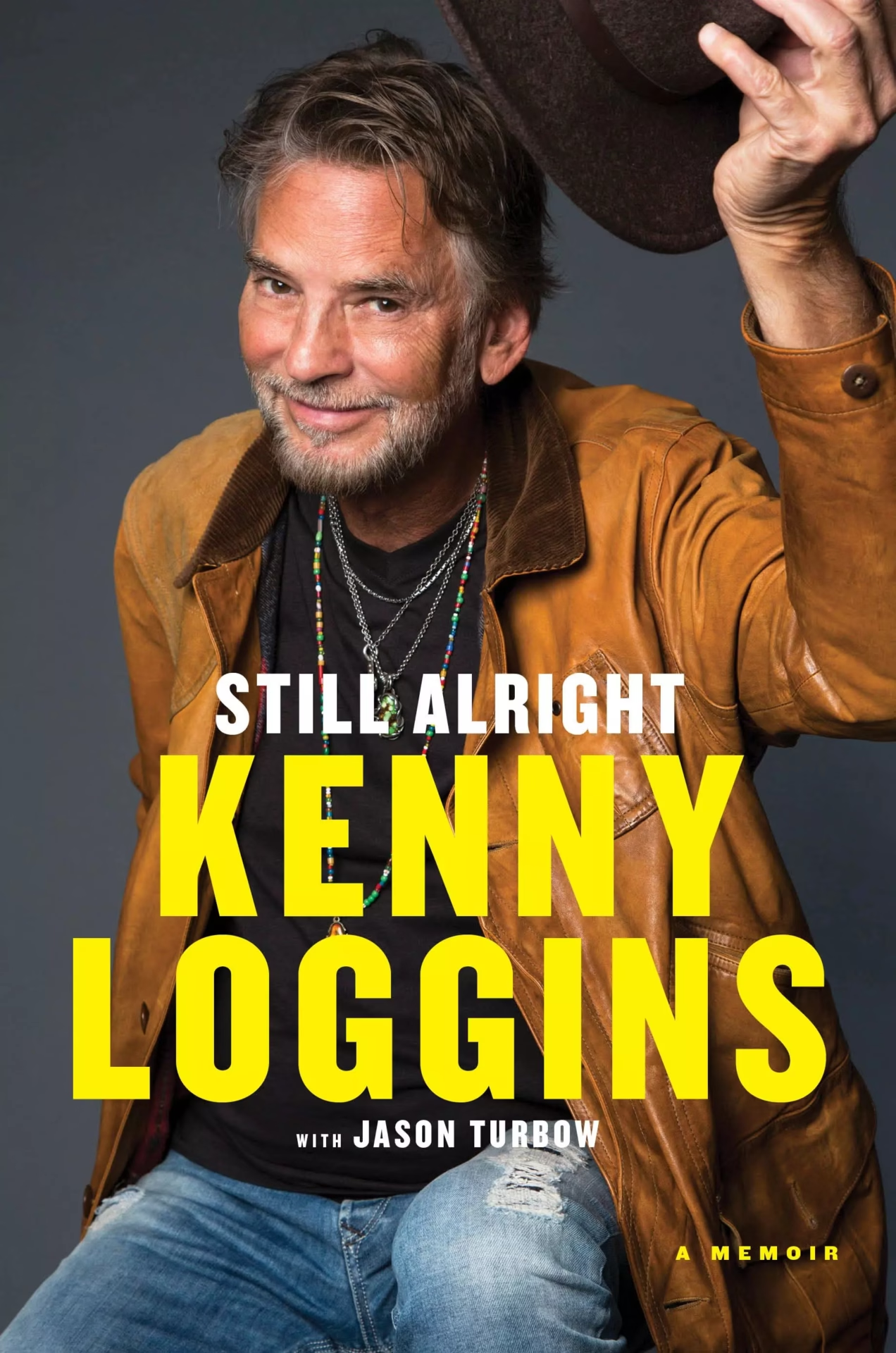
While Still Alright tells the stories behind Loggins' career, it also details his journey toward self-acceptance. Spirituality has been a presence throughout his life, manifested in different ways from Catholic school as a child, to later practicing meditation and gratitude. He had a breakthrough in 1990, when he began to understand "how holding things in a certain way matters" — including his view of himself. To get there, he had to throw everything up in the air and see what came back. "When you get a view of something that really speaks clearly to you, your job is to follow that spark," Loggins says. "And it's usually not easy. Sometimes you gotta change the situation you're in, in order to do that. And that requires courage. And the courage comes from the belief that that spark is real."
GRAMMY.com sat down with Kenny Loggins to discuss his memoir, self-love, the art of collaboration, and why Leap of Faith is his most important album.
At the end of the book, you reflect on a speech you made at your 70th birthday party and how you've finally found self-acceptance. You write: "I had created Kenny Loggins to feel acceptable, even loveable….Now I wanted to get back to what I once had been, before I'd experienced a lick of success." Who is that person, the one you're making your way back to? And do you feel like you're getting closer to him now?
I had absorbed a lot of negative self-talk, and I'd been handed that to me as a legacy of this isn't good enough and this isn't good enough, gradually trying to fit in with my brother [Danny] and his friends. And then in the process, moving into show business…there's a disowned self that is the one I was referring to there [in that passage]: that part of me that was just this sensitive kid who wanted to be a writer. And that's why I think songs like "Danny's Song" and "House at Pooh Corner" came through as such a young man, at 17-years-old. Those are still important songs in my life and career. And what I had realized was that there was a part of me — that disowned self — that I still held as unacceptable.
And so the integration of my created persona that I referred to as Kenny Loggins comes back into a more peaceful place with that part of me that I thought was embarrassing. I stopped blackmailing myself with the idea that at any moment he's going to show up and embarrass me. By accepting and holding and integrating that part of myself — and just loving, really — and saying, "Well, I get it. You're the one who wrote all the songs. You're the one who had all those feelings and had to somehow use your art to get them out." And, in that way, honoring that geeky little kid, I've become more relaxed in my approach to my career, my approach to my family, and certainly my approach to interviews and anything that's career-based.
You avoided writing a memoir for years; how did Still Alright come about?
I'd been asked to do one for a few years, and I just noticed that I was dragging my feet. It felt like it was somehow the preface to the end. And then, you know, at 74, I went, "Okay, I can see an end to touring now. I haven't really been involved in the business of music now for a while." So, this is a transitional point. Instead of thinking of it as the preface to dying, I'll think of it as the preface to another section of my life, whether or not it's still actively in music or in some other avenue. I'm open to that. Let's see where to from here is really the title of the next book. [laughs] Where do we go?
I'm part of a men's group here in Santa Barbara. It's really only five guys and we're at different stages of our lives. A couple are in their 50s and 60s; I'm the only one that's in their 70s now. But we're all asking the same questions, which is very similar to [what] my son who's moving into post-graduate work [is asking]. And the question is constantly: Where to from here? I believe that my spirit is taking me somewhere, just as it is taking Luke, my 29-year-old. And I watch how fluidly he dances with that. He doesn't have to say, "Oh, I'm going to be a doctor." He just says, "I'm going where the spark is taking me. And I'll follow that spark." And every time he does, he does terrific work.
And that's kind of what I mean by listening to your heart, following your spirit, that thing — if you trust that part of yourself, you're not running away, you're not trying to hide from life. You're actually engaging with life in a very fluid and spontaneous way.
The memoir was co-written with writer and journalist Jason Turbow, what was the process of working with him?
Well, we started with interviews. He interviewed me for weeks and then he gathered it all up, put it in chronological order, and wrote a rough draft of the first chapter. I hated it and rewrote it myself. Then I sent it back to him.
Then, he and I got on the phone together and we talked through the different approaches, because my main thing was I wanted my voice to be prominent in the book. I didn't want his voice to be prominent. So I rewrote it my way and then I added the anecdotal things that only I know. And then he and I kind of hammered out together, pretty much one line at a time. We did that for the whole f***ing book.
You talk about how important Bob Dylan and the Beatles were in helping you discover rock 'n' roll. What was it about those artists that drew you in?
Well, that was a period of time where it drew a lot of people in; it's hard to explain. I think it's a thing called the zeitgeist. Which is, there's something energetic that is connecting people. And it's not just promo. When we're brought up in this business, we think that it's marketing and promo that's making people pay attention. But there's also an energetic element that we can't define. Why did so many artists, future artists, watch Ed Sullivan that night that the Beatles were on? It's not like, "Oh, gee, it's Ed Sullivan, we can't miss this show." We didn't really give a f***. [Laughs] But all of a sudden, we were all sitting down that night watching that band and changing our lives. So, something was in the air.
The melodic way that [Paul] McCartney thought, in particular, was really addicting. The [Bob] Dylan thing preceded that for me, and was much more about lyrics and simplicity. And I know that influenced my writing too, because I didn't want it to speak directly to whatever it was I was trying to say. But, you know, as an artist, I also am a fan. Always have been. So I'm always absorbing new musical things that are catching my attention. And it doesn't stick there. It goes on beyond.
Speaking of the zeitgeist, one of my favorite parts of the book is when you bring the reader right into the thick of California counterculture. You're hitchhiking, experimenting with psychedelics, and immersing yourself in the music scene, encountering everyone from Jim Morrison and Jimi Hendrix to Cat Stevens and James Taylor. Do you think being part of that scene contributed to informing the kind of musician you wanted to be?
Absolutely. All those influences, they show up in one place or another. And not just the male artists, but the female artists as well. I found that as I sang, and got better at singing, I had the ability to mimic or emulate other artists that I admired their styles and their phrasing. I talk about Steve Winwood in the book as being a major influence. I was showing that to a couple of friends the other day, that even though I don't sound like him, there's an influence of that style in me. I don't necessarily mimic Elvis Presley, but that phrasing and that rock and roll kernel of "Hound Dog" and the early rock gets in there. And so when Jimmy [Messina] and I are writing "[Your] Mama Don't Dance," I'm leaning on that as my memory of what that kind of rock and roll is.
Part of what you draw from as a writer is everything you've heard. I remember being on stage one time and totally doing — in my mind — Aretha Franklin. Nobody heard that but me [laughs] because I don't sound like Aretha Franklin. But in my mind, I was doing her phrasing and doing that kind of soul thing. And that represents an attitude and a moment in time.
Your brother Danny is a big part of your musical history. The story behind "Danny's Song," and how it was inspired by a letter he wrote to you before his son was born, is so moving. Can you talk a little about that song and why it's always been so important to you?
When I wrote it, I thought of it as a gift, a baby gift to my brother. I hadn't yet met his wife. And because of my heart connection with Danny, the song just sort of poured out. I was going through a phase as a writer where I was very influenced by Tim Hardin, who you may know from the song covered by Bobby Darin called "If I Were a Carpenter." And so that kind of soft spoken, picking thing was influencing my writing.
Then you have to remember I was 17. I chronicled it based on the outline that [Danny had] given me in his letter. And that's why I think it was four or five verses when I first wrote it. And then when Jimmy and I finally recorded it, we tightened it up into a four verse or three verse song.
You crossed paths with Jim Messina many times before actually working together as Loggins & Messina. What do you think was the key to your magical creative alchemy?
I think the connection for Jimmy Messina and I was Buffalo Springfield. The fact that he produced them and actually been in the band for a period of time allowed me to come into our relationship with an open mind, knowing that he'd already spent a few years on the road and in the studio where I was pretty green, as I was clear to say in the book.
I think that when he showed me his stuff and I felt the synergy and the similarities in style, I felt like this was someone I could work with. And then the more we worked together, the more it gelled. And by the time Clive Davis asked if we would be a band and not just a one album act, when I thought about it, I said, "Well, this is working really well. We have a lot in common musically, and I'm doing good work, so let's keep going." So it all just sort of grew together.
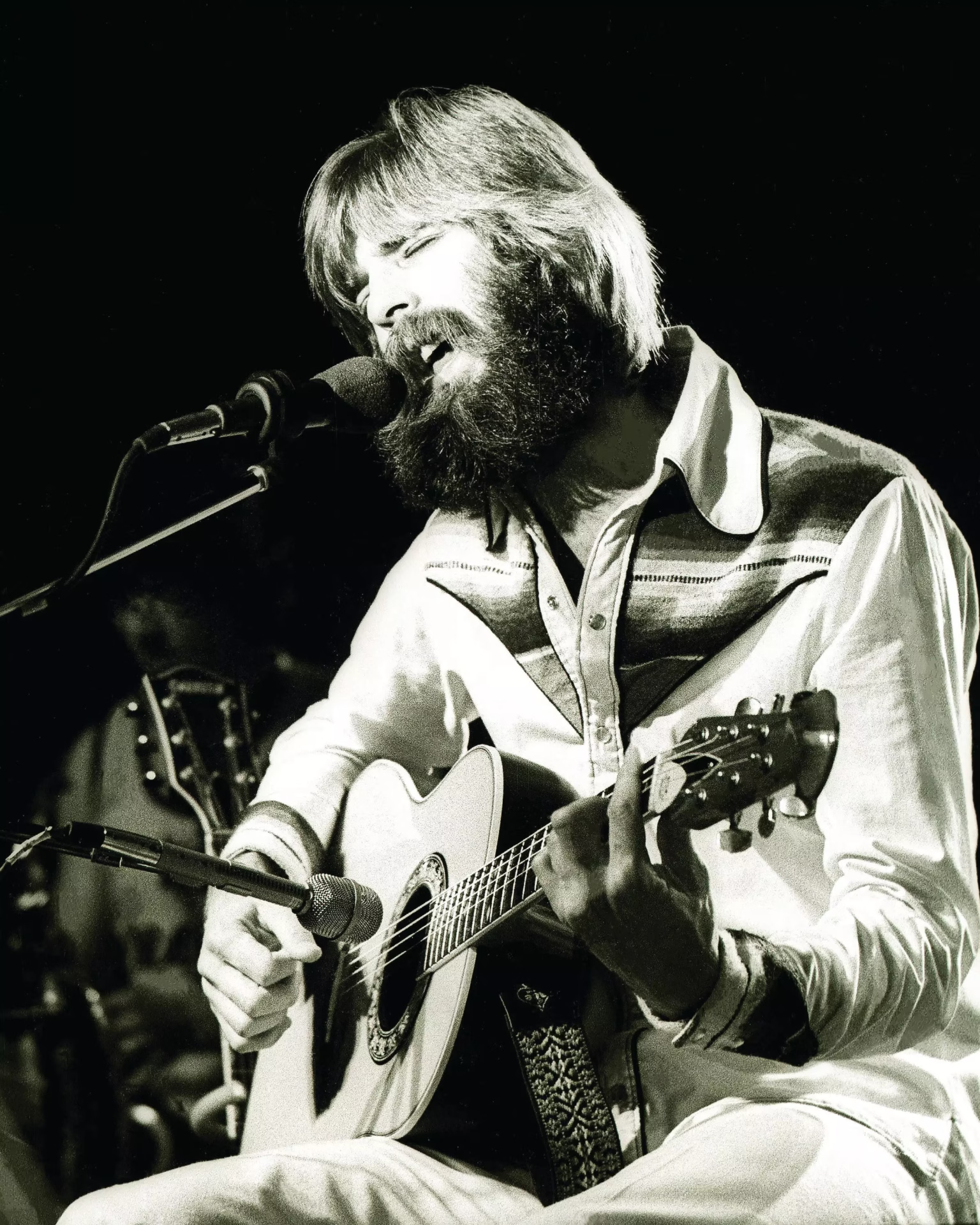
Loggins and his Ovation, with L&M. "Look how hard I’m concentrating to keep that thing from sliding off my lap." | Photo: Larry Hulst
As you describe in the book, there were complicated interpersonal dynamics between you two — which culminates in what feels like a really beautiful, powerful moment years later when you saw Jim talking to his musicians in a hallway in Chicago. You wrote: "I realized that Jimmy was just a guy. And so was I."
Yeah. My daughter has a little OCD. And because of that, when I saw Jimmy working his band in the hallway, I thought, "Oh, that's OCD. That's like my daughter." And I think because I made that connection, that's what opened up my heart to be more compassionate. This is something that happens. It's not anything about me. It's all about him. I can drop that one.
You're playing a couple of shows together this summer. What has it been like preparing for them?
Well, so far, we've been very gentle about it. Jimmy loves doing homework, so he's been making lists. And I am just about to download my guitar parts so that I can relearn to sing and play the stuff. There is a bit of a lag time between [2009, when the duo last performed together] and now, right? I've still got a month and a half before the show, so I think I'll be fine. And I know it's like getting on a bike. I know there's a major part of me that's going to go, "Oh, yeah, I remember how to do this."
I talked to my friends I was mentioning, this men's group…and they all said, "Think of it as gratitude. Think of it as honoring your friend and honoring the situation, but mostly honoring the audience." The audience is still there and still wants to feel whatever it was we were doing back then. So hopefully we'll come close to that.
I know it gets a little trickier with every year that goes by because, you know, I was 22 when we sang all that stuff. And things tend to be pitched a little higher when you're 22. But I've been working on my vocal chops and have a vocal trainer. We started off like five days a week, now we're down to three days a week and it's really important stuff because it allows me to get my voice up where it belongs. That's what was happening in 2020, I was losing my voice, I was losing my high notes. So, he had to teach me a new technique for where to sing from and how to reach that place.
You describe Leap of Faith as your best work. Can you talk about why it stands as such an important album for you?
I think primarily because it came along at a real pivotal moment in my life where I was making a huge decision to leave my [first] marriage initially. And then when my relationship with [my second wife] Julia started after I'd left my marriage, there was another huge decision to be made, which [was]: Is this where I belong? And is this something I should follow? And the creative process all was churning all at the same time as these big moments in my life had arrived. So, a song like "Now or Never" was like this feeling that I have to make a decision about my marriage now, I can't put it off anymore. That was part of the reality of Leap of Faith.
And then the other songs like "Sweet Reunion" and "Too Early for the Sun" could not emerge until I had allowed myself to feel where I was at in my life. And then, because I'm an artist, I had to write about it. And it's so rare in one's life to be in that artistic moment where there's big changes happening and you get to chronicle it. So I think that's the reason why Leap of Faith is an important record, because people who really get that record are living that record. And I get a lot of people who say, "Thank you for this."
"Real Things," the only pro-divorce song I've ever heard, is talking about following your heart. And that's been a message — talk about my songs writing messages to me — that was the message that I was getting when I wrote "I'm Alright" for Caddyshack. You know, in the middle of the f***ing song, something in me stopped and did this whole "listen to your heart" section. Like, what does that have to do with the movie? [Laughs] It's like, okay, whatever.
Why do you think smooth, soft rock had such a big moment in the '70s through the '80s?
I don't know. Again, we were just riding that wave, right? I'd come from a folk rock era. "Danny's Song" is not the smooth rock that you're referring to. And, all of a sudden, I started learning new chords and playing new melodic lines.
And, as an artist, I was drawn in that direction, which meant that I had to leave Loggins & Messina behind and find a new avenue — especially because, chordally, I only knew so many chords on the guitar, but what I was hearing was way beyond that. So that's when I decided to write with keyboard players as somebody who could help facilitate that.
Collaboration has always been an integral part of your process. You wrote how the idea first came to you in high school after reading about George S. Kaufman, a playwright who collaborated on tons of Broadway plays. How has it shaped your creative approach?
Dramatically. When I first started with "Danny's Song" and "House at Pooh Corner," I was just sitting alone in my bedroom and writing. And over a few years, I saw that I was limiting myself, that I had melodic ideas that I did not know how to do on the guitar. And it was keeping me from going in another direction, and especially when the smooth jazz thing started to really infiltrate pop music. And I wanted to write for those guys. I wanted to write something that those players could really do. And so collaboration became an important part of opening my head to other ways of writing and other ways of creating melodic structure.
I really enjoyed how you get into the DNA of the musical arrangements. "Footloose," especially, struck me with how deeply complex it was, from the mosaic of musical influences to the actual production of it where you got up to 96 tracks of guitar solos, hand claps, drums, and more instruments, and then linked four 24-track tape decks together. I mean, wow.
It had to happen in order to get all the ideas down. And, you think about a song like "Footloose," one thinks it's a very simple song, and so it's hard to imagine needing that many tracks on a simple, straight ahead rock and roll song that really equates back to Chuck Berry. But in order to get the clarity and precision of that sound, I wanted it on its own track.
"Danger Zone" is featured in Top Gun: Maverick. What's it been like hearing it in the new film and having it become a hit again?
Well, it was a rush to see it in the premiere. But I think that, emotionally, opening with "Danger Zone" was like harkening back to the original [film]. It gets everybody in that mood again. And I'm sure if there's a third [Top Gun], they'll do the same thing. It'll be the flight deck and the planes going in and out — god knows if it'll be planes, it would probably be remote control, small things. [Laughs]
I just found out yesterday it's, like, the sixth most downloaded song in the world, so that's pretty cool! I didn't see that coming, especially because the movie's just come out.
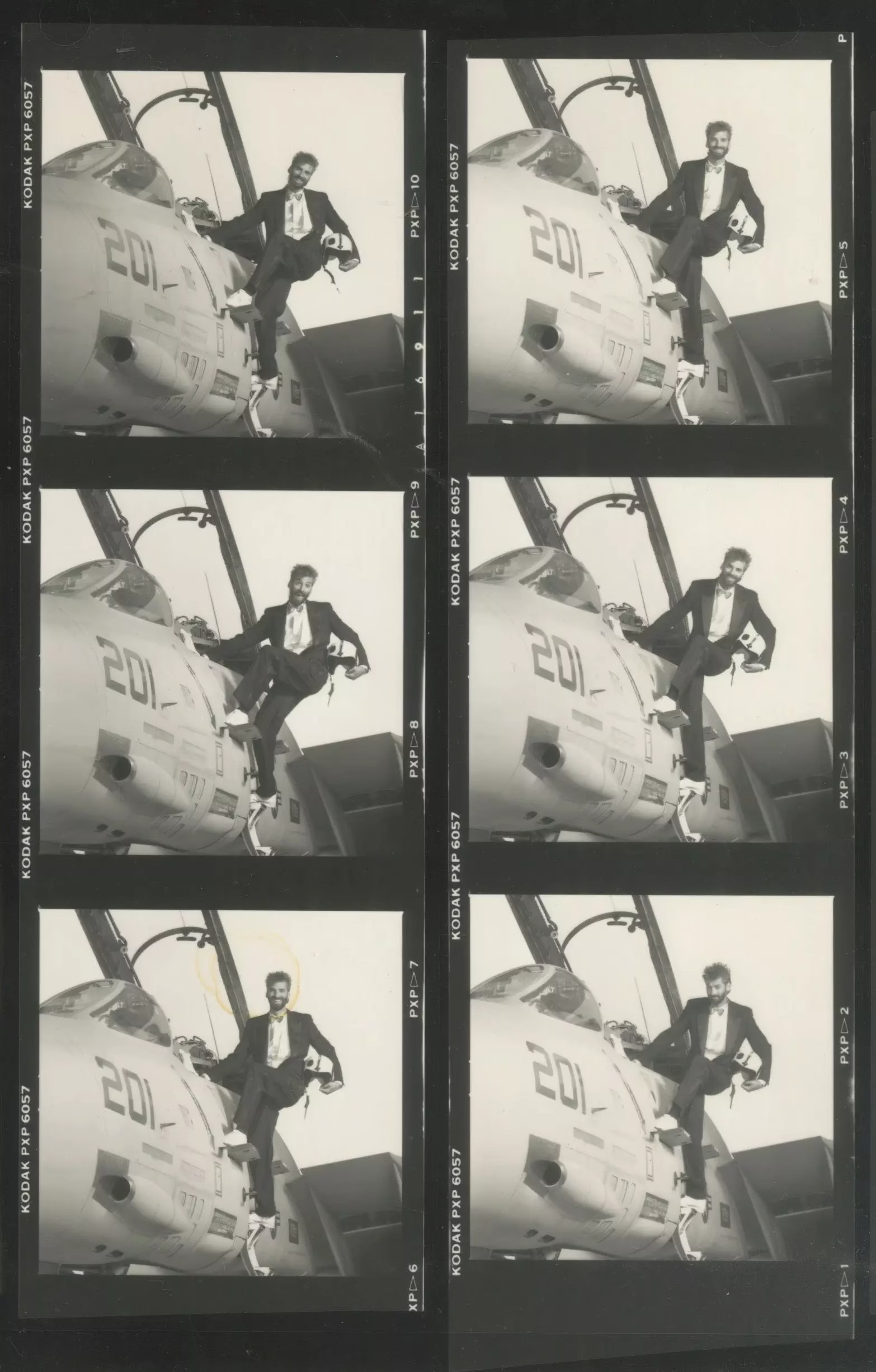
A photo shoot at the Top Gun school in San Diego. | Photo: Courtesy of Kenny Loggins
How did movie soundtracks add another dimension to your career?
When the movies came along, disco was taking pop radio over. And a lot of the acts from the '70s were going by the wayside because they couldn't compete with the disco era. And I would say I did an end run around disco because, being adopted by the movies, I didn't have to play the game to compete at Top 40 the way most other artists did. So, yeah, it absolutely protected me during that late '70s, early '80s thing where you couldn't get a straight record on radio unless it had a dance beat.
How does writing for a movie, for the perspective of someone else, differ from drawing upon your own emotions for songs about your own life?
My music has been autobiographical, primarily, for many years. And so the movies come along and they give me a character that I can write in, and they give me a motivation, an arc of personality, that I can then go into being that person. What would that feel like, from my point of view? And what does he or she need to say in this moment? And I'm practically given the dialogue, you know, the lyrics are pretty much if I can just sort of poetically stay close to it or just even get exactly what it is.
For example, when I wrote "I'm Alright" for Caddyshack, that character, Danny, the teenage boy, the opening scene is him riding his bicycle through a suburban area. And the temp music that the director put over that original scene was a Bob Dylan song. It seemed so arbitrary to have a Dylan song over a teenage kid riding a bike through suburbia. And I figured, "Oh, well. I think the director is trying to tell me that this boy is a rebel" — but he's hardly a rebel at the beginning of the movie, he's not at all.
And I'd forgotten about that until the end of the movie, when [Danny] finally goes, "F*** you people, I'm doing it however I want to do it." And I said, ‘Oh, so he is that rebel.' Therefore, the Dylan song was foreshadowing the emotional change in that character. That's where "I'm Alright" came from.
It's like following that spark we were talking about earlier.
Yeah. It just sort of jumped out, in that whole Dylan-esque approach to it, a little bit. Being as I don't actually imitate Dylan, [laughs] but I went into that character enough that you get that kind of edgy, gravelly guy. And it was really fun to make.