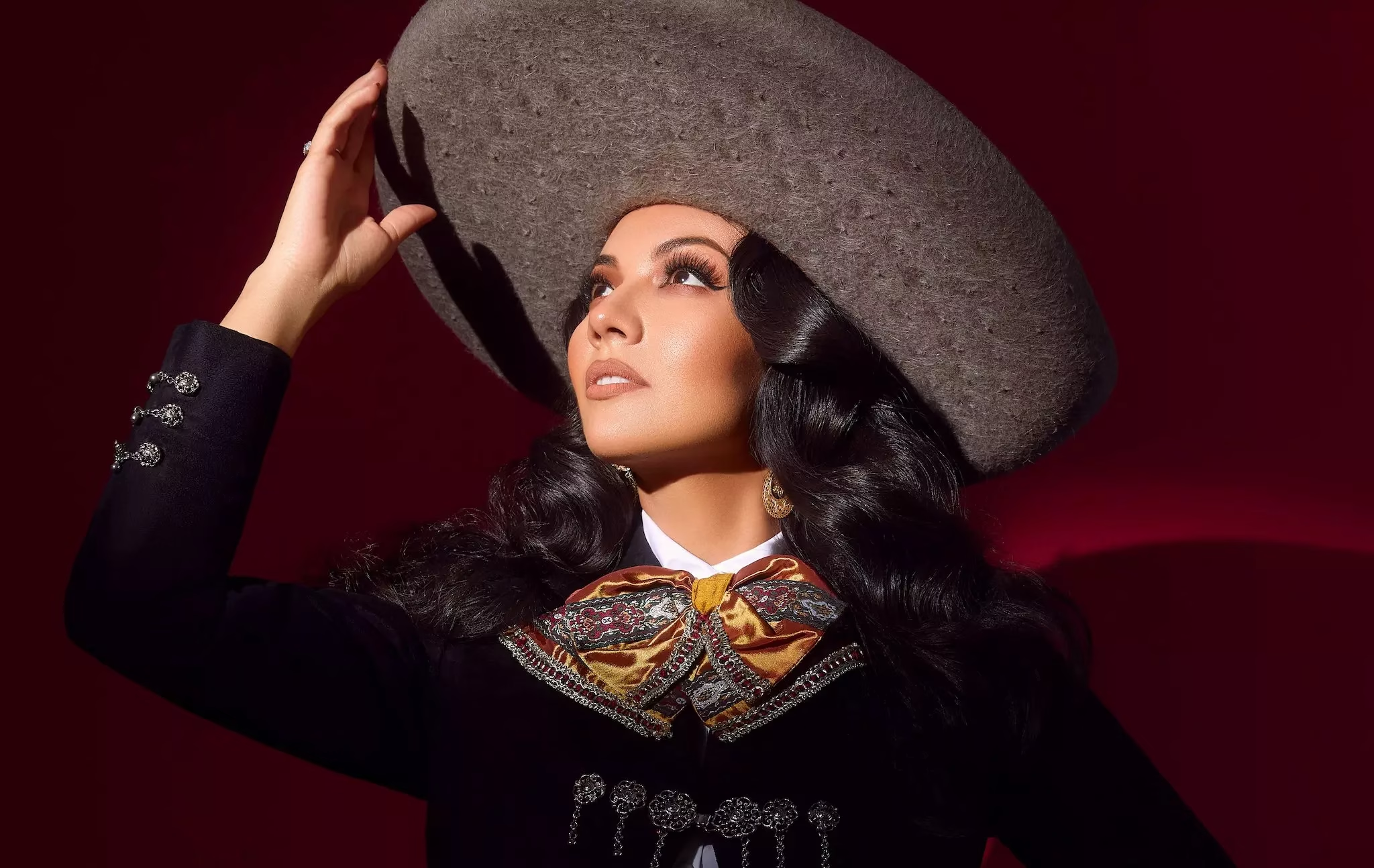
Since Lupita Infante started making music in 2018, she has dedicated her career to carrying her family's storied legacy. The granddaughter of Mexican icon Pedro Infante, the singer has put her own spin on traditional mariachi music while evoking the nostalgia of her grandfather's legendary music and movie career — and that's especially true on her second album, Amor Como En Las Películas De Antes.
Infante's latest LP is steeped in rich mariachi music. The Mexican vihuela, guitarrón, and cinematic strings conjure the music in grandfather's movies, but she makes the sound her own with bold confidence and powerful vocals. All of the songs are like vignettes in her soundtrack to love in all its forms: the dreamy "Besarte Así" describes a beautiful romance that feels lifted out of a script; on the flipside, Infante takes the power back in the heart-wrenching "Ya No Vuelvas," which sees a woman freeing herself from a toxic relationship.
Though Lupita has the Infante last name, following in her family's legacy was a journey she had to figure out on her own. Pedro Infante died in a tragic plane crash in 1957; her father, Pedro Infante, Jr. (who also was a famous actor), passed away in 2009. As she tells GRAMMY.com, Infante has been a student of her grandfather's: "From his work ethic, all the films that he left, and all the music, for me, that's been my school — listening to all of his recordings and interviews."
After years of gigging with various bands and honing her own style of mariachi music, she appeared on La Voz, a Latin spin-off of The Voice, in 2017. Two years later, she released her debut album, La Serenata, which earned Infante her first GRAMMY nomination for Best Regional Mexican Album in 2021. She's proven to continue making her mark, too, as she signed with Sony Music Latin last year.
"It's been a long road," Infante recalls. "I've had to find my own path. Even when I had started in my journey, my dad had already passed away, so I've been having all kinds of experiences from the beginning — good ones, bad ones — but luckily, I found a team of people who are incredible to work with, who have taught me so much, and have gotten me to this point today."
Infante is creating her own legacy in mariachi music and manifesting that through her songs. Before releasing Amor Como En Las Películas De Antes, she talked with GRAMMY.com about the stories behind some of the new songs, how she is paying homage to her family's history, and her future ahead.
How have your grandfather and father inspired your music?
Having a last name like Infante, I think it's opened a lot of doors for me to get in front of the right people or to get certain opportunities. At the same time, it's something that I can't take myself away from. Just growing in the career, I've always had in my mind and my heart that part of who I am, even with my performances and my recordings, it's always going to be some kind of tribute to my family. I'm just really proud and even blessed that I can do that, pay tribute to them in a way that also shares a little bit of my story too — but always, of course, giving the credit to how it all started for my grandfather and for my father too.
How are you putting your own stamp on the traditional mariachi music sound?
I feel like the sound of mariachi, it hasn't really changed a whole lot as far as arrangements and instrumentation goes. It's a very classic sound. On my new album, we did try to add certain instruments from music that's more commercial — adding the accordion or the sierreño guitar or requinto guitar.
There's even a song, "Quién No Ha Llorado Por Amor," where we added tuba instead of the guitarrón, just to change it up a little bit and give it different flavors of Mexican music. That song — which was produced by Luciano Luna and written by Omar Tarazón and myself in Mazatlán — I feel like that song has a very Sinaloa inspiration to it.
What was the inspiration for your new album Amor Como En Las Películas De Antes?
The title translates to "Love Like In the Old Time Movies." It's definitely inspired by this imagery of the collection of films that my grandfather has left us all. A friend of mine, Pedro Dabdoub, wrote this song called "Besarte Así." There's a line in there that says in Spanish: "In the old time movies, I saw this kind of love before."
Going through every song, going through every lyric, and trying to piece it together, that was a line that really spoke to me. You get all kinds of imagery from that line. I was really inspired by that and we kind of just ran with that.
Every song on the album is a love song. Some are about heartbreak. One is a love song about a car ["Mi Carrito"]. Some are talking about the perfect love. I wrote a lot of these songs before I was signed with Sony Music. I was just writing really because I wanted to talk about my feelings, and just share what I had inside. You're going to hear really personal stories.
In Regional Mexican music, historically women were presented before as damsels in distress. In your album and songs like "Ya No Vuelvas," you're showing all facets to a woman's perspective in the genre.
[We were] looking for some clips from movies from the '40s and '50s that we [could] tie in [with the music video]. Even looking at the way women are portrayed, it's very dramatic. It's like a damsel in distress, or she's mad, or she's in love. She's so emotional and kind of crazy.
It's fun to play around with those sentiments, but at the same time, it's really important to have that agency and control over what you want to express as a woman. [Like] with "Ya No Vuelvas," she's fed up with the guy's crap and she's going to let him know, and kick him out of here.
"Ya No Vuelvas" is one of your most raw vocal performances on the album. What you're feeling in that song comes through in your powerful vocals.
That's one of the songs, and "Quien No Ha Llorado Por Amor." They're songs that you go to this certain place in your heart and your soul and your Mexicanness, and you just pour it out and bring it out. It was probably one of the easiest songs to record with the least amount of takes. It was like, "Let me just get this feeling out," and that's how it came out.
"Mi Carrito" has a bit of a country music influence with it. Was that your way of bringing together the sounds of your Mexican and American backgrounds?
I definitely am. We wrote it in the pandemic, and we went to this cabin in the mountains. I think it just kind of sounded like the way it would sound if you're up there in the mountains and driving your car, because that was the only thing you could do.
Being in L.A., it's such a big car culture city. I think there's this big affinity that we have towards our cars, especially during that time — it was my only escape. ["Mi Carrito"] definitely has that country feel with the slide guitar and the fiddle, so it gives that mood.
"Pa Dentro" is a song that you wrote with another woman, Erika Vidrio. What does it mean to you to bring more women into the Regional Mexican music space?
I think it's important for women, in a sense, to form alliances and really support each other, and lift each other up. Even over the summer, Erika Vidrio, BMI and Amazon did a whole songwriter camp called Las Compositoras, and it was all women. It was just so much fun working with all different types of women — everyone coming from a different background and point-of-view. Maybe some women will be more rough and want to talk about real-life experiences and what they've been through. There's other girls who are more soft and gentle, and they want to talk more about love or hurt.
Even learning from every single person and their personalities and their writing styles, that's a lot of fun. Being part of events like that, and for us to create events like that, it's really important, especially for the future songwriters that are coming through as well. I think it's going to keep happening more and more. It's working, and it's good for us.
Throughout your career, you've shown support for the LGBTQIA+ community, who have historically been excluded from the Regional Mexican music scene. Why is it important for you to support that community?
At UCLA, I took a class about music in the LGBTQIA+ community. You had to pick an event to go to and write about it. Always appreciating mariachi, I was like, "I'm going to watch Mariachi Arcoiris at Tempo and I'm going to interview Natalia [Melendez], and see her experience and see what that's all about."
I [took] my mom with me to club Tempo. I didn't know what to expect. They would do this karaoke night back then, and people would come up and they're singing these songs that I've heard for years, but they're taking the meaning and making it mean something very specific to them, that speaks to them.
Honestly, it really transformed the way I see music and the way I saw the LGBTQIA+ community. Like the song "Vámonos" [by José Alfredo Jiménez], when I heard it being sung in that space, it had such a strong meaning for the person singing it. At the end of the day, we're all just people, and we all have feelings, and we just want to love and be loved, and I really got to see that and it was beautiful. I hope that if there is a song of mine that speaks to the LGBTQIA+ community that they would make it their own.
What can we expect from you this year?
We have a couple of live events going on throughout the year. I'm already starting on the next album. A lot of these songs [on Amor Como En Las Películas De Antes] were written quite a while ago, 2020 and 2021, so I'm looking to the future.
Nowadays music is just so instant. I think there's a certain magic about writing a song and producing it right away. I'm kind of channeling that energy for the next album. I'm just excited to keep making music.
What do you want to accomplish next with your music?
Part of it is just expression of self and culture. Another part of it, just keep making good quality music that stands the test of time. For it to become part of that mariachi repertoire.
That's always been my goal — I want to write music and create music that stays in the mariachi repertoire. When you have the mariachi come over and you say "play this song," hopefully it's one of mine.