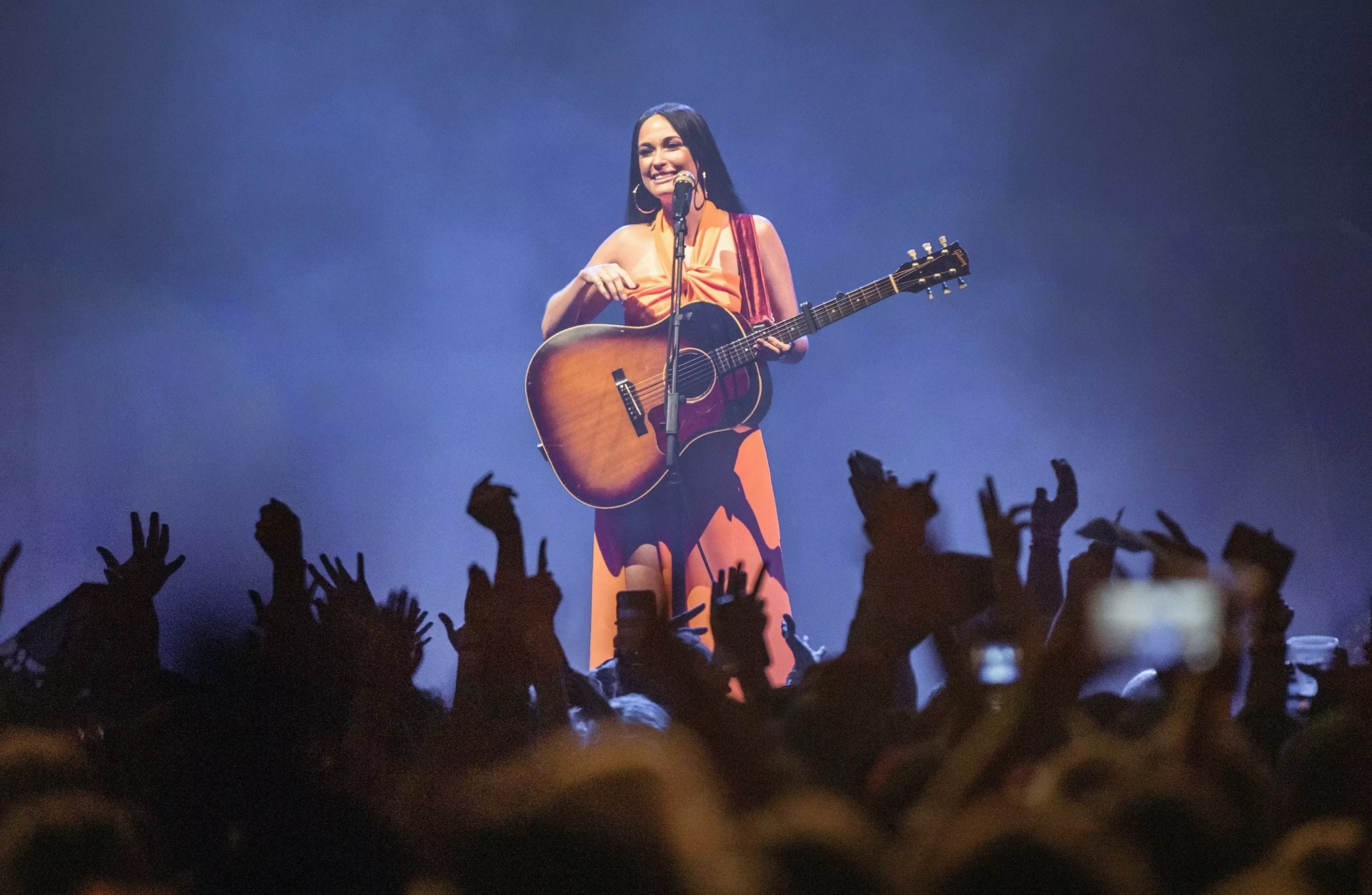
After a decade immersed in Nashville's country music scene, Marissa R. Moss has seen firsthand how pervasive gender inequalities affect female artists from all corners of the genre. Now, she's helping take control of the narrative — literally — with her new book, Her Country: How the Women of Country Music Became the Success They Were Never Supposed to Be.
Moss follows the trajectories of Kacey Musgraves, Maren Morris and Mickey Guyton as touch points for country's current climate, as all three have navigated the choppy waters of radio bias and helped broaden the genre's limitations. Looking back at the '90s — an era where, at least from the outside, country radio seemed dominated by women like Shania Twain, Faith Hill, Trisha Yearwood and Reba McEntire — provides context to the narrative, but Her Country is powerfully of-the-moment.
As Moss suggests, country music is, and always has been, a lens through which to examine broader cultural narratives in the U.S. at large. "To be able to weave in some cultural and political narratives — which, in my opinion, you always should, because you can't remove them from these conversations — that made [the book] extra timely," she tells GRAMMY.com.
Guyton saw her star rise after she released 2020's "Black Like Me," which chronicles her experience as a Black woman in America and in country music. Later that year, Morris delivered "Better Than We Found It," her reflection on the importance of making the world a more equal, welcoming place. (Both songs earned GRAMMY nominations, Guyton in 2021 and Morris in 2022.) Musgraves has long weaved advocacy for equality and acceptance into her musical narrative, with her 2013 hit "Follow Your Arrow" and Golden Hour single "Rainbow" becoming unofficial LGBTQ anthems.
While the Her Country women are at the forefront of purveying change in the genre, they're not alone. Countless artists spoke out against racial injustice after the death of George Floyd in May 2020; a month later, the Chicks dropped "Dixie" from their name as a move toward equality. The women of country have publicly supported each other, too, from Carrie Underwood's all-female roster on her 2019 Cry Pretty 360 Tour to Jennifer Nettles' 2019 CMA cape that read "Play Our F*@#!N Records, Please & Thank You."
Still, the lack of women representation within the format remains. As Moss highlights in Her Country, women make up only 16% of country radio airplay — a far cry from the heyday of the '90s. But that percentage doesn't square with the crowds they've commanded, or the diverse (and fiercely loyal) fan bases they've amassed.
To help understand the genre's complicated, often divisive trajectory toward equality and change — and to offer a look towards where it's going next — Moss discusses the themes and discoveries behind Her Country.
Moss will be moderating An Evening With LeAnn Rimes, the opening program of GRAMMY Museum’s The Power Of Women In Country Music exhibit, on May 31. The event will be held at the Clive Davis Theater in Los Angeles starting at 7:30 p.m. PT. For tickets and more information, click here.
Thinking about the current state of country music, or the broader cultural climate of the U.S., what made the topic of this book a pressing conversation for right now?
It was one of those things that was so obvious to me that I hadn't even quite necessarily thought, "I should write this book." And that's how so many really important things are. You think everyone knows these big stories, but basically, that wasn't the case. The radio charts show one story of the genre, but I knew that wasn't gonna be the story that I know, or the story I wanted to tell — [the story] that felt important to document.
If you view country music as a microcosm of what's going on in our country at any given moment right now, in so many ways, that made it extra interesting. To be able to weave in some cultural and political narratives — which, in my opinion, you always should, because you can't remove them from these conversations. To look at country music and our country's narrative at the same time — that made it extra timely.
The three focal points in Her Country are Kacey Musgraves, Mickey Guyton and Maren Morris — three artists whose careers are still relatively young, compared to '90s-era female country stars, or even current veterans Miranda Lambert and Carrie Underwood. What did it feel like writing about these women in real time, as important moments in their careers were unfolding?
You can read entire books about Miranda and Carrie, and that could have been one route. Or you could have chosen Shania or Reba — really, whoever — but I wanted women who were a couple of albums in each, but had been following this career since they were teeny tiny kids.
Obviously, Carrie and Miranda are still very much of the moment, and make modern albums, but to some degree they've moved into a little bit of a legacy status, at this point. I wanted to look at women who were right in that moment of everything exploding and unfolding. That was the best way to tell the story that I thought was important to tell.
Did you ever write a section and then have to later revisit it because a major development had happened in an artist's career?
Yeah, especially for Mickey. That was really challenging. I chose to end the book as their current albums were coming out, and leave the next phase up in the air, a little bit. Otherwise you could keep writing forever and the book would never end!
So much of what was happening was happening in real time. And at the same time, it was COVID, so I couldn't be out on the road. I was at my house giving virtual school to my two kids under seven. It was a very interesting period, because history was happening as I was writing it. But I was also writing in a very different way than I thought I would be before COVID, because I was stuck at home and I couldn't, like, pick up and move to Texas for a month. So it was all very different than I imagined, but for the best in some ways — just not the COVID part.
Did the research you did for this book shift your perspective on your subject matter?
It never stopped amazing me — as I dug back into the story of Mickey and Kacey and Maren — how truly, they were on this path from so early. People say "I've wanted to do this since I was a kid," but, you know, Maren was playing in honky tonks at, like, 11. And then on the flip side, reading back about the Chicks, and even old Kacey stuff, I found so many new things to make me mad, make me angry. Early coverage of Mickey, and the way she was written about. There was never a shortage of that, either.
There's no shortage of things to get angry about in country music's recent history, either. Maren talking about her feelings on the Morgan Wallen scandal in early 2021 is a particularly powerful passage.
I even feel that, and I'm just a regular person, not a famous musician. I had times where I just felt so discouraged, and disappointed and angry. But, you know, as Maren said, you're not going to make a difference by leaving.
I think that applies to so many things. It's a powerful idea in politics, even here in Tennessee, where politically, it feels unsafe for a lot of people — more so than before. Sometimes I wake up and I'm like, "Okay, I can't stay here." But then I understand that that's a huge privilege, and there's a lot more that can be done by staying and making a better place for people who don't have the privileges you do.
One thing that makes me hopeful about the genre is how tirelessly Mickey has worked to help carve out a space for Black artists in the genre, and how artists like Breland, Brittney Spencer, Blanco Brown, Amethyst Kiah and so many others are finding a home in the genre over the past couple of years. What makes you hopeful about country music right now?
That's so true. And those artists were always there, but they either were not supported or not heard. There's a lot of inspiring things going on with Black Opry, and amazing coalitions of artists creating their own spaces.
At the same time, I go back and forth. I see-saw between inspiration and desolation. Both of those things exist. It's hopeful and it's inspiring, but it's not candy-coated — and it couldn't be, because that's not the truth.
What grounds me is just listening to music. I know it sounds so simple. And being reminded of how much I love it and how much good music is out there, and how much more good music is going to have an opportunity to get to your ears now.
Read More: 5 Takeaways From Miranda Lambert's 'Palomino'
What music have you found most grounding recently?
I've spent a lot of time with the new Leyla McCalla album, which I think is really brilliant. Miranda [Lambert]'s new album is great. I love Maren's new record — not to shill the women I'm writing about! [Laughs.]
I love Morgan Wade. A lot of times I go back to the favorites: Tyler Childers' Purgatory, [Sturgill Simpson]'s Metamodern Sounds in Country Music and [Margo Price]'s Midwestern Farmer's Daughter. Kelsey Waldon. I listen to [her album, White Noise/White Lines] in my car, in the CD player. I never took it out because it never got old.
In the dedication for your book, you write "For anyone who needs to be reminded that it's your country music, too." Did you have any particular type of reader in mind when you were writing Her Country?
Over the years, as someone who you wouldn't think would be a country fan on paper, I guess — a Jewish kid growing up in New York — I've met a lot of people who fall into the category of being a country fan who you wouldn't stereotypically assume is a country fan. And then you realize that person doesn't exist. There's not just one [kind of] person who has a right to listen to country music.
I feel weird saying that, because the artists are really the ones doing the work — it goes an especially long way with Mickey, Kacey or Maren, with their fans saying they had never felt welcomed in the genre until they started listening to Kacey Musgraves. And then that opened up a different world to them. Or Black artists who hadn't seen a Black woman country artist at an awards show in modern times — until they saw Mickey, and that opened up a new world to them. Those are the fans that I hope will feel welcomed back in, or welcomed in for the first time, through a lot of these stories.
You describe yourself as the country fan who people might not assume is a country fan — who made you feel that country music was your genre?
I got into country music in a funny way. I was listening to the Grateful Dead and Bob Dylan, but my dad lived in Texas for a while and loved country radio. At the time I was a young kid with, you know, opinions — anything that your parents did was not cool. I didn't appreciate the '90s country thing, in the back of the car. But it must've gotten through there somehow.
I moved to Nashville in 2011, 2012. I was listening to country music before then, obviously, but I really fell in love with what was going on at the time. Caitlin Rose, Nikki Lane and Andrew Combs — all of their first records were hitting around that time. And I really fell in love with Jason Isbell. The way that they were interpreting country music and celebrating it in this different way — that still felt very traditional, but spoke to me directly — is part of the reason that I fell so hard for Nashville when I moved here. That was the soundtrack to what was happening back then. And I just loved it.