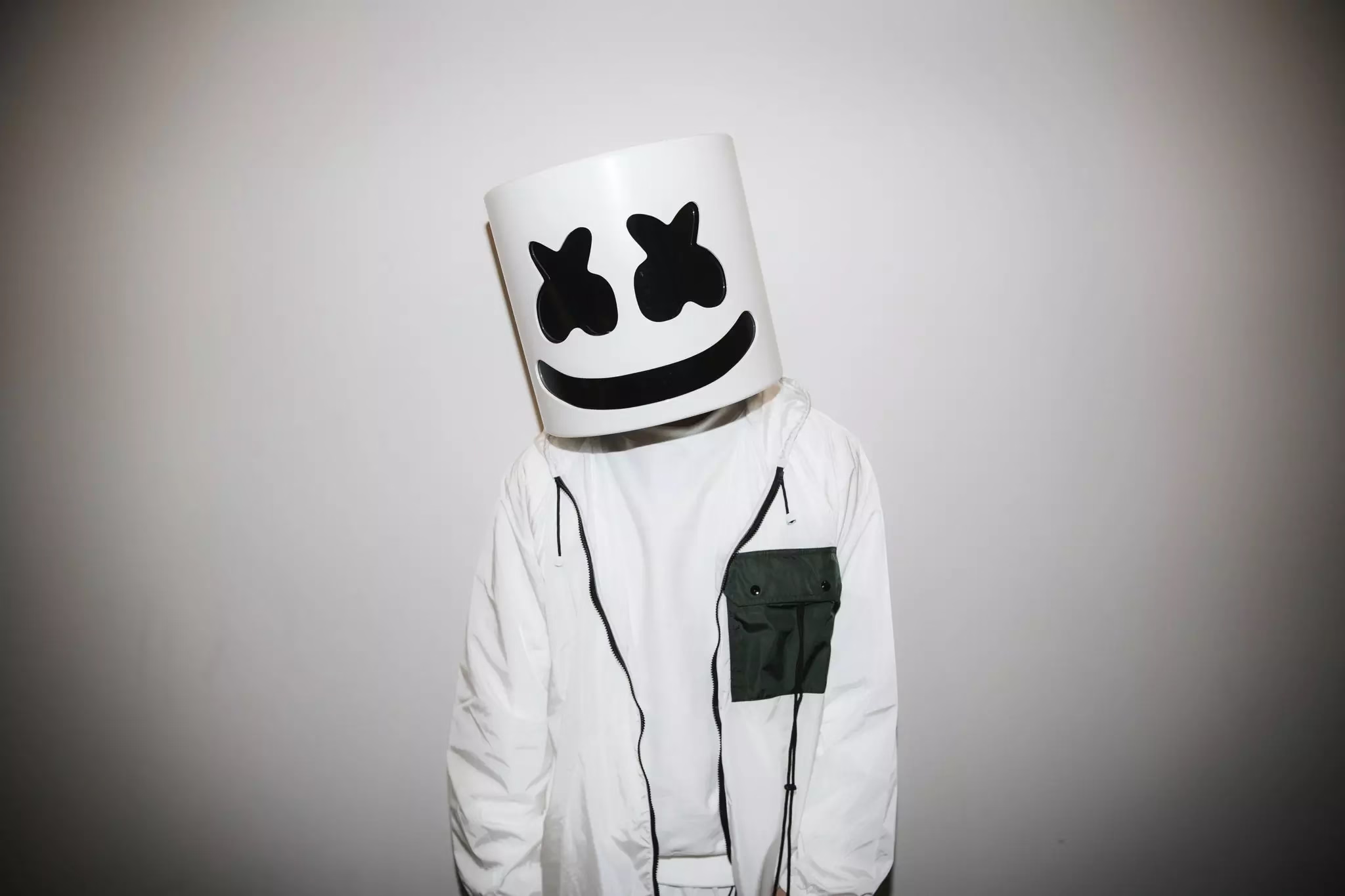
Marshmello has become one of the most recognizable faces in the modern music scene — by not showing his actual face. The electronic-pop producer has racked up billions of streams while maintaining complete recluse, thanks to a, well, marshmallow-shaped helmet that dons an adorable cartoon smile.
But even if Marshmello wasn't one of music's most mysterious identities (or a playable skin in the wildly popular video game Fortnite), his mountain of smash hits has turned the masked music man into a household name.
Since he first burst onto the scene with the Skrillex-approved "Find Me" in 2015, Marshmello's career has been in a league of its own. His record label debut "Alone" mixed buoyant synth sounds with upbeat rhythms (and his own helium-pitched voice), setting the tone for his sonic universe where youthful sing-alongs meet glass-shattering bass.
After winning over the EDM world, he soon took over the pop crossover realm, digging into his rock roots on collaborations with Noah Cyrus, Blackbear and Demi Lovato, Khalid, Selena Gomez, Bastille, and the Jonas Brothers, just to name a few.
Of course, a spotlight can also become a target, and Marshmello has had his fair share of detractors. On his fourth studio album, Shockwave, the dance star locks his X-shaped eyes directly at those haters and demonstrates just how dynamic his style can be.
It's his most diverse album yet, with features spanning from rap (Megan Thee Stallion and Juicy J) to fellow producers (Troyboi, DJ Sliink, Nitti Gritti) to a spattering of bass music heavyweights (Eptic, Peekaboo, Subtronic). Shockwave explores every corner of electronic music from Jersey Club to trap, dubstep to Eurodance and even pop-punk.
In the end, that experimentation earned Marshmello his first GRAMMY nomination for Best Dance/Electronic Album at the 2022 GRAMMY Awards. The producer chatted with GRAMMY.com about why his nomination is so meaningful, how he advanced the Marshmello sound with Shockwave, and why he feels he "needed this album."
Where were you when you found out about the nomination?
Well, I'm not really that good of a sleeper. I'm a person who needs to exude a lot of energy, so when I'm not touring and I'm home a lot, it's hard to stay asleep. I always wake up from 8 to 10 a.m., and it was during that time.
I'm half asleep, don't even know what's real, and I hear my phone vibrate. I see something about GRAMMYs, and when you're half awake — maybe a fourth awake — you don't even really process. That second or third time I really woke up, I was like, "Wait, did that happen?"
I'm sure it takes a while to sink in, even when you are fully awake for the news. What does it mean to you to be nominated?
It's something every artist strives for, even growing up. I didn't really know what to make of it, but in a good way. I was processing that, but I was just also really excited to tell everybody that was on the album. We made the album during the pandemic, and we really put a lot of — I don't know how to describe it.
Joytime I, II and III are very specific and intentionally sound, just, catchy. This album, I didn't name it Joytime. I wanted to try something different.
We did music videos very specific to each video, a lot of them with my ideas. The experience as a whole was different, and this was the album that got nominated for a GRAMMY.
That was all going through my head at once: "Everything was just different. I wonder why, blah blah blah." Then my next move was to tell everybody that was on it.
That intention does come through. It also struck me that the second song "Supernovacane" opens with a clip of some guy calling you an "overrated electronic artist," then you go on to mix your sound with revered artists and styles. Was your approach a message to people who would put you in a box?
I was going to start the album with that, but then I was also wrestling with this track "Fairytale," which is actually the intro that sounds much more like an intro.
Every artist has people that hate on them, right? I don't know if I can speak for them, but that was me saying, "I'm aware that people think this, and I'm just having fun with it."
Specifically with this album, the whole thing was like, "I want to do a trap song," so then I started the album with "Fairytale." I want to advance my Marshmello sound and try to use all my production tips and tricks that I have acquired over the years and just try something different.
Let's say somebody with this kind of hateful intention goes on to listen to that album, right? They turn that song on, and how would they feel hearing me acknowledge and even put in a song that somebody was saying what they were? I just did it because I can.
That matches with the rest of the album. It's like, "Yeah, I made this Vengaboys-sounding track with Carnage because I can. I made this Jersey Club future bass jam with DJ Sliink because I can."
Who's going to tell me not to? Joytime I, Joytime II, Joytime III, I've been doing that style for a long time. I needed this album, just to make the music that I like playing out.
Every single song, I remember sitting in my studio and thinking about playing it — and then seeing the show I haven't played yet and how the crowd would react in my head.
You have huge collaborators from all over the map on this LP, and you've had some really legendary collabs across your career. What makes a good collaboration?
Honesty. You don't want to tell somebody that you don't like their idea, and they don't want to tell you either. It's always tough. I'm not saying that everybody hated everybody's ideas. It's just like, instead of beating around the bush and dragging on, just getting right to that point, down to what everybody likes and just running with it.
Everybody that I worked with on this album, I know they really know how to produce. So you can have this connection — they've been through it all, too. It was very streamlined because of the talent, so that was really nice.
You've got so many fun sounds on this album. What style was most fun to explore?
That song I did with Carnage, I wrote all the lyrics and the melody. That was fun to step out of my box. It's old school, almost like Eiffel 65. I remember listening to Eiffel 65 on a CD. When there was a good song back in the day, you couldn't just get the song, you had to get the whole album. I'd be listening to Eiffel 65, and "Blue" was on there, but all the other songs really influenced me. I still remember them after how many years. It was cool to tap back on that.
It was really great to work with Sliink on the Jersey Club [track "Back It Up"]. I based a lot of my whole sound on Jersey Club, like a little twist on it. DJ Sliink is a legend. He would be able to whip something up and know "this is the right direction," because he is who he is.
I'm excited to see how it influences you going forward, having the opportunity to explore these other sides of yourself.
That was something that was really sweet about this album. I'm racking through my brain here, and I don't think any song does the same exact genre as any other. The Eptic dubstep is different than Subtronics' dubstep.
That was one thing that I wrestled with, the sequence of the album. You want to make it flow, so I decided to put all the heavy songs back to back, and then just close out the album with the title track.
Speaking of "Shockwave," we hear you singing, and while that's not something entirely new, it feels very personal. Are you more comfortable with your voice after spending the first few years of Marshmello anonymously?
I always grew up in bands, but being in front of people singing wasn't called for in the beginning years of Marshmello. Ironically, I did sing on a lot of stuff, but I pitched the voice up. "Alone" was me, and "WaNt U 2."
"You and Me" was the very first one, kind of a pop-punk EDM vibe, which inspired the whole album of Joytime III. I had it pitched up, and my manager was like, "Why don't you just pitch it down?" I'm like, "Yeah, but that's my real voice," and he's like, "Screw it!" I pitched it down and I was like, "Wait, this sounds sick."
That led into Joytime III which had "Proud," which did really well on [Sirius]XM and what is — I think — the biggest off that album. It's with me singing, too.
Was there a right moment to say "This is who I am under the helmet?" Did revealing your identity change the way you approached the project creatively?
Not really, because I don't really want to bring a lot of light to that. Being anonymous is a big part of the project and what I like about it now. It's not really about following a person around and watching everything they do. It's just listening to music, seeing the helmet and things that I say, which is fine, but I don't think it's about specifically who I am.
Video games are a big part of who you are, from your sound to your early days with Monstercat. There was the Fortnite concert which literally changed the way people see in-game opportunities, and you're a payable skin. What does it mean to you for Marshmello to be a video game character?
It's awesome. I like that people can buy Marshmello helmets in real life. I play a lot of video games, and I know a lot of people play video games. They can be Marshmello and have that feeling almost even more in the video game.
That goes back to the idea that everybody can be Marshmello. Now people who really identify with that can do it in a video game, too, and it stands out, right? All white with that smile. It just gives everybody a chance to connect more with myself.
You've accomplished a lot in your career, but is there a moment you're most proud of?
A lot of big shows that I've done — all the planning, and then executing. Those really stand out to me as far as accomplishments.
Coachella [2017], that was my first time playing. Lollapalooza [2021] really stands out. That was like two weeks of planning. Not even planning — that was two weeks of being on the stage that I played on, and then executing it to exactly where I, and everybody who worked on it, wanted it. I think we're going to come out with a little mini documentary about that whole thing.
So is that what's next for you?
There's a lot of things next. I like elements of surprise, so even if I could tell you, I don't want to.
Everybody wants that feeling of being a rock star in their own way, and in my way, it's DJing — and being able to craft a show with a group of guys that I spend most of my life with. Everybody's connected, all doing the same thing, and has the same passions. It's great to get together, make an idea, practice it, and do it.
I have a lot of songs ready. I'm really excited, and I have my head down right now. Expect to see me a lot [this] year, everywhere.