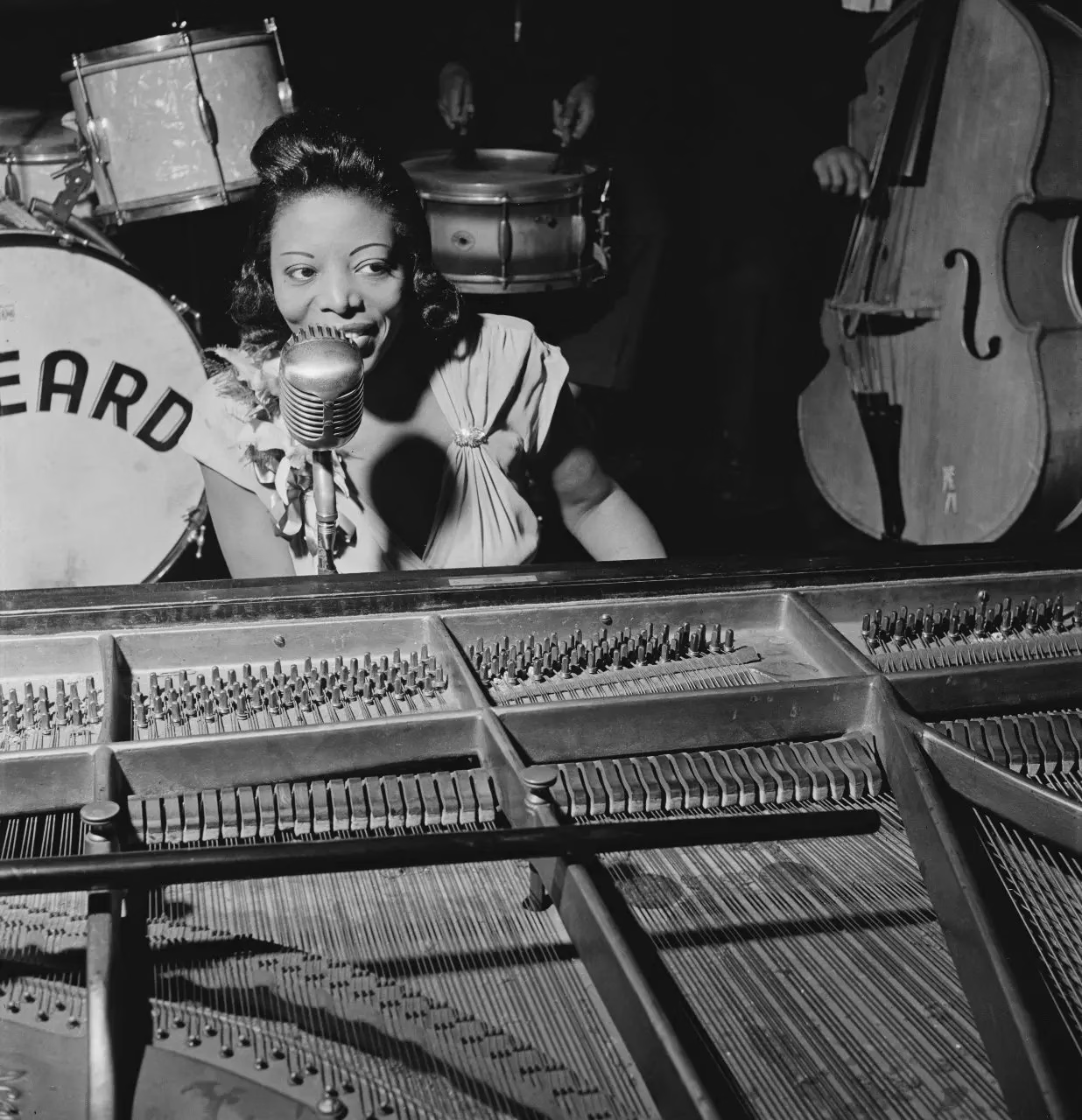
Linda Dahl is aghast at the results of an Amazon search. She knew her 22-year-old biography of Mary Lou Williams, Morning Glory, was hard to find — but not that some of her greatest music was out of print altogether.
At press time, there are two used copies of Zodiac Suite, Williams' 1945 celestial tribute to her contemporaries. What about Mary Lou Williams Presents Black Christ of the Andes, her epochal 1964 braiding of jazz and religious chorales? Gone — unless you want to cough up $60 to a third-party retailer. 1975's Zoning, which Dahl calls "a seminal recording," is hanging on by a thread — one new copy.
"I don't know what that means, but it's very upsetting," Dahl tells GRAMMY.com. "There's a mysterious element to this whole thing that I've never pinned down. Is it because she was fluid stylistically? Is it because she was female and Black? I don't know how to answer that question of why she continues to be marginalized."
Sadly, this is par for the course for the Atlanta-born, Pittsburgh-reared pianist, composer and bandleader, who charted a courageous course during her six-decade career with those terrific works and others — even as personal woes and ingrained discrimination tested her resolve.
Thankfully, all three albums are on Spotify, Tidal and Apple Music. (No dice for Amazon Music or Qobuz.) But the relative unavailability of Williams' music in the physical realm is odd, given that there's been a resurgence of interest in the hitherto obscure artist, from documentaries to books to tribute albums. Ella Fitzgerald, Charlie Parker and Miles Davis get shiny re-releases regularly.
But while Williams is back in the ether these days — and musicians have never been able to get her out of their minds — her music itself remains a little obfuscated from a public standpoint. More than 40 years after her 1981 death, she's only now getting her flowers on a grand scale.
But as jazz pianist and author Deanna Witkowski stresses, declaring someone to be a "genius" can sometimes act as a hall pass to not engage with their work further.
"We shouldn't just have Mary Lou be this exceptional icon that we put on a pedestal — because when we do that, we don't have to discuss or deal with anything specific about her music," Witkowski warns. "I think we have to sit down and have listening parties and talk about what we hear."
Musicians have tried to right that ship. As a 2021 JazzTimes cover story on Williams lays out, artists including drummer Allison Miller and pianists Chris Pattishall, Aaron Diehl and Frank Carlberg have performed and/or recorded tributes to her. That year, the Umlaut Big Band — a Parisian unit — released Mary's Ideas, a lavish two-and-a-half-hour tribute meant to "shed new light on an unjustly neglected figure."
Among those paying homage are Witkowski, who released tributes to Williams in two mediums. Those were 2022’s Force of Nature — an album composed mostly of Williams compositions like "Aries," "What's Your Story, Morning Glory?" and "Ghost of Love" — and the previous year’s Mary Lou Williams: Music for the Soul; a digestible biography written through the lens of both the author's and subject's devout Catholicism.
All of these do Williams justice, serving as helpful entryways to her legacy. And with their help, rather than wondering in circles why she wasn't bigger or more popular — her personal issues? her Catholic conversion? her hot-and-cold relationship with the music business? — let's celebrate Williams on the merits of her musical accomplishments.
"I've had this conversation hundreds of times with jazz musicians who say, 'Oh yeah, Mary Lou, she was a great arranger — great big band arranger. She was a great mentor for Thelonious Monk and Charlie Parker and Dizzy Gillespie,'" Witkowski says.
"But they still can't say, musically, how she mentored them or what her music sounded like," she adds.
Trumpeter Dave Douglas, a two-time GRAMMY nominee who released four Williams covers on 2000's Soul on Soul, warns against painting her as some sort of failed artist — whether consciously or unconsciously, or due to factors in or out of her control.
"I think you don't want to overdo, 'Hey, how come Mary Lou Williams didn't get her due?'" he tells GRAMMY.com. "Because she succeeded. She did it. She's not a household name like Duke Ellington, but she did it — and that's got to count for something."
Granted, it can be a foolhardy proposition to examine Williams' art in a vacuum, without considering the conditions she created it in. One can take away valuable lessons from her countless adversities — especially in how to nurture rather than neglect future geniuses like her.
But when you get through "the muck and the mud" of her struggles (Williams' words), Williams' music itself is what's worth taking to heart."
Mary Lou Williams Was A Masterful Rhythmist And Harmonist
Williams was unique for many reasons. A childhood prodigy active from the '20s until her death in 1981, she worked in contexts ranging from bandleader Andy Kirk's Twelve Clouds of Joy to a symphony orchestra at Town Hall in New York. She was also present for multiple sea changes in jazz's development — from boogie-woogie to big band to bebop to post-bop.
"She has emotional roots in at least two or three different periods in the development of this music," the avant-garde piano master Cecil Taylor told the Washington Post in 1977. "If we'd compared that to European music, she has the understanding to write Beethoven's 'Fifth Symphony' as well as Stravinsky's 'Rite of Spring.'"
Alongside her friend David Stone Martin, Williams even distilled her understanding of jazz history into a drawing of a tree used for her lectures, captioned "History of Jazz." From the roots to the branches are sections marked "Suffering," "Spirituals," "Ragtime," "K.C. [Kansas City] Swing" and "Bop," sprouting leaves that symbolize Coleman Hawkins, Miles Davis and dozens of other crucial jazz figures.
"The blues is a matter of feeling, and the blues is basic," Williams said in 1953. "All other styles telescope out of it." With this in mind, Witkowski stresses Williams' titanic sense of swing no matter what context she found herself in, pointing to recordings like "Waltz Boogie."
"She was able to swing even when she was recording with rhythm sections who weren't always swinging as hard as she was," Witkowski says. "She was able to lead a band in that way. That takes a lot of strength of character and strength of playing."
Though Williams was a consummate explorer and experimentalist, she never lost sight of the blues. From that rootedness in that lifegiving music grew a sublime sense of adaptability.
"The concert with Cecil Taylor is really an eye-opener," Douglas says, citing the pianists' testy 1977 performance together at Carnegie Hall — where critics viewed Williams' groundedness and Taylor's outré approach as a clash of aesthetics. Douglas doesn't quite frame it that way. Instead, he emphasizes her mastery late in life — and readiness to roll with the punches.
"She would've been almost 70 years old," he notes. "That she was able to swing with that, and in real-time, figure it out — that is a supreme spirit."
She Was Always Ahead Of The Curve
Follow the tree's trunk upward: as jazz entered new domains, so did Williams.
"Very few musicians who came of age in the swing era made the transition, in terms of their own playing, into what came after," Dahl says. (Only Coleman Hawkins comes to mind as another artist who successfully made that jump.)
Dahl also notes that Williams' presentation was uncategorizable. "She had gotten some advice that she took completely to heart — no clowning," she says. "And to her, clowning meant anything that detracted from what she wanted to do musically." Thus, she evaded all stereotypes — the sex kitten, the boogie-woogie queen, the blues mama — and was all about the music.
To Douglas, the essence of Williams' ingenuity is how she participated in and synthesized the various epochs of jazz history.
"The artists that I admire the most are the ones who go through radical transformation and change and keep growing through the years," he says. As such, he cites her development from a "ragtime, teenage piano girl" to a crucial writer in the Kansas City circuit to a mentor for bebop greats.
"Then, she writes the Zodiac Suite, which is one of the classic mid-century masterpieces," the trumpeter says. He's especially captivated by "Aries" — an ode to the personalities of Ben Webster and Billie Holiday — that "goes in so many directions and keys in such a compressed amount of time."
After converting to Catholicism, Douglas notes, Williams' music took on heavily sacred components — as on Black Christ of the Andes — and became funkier and freer on albums like Zoning.
"Her attitude was always: 'You never throw anything out; you just move into the new thing,'" he says. "If you think about Coltrane and all the progress he made, or the Beatles, or Stravinsky, or Miles — that's her path [as well]."
Williams' rhythmic mastery, killer syncopation and radiant harmonic thinking binds it all. And that's why the piano godhead Horace Silver tipped Douglas off to her work back in the '70s. The throughline of Williams' expansive catalog is "the sound of surprise," Douglas says.
Dahl agrees with his assessment. "You listen to her recordings in the '40s and the '70s and you're like, 'Is that the same person?'" she says. "For her, that was a badge of honor because she wanted to always be ahead of the curve."
She Taught The Household Names — And They Revered Her
It can be frustrating that Williams isn't a household name, and that the majestic Black Christ of the Andes isn’t mentioned in the same breath as classics like Kind of Blue, Giant Steps, The Shape of Jazz to Come, and Time Out.
"Why is it that when we think of the icons of this music, we think of male musicians and women singers?" Vijay Iyer a pianist, Harvard professor and GRAMMY nominee, asked GRAMMY.com in 2020. "We've been conditioned to believe that that's the order of things."
But Williams taught many of the icons of this music — from Olympus-tier figures like Charlie Parker, Dizzy Gillespie, Thelonious Monk and Bud Powell, to musician's musicians like Elmo Hope. Particularly in her later years, through the lens of Catholicism, Williams viewed herself as a servant of others.
"She wanted to encourage people — no matter what walk of life they were in — to have the wherewithal to go on," Witkowski says. "That may sound a little cosmic or whatever, but I really believe that she was trying to bring people together in love through her music. She said that a lot." But whether she played a mentorship role with them or not, she was beloved by top-tier musicians of her day.
Her 1936 arrangement of "Until The Real Thing Comes Along" for Clouds of Joy was so monumental that she got calls from Benny Goodman, Louis Armstrong and Duke Ellington, requesting her unique spin on the hits of the day. Williams arranged her ebullient "In the Land of Oo-Bla-Dee" for Gillespie and his orchestra; it went on to be covered by Goodman, Marian McPartland and others.
It didn’t end there: "Roll 'Em" was her biggest song for Goodman, who repeatedly (and to no avail) asked her to become his full-time arranger and pianist. Gene Krupa performed "Walkin' and Swingin'"; Monk quoted it in his classic "Rhythm-A-Ning"; it remains a big-band favorite to this day.
"One week I was called on for twelve arrangements, including a couple for Louis Armstrong and Earl Hines, and I was beginning to get telegrams from Gus Arnheim, Glen Gray, Tommy Dorsey and many more like them," she told Melody Maker. "Whenever musicians listened to the band they would ask who made a certain arrangement. Nearly always, it was one of mine."
And that reverence went all the way to the top: Ellington, who could make a case as the greatest American composer of the 20th century, called her "beyond category." For a jazz musician, what could be a more transformative endorsement?
Sure, Williams should be venerated on the terms of a brilliant Black woman who overcame the odds in a racist, misogynist system. But simply attesting to her genius isn't enough. Read about her. Study her. Be about a change in society that doesn't devalue and neglect creators like her.
But in the process, don't forget to turn up Mary Lou Williams' swinging, innovative, soul-nourishing music — loud.
John Coltrane's Unearthed A Love Supreme: Live In Seattle Is A Revelation. Without This Little-Known Figure, It Wouldn't Exist.