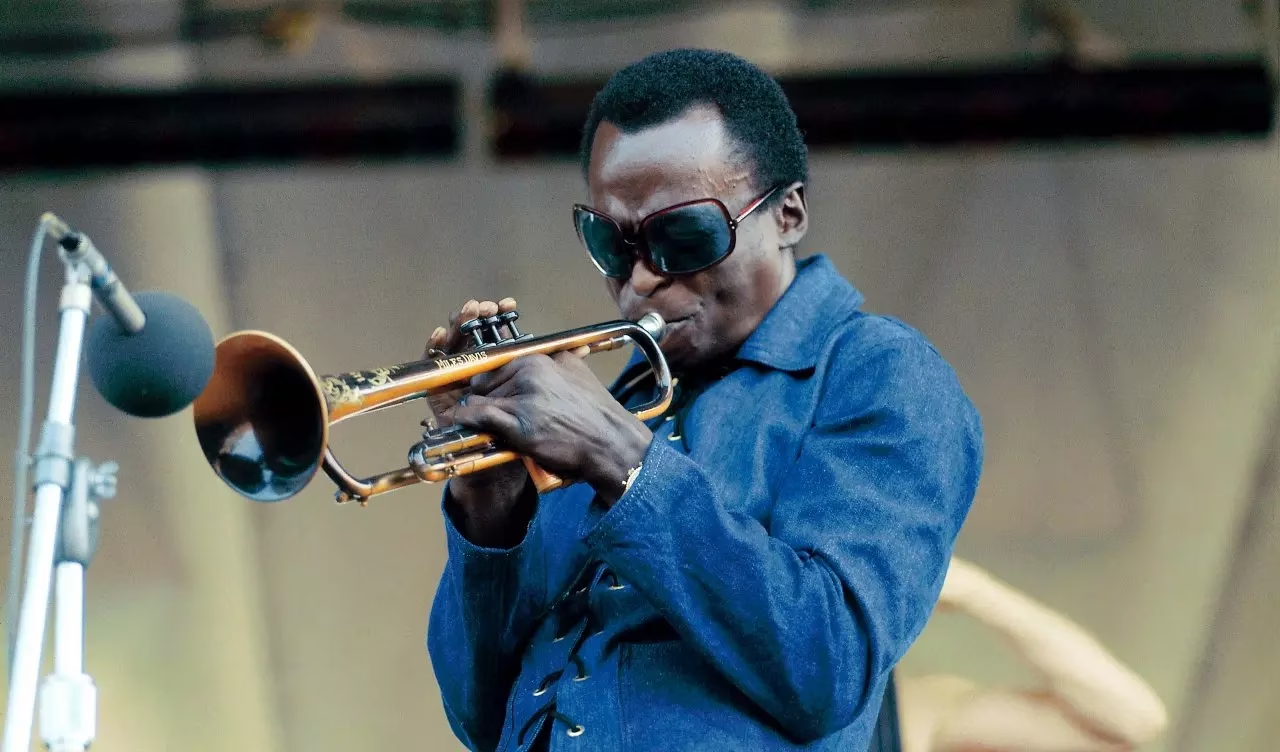
Joe Farnsworth couldn’t believe what he was watching. The leading straight-ahead drummer was sitting with the revered tenor saxophonist George Coleman, and a Miles Davis documentary happened to come on TV.
“This documentary went from Coltrane straight to Sam Rivers,” Farnsworth told LondonJazz News in 2023 — referring to the tenormen the eight-time GRAMMY winner and 32-time nominee employed in his so-called First and Second Great Quintets, respectively.
“What happened to ‘Four’ & More? What happened to My Funny Valentine? What happened to Seven Steps to Heaven?” Farnsworth remembered wondering. “Not a mention, man.”
Granted, Coleman’s tenure represented a transitional period for Davis’s group; his choice of tenorist would solidify in 1964 with the arrival of the 12-time GRAMMY winner and 23-time nominee Wayne Shorter. With pianist Herbie Hancock, bassist Ron Carter and drummer Tony Williams as the rhythm section — 18 GRAMMYs between them — the result was one of jazz’s all-time classic groups.
But Farnsworth’s point is well taken: in the recorded canon, jazz tends to lionize the rulebook-shredders and boundary-shatterers, at the expense of merely excellent work. But there’s not only room for both; in order to exist, the former requires the latter, and vice versa.
And given that Davis is, in many respects, the quintessential jazz musician, this wholly applies to him and his formidable discography — where the capital-P pivotal ones, like Kind of Blue and Bitches Brew, get the majority of the ink.
After you check out Seven Steps to Heaven and the like — and absorb Coleman’s important contributions to Davis’s story — take a spin through five more Davis albums that deserve more attention.
Water Babies (rec. 1967-1968, rel. 1976)
Axiomatically, anything Davis’ Second Great Quintet — and keyboardist Chick Corea and bassist Dave Holland, to boot — laid to tape is worth hearing.
But Water Babies should be of interest to any serious Miles fan because it reveals the connective tissue between Davis’ acoustic and electric eras.
The first three tracks, “Water Babies,” “Capricorn” and “Sweet Pea” — Shorter compositions all — were retrieved from the cutting room floor circa 1968’s Nerfiti. (Tellingly, that turned out to be Davis’ final fully acoustic album.)
Tracks four and five — “Two Faced” and “Dual Mr. Tillman Anthony” — add Corea and Holland to the mix; on electric piano, Corea adds a celestial drift to the proceedings. For reasons both
Miles in the Sky (1968)
Miles Davis and George Benson on record? It happened — lucky us. The 10-time GRAMMY-winning, 25-time nominated guitar genius can be found on two tracks from the 1979 outtakes compendium Circle in the Round, and on “Paraphernalia” from Miles in the Sky.
While Water Babies is something of a dark horse for the heads, Miles in the Sky — also featuring the Second Great Quintet —is a fleet, aerodynamic stunner and one of the most unfairly slept-on entries in his discography.
Outside of the Shorter-penned “Paraphernalia,” Miles in the Sky features two Davis tunes in “Stuff” and “Country Son,” and a Williams composition in “Black Comedy.”
It’s sterling stuff, right at the tipping point for fusion — and its obfuscation says nothing about its quality, but speaks volumes as to the volume of masterpieces in Davis’ discography.
Agharta (1965) and Pangaea (1976)
Two primo dispatches from Davis’ experimental years, capturing two concerts from the same evening in Osaka, Agharta and Pangaea are amoebic, undulating wonders.
Across the nearly 100-minute Agharta and 88-minute Pangaea, Davis and company — including alto and soprano saxophonist Sonny Fortune, and guitarists Reggie Lucas and Pate Cosey — conjure everything we expect from electric Miles.
Abstracted drones, worldbeat textures, Davis’ trumpet funneled through twisted wah-wah: check, check, and check. One critic characterized the music as “ambient yet thrashing,” compared it to “Fela Kuti jamming with Can,” and identified hints of Stockhausen, and nailed it on all three counts.
Fans of thick, heavy, electrified Miles typically reach for Bitches Brew or On the Corner first. But if those don’t completely whet your thirst, there’s a whole lot where that came from.
And given that Davis put down the horn, ravaged by illness, for six years afterward, Agharta and Pangaea represent something of a culmination of Davis as the intrepid deconstructionist.
We Want Miles (1982)
Despite what you may have heard, ‘80s Miles — his final full decade on earth, and the one where he drew heavily from pop sounds and songs — is nothing to sniff at.
From 1981’s The Man with the Horn to 1983’s Star People to 1989’s Aura, Davis produced a number of rough-hewn gems. And despite Davis’ bulldozed health during its recording, the live We Want Miles, recorded in ‘81, is among them.
Despite requiring oxygen between songs and wearing a rubber corset to keep playing, Davis is in fine form.
Plus, he’s flanked by heavyweights, from saxophonist Bill Evans (no, not that Bill Evans) to six-time GRAMMY-nominated guitarist Mike Stern and two-time GRAMMY-winning bassist Marcus Miller.
We Want Miles proves that Miles never lost his ability to produce inspired, inspiring work — no matter what his failing body or, erm, ‘80s textures threw at it.
Davis passed away in 1991, and we’ll never see his like again — so savor everything he gave us, whether illuminated or obscured by shadow.
Bird And Diz At 70: Inside Charlie Parker & Dizzy Gillespie's Final Studio Date — An Everlasting Testament To Their Brotherhood