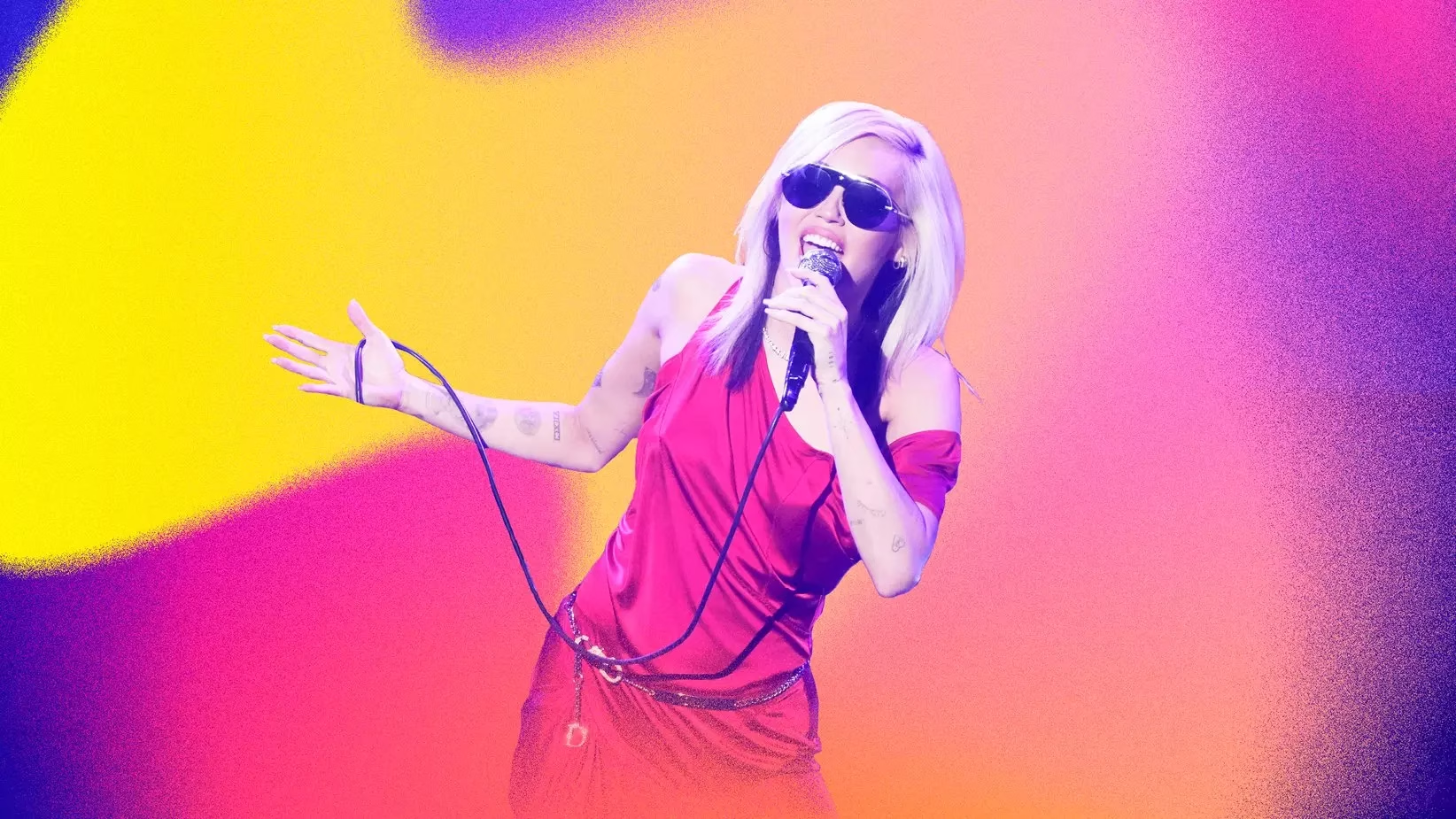
In the frigid depths of January, Miley Cyrus pronounced an Endless Summer Vacation was on its way. But it wasn't just the promise of perennial sunshine and lazy days by the pool in the near future — it was the title of her eighth studio album.
Cyrus has always been a musical shapeshifter, dating all the way back to her days as a Disney star. In fact, to call her a chameleon is something of an understatement. More than any of her contemporaries in the Disney Channel class of the late 2000s, the superstar has zigzagged wildly from genre to genre, and aesthetic to aesthetic, across more than 15 years in the business.
Of course, before Cyrus became a pop star in her own right, she was known to an entire generation as Hannah Montana, the titular character of the hit Disney Channel sitcom that ran from 2006 to 2011. Portraying Hannah gave the then-child star her first taste of life as a (fictional) music sensation, one who lived in the "Best of Both Worlds" and could put her fame on like a costume by adopting a stage persona and new look.
When looking at Cyrus' wide-spanning career, it could be argued that the foundational experience of playing Hannah Montana informed the way a young Miley approached her own identity as a pop star, shifting from one style to the next — and yet, having each of them feel entirely authentic to her talent and point of view.
Despite the sometimes drastic stylistic changes from one album to the next, Cyrus has always insisted her music is rooted in personal truth and reflective of her current moment. "Everyone that I've been — whether you are thinking about Hannah Montana or the music I made in the past — all of it has always been the truth," she said in a 2017 interview with NPR. "So I think people are saying 'the new Miley' or 'the more honest Miley' — I've always been that. But I've been honest for who that person was then."
The singer first started breaking away from her Hannah Montana character long before the kid-friendly series finished airing in 2011. Establishing her own identity happened in fits and starts, even as her persona as Hannah grew larger than life. In 2007, she released Hannah Montana 2: Meet Miley Cyrus — a part soundtrack/part double album to introduce fans to the budding artist underneath Hannah's blonde wig. The project earned Cyrus her very first top 10 hit in the form of "See You Again."
In the years that followed, she essentially lived parallel lives as both Miley and Hannah. Breakout, her second studio album, arrived in 2008 with singles "7 Things" and "Fly on the Wall," and yet Hannah was still making appearances on her Best Of Both Worlds Tour. "I think having Hannah come up on stage gives it a cool vibe," she explained to MTV News at the time. "And it shows, like, one girl but definitely two sides and I like that you get both tastes of music, and I think it's just really fun."
That dichotomy continued the following year when her alter ego made the leap to to the big screen in Hannah Montana: The Movie. And yet, Hannah's big break also gave Miley the perfect platform to debut "The Climb," the soundtrack offering that rose all the way to No. 4 on the Billboard Hot 100 and became her highest-charting single at the time.
As with many child stars before her, the time eventually came for Cyrus to grow up, and as she pushed against the constraints of her kid-friendly image, controversy came calling. First, there was the pearl-clutching over "Party in the U.S.A.," with Miley's short shorts and playful pole dancing at the 2009 Teen Choice Awards; nearly a year later, her cheekily titled third album, 2010's Can't Be Tamed, sparked minor outrage over the themes and title, as well as the slight raciness of the title track's music video.
However, if the road to autonomy started out a tad bit bumpy, Cyrus burned the bridge to her tween idol past to cinders with her fourth album, 2013's Bangerz.
As its brash title suggests, the studio set is indeed a collection of banger after banger — and a provocative swerve into party-ready hip-hop and electro-pop, including a tracklist filled with all-star guest features like Britney Spears (the fan favorite "SMS (Bangerz)"), Nelly (the country-fried stomp of "4x4"), Big Sean (the blurred-out "Love Money Party"), Future (Ben E. King-sampling highlight "My Darlin'") and more. And stylistically, Miley had traded in both her long brunette waves and Hannah's signature blonde wig for a platinum pixie cut, bold red lip and rotating wardrobe of barely-there bodysuits made from latex and the pelts of abandoned teddy bears.
In retrospect, the album is unequivocally part of the defining soundtrack to the early 2010s. While the most indelible image from the Bangerz era was Miley swinging naked and free atop a giant wrecking ball, lead single "We Can't Stop" became the hedonistic anthem for a then-rising generation of young millennials coming of age in the post-recession years of Obama's second term — Cyrus included.
And for as much scandal as Miley gleefully courted during the era — whether over her appropriation of hip-hop and Black culture, that unforgettable VMAs performance with Robin Thicke, all the twerking, or the constantly stuck-out tongue of it all — the album also earned the singer her first, and so far lone, solo GRAMMY nomination for Best Pop Vocal Album. Still, even Miley can admit all these years later that she'll pretty much "never live down that I licked a sledgehammer."
Following a project like Bangerz, most pop stars might perform something of a label exec-encouraged course correction into less provocative territory. But Miley isn't just any pop star. So, instead, she took her antics, and her music, even further down the rabbit hole with Miley Cyrus & Her Dead Petz in 2015.
Enlisting a trusted pair of Bangerz producers, Mike WiLL Made-It and Oren Yoel, the singer added a psychedelic bent to her existing oeuvre by teaming with Wayne Coyne and the rest of the Flaming Lips. The resulting project — which opened with the discordant declaration, "Yeah I smoke pot, yeah I love peace/ But I don't give a f—, I ain't no hippie!" — was so experimental and decidedly noncommercial that it was originally released independently, available to stream for free on Soundcloud. (While it didn't count towards her multi-album deal with RCA, the album was later added to traditional streaming services by the label, but never made a mark on the Billboard 200 or any other official chart.)
"I created my surroundings, my own world. What seems like fantasy or trippy, it's not to me. It's my actual reality," the star explained in a profile in the New York Times about the oddball release, and argued that despite its lack of traditional, well, bangers, it was actually an innate progression from its pop-heavy predecessor.
"When I made Bangerz, it was as true to me then as this record is now," she told the NYT. "It just happened naturally in my head. It's like anything — styles just change…I literally can do whatever I want. It's insane. This music was not meant to be a rebellion. It was meant to be a gift."
For his part, Miley's trusty right-hand man Mike WiLL Made-It saw her evolution through much the same lens, declaring to the NYT, "Why would she drop another Bangerz? Miley is the new Madonna."
Of course, there's only so far off the yellow brick road you can go before risking losing your fanbase to woozy fields of poppies. No matter how delayed, the course correction was bound to come — "what goes up must come down," as the saying goes and all that — but like every other step of her evolution, Miley veered back to the middle of the road entirely on her own terms.
Not only was Younger Now, her fifth album from 2017, a sonic shift to rootsy country pop (led by the downtempo, dreamy "Malibu"), it was also the first time Cyrus laid bare her approach to personal and artistic reinvention in song. "Feels like I just woke up/ Like all this time I've been asleep/ Even though it's not who I am/ I'm not afraid of who I used to be," she intoned on the opening title track, decked out in her best rockabilly cosplay before preaching, "No one stays the same/ Know what goes up must come down/ Change is a thing you can count on/ I feel so much younger now."
The album cycle was also marked by seismic changes in Cyrus' personal life. In 2016, she reconciled with longtime on-and-off boyfriend Liam Hemsworth and by the time Younger Now was released into the world, the pair were engaged to be married. The romance had gone through many different stages, breakups and reconciliations since the duo met filming The Last Song in 2009, but Cyrus had no idea at the time just how impactful it would turn out to be in the years to come.
At the time she dropped Younger Now, the superstar actually confessed her enthusiasm had already waned for her singer/songwriter phase — one natural drawback to her need for constant creative reinvention. "I'm over this now," she said during a promotional visit from BBC Radio 1 at her home studio in Malibu two full weeks before the album debuted at a career low of No. 5 on the Billboard 200. "I want to figure out what I want to do next."
If her 2019 EP She Is Coming is any indication, what Miley originally had planned was a full-circle return to her role as pop provocateur. The seven-track sampling came across as a sort of Bangerz 2.0, trading the debauchery of "We Can't Stop" for the unabashed political message of lead single "Mother's Daughter."
The EP was meant to be the first in a trilogy that would eventually make up a full-length record, but the idea was scrapped when another metaphorical wrecking ball came crashing through the pop star's life: In August of that year, she announced her separation from Hemsworth after just eight months of marriage. Two weeks later, the actor officially filed for divorce. But even before he'd filed the papers, Cyrus had released standalone single "Slide Away" to eloquently and powerfully tell her side of the story.
"Once upon a time it was paradise/ Once upon a time I was paralyzed/ Think I'm gonna miss these harbor lights/ But it's time to let it go," she reflected, cutting her losses before bluntly telling her ex, "Move on, we're not 17/ I'm not who I used to be/ You say that everything's changed/ You're right, we're grown now."
Although it had spanned more than a decade of her life, Miley had never been so autobiographical about her relationship in her music up to that point — and the emotional vulnerability seemed to crack open a door she still has yet to close.
In fact, it's easy to see the throughline connecting "Slide Away" to cuts like "Midnight Sky," "WTF Do I Know" and "Never Be Me" off her excellent 80s-inspired seventh album Plastic Hearts, even through the glam rock sheen and covers of Blondie, Metallica and the Cranberries.
By the time Plastic Hearts was ready to be unwrapped in late 2020, Miley had also made peace with all the versions of herself that had come before. "I discredited myself for what I had been almost every step of the way," she said in a Rolling Stone cover story. "During Dead Petz, discrediting Bangerz. During Bangerz, discrediting Hannah Montana. During "Malibu," discrediting Bangerz. It's almost like when I have evolved, I've then become shameful of who I was before. What makes you an adult, I think, is being OK with who you've been before."
That personal reckoning is part of what makes "Flowers," the lead single off Endless Summer Vacation, feel like such a victorious culmination of what makes Miley Cyrus a superstar. The disco-inspired track is a testament of self-determination and hard-won independence, and has already become the biggest hit of her career by a long mile before the rest of the album even drops. She's broken colossal streaming records set by the likes of Adele not just once but twice over and spent six consecutive weeks at No. 1 on charts across the globe.
The rest of Endless Summer Vacation is divided into two sides — A.M. and P.M. — representing different acts of a complete story. But even before fans heard the new album, it was clear Cyrus had already arrived at the most fully-formed version of herself yet.
"I hope this show is a representation of you never need[ing] to choose who you want to be. And you don't need to fit into any boundaries or into any boxes," she told the rapt crowd at the 2022 Super Bowl Music Fest, which was recorded for her live album ATTENTION: MILEY LIVE ahead of Endless Summer Vacation's arrival. "You can be anything and everything that you've ever wanted to be all at the same time."
The singer knows that better than just about anyone. After all, she's just being Miley.