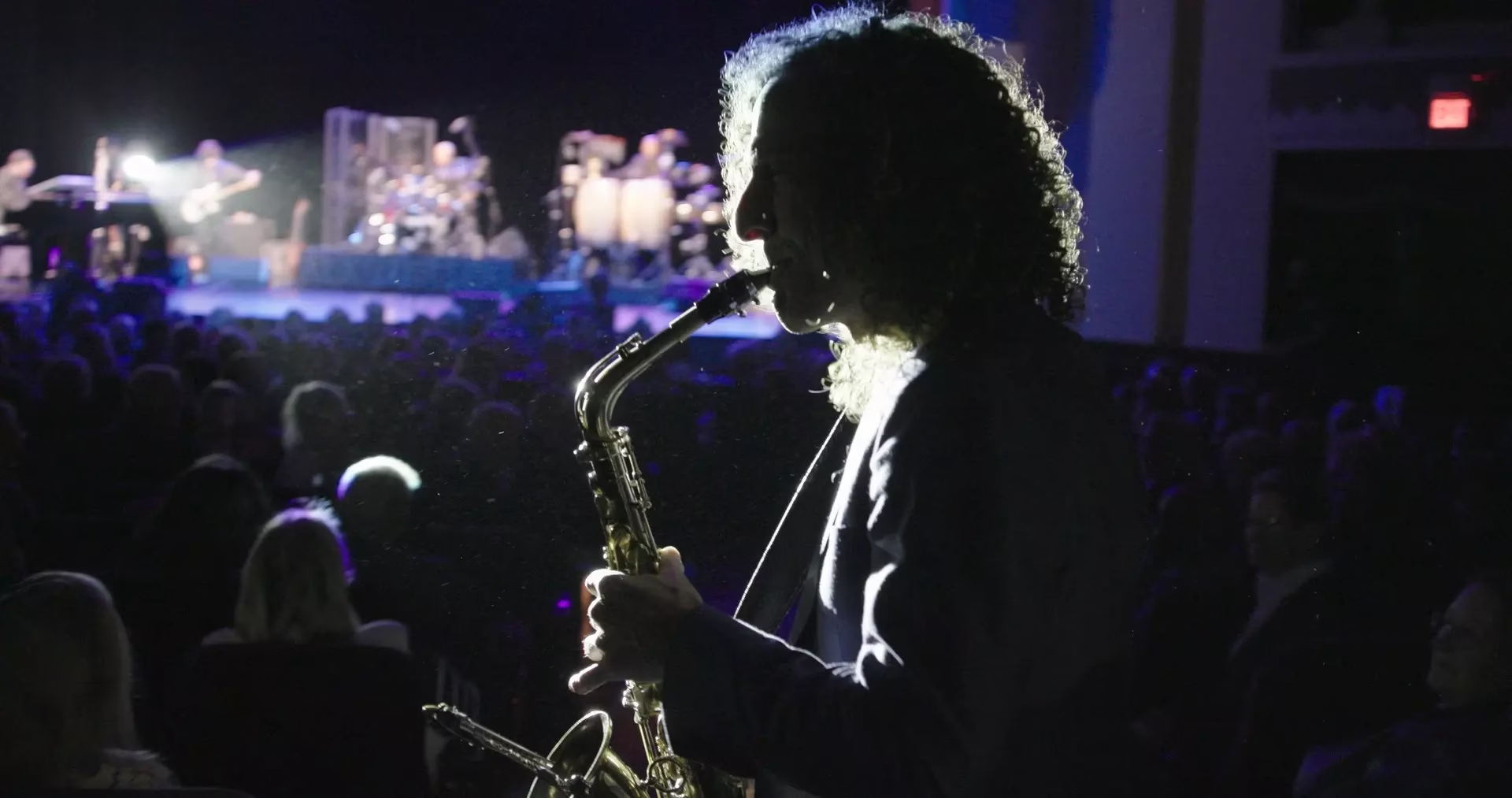
There's a poignant moment in a new Kenny G doc where we get to meet his fans as real people — not as faceless record-sales statistics.
Lined up in front of the Blue Note in New York's Greenwich Village, we see those he touched, who hail from all ages, racial backgrounds and walks of life. Three women — all saxophonists — traveled all the way from Costa Rica to see him. Several sets of parents and adult children say they've been enjoying him together for decades. "He's a really serious, excellent musician," one older woman says pointedly, irate that the wider world would have the gall to mock him.
None of these expressions — however arresting — are bound to sway the jazz aficionados who loathe Kenny G. The points of contention are manifold, from his vanilla sound to his decades-long cultural ubiquity to his astronomical record sales. (At press time, he's sold more than 75 million records.) Neither might they rewire the brains of those conditioned to find him laughably milquetoast via gags on "South Park," "Family Guy" and "The Tonight Show Starring Jimmy Fallon."
The cover of Kenny G's New Standards.
But as director Penny Lane's recent HBO doc, Listening to Kenny G, expertly lays out, the GRAMMY-winning and 17-times-nominated saxophonist born Kenneth Gorelick never set out to siphon a precious American tradition for fame and cash. ("If only I was that smart!" he cracks.) Rather, as the film shows, he's simply an idiosyncratic, impossibly driven oddball making music that he personally finds beautiful — and it just so happens that millions of people feel the same.
And if you're not one of the scores of people captivated by tunes like "Songbird," "Going Home" and "Silhouette," that's fine. Listening to Kenny G is not an argument for his brilliance as an instrumentalist, nor that he's more gritty and authentic than people think. (He isn't.) But to be so quick to take him to task — as TV outlets, the highly-educated bearers of coarse opinions on Jazz Facebook, and, most vociferously, the brilliant guitarist Pat Metheny — has a troubling ripple effect worth examining.
The first problem? To view him as an existential threat to the genre is questionable — partly because he's not really a "jazz" artist, but also because it implies the world he at least tangentially occupies is a fragile entity requiring constant, vigilant defense. Then, we come to the elephant in the room: elitism. Left unabated, this attitude threatens to make jazz an arid, insular place only catering to the properly-vetted intelligentsia.
<style>.embed-container { position: relative; padding-bottom: 56.25%; height: 0; overflow: hidden; max-width: 100%; } .embed-container iframe, .embed-container object, .embed-container embed { position: absolute; top: 0; left: 0; width: 100%; height: 100%; }</style><div class='embed-container'><iframe src='https://www.youtube.com/embed//mmgg5XObNl8' frameborder='0' allowfullscreen></iframe></div>
Because no matter how many records Kenny G sells, the tradition and language of jazz has held together just fine, thanks — no matter how many "duets" he records with long-dead luminaries like Louis Armstrong and Stan Getz. Metheny may have slammed his work and its implications as "something that we all should be totally embarrassed about — and afraid of," and maybe you agree or disagree. But go ahead and tell that to the people who married, buried and gave birth to his music.
Ever since Charlie Parker helped forge the archetype of the "jazz" musician as an uncompromising intellectual rather than an entertainer, this world has been a place of solemn reverence, brain-breaking study and genuflection to one's elders. (Sidebar: if you want to burst that bubble regarding Bird's perception, consider that he was a goofball who loved country music as much as he was a dead-serious innovator and visionary.)
This new paradigm locked Bird, everyone he birthed and influenced, and all the scholars and students in his cosmology, into a common practice — one that's sophisticated, culturally resonant and incontrovertibly connected to the Black experience. With every successive generation and school of players that builds on the last one's contributions, the lineage grows deeper, more thrilling, more lasting.
<style>.embed-container { position: relative; padding-bottom: 56.25%; height: 0; overflow: hidden; max-width: 100%; } .embed-container iframe, .embed-container object, .embed-container embed { position: absolute; top: 0; left: 0; width: 100%; height: 100%; }</style><div class='embed-container'><iframe src='https://www.youtube.com/embed//QN2RnjFHmNY' frameborder='0' allowfullscreen></iframe></div>
So for this curly-haired interloper to take something resembling jazz, butter it up for the world and experience a cash windfall for his trouble understandably rubs musicians the wrong way. As often lifelong practitioners of the craft, they're entitled to their opinions on the man. But the fact that he stirred the pot on such a scale still begs the question: Is Kenny G really jazz?
As the jazz writers among Listening to Kenny G's talking heads explain, Kenny G's music is free of dialogue, either with jazz progenitors or the musicians who accompany him. Nothing he plays is clearly traceable to the Gamaliels of this form — no Duke Ellington, no Coleman Hawkins, no Lester Young, no Sonny Rollins. The deeply uncharitable view would be that he projects a theoretical world without them.
And while the essence of desert-island discs like John Coltrane's A Love Supreme, Miles Davis' Kind of Blue or Dave Brubeck's Time Out is the poetic interplay between ensembles, G's saxophone hangs weightlessly in a soothing, digital soundscape — the other instruments are seemingly unreactive to what he's doing. Also, his songs are mainly structured on prewritten pop melodies, not improvisation — which somewhat disqualifies him from a form predicated on hip, extemporaneous expression within a musical language.
Kenny G. Photo courtesy of HBO.
So, given that Kenny G arguably doesn't fulfill the most basic requirements of jazz, how can he threaten it? How can he be a weak link if he was never part of the chain at all?
"When all these jazz guys get in a tizzy over Kenny G, they need to leave Kenny alone. He's not stealing jazz," the three-time GRAMMY-winning saxophone great Branford Marsalis once told Jazziz. "It's not like some guy says, 'You know, I used to listen to Miles, Trane and Ornette. And then I heard Kenny G, and I never put on another Miles record.' It's a completely different audience."
As G says in the film, "My songs were played on pop radio. They were played on jazz radio. They were played on R&B radio. Am I an R&B artist? Am I a pop artist? Am I a jazz artist? I think, maybe, the answer is yes, just to everything."
<style>.embed-container { position: relative; padding-bottom: 56.25%; height: 0; overflow: hidden; max-width: 100%; } .embed-container iframe, .embed-container object, .embed-container embed { position: absolute; top: 0; left: 0; width: 100%; height: 100%; }</style><div class='embed-container'><iframe src='https://www.youtube.com/embed//3u6Ccdh2308' frameborder='0' allowfullscreen></iframe></div>
Genre aside, some musicians have thoughtfully made the case that G's interpolation of Armstrong's "What a Wonderful World" recording (as found on 1999’s Songs of the Key of G) was disrespectful. "My gut reaction is that it's like [early composer/bandleader] Paul Whiteman trying to 'make a lady' out of jazz," pianist Fred Hersch told JazzTimes that year. "I don't think we need Kenny G to be a spokesperson for Louis Armstrong. I think Louis speaks fine for himself."
In the same article, saxophonist Charles McPherson agreed. "None of those people need Kenny G or anybody else to validate them," he said, before adding: "But it's true that his audience probably does not know Armstrong or Getz or Charlie Parker. So if he feels like his audience should be more familiar with those people, I can't see anything aesthetically wrong with that."
Kenny G. Photo courtesy of HBO.
Despite Metheny's hurled accusations of artistic defilement and "musical necrophilia," Kenny's re-do of "What a Wonderful World" never superseded the original in the public consciousness, and Satchmo is still venerated the world over as an improvisatory titan.
It’s a similar case with the mellow tenor saxophonist Stan Getz, who died in 1991 — only for Kenny G to resurrect him on his latest album, New Standards. Therein, he used software-based reconstruction to generate new melodies based on Getz musical thinking — and drew jazz scholars' ire for his trouble.
If new blood is disallowed if it flows through the G-Man, it might be more deleterious to the long-term health of this music than gatekeepers fully grasp.
Once the heat dies down, though, this — like the Armstrong "duet" — will likely be a brief off-ramp in G's career. He couldn’t replace the originals even if he tried, and fans old and new will continue wholly enjoying the timeless artist known worldwide as "The Sound."
Many who hear this uncanny-valley collaboration might never think of Getz again; others who may have never otherwise gone for him might make a beeline for classics like 1964’s Getz/Gilberto. Will purists sneer at them or graciously let them in? Because if new blood is disallowed if it flows through the G-Man, it might be more deleterious to the long-term health of this music than gatekeepers fully grasp.
<style>.embed-container { position: relative; padding-bottom: 56.25%; height: 0; overflow: hidden; max-width: 100%; } .embed-container iframe, .embed-container object, .embed-container embed { position: absolute; top: 0; left: 0; width: 100%; height: 100%; }</style><div class='embed-container'><iframe src='https://www.youtube.com/embed//Qt6vqcoCkdU' frameborder='0' allowfullscreen></iframe></div>
If the blazered and accredited wouldn't march up to the fans in line at the Blue Note and insult them as tasteless buffoons — taking them to task for enjoying art unapproved by the pedagogy — perhaps thinking twice is in order before castigating Kenny G. Consider how a slight against your favorite artist can feel like an attack on you, then extend that ugly feeling outward to millions.
So, has Kenny G's existence been a net positive or negative for jazz? That can't and won't be litigated in a single article. He continues to pick up new fans every day, whether by appearing with Weezer and Kanye West or on "SpongeBob SquarePants." He remains charming, ageless, a tad self-regarding. His longtime devotees clearly aren't going anywhere; the indifferent will probably remain that way; haters gonna hate.
But Listening to Kenny G kicks up all manner of complicated questions. And given his global reach and sway, those raring to exile him from real jazz — to alienate his fanbase before their journey into the deeper things of this music even begins — would be well-advised to weigh the benefits and costs of such a disassociation.
Virtuosos, Voyagers & Visionaries: 5 Artists Pushing Jazz Into The Future