Ever hear of the Ship of Theseus thought experiment? It asks the reader to picture a ship whose components have been replaced — hull, mast, sail, rudder, and every single plank of the deck. Is it still Theseus' craft? Or something else entirely? The question still bedevils philosophers.
Now apply this framing to beloved musical groups of the 20th century. That's what Rolling Stone writer David Browne did in his 2022 feature, "The Future of Classic Rock Tours: One or Two Surviving Members…or None?"
As Browne illuminated, estate-authorized acts like the Allman Brothers Band Presents: Trouble No More are bringing beloved songbooks to audiences thirsting for them — without most or all of the parent band's original members. (Lynyrd Skynyrd is down to one.)
And with the passage of time, Trouble No More could become a model for keeping acts on the road — and, in turn, streaming numbers up, and the brand in people's mouths.
Audiences may feel one way or another about seeing Woodstock-era favorites Canned Heat with one almost-original member: Adolfo "Fito" de la Parra. (Side note: they still cook.) But what if the massive turnover isn't an unfortunate hurdle due to members dying or leaving? What if, to some degree, it's the whole point?
Welcome to the sphere of music where classic ensembles act as hubs for emerging talent; they turn over like college alumni or sports teams. Many of Art Blakey's Jazz Messengers became jazz legends; John Mayall's Bluesbreakers gave the world Eric Clapton, Mick Taylor and Peter Green.
And this model applies across the board: to big band, to classical, to cumbia and salsa. Slipknot and Tower of Power arguably qualify. So do Yellowjackets. And so did Miles Davis' and David Bowie's various groups. Doo-wop is full of them. There's one titanically important electronic band, extant since 1967, passed to a new heir.
All ensembles may consist of mortals with shifting priorities, but their music doesn't have to disappear when they do. Here are 15 longstanding acts who replaced most or all of their planks — to borrow a metaphor — and made the most of it.
Art Blakey and the Jazz Messengers
Art Blakey and the Jazz Messengers aren't only a serious contender for the greatest jazz band of all time, they functioned as an unofficial jazz university, with drummer Blakey as their tempestuous headmaster. The group featured dozens of cats throughout its four-decaderun: Horace Silver, Hank Mobley, Jackie McLean, Joanne Brackeen, Wynton and Branford Marsalis were all nurtured as Messengers, and that's just scratching the surface. When Blakey died in 1990, saxophonist McLean said just about the only three words you can say: "School is closed."
Count Basie Orchestra
From the Mingus Big Band to the Duke Ellington Orchestra to the Vanguard Jazz Orchestra (once known as the Thad Jones/Mel Lewis Orchestra), jazz is replete with big bands whose leaders died long ago. Some call them "ghost bands," whether or not their musicians appreciate the tag. Whatever your chosen vocabulary, Count Basie Orchestra is one of the most prestigious ensembles without their fearless leader, who formed the group in the mid-1950s. As for the Basie band's current incarnation, led by the illustrious Scotty Barnhart? They were nominated for a GRAMMY in 2021, for Live at Birdland!.
John Mayall's Bluesbreakers
John Mayall's Bluesbreakers hold the strange distinction of being written and talked about more than listened to. Any biography of the Rolling Stones, Cream and Fleetwood Mac will invariably mention them, but when's the last time you cued them up on Spotify? That shouldn't be the case, necessarily; they made classics like 1966's Blues Breakers with Eric Clapton and fostered guitar gods in all three of those household names. And best of all, they’re still at it.
Juilliard String Quartet
Founded in 1946, the Juilliard String Quartet is critically important to the evolution of chamber music stateside. William Schumann, the then-president of the New York school, founded it; violinists Robert Mann and Robert Koff, violist Raphael Hillyer, and cellist Arthur Winograd formed the OG lineup. Areta Zhulla, Ronald Copes, Molly Carr, and Astrid Schween are currently in their seats; over the decades, they've won four GRAMMYs and been nominated for 16.
La Sonora Dinamita
Since their founding in 1960, Colombian cumbia greats La Sonora Dinamita have played an instrumental role in the form's popular resurgence. Beneath the unchanging banner, their lineup has turned over, and over, and over: original singer and musical director Lucho Argain's passing in 2002 didn't stymy their constant evolution. In the 2020's, with current players at the vanguard of cumbia, they remain absolute dinamita, releasing music with abandon.
Menudo
Do you typically think of boy bands as being relatively static, membership-wise? Maybe one or two members in and out, but the familiar faces remaining? Feast your eyes on Menudo's Wikipedia page: a whopping 38 past members. Since the brand's formation in 1977, Menudo has provided a launching pad for international stars Ricky Martin and Draco Rosa, and weathered tragedy and legal battles. But they're not ending anytime soon — thanks to Mario Lopez and his global talent search.
Parliament-Funkadelic
Who's the most prolific, dynamic and influential ensemble in funk history? It's borderline axiomatic that the answer is P-Funk. Together or apart, Parliament and Funkadelic haven't just made bona fide classics — press play on 1971's Maggot Brain or 1978's One Nation Under a Groove — they architected their own bizarre, hyper-imaginative, Afrofuturist universe. And it goes even deeper: under the tutelage of George Clinton, members like Bootsy Collins, Bernie Worrell and Eddie “Maggot Brain” Hazel became stars. The collective is still going today; looking at the astonishing headcount over the years, it seems hard to find someone who wasn’t in P-Funk. To everyone who was, is, and has been — what a feather in your cap.
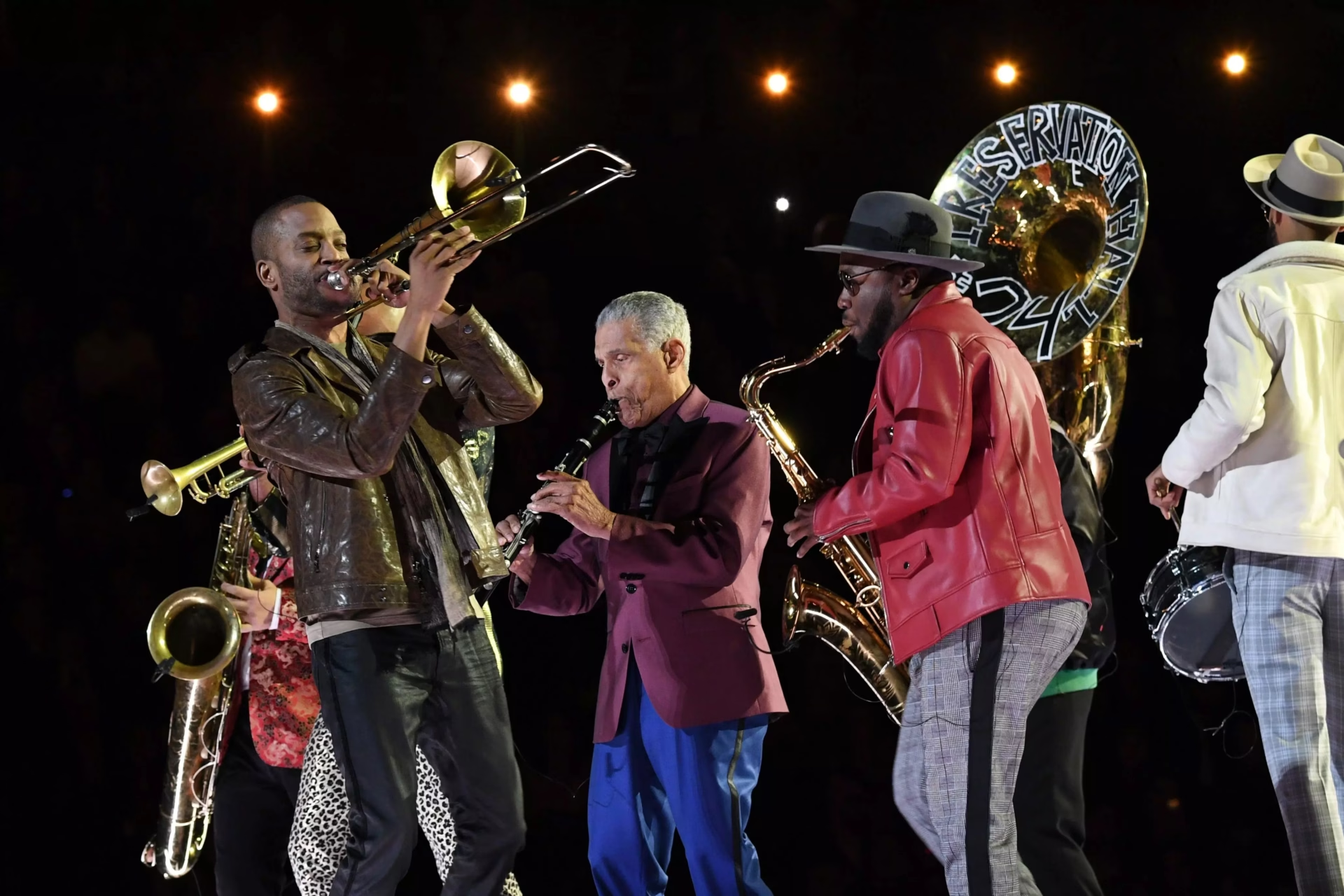
Preservation Hall Jazz Band
New Orleans is Pres Hall is New Orleans: watch the wonderful 2018 documentary A Cuba to Tuba to find out why. These days, countless historical jazz sites in the Big Easy are crumbling and collapsing, but institutions like the Preservation Hall Jazz Band — as well as Dirty Dozen Brass Band, among others — ensure the music is unscathed. Founded in the early 1960s as the house band for the hallowed French Quarter venue, the ensemble has never reneged on its mission: "nurturing and perpetuating the art of New Orleans jazz."
Tangerine Dream
Founded in 1967, the German electronic music pioneers join Guided by Voices and the Grateful Dead with this distinction; you could only listen to Tangerine Dream and be well-stocked with jams for the foreseeable future. As the brainchild of Edgar Froese for decades, they made classics like 1972's Zeit, 1974's Phaedra, 1980's Tangram… the list goes on. The band could have understandably folded when Froese passed in 2015, but his successor, Thorsten Quaeschning, remains the bearer of the flame. And by the sound of their stunning 2022 album Raum, rightfully so.
The Four Seasons
If infectious, pre-Beatlemania tunes like "Sherry" and "Big Girls Don't Cry" have been basically implanted in your skull from birth, thank one man first and foremost: Frankie Valli. His Four Seasons have provided a platform for numberless singers and instrumentalists since then — through the '70s, '80s, '90s, and up to the present day. These days, 88-year-old Valli is the only remaining original member of these Jersey boys — which says much less about the integrity of the original group than his capacity to hand out hat-hanging legacies.
The Skatalites
Whether or not the ska revival swept you up or not — and regardless of the volume of checkerboard threads in your closet — the fact remains that the Skatalites are pillars of the form. Like the Four Seasons, the instrumental supergroup began during Beatlemania time, and never stopped mutating and evolving. Decades past their early hits, like "Guns of Navarone," they give younger players like New York saxophonist Anant Pradhan a chance at ska royalty while offering legends the chance to bring Jamaica's freedom sounds to new generations — like 85-year-old percussionist Larry McDonald.
The Temptations
Ah, the Temps: Detroit legends, undersung psychedelic voyagers, the first Motown signees to win a GRAMMY. (That was in 1968, for "Cloud Nine"; how could Membership back then sleep on "My Girl"? We digress.) In 2018, the Broadway show Ain’t Too Proud gave opportunities beyond the purview of the endlessly shapeshifting original band. Come the 2020s, Otis Williams is the only original Temptation; many, many men have been one. Imagine the feeling of learning you're one. A certain jam from '68 might sum it up.
The Wailers Band
We're used to hearing this band name glued to "Bob Marley &"; is their association with Marley the long and short of their importance? Heavens, no, as at least two other members were legends in their own right: Peter Tosh and Bunny Wailer. After Marley's death in 1981, the band continued under various permutations and spin-offs — including The Original Wailers — with talented members in and out the door. These days, Aston Barrett Jr. and Emilio Estefan Jr. are at the helm of the Wailers Band; Barrett's been nominated for a GRAMMY, Estefan's won two.
The Yardbirds
Despite being something of a '60s relic, the Yardbirds' whole catalog holds up; they were as psychedelic as anyone, white British boys with a deep command of the blues. In their heyday, they launched the careers of Eric Clapton, Jimmy Page and Jeff Beck; Led Zeppelin originally took flight as the New Yardbirds. And their lineup churn continues; original drummer Jim McCarty remains.
So many members of the Allmans have dropped, but their popularity remains undimmed. (Crank up 1971's At Fillmore East on a good system and you'll see why.) Their estate has tried a unique tack: sending an estate-approved band called Trouble No More on the road, platforming young talent while giving the people the jams they require. Diehards' mileage may vary regarding a completely reconstituted Allmans. But the magnitude of talent from the multiracial, multigender ensemble might make haters eat a peach.
Ian Anderson On The Historical Threads Of Fanaticism, Playing Ageless Instruments & Jethro Tull's New Album The Zealot Gene