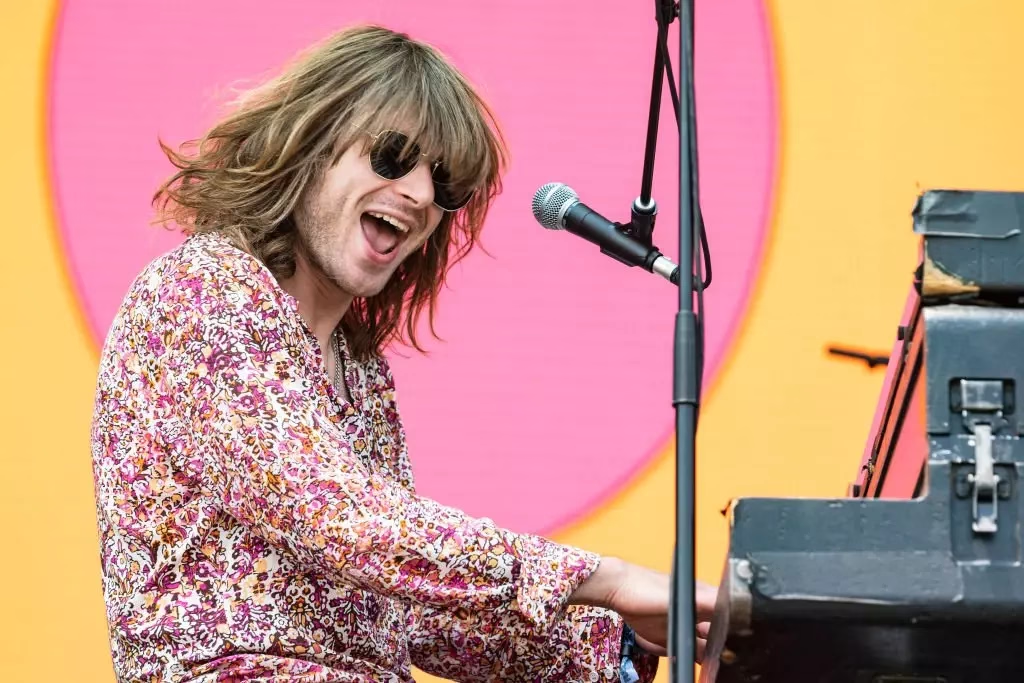
A hometown gig is often something special for a performer — local friends and family bring a particular energy to the audience; the feel of a familiar room can enliven the show. Undoubtedly, there's a joy in performing for people who live in the same milieu that inspired your music.
For singer, songwriter and pianist Neal Francis, a hometown show was the ultimate stage to capture his energetic performance via live album and concert film. Recorded live to tape at Chicago's Thaila Hall with an expanded 11-piece band, Francis Comes Alive could've been cut in 1973 or 2023 — as if the Band, the Meters, Wings and Dr. John had become unstuck in time.
Fittingly, Francis and co. rollick through 12 originals on vintage analog equipment under moody lighting. Most of the band don custom jumpsuits; shaggy-haired Francis is centerstage wailing on the keys, his paisley-printed one-piece open to the navel. Through an occasionally hazy filter, the camera pans over the sold-out audience and the sound engineer, who is grooving backstage.
Compared to the incredible and bombastic stage shows documented in Renaissance: A Film By Beyoncé and Taylor Swift: The Eras Tour, Francis Comes Alive is stripped down. But it's clear Francis and his all-Chicago band are having a great time. Touring with such a large, local ensemble "felt like a high school band field trip," Francis tells GRAMMY.com. "We ham it up there…everybody's just so together and it feels like one unit."
Neal Francis will close 2023 — which saw him play 113 dates across the country — with a New Year's Eve show in Denver, Colorado. GRAMMY.com caught up with Francis to discuss Francis Comes Alive, his spiritual journey back to music, and receiving a blessing from the OG rocker to Come Alive.
This interview has been edited for length and clarity.
You've been touring heavily in the past few years, which would certainly hone your live show. Was that part of the thinking behind putting out a live album?
Definitely. We had talked about doing a live record and it just made sense: We've played hundreds of shows together, let's document it. But then of course adding an extra seven people to the equation, that was more of a separate vision.
What about your live performance did you think would translate well to a live album/film?
We've persisted in presenting this kind of old school rock show that may not be as common anymore, which I think resonates with people. I think people don't expect it because my recorded music is a lot more laid back and chill than what they encounter live. We just pour all of our energy into it.
I tried to make the presentation of the live album and the live film— as much as I could within the constraints of our budget— look special and ethereal. It all came from my initial brainchild, but I definitely would not have come close to pulling it off were it not for having that team around me: Al Basse is the director, [and] my stylist Rachel Epperson made all the jumpsuits from scratch for the entire band – including the one I was wearing.
There's one guy in a white suit that has all this fringe under his arms…
That's our guitarist. It was funny because that was what I envisioned myself wearing initially. What always happens with Rachel is I'll come in with some idea and then she'll just really go out in left field with it and end up creating something that's way more cool than anything I could ever think of.
Rachel makes a lot of what we wear on stage on any given night. She's been with us since early on.
There have been quite a few concert films out this year, including massive ones from Taylor Swift and Beyoncé. While yours is markedly different, did you think about any of those big tours as you were putting this concept together?
I don't want to say I have my head under a rock, but in some ways I do because I didn't have any idea that those were coming out! I don't have social media at all; I have a presence there thanks to my management team. I'm generally looking towards stuff I like from the past for inspiration, and [to] my spiritual journey. I read a lot.
My range of influence is a little bit different than whatever's happening currently. And I'd love to see T Swift's movie. My dad actually went and saw it, and I didn't ask how he liked it, but I should. [Laughs.]
As far as other concert films, there's two that really come off the top of my head: The Last Waltz and Stop Making Sense. I feel like a cue was taken from The Last Waltz in hiring a horn section, perhaps.
I had this pretty strong visual experience doing some breathwork in January of 2023 that gave birth to the whole visual concept, and that gave me enough vocabulary and manic energy to start collaborating with Al and Rachel. And it just took shape from there.
I wanted custom set pieces like you would see on a 1960s variety show, but ideas like that had to be pared down. We ended up dressing up the risers, et cetera instead. The people I have working with me are just ingenious, so I think it came off really well.
Beyond the pandemic, the past five years or so have been quite a whirlwind for you. You broke up with a partner, you started a music ministry job in 2018, made your debut album Changes in 2019 and then put out In Plain Sight — which was recorded in that church, where you were also living, in 2021. How does your creative journey reflect those experiences?
I got sober in October of 2015 and I didn't really start investing back into my music career until I was a couple years sober.
The common thread for me has been as I develop a spiritual way of life — not to say a religious way of life, but just as I devote more time to things like meditation and increased mindfulness and awareness — it seems to translate to these gifts in my career that I didn't have at all before getting sober. The more I contribute to that side of things, the more everything else blossoms.
Have you seen yourself evolve as a performer as well?
Unquestionably. I'll just say inwardly, Wow, I'm able to sing so much better now. When that recording was made at Thalia Hall, unfortunately, I was still smoking. And that was something that I was actually in the midst of a relapse, smoking cigarettes. And I can really hear it, when I listen back.
One of the things that has been getting more consistent is my commitment to my vocal process, warming up and the sort of exercises I do. Also just the way in which I sing — learning how to sing at all because I just wasn't a singer before starting this project. Changes is really my first recorded attempt at singing lead vocals on anything.
What was your favorite song to play during this live session?
I still really enjoy playing "Changes" because we have this arrangement that's been kicked around live for a while, and the audience always really responds to it. "Sentimental Garbage" is another one that's really fun to play because we've added this sort of spacey droning synth section that is really fun and funny.
We ham it up there and it's really fun to play with this band because everybody's just so together and it feels like one unit.
I've always appreciated that your music sounds a bit out of time. I'd love to hear a little bit about the sonic fabric of Neal Francis.
When I was making Changes, I was kind of like, how close can I get to this? Specifically Allen Toussaint and Leon Russell and J.J. Cale and Curtis Mayfield— these are some of my heroes; what is in their playbook for these situations? That's sort of how I arrive at new things, just really trying to go for a certain aesthetic and then inevitably ending up somewhere different.
I've got a huge range of influences that I tried to open up more to on my second record. And now the record I'm working on currently, it's just another snapshot. I think the unifying element is probably the process; we do a lot of stuff analog, recording live as a band, and I think that's perhaps increasingly rare, and it yields a certain sound that's difficult to replicate.
I don't know if this is a musical hero of yours, but I read that you received a congratulatory text from Peter Frampton.
I guess he was tipped off by my friend Tom Cusimano. And the music industry is tiny in that regard. Tom sent Peter this Chicago Sun Times article about the Francis Comes Alive shows, and he sent his blessing. He was like, "Congratulations in advance, here's hoping it goes smoothly for you." It was so funny to get that the day we were recording. A real nice nod from him.
I have to ask you about this because it happened to me: the Neal Francis/ Neil Frances confusion. How do you feel about getting mistaken for that pop/dance duo?
It's definitely been a process. It's my actual name and not having any control over it, especially early on, it was really a challenge to let it roll off and accept it. Now we're actually acquainted with those guys and I'm going out to record something with them in early January.
We run into them: We had consecutive sets at Outside Lands and then they were on the same flight to L.A. recently from San Fran. It's very congenial and they're really in a different space musically. So there's not really a threat; if anything, I think, it's a boon to our individual success because people will mistakenly end up at the other person's shows, but end up enjoying it because it's a quality experience. So hopefully our collaboration will yield something interesting.
Beyond that collab, you mentioned that you're working on a new album. What else is on your plate?
That's the main thing on my horizon is getting rest and then making the album. Hopefully, having that wrapped the first couple of months of the year. Then I'm not really touring very much until that record gets released. We'll be doing more of those one-offs and festivals over the summer, starting with Jazz Fest in May, and then coming back with a proper album release tour.
[I'm also] building my own recording rig here at home so that we can record more and release more. It's two years since our last studio effort, and [I want to be] less precious about it but still having quality releases, but just maybe them being more frequent. That's just another muscle that I'm really excited to be working— just recording stuff on my own.