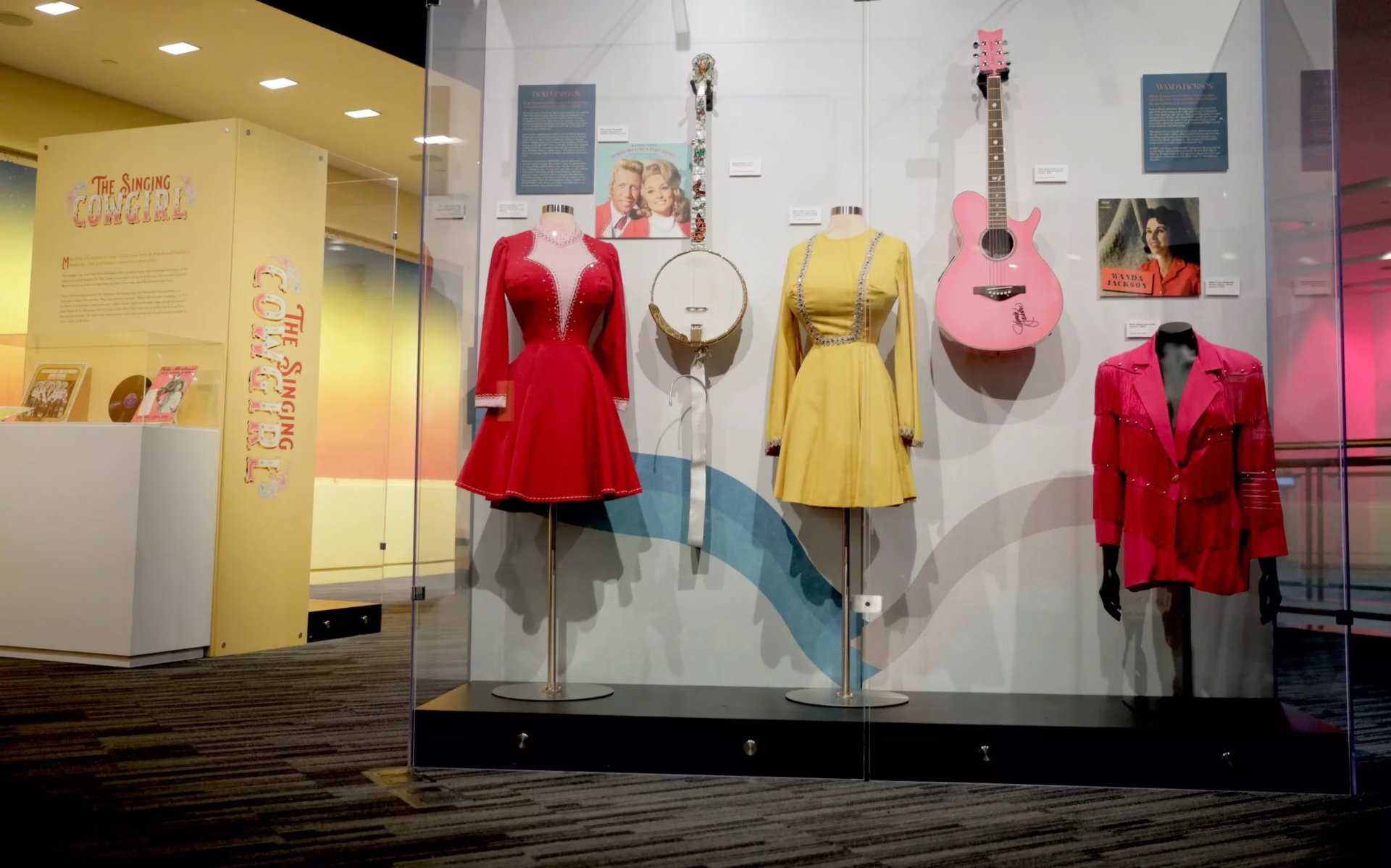
"The Power Of Women In Country Music" exhibit opened May 27 at the GRAMMY Museum in downtown Los Angeles, and it's a must-see for any lover of country music, strong women, or the history of the recording industry at large.
Encompassing almost 100 years of female-led folk or hillbilly music, the exhibit looks at the evolution of what it means to be a woman in the country genre — from its first pioneers to today's generation of future stars.
Whether you're a fan of Dolly Parton, Shania Twain, Maybelle Carter, or Kelsea Ballerini, you'll find something to love at "The Power Of Women." Full of stage-worn costumes, hand-written lyrics sheets, and well-loved instruments, the exhibit will allow visitors to see relics such as Taylor Swift's stage props and Patsy Cline's dress made by her mother.
There's lots to learn, too. You can get to know tones of instruments like the autoharp, or explore the early plight of women in country music, when the industry was a bit more concerned with style than substance.
The exhibit will run through Sun. Oct. 2. Whether you are hoping to check it out yourself or just curious what it's all about, here are some of the biggest takeaways from "The Power Of Women In Country Music" at the GRAMMY Museum.
The Arc Of Women In Country Music Is Long
Long before country music was recorded, women were helping define its sound, whether it was through strumming a banjo on a front porch or belting out a twangy traditional in church.
In 1927, the Carter Family's Maybelle and Sara Carter made the first country music recordings featuring women. That doesn't mean the doors busted wide open in their wake — women were still mainly shuffled into roles primarily as family caregivers and support staff for their working husbands.
That started to change a bit after World War II, when artists like Patsy Cline and Rose Maddox started to make waves by crossing over onto the pop charts. But the real heyday of women in country music didn't come until perhaps the late '80s or early '90s, when stars like Reba McEntire and Shania Twain became truly international superstars.
Many, many women helped pave the road along the way, and "The Power Of Women In Country Music" helps celebrate their stories.
"The Singing Cowgirl" Deserves More Credit
Everyone knows about Gene Autry and Roy Rogers, but in the mid-'30s, female country artists like Patsy Montana, Rose Maddox, and The Girls Of The Golden West found success as "singing cowgirls." (In fact, as her part of the exhibit details, Montana was the first female country singer to sell a million records.)
Dressed in fringed skirts, bolero vests, and wide-brimmed Stetson hats, singing cowgirls reminded Depression-struck America that it was still possible to be determined, optimistic, and in charge of their own destiny — even when things didn't always seem so bright.
Fun fact: The success of singing cowgirls and their male counterparts is part of the reason that the genre eventually became called "Country & Western."
There's More To Country Music Than Just Being On Stage
Many women have made their mark in country music through songwriting rather than through performance. There's some crossover, of course — Dolly Parton and Maren Morris broke into the industry by writing songs for others before finding their own success — but women like Jessie Jo Dillon, Laura Veltz, and Liz Rose have become country powerhouses because of the power of their pens rather than their voices.
That makes a lot of sense, given how much Nashville values the craft of songwriting. "The Power Of Women" contains handwritten lyrics for songs like Diane Warren's "How Do I Live" (made famous by LeAnn Rimes) and Dan + Shay's "Tequila," which was co-written by Nicolle Galyon, who has co-written nine other no. 1 hits as well as Miranda Lambert's GRAMMY-nominated "Automatic."
Read More: 10 Songs You Didn't Know Dolly Parton Wrote: Hits By Whitney Houston, Kenny Rogers & More
Country Women Can Be Stronger Together
Among country's singular female stars like Dolly, Reba, and Shania, the exhibit reminds that some of the genre’s biggest women acts have found strength and success in groups. The Judds and the Chicks had massive success in the '80s and '90s, respectively; today, groups like the Pistol Annies and the Highwomen create songs and sounds that mesmerize and mystify.
Those groups are also often made up of powerhouse acts in their own right, like Dolly Parton, Linda Rondstandt, and Emmylou Harris' Trio, and the Pistol Annies' Miranda Lambert, Ashley Monroe, and Angeleena Presley. Visitors to "The Power Of Women" exhibit can check out the Pistol Annies' fun nameplates ("Lonestar Annie," "Hippie Annie" and "Holler Annie"), as well as the outfits the trio wore on the cover of their 2021 Christmas album, Hell Of A Holiday.
Country's Females Have Always Pushed Genre Limits
Starting in the '70s and '80s, a group of female musicians emerged that would challenge what it meant to be a country music star. Emmylou Harris, Linda Ronstadt, and Rosanne Cash blurred the lines between country and rock, while Alison Krauss broke into bluegrass's boys club.
"The Power Of Women" pays tribute to those pioneers with a display case containing, among other things, the beautifully embroidered, Manuel-created boots Harris wore on the cover of 1979's excellent Blue Kentucky Girl.
The exhibit also tips its hat to genre-crossing artists like Shania Twain, Faith Hill, and Taylor Swift, all of whom crossed over into the pop and rock spheres, pushing both the boundaries of what country music could be and drawing new fans to the genre.
Even Taylor Swift Used To Buy Off The Rack
Some of the most interesting artifacts in "The Power Of Women" exhibit are the stage and video-worn outfits sent from the closets of country's biggest stars. There are two looks from Dolly Parton set on mannequins that really let viewers know just how tiny she really is. One — a red and pink high-necked dress — was worn by Parton on the cover of 1972's Together Always with Porter Wagoner.
One of the sweetest garments on display in "The Power Of Women" is also one of its most understated: An orange cotton day dress made in the '50s or early '60s for Patsy Cline by her mother, Hilda Hensley. Cline died in a plane crash in 1962, when she was just 30, and the dress is a bittersweet reminder of how young she was, and how close she remained with her family.
Taylor Swift sent over four outfits, including one worn on stage at the 63rd GRAMMY Awards. The other three outfits were worn in various music videos, like 2008's "Tim McGraw," which found Swift and her stylist pulling from racks at BCBGIRLS and Betsey Johnson to create the starlet's on-screen look.
Speaking of GRAMMY-worn outfits, Shania Twain fans will certainly recognize the satin suit/gown and top hat that Twain wore for both the "Man! I Feel Like A Woman" music video and on stage at the 41st Annual GRAMMY Awards. It sits not too far from one of Faith Hill's actual GRAMMY statues, her Best Female Country Vocal Performance gramophone she won for “Cry” in 2003.
Country's Female Future Is Strong
"The Power Of Women" devotes considerable space to women that might not yet be household names, but who have a strong chance at becoming country's next big stars. It's an incredibly diverse group of artists — something country music hasn't always been known for — including Black women like Reyna Roberts and Brittney Spencer, Mexican-American artists like Leah Turner, and stars who have risen from TV competitions, like The Voice's Danielle Bradbery.
The exhibit even highlights acts from outside of the U.S. who have found their way to country music, like the U.K.'s Yola, proving that the genre is only growing in popularity and reach — with women continuing to break the mold.
10 Things We Learned At "An Evening With LeAnn Rimes" At The GRAMMY Museum