Is there any killer of creativity like the pressure to please everybody? Ask Sampa the Great, a Zambian-born rapper who had a banner year in 2019.
Due to the power of its production and lyricism, her single "Final Form" reached that fever pitch of internet attention where strangers made awestruck reaction videos. She swept a variety of awards ceremonies, including the ARIA Awards and the Australian Music Prize.
Through it all, Sampa the Great was dubbed a trailblazer — and more concerningly, something of an ambassador for the landlocked Zambia on the world stage. For a young person who simply wanted to be creative and see the world, this generated an unsustainable degree of weight on her shoulders.
"There's a huge pressure to be perfect, which is just not even real as a human being," the artist born Sampa Tempo tells GRAMMY.com over Zoom, from an isolated Zambian farm. "It takes out the fun from actually expressing yourself and doing music, which was the main intention growing up and why I wanted to do music in the first place.
A peculiar sort of relief came by way of the pandemic, which spurred Sampa to move back to Zambia from her residence in Australia. With shows and tours on pause, she found inspiration in returning to where she'd initially dreamt of dedicating her life to art.
While hunkered down with everyone else, Sampa reconnected with her old network of friends, family and collaborators. The eventual result was As Above, So Below, Sampa the Great's new album, which drops on Sept. 9 via Loma Vista. With songs like the Botswana-influenced "Bona" and the Angélique Kidjo-assisted "Let Me Be Great," the album reflects Sampa's newfound sense of grounding, rejuvenation and recentering — and ultimately serves as her "self-love note."
Read on for a candid interview with Sampa about the genesis of As Above, So Below, the tension between her introverted and extroverted sides, and why the album was a personal watershed — one that makes her feel like she can express anything from here.
This interview has been edited for clarity.
Nice to meet you, Sampa. Where are you located currently?
I'm in Zambia right now, on a farm two hours away from the city. There's nature around me — no cows, though, no animals. It's pretty serene — pretty quiet. A good environment to rest from tour.
That sounds mind-clearing!
Yeah, a hundred percent.
Do you generally prefer those environments when you're off the road? Somewhere where your brain isn't bombarded?
Definitely — especially after a tour like this. It just helps me recenter and calm down. I'm pretty much an introvert. I don't know how I've lied to everybody that I'm an extrovert and like loud things and loud surroundings! Quiet and serene is my vibe.
How do you pull that larger-than-life persona out of yourself?
I think it comes from the family that I'm from. We are a very expressive family. We love telling stories. We love putting you into the mindframe of the story, and that just comes with being very dramatic with the way we tell our stories. Everything is loud. Everything is extra.
And then, musically, nothing stops at the studio. You want to be able to continue the story outside of the studio and bring people into an experience. So, it's not hard. I think the hard part is actually convincing myself to go back into the introvert space and actually rest and be reclusive. The extrovert — that's like default.
Musical parents?
I'd say yes. They'd say it's just a hobby, but I think that's still "musical." Dad loved playing piano and was a DJ. Mom loved dancing — ballroom, surprisingly. But, yeah, both kind of landed at just being hobbies.
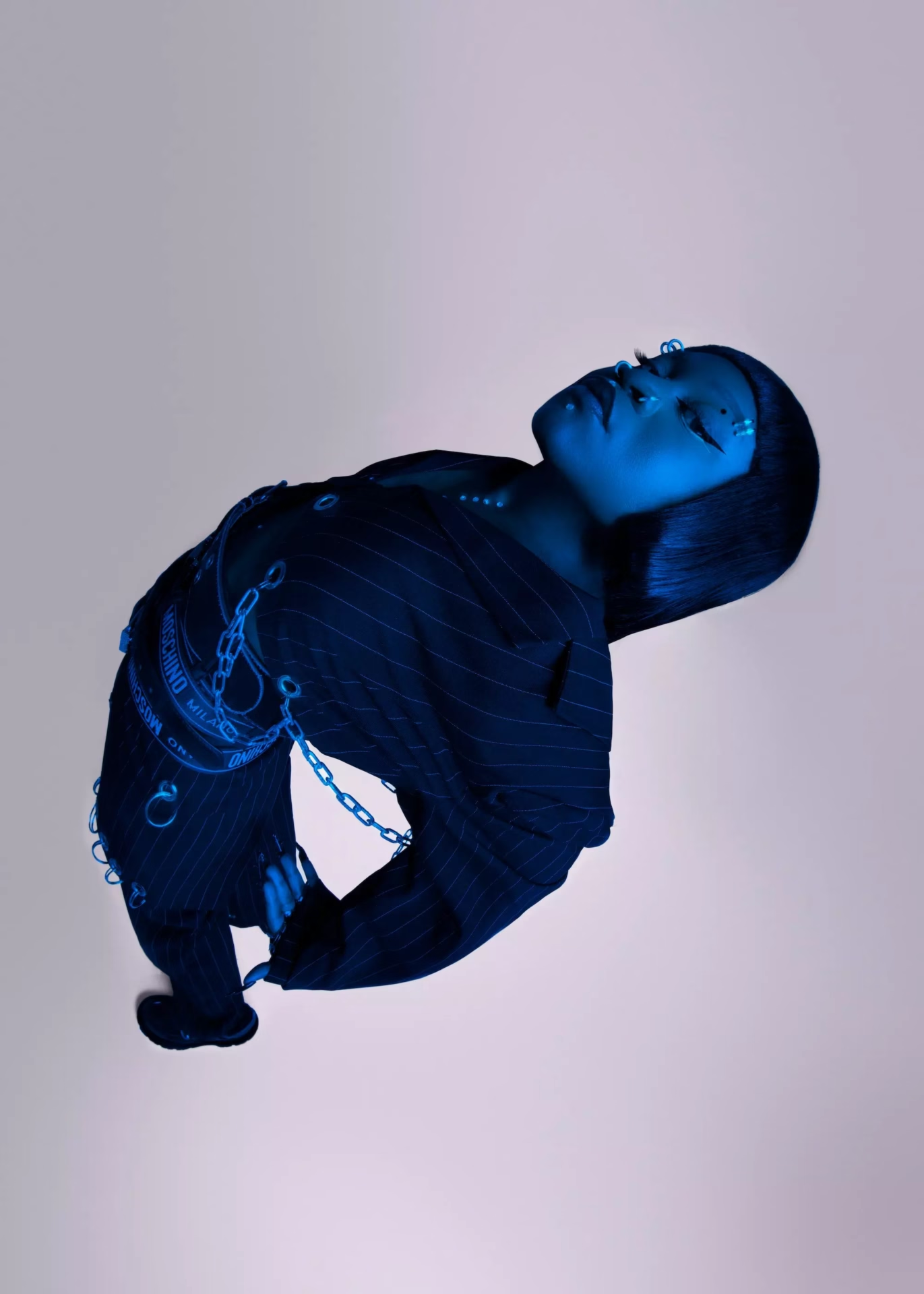
*Sampa the Great. Photo: Travys Owen*
So, I imagine, when you started really taking this seriously, it wasn't a jarring change, but a smooth incline.
Oh my god. The opposite. The total opposite!
Tell me about that.
I mean, it was a lot of convincing. Like I said, music is seen as a hobby here. Traditionally, music is played everywhere — gatherings, celebrations. It's just a given. So, to try and pursue it as a career is just something that's like, "Why would you do that when we do it anyway?"
And on top of that, [from] parents in this generation, it's like, "Can this thing sustain you?" I don't think a lot of our parents had the advantage of doing that they were passionate about. It was more about doing something that would earn you money, sustain you, and keep your family safe.
Now, I get to actually do something I'm passionate about and pursue my art as a career, which is something they've never done before. So, it took a lot of convincing to be like, "I want to do music as a career. Not only that, I want to be a rapper and a woman. [Dryly] Yay."
So, yeah, it took a lot of convincing, but they're on board now.
Well, I think that concern transcends cultures. What was the first song you created that your parents really loved?
I did a song called "Mona Lisa" where I sort of sampled a Zambian nursery rhyme and finessed hip-hop in it. And I remember sending it to my dad, and he was like, "This is really good."
And he doesn't listen to hip-hop! He doesn't really know what I'm saying; I rap too fast. But he was really proud that I added traditional elements into my music.
If your parents don't like a song you make, do they tell you?
Oh my god, do they tell me. [Laughs.] The majority of the songs, because I curse. "Final Form," which everyone's raving about, Mom hates it. She hates the fact that I say "f—" a lot. One time, she told me to take it off of YouTube, and I was like, "I can't really do that."
"It's got millions of views, Mom!"
Yeah. They don't really like cursing, but, again, it's the way I express [myself]. So, they've gotten used to it.
Tell me about the on-ramp to As Above, So Below. What was going on in your life and career that led you to write these particular songs?
So, the pandemic had just hit. This was three years ago. I was in Melbourne, Australia, and everything was being shut down — tours and shows being canceled. I reiterate all the time that I'm actually Zambian and based in Australia. So, if I'm not there for a reason, then I have to come back.
My sister's a uni student as well. They were sending students back home because Australia was about to shut down borders. My whole life had fallen in front of me. The industry that I fought so hard to be in looked like it wasn't going to be there next week.
It was kind of this intense moment in time where I was like, "OK, what do I do outside of my career?" And more importantly, "Who am I outside of my career?"
So, I relocated back to Zambia. I came to see my dad. My dad got COVID; I made sure he was OK. And at this point, I couldn't even get back to Australia because the borders were closed.
I was sitting in this house in Botswana, thinking, "Yo, it's wild that this is the place where I actually dreamt of being an artist." It was wild that I was back in the places where I dreamt of all these things that I actually got to do in Australia. What a 360 moment that was. [I thought], "Now, I actually can't go back to Australia and do these things. Why don't I do them here?"
So, a 15-year goal shrunk into a five-year goal, where I was trying to create a project, create these music videos in a place where our industry was still growing, but still do it at the level I'd done before — and try to showcase the amazing talent that is in my country and the continent, basically.
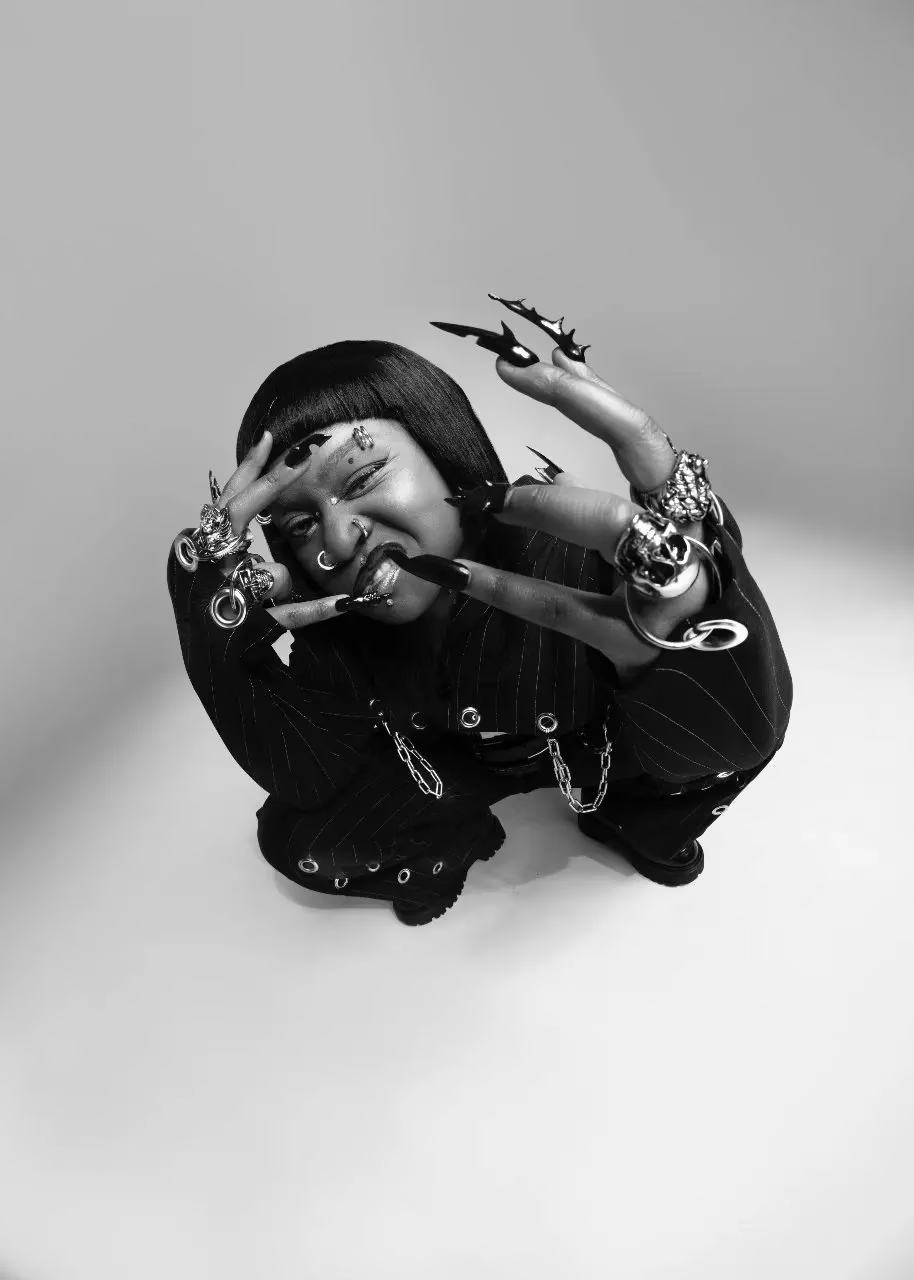
*Sampa the Great. Photo: Travys Owen*
How did things take shape from there?
So, I was sitting down and talking to a friend who I'd watched just nail music and be[come] an amazing artist. We were talking about the way we love the music that comes from our country. Why didn't we try and expand it? I was like, "That's a really good idea."
Because for the majority of my career, I've been trying to recreate the music I heard growing up — not expand it. And that's because I'm working with people outside of my country who didn't grow up on that music, so they don't know that music.
We see it as an opportunity to work on the project together [despite our different backgrounds]. I'm like, "Sweet, sweet," and we just start talking about where we are in life.
I find myself in a different headspace, because I'm no longer in a country where I really had to fight to get my place, but also fight for people who were like me — the young Black artists like me who weren't seen or who were underground.
I subconsciously put on this huge pressure to be an ambassador for people like me, to be perfect in the way I speak in the projects that I do, because I'm now winning awards and being the first Black woman to do this, that and the third. With that, you're like, "OK, if I'm the first, it looks like I'm an ambassador for a whole community of people."
There's a huge pressure to be perfect, which is just not even real as a human being.
No young person should have to carry that weight.
What's worse is it takes out the fun from actually expressing yourself and doing music, which was the main intention growing up and why I wanted to do music in the first place.
So, a beautiful thing happened where I got to relocate back home. As uncertain and scary as it was, I got to work with artists I saw growing up. Then, I got to journey back to the young Sampa, who dreamed of being an artist, and revert to the reasons why I wanted to be an artist in the first place.
A lot of that armor and pressure I put on myself when I was in Australia started to shed away. I started really getting into the fact that I wanted to express who I was — and be an ambassador for me for once.
Then, it turned into this beautiful journey of expression and experimentation — no holds barred, and not feeling like I had to be a certain way in order to represent people perfectly.
What burst from that was one of my [most] fearless, transparent and authentic projects to date. I don't feel like I have to be a certain way for anyone. I can just be who I am 100 percent, which feels like something that's easy to do. But depending on who and where you are as an artist, things get more complex.
Being back home, I don't have to represent being the first African [to accomplish something in particular], because there are Africans everywhere. I just have to represent being an artist.
At the core of hip-hop is a certain sense of "I don't give a damn what you think." How do you tap into that feeling — of freedom from being a spokesperson, or even what your mom thinks of you cursing?
You get frustrated with not enjoying something you're passionate about. It reaches a certain point where you're like, "I'm actually not enjoying this experience, because I'm trying too hard to make it something that it's not, and it's affecting the creative process.
That's usually the catalyst — to be like, "Well, if I can't create, I can't live." So, I have to drop that pressure, or drop whatever I think would make a good artist to whoever I'm trying to represent, and just actually create.
Tell me about the sound of the record — how you wanted it to hit the listener.
Ingredients. Every spice known to man, in one bowl of soup, and you drink that and experience all these different spices in one go.
For me, it became a thing [where] we were throwing in everything we'd been inspired by from music — whether [it was] hip-hop, folk music from Zambia, Kalindula, because you get to a place where, again, you're really tired of trying to represent one thing.
I'm constantly explaining that I'm Zambian, or trying to defend who I am and where I'm from. It became exhausting, and less [about] proving that in this project, and more [about] bringing every influence that I'm inspired by, putting that into one part, and giving you a well-rounded mixture of genres.
I'm sensing frustration with the limitations of identity. We're in an extremely identity-obsessed time — gender, racial background, sexual preference. Then, you cross-pollinate that with the music industry, where everything — and everyone — is categorized and labeled for consumption. It seems to me like you're just a person who wants to be creative and have fun.
A hundred percent. I mean, who wants to constantly defend their humanness? So, I became less of that. Especially three years ago, that was the main focus — trying to defend this. That's very tiring, and it affects the music I create. It just became more about being expressive.
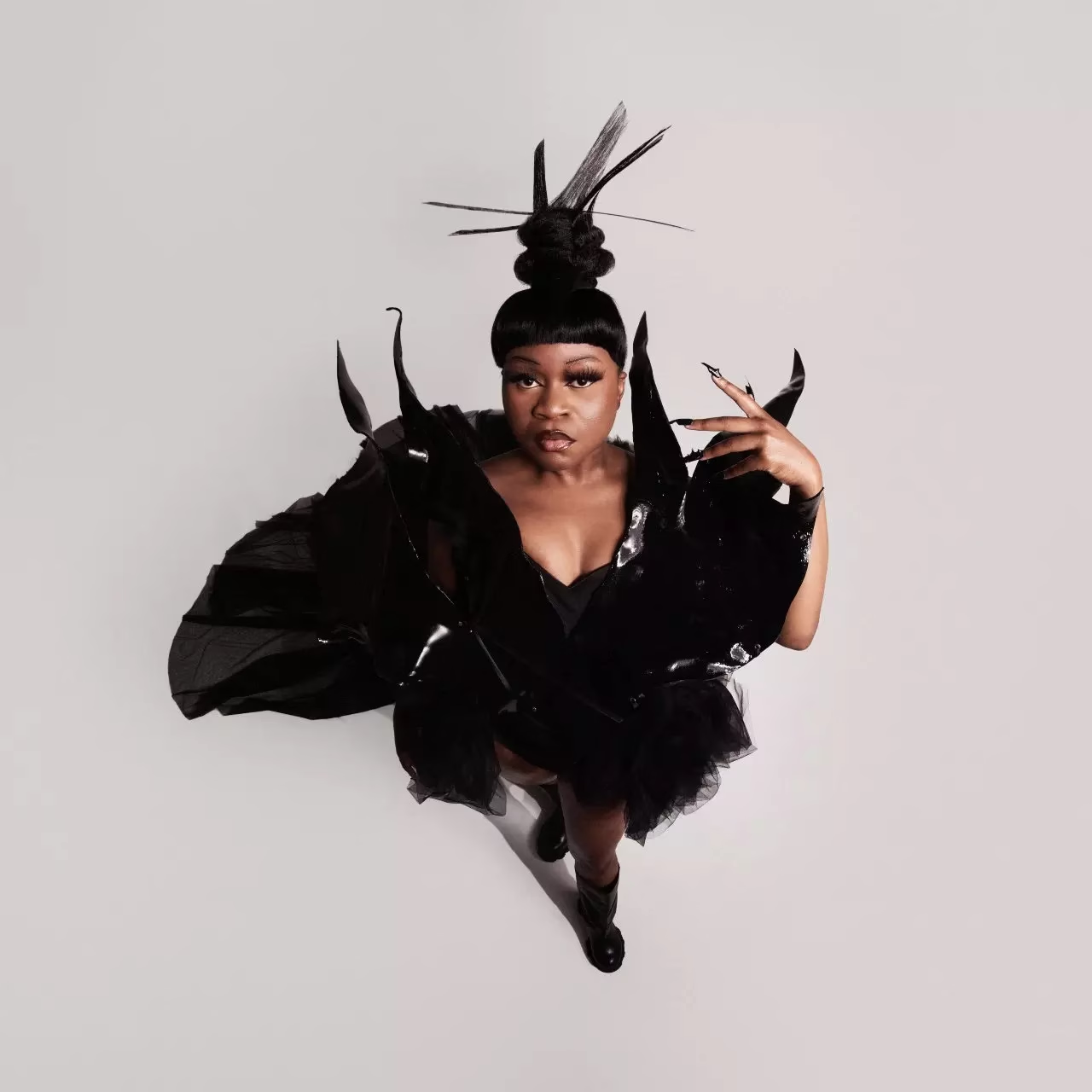
*Sampa the Great. Photo courtesy of BIZ 3.*
Give me a line on the album that sums up everything we're talking about — if there is one.
I'd probably go to a song like "Can I Live?", which is a more vulnerable song on the album. I express how as artists, we actually just want to be loved, if we get down to the nitty-gritty. We want to express ourselves, we want to connect with people, and we want to be loved like everybody else.
But in doing so, I think we're throwing this expectation into the world of people reflecting that back to us. And that's just not going to be the case. Your job as an artist is to express your lived experience and leave it at that — not expect any love from anyone else, or expect anyone else to make you feel whole.
I think in my past projects, in trying to make sure I represent people and make sure people are seen, the source of all that was to make sure to be loved, basically. And you can't do that. The main journey is to love [one]self. You actually have to love who this is as an artist before you expect anyone else to love you.
Now that you've experienced this full-circle moment, what's immediately ahead of you?
Oh, man. I just broke so many walls in terms of what I was willing to show and express, because I thought I had to be a certain way. It doesn't feel like there are any limits in the way I can express [myself].
Not only in music, but even venturing into film. Film has always been a huge love for me, and I think we visually show the stories of these songs beautifully. That's something that I'm ready to venture on into and tell more stories through that avenue. But there are no limits.