In November of 1978, the Police made an emphatic statement with their debut album, Outlandos d'Amour, which featured now-classic singles"Roxanne" and "Can’t Stand Losing You." Drawing from the subliminal talents of vocalist Sting, guitarist Andy Summers and drummer Stewart Copeland, the London-based band created a distinctive sound drawing reggae, pop, and punk. Their songs and sound have become classics.
In 2006, Copeland released Everyone Stares: The Police Inside Out, a film he created out of Super 8 footage of the band’s early days. The film employed rearranged, or "deranged", versions of the band’s songs to score the film. More than 15 years later, the work evolved into Police Deranged for Orchestra. Copelan's forthcoming album, out June 23, combines his rearrangements with a symphony orchestra and all-star rock band.
The derangements on Police Deranged are far from a paint by numbers revisit of the songs. Rather, Copeland channels his classical and jazz roots in an experimental tweaking of the Police's classics. The resulting songs arrive at exciting sonic destinations with new elements, yet never totally lose sight of the originals.
"I've been mostly erring on the side of pushing it over the edge," Stewart told GRAMMY.com. Indeed, "Message in a Bottle," for example, arrives with a more cinematic atmospheric vibe; its tangents freely wander.
"The hooks of those songs are so strong that I can take wild liberties with every other aspect," he continues. "People are sometimes afraid to look backwards, and that's only a valid fear if you're not going forwards."
In addition to performing with bands, Copeland has a long history of film and compositional work, including the film score for 1987’s Wall Street and the 1983 Francis Coppola directed Rumble Fish. He calls Police Deranged a reflection of his orchestral and arranging work, which has also been an "inevitable byproduct product of scoring for film." He’ll continue the Police theme later this year in the form of Stewart Copeland’s Police Diaries, a new book featuring diary entries from 1976-79.
The seven-time GRAMMY-winning composer discusses his journey revisiting the Police’s music, how he adjusts to playing drums for orchestra, and why he thinks he can push the songs to their limits. Today, GRAMMY.com premieres "Every Breath You Take," the first single from Police Deranged for Orchestra.
Today you're releasing the album's first single, "Every Breath You Take." What was your journey like revisiting the song?
That one I turned over to [conductor and composer] Eímear Noone and Craig Stuart Garfinkel. I had already orchestrated all of the other music and I finally realized, wait a minute, "Every Breath" was never my most fun song to play live. So, at that point, I just handed that one off to professionals. The journey of that one was egging them on and pushing them to get further and further away from the original, which wasn't broke, but that doesn't mean we can't fix it.
And the orchestral interlude was actually conceived of for a stage moment that actually didn't really work. They were going to start playing ["Every Breath"] and then I walk out, but that looks stupid. So, [the song’s prelude’s] just there as an artifact, but it's actually darned beautiful.
So, they were able to find a pretty nice balance between the core of the original and giving it a new spin?
Actually, I haven't been too concerned about that balance. I've been mostly erring on the side of pushing it over the edge because the hooks of those songs are so strong that I can take wild liberties with every other aspect.
What did you learn about the songs while revisiting them?
That Sting is a darn good songwriter. I missed that back in the day. I was at the back of the stage banging s— and all I ever saw was the back of his head.
Doing these derangements really woke me up to the quality of his music. I already knew that, but the lyrics as well. Man, he had a way with words. Don't tell him I said that.
While working on Police Deranged for Orchestra and digging into the band's recordings, it sounds like you gained a deeper appreciation for what made the Police special, from the small details to what each person brought to the band.
Very much so. Both of them, with Andy as well as Sting. Sting turns out to have been a darn good songwriter. But Andy, the colors, the harmonic textures that he brought. He was a one-man orchestra, that guy. And a lot of the orchestrations that I've done are all built on his harmonic voicing and his arpeggiated guitar figures and so on and does sound great in the orchestra.
There were big moments where we just came up with stuff onstage that were very Police-ish because it came from the three of us, but didn’t exist on any record until now.
In what ways did pairing with an orchestra bring out new things from the songs?
The orchestra has its own vocabulary in those swirls and cool swooshes and wangs and bangs. I introduced some elements that are strictly orchestral, just so that you can utilize all of the diverse forms of expression that an orchestra is capable of.
They were all inspired by Andy and Sting. But I also did add a few new ingredients of my own, mostly to do with the orchestration.
Sometimes when artists put songs in a new light, you gain even more appreciation for the song.
Oh yeah, a bunch of stuff. And I want to call those guys back and say, "Hey, guys, all is forgiven." Well, actually, I have called them back and all is forgiven. We actually get along really great now.
Sting is actually very supportive of this mission. He loves to hear his songs performed by other artists, even when they change it up. It makes him feel like Rodgers and Hammerstein, and indeed is of that stature when it comes to songwriting. But yes, getting deep into these songs definitely gave me much more insight into what those guys came up with.
The album features a pretty impressive all-star cast of musicians and vocalists. Can you talk a little bit about some of the players and why you brought them on?
Armand Sabal-Lecco on bass, has been my bass groove for something like 30 years, and he's played with Paul Simon, Seal, Peter Gabriel, just about everybody. He just has that African lilt, which just works for me, and we're real very close friends. But mainly on the bass, he really lights me up, gives me something to work with.
On guitar, Rusty Anderson played in Animal Logic, a band that I had with Stanley Clarke decades ago, and that's where I met him. And we've been chuckle buddies ever since. He's a guitarist who I called when I was doing film scores. When I knew exactly what I wanted, I could play it myself. But when I was stumped, when I didn't know exactly what I wanted, I'd call Rusty and he would come up with something that I never would've dreamed of. He has incredible technique, a really wide vocabulary of style and sound. I guess that's why Paul McCartney likes him so much too.
The ladies are from three different worlds; they're triple scale alpha vocalists here in Los Angeles. Backing singers generally have more technique and more exactitude in their performance than do star singers. So, these women are all really technically proficient, but I egged them on. I exhorted them to step forward, take the mic, grab the spotlight. And they really did. They really did put stuff beyond what you would get from session musicians and they really lit it up, all three women in very different ways.
Amy is the big, huge Earth mother voice. Ashley is a tinkly on top, very agile. In opera, we would call her a coloratura soprano. And Carmel and the alto range, she's the rock upon which all the others build, very solid and with a lot of unique personality. Carmel is into heavy metal and country, so she has a cultural makeup that is very interesting.
I should also mention our conductor, Edwin Outwater. He really brought a lot of extra X factor out of both the singers and the orchestra. When we developed the show originally for live performance, that's what this all came from and what we got organized for, he really worked with the singers to get them confident, because they're complicated arrangements. I'm reproducing Sting's quite exotic, rhythmic phrasing. And for them to learn it took a lot. What conductors do is they bring all the elements together into one thing. And similarly, Craig Stuart Garfinkel, who actually mixed and recorded it. These were people that I really relied on to make it become real. Now we can move on.
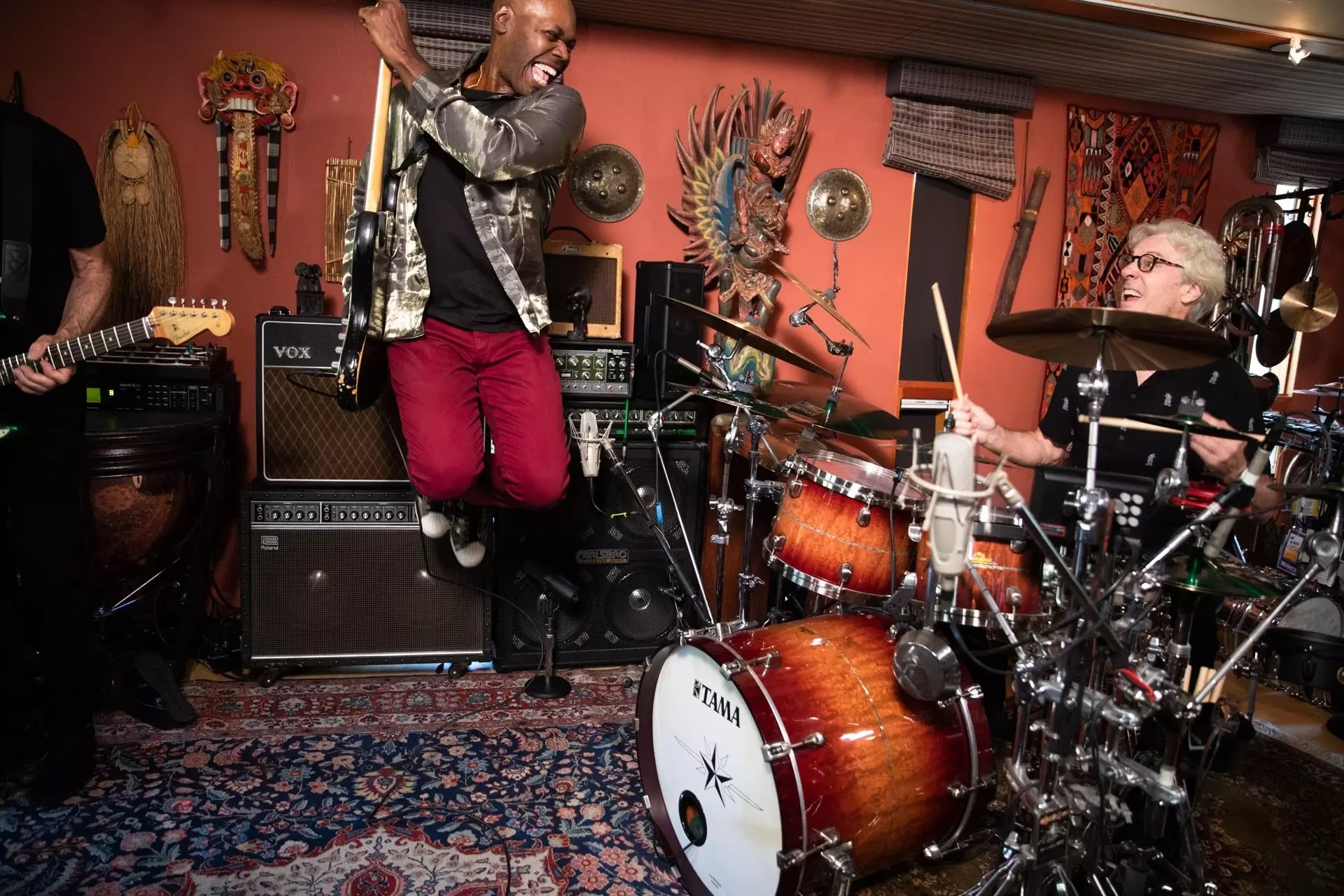
*(L-R): Rusty Anderson, Armand Sabal-Lecco and Stewart Copeland performing in the studio | Photo: Jessica Lehrman*
What songs surprised and challenged you most?
"Tea in The Sahara," [from tk year's album] which was always an obscure favorite of mine, became my favorite piece of orchestration. The rolling waves of the sand dunes really inspired the use of the orchestra in that way..
"Message in a Bottle" was like a diamond and I could not mess with it; the form of it is what it has to be. I did mess with the orchestration, with the sound textures and so on, but the song itself resisted all of my attempts at de-arrangement. But I did orchestrate the heck out of it.
Percussion and rhythm are things that overlap in a lot of styles of music. What’s it like playing drums with an orchestra and how do you adjust compared to other forms?
The orchestra sounds bigger and more majestic and has more presence. The actual volume is not so much; the drum set is designed to compete with big amplification. I had to really adjust my technique and there were some unexpected benefits from that. One is that all kinds of techniques that I had learned as a kid, rudiments and so on, things that just don't read in a rock environment, have a place in an orchestral environment.
So, there's all kinds of cool little stuff that I can do with the drums that would never exist in rock 'n' roll. And also, the drums sound better when I'm not trying to kill them. I guess nobody gets a headache with this quieter technique.
In the '80s, you focused more on your classical roots and, later, the film scores. How do you think that decision has made you a more well-rounded musician?
Well, the two informed each other. Like I say, the film music brought me back to orchestra. My daddy raised me to be a jazz musician, which was going fine until I heard Jimi Hendrix. Meanwhile, my mother was playing 20th century classical: Stravinsky, Revel, Debussy and such, and that really stuck emotionally. So that sound of the orchestra was always there in my heart.
But then when I was doing film music, I was pointed in various directions by my bosses, the directors, that I never would've gone voluntarily as an artist or never would've crossed my mind. But when Francis Coppola [whom I worked on the score for Rumble Fish] turns around and says, "I need strings," I went off and learned how to work with strings. And the rest is history, of working with orchestras, because I was told to. And so that's the benefit of going through a phase as a professional [hired gun]. I'm back to being an artist now, where it's my medium. I do what I want and I follow my own artistic instincts, but I learned all this cool stuff when I was an employee.
What do you recall of your first time hearing classical music?
The first time hearing classical music was kind of beyond memory. It was in the house before I remember, but I suppose the first conscious memory that I have is "Carmina Burana" by Carl Orff and crawling around in our house in Beirut, Lebanon, my face in the Persian carpets that my mother bought in Isfahan. I'm looking at one of them right now.But those patterns, the combination on those Persian rugs of chaos and order, are pretty much exactly what my music is all about.
U2 had an interesting quote recently about their new album where they were revisiting their old classics, that a great song is indestructible. Do you agree with that?
A good song is a good song and there are many ways of slicing a really good song. And Sting really appreciates this too. And so, for U2 to go and go back to those great songs and reimagine them was probably very healthy for them artistically.
People are sometimes afraid to look backwards, and that's only a valid fear if you're not going forwards. If you're moving forwards with great velocity, it's fine to look over your shoulder and check out where you've been and put some of that to good use.
You’re going to be touring with the orchestra later this year.
It’s not so much a tour. I mean, I play 20, 25 shows, and they're all individual events. I fly to Atlanta, I play with the Atlanta Symphony, I fly to Cleveland, play with the Cleveland Orchestra, fly to Nashville. Rather than me hiring an orchestra and 50 hotel rooms, they hire me. And I just show up with my singers and guitarists and it's a much better business model.
I'm going down to Cannes to be a judge at the Cannes Series Festival. And then I'm going to play a show in London at the Coliseum in London and then come back. Then this summer, I'm playing an Italian tour and then a one-off date in Luxem.
I imagine each orchestra has their own unique personality.
Yes, they do. In spite of the diligence, they play exactly what I put on the page. And the more detail that I put on the page, the more detail is their performance, and that shapes what they do. They don't just play the notes. And their philosophy, their reason for living is to faithfully execute what they see on the page.
Nevertheless, the Cleveland Orchestra has a different personality from the Atlanta Symphony or the Chicago. They swing together as one thing, and that one thing has a personality. Sometimes the brass are really crisp in this one here and the other one, it's the strings that shine and so on.
You have a few other projects coming up this year, including a reissue on Record Store Day.
Yeah, that's going to be a deluxe version of my [1980 album as] Klark Kent, comprised of the original tracks, plus the demos that I did at home in my home recording studio and various other pieces to go with that.
Ricky Kej — my buddy with whom I won a GRAMMY this year [for Best Immersive Audio Album] and another one last year — is doing a version of the album, which tentatively titled Police: Deranged for Paradise, with the Soweto Gospel Choir and other ethnic artists from around the world. [It is a] completely alternate version of the album, using all of the Derangettes, my American singers and American players, and the Irish Orchestra, but adding these otherworld elements. That's going to be a cool record.
Yeah, it'll be neat to hear those songs in that context as well.
Yeah, absolutely. In Zulu, in Hausa, in Mandarin, in Tamil. That'll be interesting. And Armenian.
This fall you’re releasing a new book, Stewart Copeland’s Police Diaries.
Yes. That's based on my diaries of the starving years of the Police. I've got every day, what concert we played, how much we got paid, how many people were there. I gave myself reviews, but also I've got the receipts for the trucks that I hired. For some reason, I don't throw stuff away and I've still got all this stuff. And they tell an interesting story.
And the main surprise of that story was how we stuck together before we had any idea what music to play. We were playing crap punk songs that I wrote with yelling, because that's what we had to play to get by and get hired and play those clubs. But we bonded musically and starved until Andy joined and he starved with us. And then it was like a year or two into the Police mission that Sting started coming up with those amazing songs that turned everything around for us. So, we bonded musically before we had any idea of what to play.
Ian Munsick Is Bringing The West To The World With 'White Buffalo'